A caged bird doesn’t dream about bigger cages it dreams about open sky. That’s the kind of image writers reach for when plain words like “free” or “liberated” just don’t cut it. Similes for freedom do exactly this: they turn an abstract feeling into something you can practically taste, see, or touch, whether you’re describing a soul finally unshackled or a Saturday with nothing planned.
Maybe you’re drafting a poem, polishing a personal essay, or just hunting for the perfect line to caption a photo from your first solo trip. Whatever brought you here, you’ve probably noticed that “free as a bird” gets old fast, and generic comparisons rarely capture what real liberation feels like that mix of lightness, possibility, and relief.
This article rounds up vivid, varied comparisons for independence, release, and unbound joy, sorted so you can find the right mood in seconds. No clichés, no filler just phrases that actually land. Ready to find words that finally match the feeling? Let’s start with the classics before moving into the unexpected ones.
Similes for freedom are comparisons that use “like” or “as” to describe the feeling of being free, independent, unrestricted, or released from control.
They help writers make the abstract idea of freedom more vivid through nature, animals, objects, emotions, and everyday experiences.
What Do Similes for Freedom Mean?
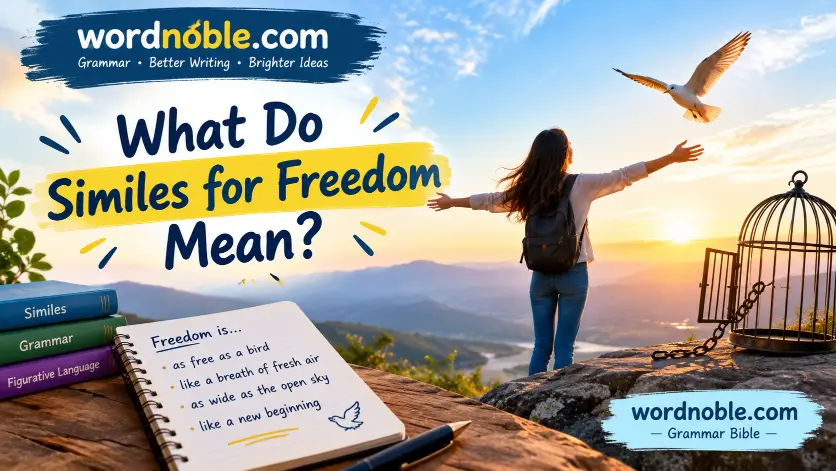
Similes for freedom compare freedom to something familiar so readers can imagine its meaning more easily.
Freedom is an abstract concept. You cannot physically hold freedom in your hands, but you can describe how it feels. A simile might compare freedom to a bird flying through an open sky, water moving freely through a river, or wind traveling across a wide field.
For example:
She felt as free as a bird soaring across the sky.
The comparison does not mean that she literally became a bird. Instead, the bird represents independence, movement, openness, and the absence of restrictions.
Similes for freedom are especially useful in figurative language, where writers communicate ideas through imaginative comparisons rather than literal statements.
How Do Similes for Freedom Work?
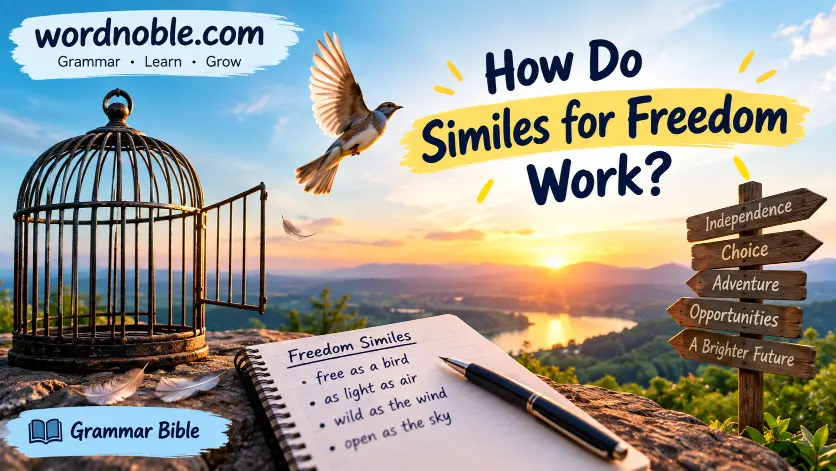
A strong freedom simile usually connects the abstract idea of freedom with something that naturally suggests openness or independence.
Common comparison sources include:
- Birds flying through open air
- Wind moving without barriers
- Rivers flowing toward the sea
- Clouds drifting across the sky
- Open roads
- Ocean waves
- Doors opening
- Chains breaking
- Butterflies leaving cocoons
- Wild animals moving through nature
The comparison gives freedom a sensory quality. Readers can visualize movement, space, openness, release, or independence instead of simply reading the word “freedom.”
Why Do Writers Use Similes for Freedom?
Writers use similes for freedom because freedom can carry many different meanings.
It can represent:
- Independence
- Personal choice
- Emotional release
- Political liberty
- Escape from restrictions
- Self-expression
- Adventure
- Peace
- Opportunity
- Personal growth
A simile allows the writer to communicate the specific type of freedom they mean.
For instance, comparing freedom to a bird in flight emphasizes movement and independence, while comparing it to a door swinging open emphasizes release from restriction.
Similes also make writing more memorable. Instead of simply saying, “He finally felt free,” a writer can create an image that allows the reader to experience that feeling.
Similes for freedom are figurative comparisons that describe freedom through familiar images associated with independence, openness, movement, release, or unrestricted choice. They commonly use “like” or “as” to connect the idea of freedom with animals, nature, objects, experiences, or emotions.
Contextual Meaning of Similes for Freedom
The same simile can create different effects depending on where it appears.
Freedom in Storytelling
In stories, freedom similes can reveal a character’s emotions or development.
After leaving the locked room, he felt as free as a bird in the open sky.
This emphasizes physical and emotional release.
Freedom in Poetry
Poetry often uses freedom similes to create strong visual imagery.
Her spirit moved like wind across an empty field.
The comparison creates an impression of movement, openness, and independence.
Freedom in Casual Speech
People may use simple similes when talking about everyday experiences.
After finishing my exams, I felt as free as a bird.
The expression communicates relief and happiness without requiring a lengthy explanation.
Freedom in Humor
Humorous comparisons can exaggerate the feeling of freedom.
After deleting my work emails, I felt as free as a cat escaping a bath.
The unusual comparison creates comedy while still communicating relief.
Freedom in Academic Writing
Academic writing generally requires more precise and controlled figurative language. A simile may be appropriate in literary analysis, creative assignments, or discussions of symbolism, but it should not replace clear factual explanation.
Types of Similes for Freedom
🐾 Animal-Based Similes for Freedom
Animals often symbolize independence because many move naturally without human restrictions.
Examples
- As free as a bird in the sky
- Free like a wild horse running across the plains
- As free as a butterfly leaving its cocoon
- Like a wolf roaming through the wilderness
- As free as an eagle above the mountains
Meaning
Animal-based similes often emphasize movement, independence, instinct, and the ability to go wherever one chooses.
The bird is especially common because flight creates a powerful image of unrestricted movement.
📡 Technology-Based Similes for Freedom
Modern technology can also provide interesting comparisons for freedom.
Examples
- Free like a signal traveling through open space
- As unrestricted as data moving through an open network
- Like a device finally disconnected from its charger
- As free as a message sent without restrictions
Meaning
Technology-based comparisons can represent independence, connectivity, access, and the removal of limitations.
These similes work particularly well in contemporary creative writing because they connect traditional ideas of freedom with modern experiences.
🌿 Nature-Based Similes for Freedom
Nature provides some of the strongest imagery for freedom.
Examples
- Free like the wind across an open field
- As free as a river flowing toward the sea
- Like clouds drifting across a limitless sky
- As free as waves moving across the ocean
- Free like sunlight spreading across the mountains
Meaning
Nature-based similes emphasize openness, movement, space, and natural independence.
They are particularly effective in poetry and descriptive writing because they create strong visual and sensory imagery.
😂 Humorous and Exaggerated Similes for Freedom
Humorous similes make freedom feel relatable and entertaining.
Examples
- As free as a student after the final exam
- Free like a dog released from a leash
- As free as someone who finally found the remote control
- Free like a teenager when the parents leave for the weekend
- As free as a cat escaping an unwanted bath
Meaning
These comparisons exaggerate everyday situations to communicate relief, excitement, or independence.
They are useful in informal writing, social media, dialogue, and humorous stories.
🎭 Emotional and Behavioral Similes for Freedom
Freedom is not always physical. Sometimes it describes an emotional or psychological experience.
Examples
- She felt as light as a feather after telling the truth.
- He felt free like a person finally released from fear.
- Her heart opened like a window to the morning sky.
- He moved through life like someone carrying no chains.
- She felt as free as a child running through an open field.
Meaning
These comparisons focus on emotional release, confidence, self-expression, and freedom from fear or pressure.
15 Powerful Similes for Freedom With Meanings
| Simile | Meaning | Category | Clarity |
|---|---|---|---|
| As free as a bird in the sky | Complete independence | Animal | Suggests unrestricted movement |
| Free like the wind | Unrestricted movement | Nature | Wind moves without being controlled |
| As free as an eagle above the mountains | Strength and independence | Animal | Suggests freedom from limitations |
| Like a river flowing to the sea | Natural movement | Nature | Represents moving toward one’s destination |
| As free as an open road | Choice and opportunity | Object/Nature | Suggests many possible directions |
| Free like clouds across the sky | Lack of restriction | Nature | Clouds drift wherever conditions carry them |
| Like a butterfly leaving its cocoon | Transformation and release | Animal | Represents emerging into a new life |
| As free as waves on the ocean | Movement and openness | Nature | Waves move across a vast space |
| Free like a wild horse | Independence | Animal | Suggests untamed movement |
| Like a door finally opening | Release from restriction | Object | Represents an opportunity or escape |
| As free as sunlight | Openness and expansion | Nature | Suggests something unrestricted and widespread |
| Free like a kite in the wind | Joyful freedom | Object/Nature | Represents movement through open air |
| Like chains falling from the hands | Liberation | Object | Suggests release from control |
| As free as a child running outdoors | Joy and independence | Emotional | Highlights carefree freedom |
| Free like a road with no end | Unlimited possibilities | Object | Suggests endless choices |
Context Table
| Context | Meaning | Use Case | Example |
|---|---|---|---|
| Poetry | Emotional or symbolic freedom | Poems | Free like the wind |
| Fiction | Character development | Stories | As free as a bird |
| Personal essay | Emotional release | Essays | Like a door opening |
| School writing | Clear creative description | Assignments | Free like a butterfly |
| Casual speech | Relief or happiness | Conversation | I felt as free as a bird |
| Humor | Exaggerated independence | Comedy | Free like a student after exams |
| Literary analysis | Symbolic interpretation | English literature | The bird symbolizes freedom |
| Descriptive writing | Strong imagery | Creative writing | Like clouds across the sky |
How to Use Similes for Freedom in Writing
A good simile should make your writing clearer rather than simply making it more decorative.
1. Decide What Kind of Freedom You Mean
Ask whether your subject is experiencing:
- Physical freedom
- Emotional freedom
- Creative freedom
- Personal independence
- Freedom from fear
- Freedom from responsibility
- Freedom of choice
Then choose a comparison that matches the meaning.
2. Choose a Familiar Image
Readers understand familiar images quickly. Birds, wind, rivers, roads, oceans, and open skies are effective because their connection with movement and openness is easy to recognize.
3. Match the Emotional Tone
A serious poem may need a graceful comparison such as:
Her spirit moved like wind across an empty field.
A humorous story might use:
He felt as free as a student walking out after the final exam.
The best comparison depends on the tone.
4. Avoid Explaining Too Much
Once the image communicates the idea, let the reader experience it.
Instead of writing several sentences explaining that someone is independent, a carefully chosen simile can communicate the feeling immediately.
5. Use Sensory Language
Strong similes often work with sensory imagery.
You can describe:
- What freedom looks like
- What it sounds like
- How it feels
- How it moves
- What it might suggest emotionally
This makes figurative writing more immersive.
Simile vs. Metaphor: What Is the Difference?
A simile makes a comparison using words such as like or as.
She was as free as a bird.
A metaphor makes a direct comparison without using “like” or “as.”
She was a bird released into the sky.
Both devices can communicate freedom, but they do it differently.
| Simile | Metaphor |
|---|---|
| Uses like or as | Makes a direct comparison |
| “He was free like the wind.” | “He was the wind.” |
| Usually signals the comparison clearly | Often sounds more direct or symbolic |
| Useful for accessible descriptions | Often creates stronger symbolic imagery |
Neither device is automatically better. The choice depends on the effect the writer wants.
Common Mistakes When Writing Similes for Freedom
Overusing the Same Comparison
The bird comparison is popular, but repeating it throughout a piece can make the writing predictable.
Try alternatives such as rivers, roads, wind, butterflies, oceans, or open doors.
Making an Illogical Comparison
A simile should have a meaningful connection.
He was as free as a brick wall does not naturally communicate freedom unless the writer provides a specific creative context.
Confusing Similes With Metaphors
Remember:
Simile: She was free like a bird.
Metaphor: She was a bird.
The distinction matters when completing grammar or literature assignments.
Using Similes Everywhere
Too many comparisons can weaken the effect of each one. Use figurative language strategically.
Choosing an Image That Does Not Match the Emotion
A playful comparison may not fit a serious scene. Consider the tone before selecting your simile.
Do and Don’t Usage Guide
Do
- Choose comparisons that clearly suggest freedom.
- Use familiar imagery when clarity matters.
- Match the simile to your tone.
- Combine similes with sensory language.
- Use original comparisons when appropriate.
- Explain the meaning when teaching students.
Don’t
- Repeat the same bird comparison excessively.
- Add similes simply to increase word count.
- Mix literal and figurative meanings confusingly.
- Use an unrelated comparison.
- Make every sentence figurative.
- Forget the context of your writing.
Natural Chat Responses Using Similes for Freedom
Friend: How did you feel after leaving that stressful job?
Reply: I felt as free as a bird.
Friend: How was your vacation?
Reply: Amazing. I felt free like the wind with no schedule to follow.
Friend: What did finishing the exam feel like?
Reply: I felt as free as a student walking out of the classroom after the final test.
Friend: Why do you love traveling alone?
Reply: It makes me feel like a bird flying wherever it wants.
Friend: How does writing make you feel?
Reply: Writing makes me feel as free as a river flowing wherever it finds a path.
Related Terms and Semantic Concepts
Understanding related literary concepts can help writers use freedom similes more effectively.
Figurative Language
Figurative language communicates ideas beyond their literal meanings. Similes and metaphors are two major examples.
Auditory and Sensory Imagery
Sensory imagery helps readers imagine experiences through sight, sound, touch, taste, and smell. Although freedom is abstract, writers can give it sensory qualities through imagery.
Descriptive Writing
Descriptive writing uses precise details and imagery to help readers visualize a person, place, object, emotion, or experience.
Metaphor vs. Simile
Both are comparison-based literary devices, but a simile typically signals the comparison with “like” or “as,” while a metaphor creates a direct comparison.
English Literature
Similes are important in English literature because they help writers communicate emotions, symbolism, characterization, atmosphere, and abstract ideas.
FAQs:
What Are Similes for Freedom?
Similes for freedom are comparisons that describe the experience of being free by connecting it to a familiar image. They commonly use “like” or “as.” For example, “She felt as free as a bird” compares emotional independence with a bird’s unrestricted movement. Such comparisons make the abstract idea of freedom easier to visualize and understand.
What Is a Good Simile for Freedom?
A strong general simile is “as free as a bird.” It works because birds are commonly associated with flight, open spaces, and independent movement. Other possibilities include “free like the wind,” “as free as an open road,” and “like a river flowing toward the sea.” The best choice depends on the context and emotion.
What Are Some Examples of Similes for Freedom?
Examples include “as free as a bird in the sky,” “free like the wind,” “as free as an eagle,” “like clouds drifting across the sky,” and “free like a wild horse.” Each comparison emphasizes a slightly different aspect of freedom, such as movement, independence, openness, adventure, or escape from restrictions.
What Are Funny Similes for Freedom?
Funny freedom similes often connect freedom with familiar everyday situations. For example, someone might say, “I felt as free as a student after the final exam” or “I was free like a dog released from a leash.” These comparisons exaggerate ordinary experiences to create humor while still communicating relief, independence, or excitement.
What Are Poetic Similes for Freedom?
Poetic similes for freedom often use nature and movement to create vivid imagery. Examples include “her spirit moved like wind across an empty field” and “his dreams rose like birds into the open sky.” Such comparisons can make freedom feel expansive, emotional, peaceful, or powerful while adding rhythm and imagery to poetry.
What Is the Difference Between a Simile and a Metaphor for Freedom?
A simile makes a comparison using “like” or “as,” while a metaphor makes a direct comparison. “He was as free as a bird” is a simile because it uses “as.” “He was a bird released into the sky” functions as a metaphor because it directly identifies the person with the image. Both can communicate freedom effectively.
How Can I Use Similes for Freedom in Writing?
First, identify the kind of freedom you want to describe. Then choose an image that naturally represents that idea. For physical freedom, a bird or open road may work. For emotional release, an opening door or flowing river may be more appropriate. Keep the comparison relevant, clear, and consistent with the tone of your writing.
Why Are Similes for Freedom Important in English Literature?
Similes help literary writers transform abstract concepts into vivid images. Freedom is difficult to visualize directly, but a comparison with birds, wind, oceans, or open roads gives readers something concrete to imagine. In English literature, this can strengthen characterization, symbolism, emotional expression, atmosphere, and thematic meaning.
How Can Students Use Similes for Freedom?
Students can use freedom similes in creative writing, poetry, descriptive paragraphs, essays, and literary assignments. A simple example is “After overcoming his fear, he felt as free as a bird.” Students should explain the comparison clearly and choose an image that matches the intended meaning rather than adding figurative language simply for decoration.
Can Similes for Freedom Be Used in Poetry?
Yes. Similes are especially useful in poetry because they create compact, memorable images. A poet can compare freedom with wind, birds, rivers, oceans, sunlight, or open skies to express different emotions. The strongest poetic similes usually support the poem’s larger theme rather than functioning as isolated decorative phrases.
Conclusion:
Similes for freedom give writers a powerful way to describe an abstract idea through familiar images. A bird flying across an open sky, wind moving across a field, or a river traveling toward the sea can make freedom easier to visualize and feel.
The strongest comparisons are not simply beautiful; they are meaningful. They match the emotion, context, and type of freedom being described. Whether you are writing a poem, story, school assignment, essay, or casual message, a well-chosen simile can make ordinary language more vivid.
The key is simple: choose an image that naturally represents the freedom you want your reader to imagine. When the comparison feels clear and purposeful, figurative language becomes a powerful tool for communication.

I am Naqash Ayub, proudly writing for WordNoble, where I focus on creating clear, informative, and SEO-friendly content. I enjoy turning detailed information into simple, trustworthy articles that help readers find the answers they need.