
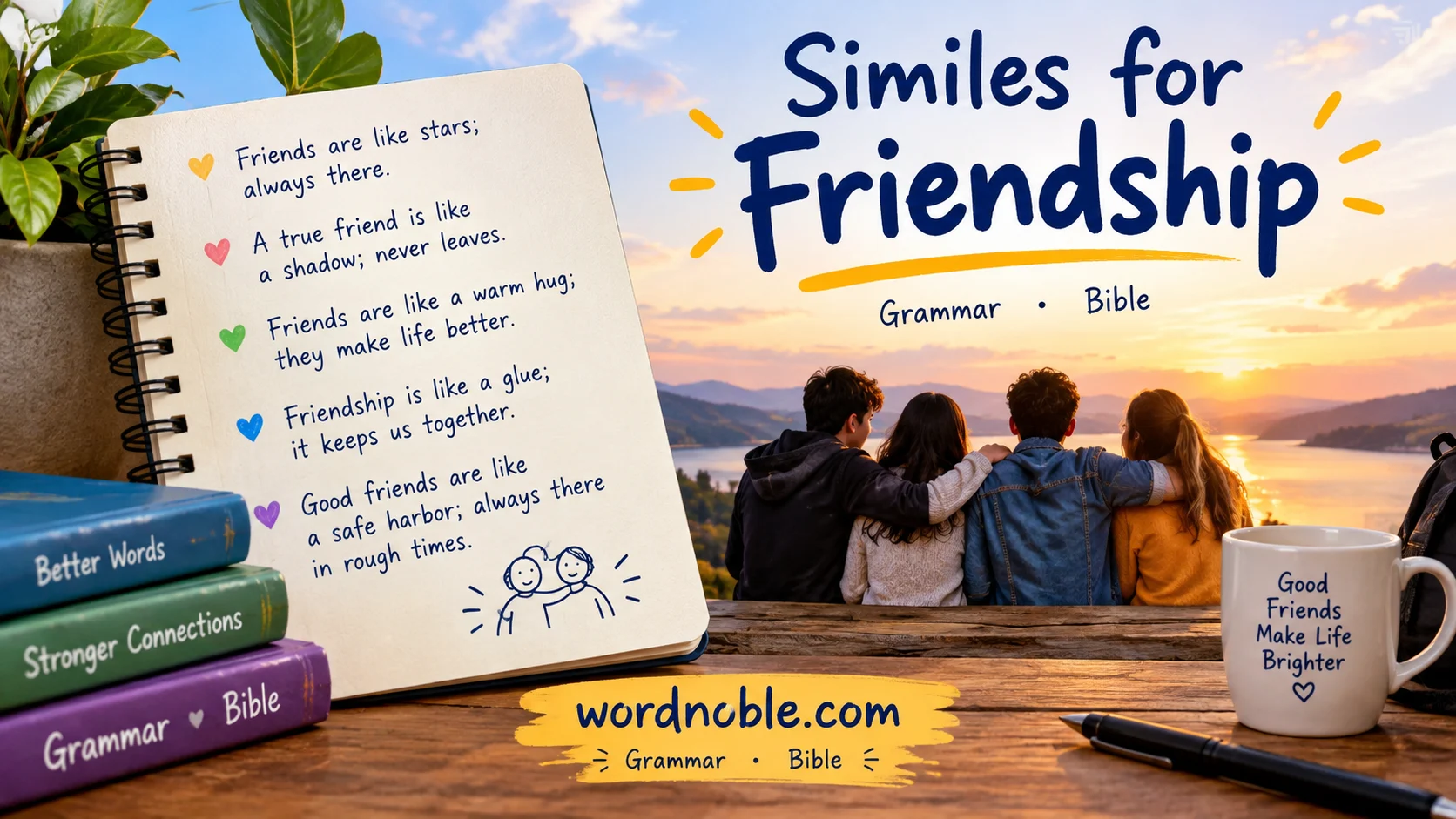
Best friends don’t just “get” each other they finish each other’s sentences, laugh at inside jokes nobody else understands, and somehow always know when something’s wrong.
Capturing that kind of bond in words isn’t easy, which is exactly why similes for friendship exist. They turn a simple feeling into a vivid picture: comparing a loyal friend to a lighthouse, or an old friendship to a well-worn pair of shoes that just fit right.
Whether you’re writing a heartfelt birthday card, crafting a toast for a friend’s wedding, or just want to describe your squad in a way that actually lands, the right comparison makes all the difference. Plain words like “close” or “supportive” only go so far similes bring emotion, imagery, and personality into your writing.
In this guide, you’ll find fresh, meaningful similes for every kind of friendship: the ride-or-die kind, the childhood kind, and the ones that feel like family.
You’ll also learn how to use friendship metaphors and comparisons naturally, so your words feel genuine instead of forced. Let’s start with what makes a friendship simile actually work.
Similes for friendship are comparisons that describe friendship using like or as, helping writers express qualities such as loyalty, trust, warmth, comfort, and strength through vivid imagery.
What Are Similes for Friendship?
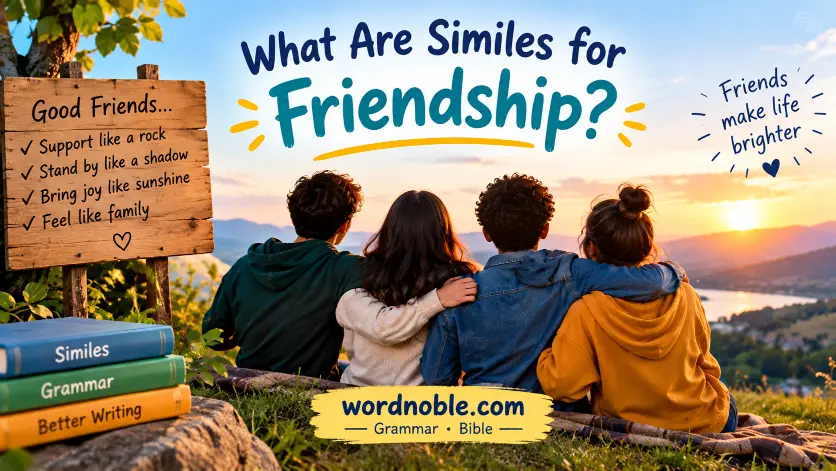
Similes for friendship are figurative expressions that compare a friendship or a friend to something familiar. They usually use like or as to make an emotional quality easier to picture.
For example:
Their friendship was like a sturdy bridge over a rushing river.
The comparison suggests that the friendship provides stability and support even when life becomes difficult.
Unlike a plain statement such as “They are good friends,” a simile creates an image. It can make friendship feel warm like sunlight, strong like an oak tree, comfortable like an old sweater, or bright like a summer morning.
These comparisons are useful in creative writing, poetry, speeches, school assignments, stories, greeting cards, social media captions, and everyday conversations.
How Do Similes for Friendship Work?

A friendship simile connects an abstract idea with something readers can imagine through sensory language or familiar experience.
Friendship itself cannot be physically held or measured. A writer can make it more concrete by comparing it with something visible, audible, or emotionally recognizable.
For example:
“Our friendship is as steady as a lighthouse.”
A lighthouse represents guidance, reliability, and stability. The reader therefore understands that the friendship remains dependable during difficult moments.
Good similes do more than add the word like or as. They create a meaningful relationship between two things.
Why Writers Use Friendship Similes
Writers use similes for friendship to:
- Show loyalty and trust
- Express emotional closeness
- Make descriptions more memorable
- Create vivid mental pictures
- Add personality to ordinary sentences
- Strengthen poetry and storytelling
- Make school writing more descriptive
- Communicate complicated emotions simply
Similes for friendship are figurative comparisons that describe the qualities, feelings, or experiences of friendship by relating them to familiar people, objects, animals, places, or natural elements, commonly using “like” or “as.”
Contextual Meaning of Friendship Similes
The same comparison can communicate different ideas depending on the context.
In Storytelling
A friendship simile can reveal the relationship between characters without lengthy explanation.
Example:
“Her friendship was like a warm blanket on a freezing night.”
This suggests comfort, safety, and emotional support.
In Poetry
Poets often use nature, light, seasons, and objects to express the emotional depth of friendship.
Example:
“Our friendship grew like wildflowers after spring rain.”
The image suggests natural growth and beauty.
In Casual Speech
Simple similes can make everyday conversation more expressive.
Example:
“He is like a brother to me.”
This communicates strong emotional closeness.
In Humor
Exaggerated comparisons can make friendship descriptions playful.
Example:
“Our friendship is like an old Wi-Fi connection: sometimes strange, but somehow it always reconnects.”
The humor comes from comparing a human relationship with a familiar technology problem.
In Academic Writing
Students can use controlled similes in descriptive essays, literature assignments, narratives, and personal reflections.
The comparison should support the main idea rather than distract from it.
Types of Similes for Friendship
Animal-Based Similes
Animals can represent loyalty, companionship, energy, protection, or playfulness.
- Our friendship is like a loyal dog, always there when I need it.
- They stuck together like two penguins in the cold.
- Their friendship was as playful as kittens chasing a ball.
- We were like two horses running freely across an open field.
Animal comparisons work especially well when the animal has a recognizable characteristic that matches the friendship.
Technology-Based Similes
Modern technology provides familiar comparisons for contemporary writing.
- Our friendship is like a strong Wi-Fi signal, connecting us even from far away.
- We are like two devices that always find a way to connect.
- Their friendship is like a reliable phone battery that never seems to run out.
- Our friendship is like cloud storage, keeping countless memories safe.
Technology-based similes can make writing feel modern, humorous, and relatable.
Nature-Based Similes
Nature is one of the richest sources of imagery for friendship.
- Our friendship is like an oak tree, strong through every season.
- Their friendship grew like flowers after spring rain.
- Our bond is as calm as a quiet lake.
- Their friendship shines like sunlight through the clouds.
- We are like stars in the night sky, distant sometimes but still connected.
Nature-based comparisons are especially effective in poetry and emotional writing.
Funny and Exaggerated Similes
Humorous similes use exaggeration or unexpected comparisons.
- Our friendship is like a pizza: somehow better when we share it.
- We argue like two cats fighting over the same cardboard box.
- Our friendship is as complicated as assembling furniture without instructions.
- We laugh like comedians who forgot the script.
- Our friendship is like a group chat: chaotic, noisy, and impossible to leave.
These comparisons are useful for captions, messages, personal essays, and informal writing.
Emotional and Behavioral Similes
These similes focus directly on qualities such as trust, loyalty, kindness, and comfort.
- Her friendship was like a safe harbor during a storm.
- His loyalty was as strong as iron.
- Their friendship was like a gentle hand on a difficult day.
- Our bond was as dependable as sunrise.
- Their friendship felt like coming home after a long journey.
These are particularly effective when the goal is to communicate emotional depth.
15 Similes for Friendship With Meanings
| Simile | Meaning | Category |
|---|---|---|
| Our friendship is like a strong oak tree. | It is stable and enduring. | Nature |
| Their friendship was like sunlight on a cloudy day. | It brings happiness and hope. | Nature |
| We are like two peas in a pod. | We are very close and similar. | Everyday |
| Her friendship is like a warm blanket. | It provides comfort and security. | Emotional |
| Our bond is as strong as iron. | The relationship is difficult to break. | Object |
| Their friendship grew like flowers in spring. | Their connection developed naturally. | Nature |
| He is like a loyal dog by my side. | He is dependable and faithful. | Animal |
| Our friendship is like a lighthouse. | It provides guidance and support. | Object |
| We laugh like children at a playground. | Our friendship is joyful and playful. | Behavioral |
| Their friendship is as calm as a quiet lake. | Their relationship feels peaceful. | Nature |
| Our friendship is like an old book. | It contains years of memories and meaning. | Object |
| We are like stars in the same sky. | We remain connected even when apart. | Nature |
| Their friendship is like a bridge between two worlds. | It connects people despite differences. | Object |
| Our friendship is as reliable as a clock. | It is dependable and consistent. | Object |
| Their bond is like a thread that never breaks. | Their connection remains strong. | Object |
Context Table: Choosing the Right Friendship Simile
| Context | Meaning | Use Case | Example |
|---|---|---|---|
| School essay | Loyalty and support | Descriptive writing | Our friendship was like a sturdy bridge. |
| Poetry | Emotional depth | Poems and verses | Our friendship bloomed like spring flowers. |
| Storytelling | Character development | Fiction | Their friendship was like a lighthouse in the storm. |
| Social media | Warmth and humor | Captions | Friends are like stars; you may not always see them. |
| Speech | Appreciation | Friendship speeches | Your friendship is like sunlight on a difficult day. |
| Casual conversation | Closeness | Everyday speech | He is like a brother to me. |
| Comedy | Playfulness | Funny writing | Our friendship is like a chaotic group chat. |
How to Use Similes for Friendship in Writing
A strong friendship simile should feel natural rather than forced. Start by deciding what quality of friendship you want to communicate.
Is the friendship:
- Loyal?
- Supportive?
- Funny?
- Peaceful?
- Long-lasting?
- Exciting?
- Comforting?
- Unbreakable?
- Growing?
- Distant but meaningful?
Once you identify the quality, choose an image that naturally represents it.
For example, if you want to describe loyalty, a lighthouse, loyal animal, strong tree, or dependable clock may work.
If you want to describe growth, flowers, trees, seasons, or rivers can provide useful imagery.
Make the Comparison Specific
Instead of:
“Our friendship is like a tree.”
Try:
“Our friendship is like an old oak tree, growing stronger through every season.”
The second version provides a clearer image and explains why the comparison works.
Use Sensory Language
Sensory details can make figurative language more vivid.
Instead of simply saying:
“Her friendship was comforting.”
You might write:
“Her friendship felt like warm sunlight after a long winter.”
The reader can imagine warmth, light, and relief.
Avoid Forcing a Simile
Not every sentence needs figurative language. A well-placed comparison is often more powerful than several unrelated ones.
Simile vs. Metaphor
A simile directly compares two things, usually with like or as.
Simile:
“Our friendship is like a strong bridge.”
A metaphor makes the comparison directly without using “like” or “as.”
Metaphor:
“Our friendship is a strong bridge.”
Both can communicate a similar idea, but they create the comparison differently.
| Simile | Metaphor |
|---|---|
| Uses a direct comparison | States the comparison directly |
| Often uses “like” or “as” | Usually avoids “like” or “as” |
| “Our friendship is like sunlight.” | “Our friendship is sunlight.” |
| Often feels explanatory | Often feels more direct or poetic |
Common Mistakes When Writing Friendship Similes
Overusing Similes
Using a comparison in every sentence can make writing feel crowded.
Better approach: Use similes at moments where imagery adds something meaningful.
Making Illogical Comparisons
A comparison should have a clear connection.
Weak example:
“Our friendship is like a refrigerator because we are friends.”
The comparison does not communicate a recognizable quality.
Better:
“Our friendship is like a refrigerator on a hot day because it always brings comfort.”
Now the comparison has a clear purpose.
Confusing Similes With Metaphors
Remember the basic distinction:
Simile: “Our friendship is like a garden.”
Metaphor: “Our friendship is a garden.”
Choosing a Familiar Image Without Adding Meaning
Common comparisons can work, but they become stronger when the writer explains the specific quality.
Instead of only writing:
“My friend is like a star.”
Write:
“My friend is like a star, always shining brightest when the night feels darkest.”
Do and Don’t Usage Guide
Do
- Choose comparisons that support your message.
- Use familiar images when clarity matters.
- Add sensory details when appropriate.
- Match the simile to your audience.
- Use different imagery throughout longer pieces.
- Explain unusual comparisons when necessary.
- Read the sentence aloud to check its natural flow.
Don’t
- Add “like” randomly just to create a simile.
- Use several comparisons that mean exactly the same thing.
- Make confusing or unrelated comparisons.
- Overload formal academic writing with decorative language.
- Copy clichés when a fresher comparison would work better.
- Forget the original meaning of the sentence.
Natural Chat Responses Using Friendship Similes
Here are some natural ways friendship similes can appear in everyday conversation:
- “You’re like a brother to me, and I’m grateful for that.”
- “Our friendship is like an old song; somehow it never gets boring.”
- “You’re like sunshine on a bad day.”
- “We’re like two peas in a pod when it comes to our sense of humor.”
- “Our friendship is like a good Wi-Fi connection; distance doesn’t always break it.”
- “Having you as a friend is like having a safe place to come back to.”
Why Friendship Similes Matter in English Literature
Similes are an important part of figurative language and creative expression. They allow writers to communicate ideas that may be difficult to explain literally.
Friendship is especially suitable for figurative language because it involves abstract qualities such as trust, loyalty, affection, memory, companionship, and emotional support.
A writer can turn these invisible qualities into visible images.
This connects friendship similes with broader English literature concepts such as:
- Figurative language
- Imagery
- Sensory language
- Descriptive writing
- Characterization
- Creative writing techniques
- Symbolism
- Poetry
- Narrative description
A carefully chosen comparison can reveal a relationship between characters without directly explaining every emotion.
Related Figurative Language Terms
Understanding related concepts can help writers use friendship similes more effectively.
Figurative Language
Language that communicates ideas beyond their most literal interpretation.
Sensory Language
Words that appeal to senses such as sight, sound, touch, taste, and smell.
Descriptive Writing
Writing that uses precise details to help readers imagine people, places, objects, or experiences.
Auditory Imagery
Language that creates an impression of sound. Although friendship itself is not necessarily auditory, sound-based comparisons can add another sensory dimension to descriptions.
Metaphor vs. Simile
Both create comparisons, but similes commonly use “like” or “as,” while metaphors state the comparison more directly.
FAQs:
What Are Similes for Friendship?
Similes for friendship are comparisons that describe a friendship through another familiar thing, person, animal, object, or natural element. They commonly use “like” or “as.” For example, saying “Our friendship is like a sturdy bridge” suggests that the relationship provides support and connection. These comparisons make abstract qualities such as loyalty, trust, comfort, and affection easier for readers to visualize.
What Are Some Examples of Similes for Friendship?
Examples include “Our friendship is like an oak tree,” “You are like sunshine on a cloudy day,” and “Our friendship is as strong as iron.” Each comparison highlights a particular quality. An oak tree can suggest strength and longevity, sunshine can represent happiness and hope, and iron can represent durability. The best example depends on the specific emotion or characteristic you want to communicate.
What Are Funny Similes for Friendship?
Funny friendship similes use unexpected or exaggerated comparisons to create humor. For example, “Our friendship is like a group chat: chaotic but impossible to leave” creates a playful image of a close relationship. Other possibilities include comparing friends to pizza, unreliable Wi-Fi, confused cats, or furniture assembled without instructions. Funny similes work especially well in casual messages, social media captions, and humorous personal writing.
What Are Poetic Similes for Friendship?
Poetic similes describe friendship through beautiful or emotionally suggestive imagery. Examples include “Our friendship grew like wildflowers after spring rain” and “Our bond shines like stars across a dark sky.” Nature is particularly useful in poetic writing because seasons, flowers, rivers, sunlight, stars, and trees can represent growth, hope, distance, strength, and permanence.
What Is the Difference Between a Simile and a Metaphor?
A simile makes a comparison using words such as “like” or “as,” while a metaphor makes the comparison directly. For example, “Our friendship is like a bridge” is a simile because it uses “like.” “Our friendship is a bridge” is a metaphor. Both forms of figurative language create imagery, but they present the comparison differently.
How Can I Use Friendship Similes in Writing?
Start by identifying the quality you want to describe, such as loyalty, comfort, trust, humor, or strength. Then choose an image that naturally represents that quality. For example, if you want to emphasize reliability, you might compare friendship to a lighthouse or sturdy tree. Keep the comparison relevant and avoid adding similes simply for decoration.
Why Are Similes Important in English Literature?
Similes help literature communicate abstract emotions and ideas through concrete images. Friendship, love, fear, sadness, and hope can be difficult to describe literally. A carefully chosen comparison gives readers something recognizable to imagine. Similes can therefore strengthen characterization, poetry, storytelling, descriptive passages, and emotional scenes while making language more memorable.
How Can Students Use Similes for Friendship?
Students can use friendship similes in essays, creative writing assignments, poems, personal narratives, speeches, and classroom exercises. A student might write, “My best friend is like a lighthouse because she always guides me when things become difficult.” The important point is to connect the comparison to a specific quality rather than simply adding a random image.
Can Friendship Similes Be Used in Poems?
Yes. Friendship similes are especially effective in poetry because poems often rely on imagery and concise comparisons. A poet can compare friendship to stars, flowers, rivers, sunlight, trees, or seasons. For example, “Our friendship blooms like roses after rain” creates an image of growth and beauty while keeping the expression short and emotionally suggestive.
How Do I Make a Friendship Simile More Creative?
Make the comparison specific rather than relying only on familiar phrases. Think about the unusual details of the friendship. Perhaps it survives arguments, grows stronger over distance, or makes difficult days easier. Then choose an image that captures that exact quality. Combining a familiar subject with a fresh connection can make the simile more memorable without sacrificing clarity.
Conclusion:
Similes for friendship turn an abstract relationship into something readers can see, feel, and remember. A friendship can be compared to a strong tree, a guiding lighthouse, warm sunlight, a peaceful lake, or countless other images depending on the emotion you want to express.
The strongest similes are not simply decorative. They communicate a specific quality such as loyalty, comfort, trust, humor, growth, or strength. When you choose an image that genuinely matches your meaning, your writing becomes clearer and more memorable.
Whether you are writing a poem, school assignment, story, speech, caption, or personal message, a well-crafted friendship simile can give ordinary words a stronger emotional impact.

I am Naqash Ayub, proudly writing for WordNoble, where I focus on creating clear, informative, and SEO-friendly content. I enjoy turning detailed information into simple, trustworthy articles that help readers find the answers they need.