Have you ever wondered why some people seem to tower over everyone else? Simply saying someone is “tall” often fails to capture the striking image you want readers to imagine.
That’s where similes for tall come in. They compare height to familiar objects, nature, or landmarks, making descriptions more vivid, memorable, and engaging.
Whether you’re writing a story, poem, school assignment, or everyday description, the right simile can instantly bring your words to life.
Similes for tall are figurative comparisons that use “like” or “as” to describe someone’s height in a vivid and imaginative way. They make writing more expressive, memorable, and engaging by helping readers clearly picture exceptional height.
What Are Similes for Tall?
A simile for tall is a figure of speech that compares a person’s or object’s height to something else using the words like or as. Instead of merely saying someone is tall, a simile creates a stronger mental image by connecting that height with something familiar.
For example:
- As tall as a giraffe
- Like a towering pine tree
- As tall as a lighthouse
These comparisons help readers immediately imagine extraordinary height while adding creativity and emotion to the description.
Similes are one of the most common forms of figurative language in English. They are widely used in storytelling, poetry, novels, speeches, classroom writing, and everyday conversations because they make descriptions more colorful and memorable.
Unlike literal descriptions, similes encourage readers to visualize a scene rather than simply read about it.
Why Writers Use Similes for Tall
Describing height with a simple adjective often lacks personality. Similes transform an ordinary description into one that captures attention and leaves a lasting impression.
Writers use similes for tall because they:
- Create vivid mental imagery
- Make characters easier to remember
- Add humor to descriptions
- Build emotional tone
- Improve descriptive writing
- Strengthen storytelling
- Help readers visualize scenes instantly
For example, compare these two sentences:
Plain: The basketball player was very tall.
With a simile: The basketball player stood as tall as a redwood tree, making everyone around him seem tiny.
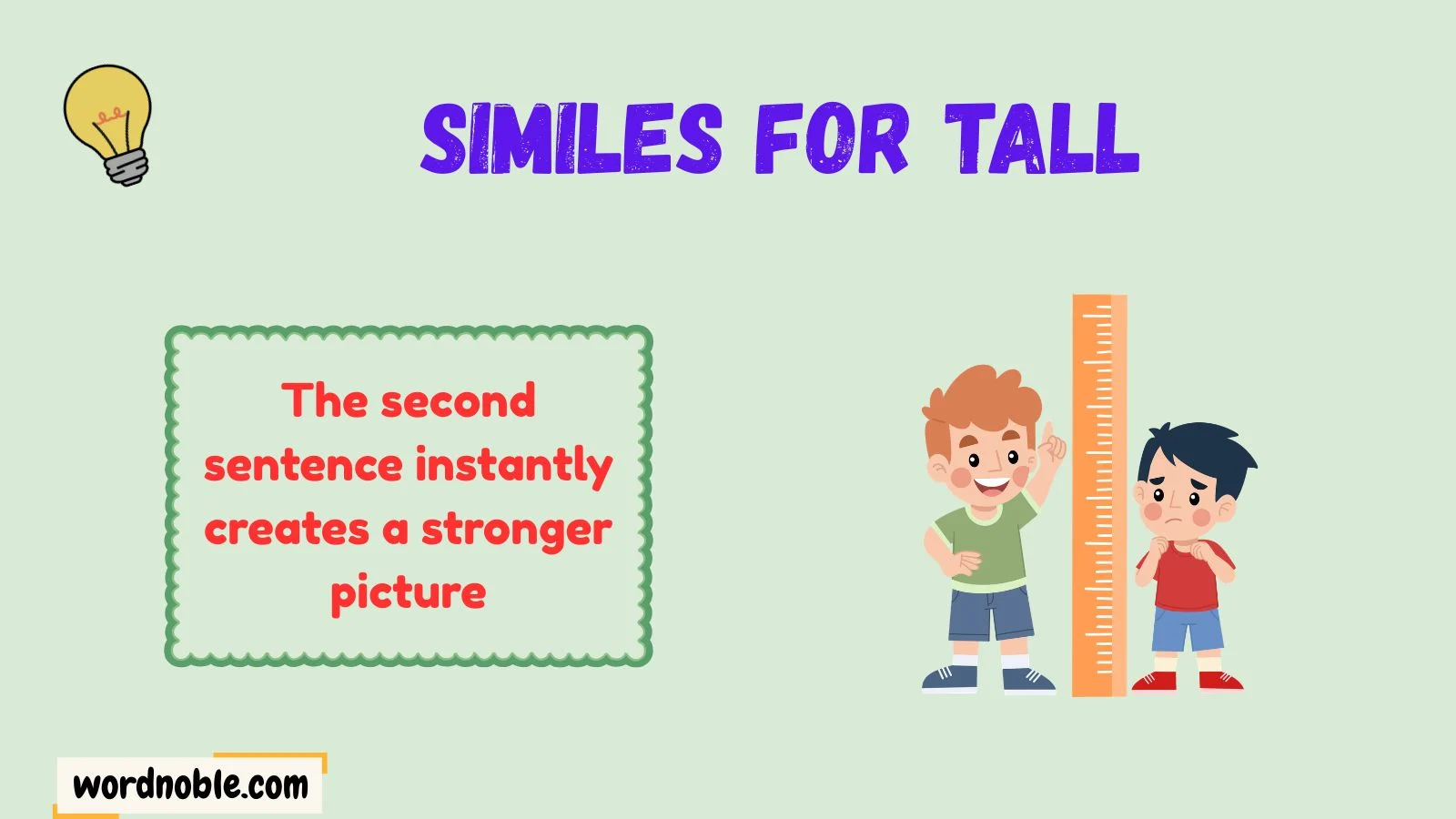
The second sentence instantly creates a stronger picture.
Similes for tall are descriptive comparisons that use “like” or “as” to express exceptional height through familiar images. They enrich figurative language by making descriptions clearer, more imaginative, and easier for readers to visualize in both creative and everyday writing.
How Similes for Tall Work
A simile connects two different things that share one noticeable quality—in this case, height.
The structure is simple:
Subject + like + comparison
or
Subject + as + adjective + as + comparison
Examples:
- He was as tall as a skyscraper.
- She stood like a majestic pine tree.
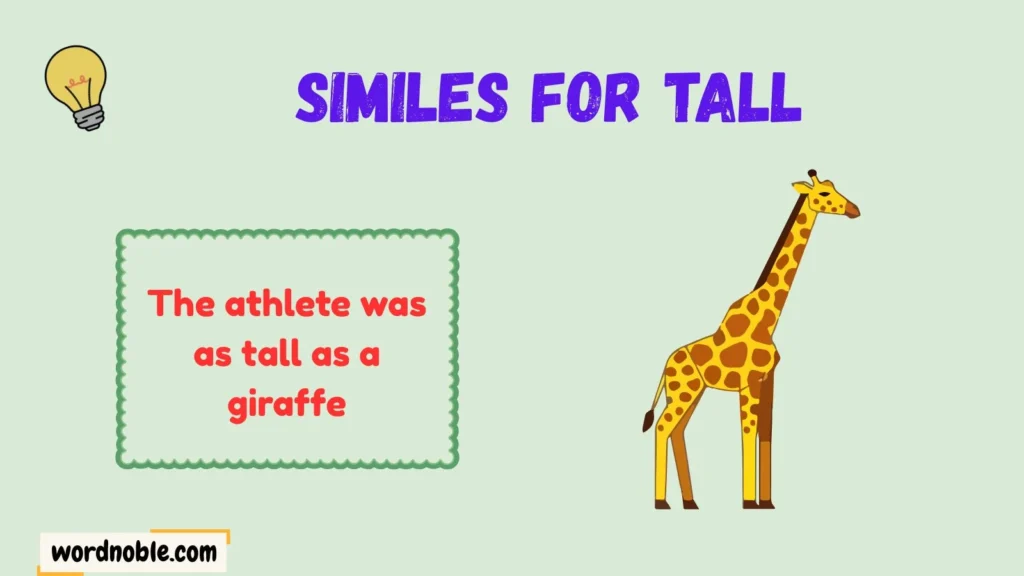
- The athlete was as tall as a giraffe.
The comparison isn’t meant to be literally true. Instead, it emphasizes the person’s impressive height through imagery.
This balance between imagination and clarity makes similes an essential creative writing technique.
Emotional and Descriptive Power of Similes for Tall
Height can communicate much more than physical appearance. A carefully chosen simile can suggest confidence, elegance, strength, authority, awkwardness, mystery, or even comedy.
Consider these examples:
- As tall as a castle tower suggests power and grandeur.
- Like a beanpole creates a humorous image.
- As tall as an ancient oak conveys strength and stability.
- Like a crane reaching the clouds implies graceful movement.
Because of this emotional flexibility, similes are valuable in fiction, poetry, speeches, and descriptive essays.
Contextual Meaning Expansion
Storytelling
Novelists often use similes for tall characters to make them instantly recognizable. A towering comparison can establish a character’s presence before they even speak.
Example:
The guard stood as tall as a fortress wall, silently watching everyone enter.
Poetry
Poets rely on similes to create vivid imagery while adding rhythm and symbolism.
Example:
She rose like a mountain greeting the sunrise.
Everyday Conversation
People frequently use humorous similes when describing friends or family.
Examples:
- You’re as tall as a telephone pole!
- He’s like a walking ladder.
These expressions make casual conversations more entertaining.
Humor
Funny similes exaggerate height for comic effect.
Examples include:
- As tall as tomorrow.
- Like a giraffe on stilts.
- As tall as three refrigerators stacked together.
The exaggeration creates laughter without needing a literal comparison.
Academic and Classroom Writing
Students often use similes to improve descriptive paragraphs and creative essays.
Instead of writing:
The boy was tall.
They might write:
The boy was as tall as a lighthouse overlooking the sea.
This richer description demonstrates stronger vocabulary and imaginative thinking.
Types of Similes for Tall
Organizing similes into categories makes it easier to choose the right comparison for different writing styles and tones.
🐾 Animal-Based Similes
Animals naturally provide memorable comparisons because many are known for their impressive height.
As tall as a giraffe
Meaning: Extremely tall.
Like a camel standing proudly
Meaning: Tall with a noticeable upright posture.
As tall as an ostrich
Meaning: Tall and slender.
Like a long-legged crane
Meaning: Gracefully tall.
As tall as an elk
Meaning: Tall with a powerful presence.
These comparisons work especially well in children’s writing, storytelling, and descriptive narratives.
🌿 Nature-Based Similes
Nature offers timeless comparisons that create beautiful imagery.
As tall as a redwood tree
Meaning: Exceptionally tall and majestic.
Like a towering pine
Meaning: Tall, elegant, and strong.
As tall as a mountain peak
Meaning: Enormously tall.
Like a towering waterfall
Meaning: Impressively high and striking.
As tall as an ancient oak
Meaning: Tall with strength and stability.
Nature-based similes are especially effective in poetry and literary writing.
📡 Object and Technology-Based Similes
Modern comparisons help readers visualize extraordinary height through familiar structures and objects.
As tall as a skyscraper
Meaning: Exceptionally tall.
Like a radio tower
Meaning: Very tall and noticeable.
As tall as a lighthouse
Meaning: Tall enough to stand out from everything around it.
Like a flagpole
Meaning: Thin and extremely tall.
As tall as a wind turbine
Meaning: Remarkably high and commanding.
These similes are ideal for modern fiction and descriptive essays.
😂 Humorous and Exaggerated Similes
Comedy often relies on playful exaggeration to create memorable descriptions.
Like a beanpole
Meaning: Very tall and skinny.
As tall as tomorrow
Meaning: Humorously impossibly tall.
Like a ladder with shoes
Meaning: Extremely tall and thin.
As tall as three refrigerators stacked together
Meaning: Ridiculously tall.
Like a giraffe wearing stilts
Meaning: Comically exaggerated height.
These similes are perfect for lighthearted dialogue and humorous storytelling.
🎭 Emotional and Behavioral Similes
Sometimes a simile communicates personality as well as height.
Like a king standing above his court
Meaning: Tall and authoritative.
As tall as hope reaching the sky
Meaning: Inspiring and uplifting.
Like a guardian watching over everyone
Meaning: Protective and commanding.
As tall as confidence itself
Meaning: Tall with strong self-assurance.
Like a silent monument
Meaning: Tall, calm, and imposing.
These comparisons add emotional depth to characters and scenes.
Best Similes for Tall with Meanings and Examples
| Simile | Meaning | Category | Example Sentence |
|---|---|---|---|
| As tall as a giraffe | Extremely tall | Animal | The teenager grew as tall as a giraffe during the summer. |
| Like a towering pine tree | Tall and elegant | Nature | She stood like a towering pine tree among the crowd. |
| As tall as a skyscraper | Exceptionally tall | Object | He looked as tall as a skyscraper beside his younger cousins. |
| Like a beanpole | Tall and skinny | Humorous | My brother is like a beanpole after his latest growth spurt. |
| As tall as an ancient oak | Strong and tall | Nature | The old warrior remained as tall as an ancient oak despite his age. |
| Like a lighthouse | Easy to notice | Object | The captain stood like a lighthouse on the deck. |
15 Creative Similes for Tall with Meanings and Examples
Below are additional similes that can enrich your writing. Each example includes a clear meaning and a sample sentence for better understanding.
| Simile | Meaning | Category | Example Sentence |
|---|---|---|---|
| As tall as a castle tower | Extremely tall and impressive | Object | The knight stood as tall as a castle tower in shining armor. |
| Like a crane reaching the sky | Tall and graceful | Animal | She walked like a crane reaching the sky across the stage. |
| As tall as a palm tree | Tall with a slender build | Nature | The model was as tall as a palm tree. |
| Like a giant among children | Noticeably taller than everyone | Emotional | He looked like a giant among children at the school event. |
| As tall as a church steeple | Remarkably tall | Object | The old chimney rose as tall as a church steeple. |
| Like a mountain touching the clouds | Massive and towering | Nature | The hero stood like a mountain touching the clouds. |
| As tall as a telephone pole | Very tall and thin | Object | Jake is as tall as a telephone pole now. |
| Like a towering statue | Tall and commanding | Emotional | She stood like a towering statue during the ceremony. |
| As tall as a cedar tree | Tall and sturdy | Nature | The hunter was as tall as a cedar tree. |
| Like a giant oak | Tall and powerful | Nature | The captain stood like a giant oak before his team. |
| As tall as a watchtower | Easily noticeable | Object | The soldier appeared as tall as a watchtower. |
| Like a monument rising above the city | Tall and majestic | Emotional | The skyscraper rose like a monument above the skyline. |
| As tall as a rocket on its launch pad | Extremely high | Technology | The new building stood as tall as a rocket on its launch pad. |
| Like a lamppost | Very tall and slim | Humorous | My cousin is like a lamppost after his growth spurt. |
| As tall as the tallest tree in the forest | Exceptionally tall | Nature | The mythical giant was as tall as the tallest tree in the forest. |
Context Table for Similes for Tall
| Context | Meaning | Best Use Case | Example |
|---|---|---|---|
| Storytelling | Creates vivid character descriptions | Novels and short stories | As tall as a redwood tree |
| Poetry | Adds imagery and symbolism | Poems | Like a mountain touching the clouds |
| Classroom Writing | Improves descriptive paragraphs | School assignments | As tall as a giraffe |
| Casual Conversation | Makes speech more expressive | Daily conversations | Like a beanpole |
| Humor | Creates funny exaggeration | Comedy and dialogue | Like a ladder with shoes |
| Fantasy | Describes giants and magical beings | Fantasy fiction | As tall as a castle tower |
| Historical Writing | Adds dramatic imagery | Historical stories | Like a towering monument |
| Children’s Literature | Creates simple visual comparisons | Storybooks | As tall as a palm tree |
How to Use Similes for Tall Naturally
A good simile should make your writing clearer rather than more complicated. Choose comparisons your readers can easily imagine.
Match the comparison to the situation
A humorous story may use:
- Like a beanpole
- Like a ladder with shoes
A serious novel may use:
- As tall as an ancient oak
- Like a mountain touching the clouds
A poem may use:
- As tall as a pine tree
- Like a lighthouse beside the sea
Selecting a comparison that fits the tone makes your writing feel more natural.
Build Strong Visual Imagery
Ask yourself what kind of image you want readers to see.
Instead of saying:
The man was tall.
Write:
The man stood as tall as a lighthouse, overlooking the busy harbor.
This creates a vivid mental picture.
Keep Similes Relevant
Choose comparisons your audience understands.
For younger readers:
- As tall as a giraffe
- Like a tree
For older audiences:
- As tall as a skyscraper
- Like a radio tower
Simple comparisons often have the greatest impact.
Don’t Overuse Similes
Too many similes in one paragraph can distract readers.
❌ Weak Example:
He was as tall as a giraffe, like a tree, as high as a tower, and like a mountain.
✅ Better Example:
He stood as tall as a redwood tree, quietly watching the crowd.
One strong comparison is usually more effective than several weak ones.
Simile vs. Metaphor
Although both are figures of speech, they are used differently.
| Simile | Metaphor |
|---|---|
| Uses like or as | Makes a direct comparison |
| “He is as tall as a giraffe.” | “He is a giant.” |
| Comparison is explicit | Comparison is implied |
| Easier for beginners | Often more poetic |
A simple way to remember the difference:
- Simile: compares using like or as.
- Metaphor: says one thing is another to create imagery.
Common Mistakes When Writing Similes for Tall
1. Overusing Similes
Adding a simile to every sentence reduces its impact.
Instead, use them only when they strengthen the description.
2. Choosing Illogical Comparisons
A simile should make sense.
Poor example:
As tall as a pencil.
A pencil is long, but it is not an effective comparison for a person’s height in most contexts.
Better:
As tall as a flagpole.
3. Mixing Similes and Metaphors
Incorrect:
He was like a giant mountain.
Better:
He was as tall as a mountain.
Or:
He was a giant.
Keep the figure of speech consistent.
4. Using Clichés Too Often
Popular similes are useful, but repeating them can make writing predictable.
Instead of always writing:
- As tall as a giraffe
Try alternatives:
- As tall as a cedar tree
- Like a soaring pine
- As tall as a lighthouse
- Like a watchtower
Variety keeps your writing fresh.
Do and Don’t Guide
✅ Do
- Choose comparisons readers recognize.
- Match the simile to your writing style.
- Use vivid imagery.
- Keep comparisons simple and meaningful.
- Read your sentence aloud to check its flow.
- Use similes to support the story rather than interrupt it.
❌ Don’t
- Compare unrelated things.
- Force a simile into every sentence.
- Repeat the same comparison throughout an article.
- Confuse similes with metaphors.
- Use comparisons that distract from the main idea.
- Overcomplicate simple descriptions.
Natural Chat Responses Using Similes for Tall
Here are some conversational examples that sound natural in everyday English.
Friend: Did you see the new basketball player?
Reply: He’s as tall as a giraffe—I had to look way up to talk to him!
Friend: Your younger brother has grown so much!
Reply: I know! He’s like a beanpole now.
Friend: Who’s that standing by the door?
Reply: The guy who’s as tall as a lighthouse—you can’t miss him.
Friend: Your cousin looks different.
Reply: He’s shot up like a towering pine tree over the last year.
Friend: Was the actor really that tall?
Reply: Absolutely. He looked like a giant among everyone else on stage.
Friend: How did you spot your friend in the crowd?
Reply: It was easy—she stood as tall as a flagpole above everyone else.
Related Terms (SEO Cluster Expansion)
To better understand and use similes for tall, it’s helpful to explore related language concepts and writing techniques:
- Similes
- Figurative language
- Descriptive writing
- Sensory language
- Visual imagery
- Creative writing
- Character description
- Metaphor vs. simile
- Literary devices
- Symbolism
- Personification
- Hyperbole
- English literature
- Narrative writing
- Poetry techniques
Related Topic Clusters
If you’re expanding your knowledge of figurative language, these related topics are worth exploring:
- Similes for eyes
- Similes for face
- Similes for hands
- Similes for hair
- Similes for smile
- Similes for strength
- Similes for beauty
- Similes for confidence
- Figurative language examples
- Descriptive writing techniques
- English literature devices
- Sensory language in writing
- Metaphors with examples
- Personification examples
- Hyperbole examples
FAQs:
1. What are similes for tall?
Similes for tall are figurative expressions that compare someone’s height to another object, animal, or natural feature using the words “like” or “as.” They help readers create a vivid mental picture of exceptional height. Writers use them in stories, poems, essays, and everyday conversations to make descriptions more engaging and memorable.
2. What are some common examples of similes for tall?
Some of the most common similes for tall include:
- As tall as a giraffe
- As tall as a skyscraper
- Like a towering pine tree
- As tall as a lighthouse
- Like a beanpole
- As tall as an ancient oak
- Like a flagpole
- As tall as a mountain
These comparisons make descriptions more colorful and easier to imagine.
3. Why do writers use similes for tall?
Writers use similes for tall to create stronger imagery and make descriptions more expressive. Instead of simply stating that someone is tall, a simile helps readers visualize the character or object more clearly. Similes also add emotion, personality, humor, and creativity, making writing more enjoyable and memorable.
4. What is the difference between a simile and a metaphor?
A simile compares two things using “like” or “as.” A metaphor makes a direct comparison without using those words.
Simile: She is as tall as a pine tree.
Metaphor: She is a towering pine tree.
Both figures of speech create imagery, but similes make the comparison explicit, while metaphors imply it more directly.
5. Can similes for tall be funny?
Yes. Funny similes exaggerate height to create humor while remaining easy to understand. Examples include:
- Like a ladder with shoes
- As tall as tomorrow
- Like a giraffe on stilts
- As tall as three refrigerators stacked together
These playful comparisons are commonly used in conversations, humorous stories, and children’s writing.
6. How can students use similes for tall in school assignments?
Students can use similes for tall in descriptive essays, creative writing, book reports, and poetry to make their work more engaging. A well-chosen simile helps teachers see stronger vocabulary, imagination, and descriptive skills. Using only one or two effective similes is usually better than adding too many.
7. Are similes for tall useful in poetry?
Absolutely. Poets often use similes to create vivid imagery and emotional depth. Comparing someone’s height to mountains, trees, towers, or natural landscapes helps readers visualize the subject while adding rhythm and beauty to the poem. Nature-based similes are especially popular because they feel timeless and expressive.
8. How do I choose the best simile for tall?
Choose a simile that matches the tone and context of your writing. For humorous pieces, use comparisons like “like a beanpole.” For serious or literary writing, choose imagery such as “as tall as an ancient oak” or “like a towering pine tree.” The best similes are simple, relatable, and easy for readers to picture.
9. Can similes for tall be used in everyday conversation?
Yes. Similes naturally appear in everyday speech because they make conversations more expressive. Someone might say, “He’s as tall as a giraffe,” or “She’s like a flagpole standing in the crowd.” These comparisons are easy to understand and often make conversations more lively and memorable.
10. Why are similes important in English literature?
Similes are an essential literary device because they strengthen descriptive writing and improve imagery. They help readers connect with characters, settings, and emotions by comparing unfamiliar ideas with familiar ones. From classic poetry to modern novels, similes remain one of the most effective techniques for creating vivid and memorable language.
Conclusion:
Whether you’re writing a story, poem, essay, or simply looking for a more creative way to describe someone’s height, similes for tall can transform ordinary descriptions into vivid, memorable imagery.
By comparing height to familiar animals, towering structures, or elements of nature, you help readers picture your subject instantly while adding emotion, humor, or elegance to your writing.
The key is to choose comparisons that fit your tone, audience, and purpose. With thoughtful use, similes not only improve descriptive writing but also strengthen creativity, making your words more engaging and impactful across every type of communication.

I am Naqash Ayub, proudly writing for WordNoble, where I focus on creating clear, informative, and SEO-friendly content. I enjoy turning detailed information into simple, trustworthy articles that help readers find the answers they need.