

Learning English becomes much easier when you start with idioms that people actually use in everyday conversations.
If you’re new to English, idioms may seem confusing at first because their meanings are often different from the literal words. But once you understand them, they can make your speaking and writing sound more natural, confident, and fluent.
Whether you’re a student, an English learner, or simply looking to improve your communication skills, you’ll discover beginner-friendly idioms that are easy to remember and use in real-life situations.
Idioms for beginners are common English expressions whose meanings are different from the literal meanings of the individual words. Learning basic idioms helps improve speaking, writing, and understanding everyday English.
What Are Idioms?

An idiom is a group of words with a figurative meaning that is different from the literal meaning of the individual words.
For example:
- Break the ice means to start a conversation.
- It does not mean breaking actual ice.
Idioms are a key part of figurative language. They add personality, emotion, and color to everyday communication and are commonly used in conversations, books, movies, and English literature.
Idioms are fixed expressions that convey a figurative meaning rather than a literal one. They are widely used in spoken and written English to express ideas naturally, making communication more engaging and culturally meaningful.
Why Learning Idioms Is Important
Learning idioms helps you:
- Understand native English speakers more easily
- Improve speaking confidence
- Make writing more engaging
- Perform better in English exams
- Read books and stories with greater understanding
- Enjoy movies and TV shows without confusion
- Sound more natural during conversations
Literal Meaning vs. Idiomatic Meaning
| Expression | Literal Meaning | Idiomatic Meaning |
|---|---|---|
| Break the ice | Break frozen water | Start a conversation |
| Piece of cake | A slice of cake | Very easy |
| Hit the books | Strike books | Study hard |
| Under the weather | Below bad weather | Feeling sick |
| Spill the beans | Drop beans | Reveal a secret |
Idioms For Beginners Pdf

- A beginner friendly PDF can collect common idioms with simple meanings.
- Each idiom should include a short example sentence for easy understanding.
- Grouping idioms by topic can make the PDF easier to study.
- Everyday expressions are useful for building practical English skills.
- Simple explanations help beginners understand figurative meanings.
- A pronunciation guide can support learners who are new to English.
- Example sentences show how each idiom works in real communication.
- Adding short practice exercises can improve retention.
- Idioms can be arranged from basic to more advanced expressions.
- A glossary can help readers quickly review unfamiliar words.
- Visual examples can make difficult expressions easier to remember.
- Learners can use the PDF for school, writing, or conversation practice.
- Regular revision helps beginners remember idioms for longer.
- A well organized PDF can become a useful everyday English reference.
50 Common Idioms for Beginners

Everyday Conversation Idioms
1. Break the ice
Meaning: Start a friendly conversation.
Example: She told a joke to break the ice.
2. Piece of cake
Meaning: Very easy.
Example: The quiz was a piece of cake.
3. Better late than never
Meaning: Doing something late is better than not doing it.
Example: He finally apologized. Better late than never.
4. Once in a blue moon
Meaning: Very rarely.
Example: We eat out once in a blue moon.
5. Call it a day
Meaning: Stop working.
Example: Let’s call it a day and continue tomorrow.
6. Hit the road
Meaning: Leave or start a journey.
Example: We should hit the road early.
7. Hang in there
Meaning: Don’t give up.
Example: Hang in there. Things will improve.
8. On cloud nine
Meaning: Extremely happy.
Example: She was on cloud nine after winning.
9. Costs an arm and a leg
Meaning: Very expensive.
Example: That phone costs an arm and a leg.
10. Miss the boat
Meaning: Miss an opportunity.
Example: Apply today or you’ll miss the boat.
100 Idioms And Their Meanings
- A list of 100 idioms gives learners a useful collection of common expressions.
- Each idiom should have a clear and simple meaning.
- Example sentences can show how the expression is used naturally.
- Common conversational idioms are especially useful for beginners.
- Idioms can be organized alphabetically for quick reference.
- Topic based categories can make related expressions easier to learn.
- Short meanings help readers understand expressions without confusion.
- Realistic examples connect idioms with everyday situations.
- Learners can practice using several idioms in their own sentences.
- Reviewing a few idioms each day can make learning manageable.
- Context is important because an idiom may not have a literal meaning.
- Similar expressions can be compared to improve vocabulary.
- Writing exercises can help learners use idioms confidently.
- A 100 idiom collection can provide a strong foundation for further learning.
School and Study Idioms
- Hit the books Study seriously.
- Learn the ropes Learn how something works.
- Pass with flying colors Achieve excellent results.
- Pull an all-nighter Stay awake studying all night.
- Read between the lines Understand hidden meaning.
- Practice makes perfect Improvement comes through practice.
- Know the ropes Be experienced.
- Ace the test Score very well.
- Brush up on Review your knowledge.
- Go back to the drawing board Start again.
Work and Business Idioms
- Get the ball rolling
- Think outside the box
- Back to square one
- In the same boat
- Cut corners
- Raise the bar
- Learn the ropes
- Keep your eye on the ball
- On the same page
- Bite off more than you can chew
Idioms For Beginners With Meaning
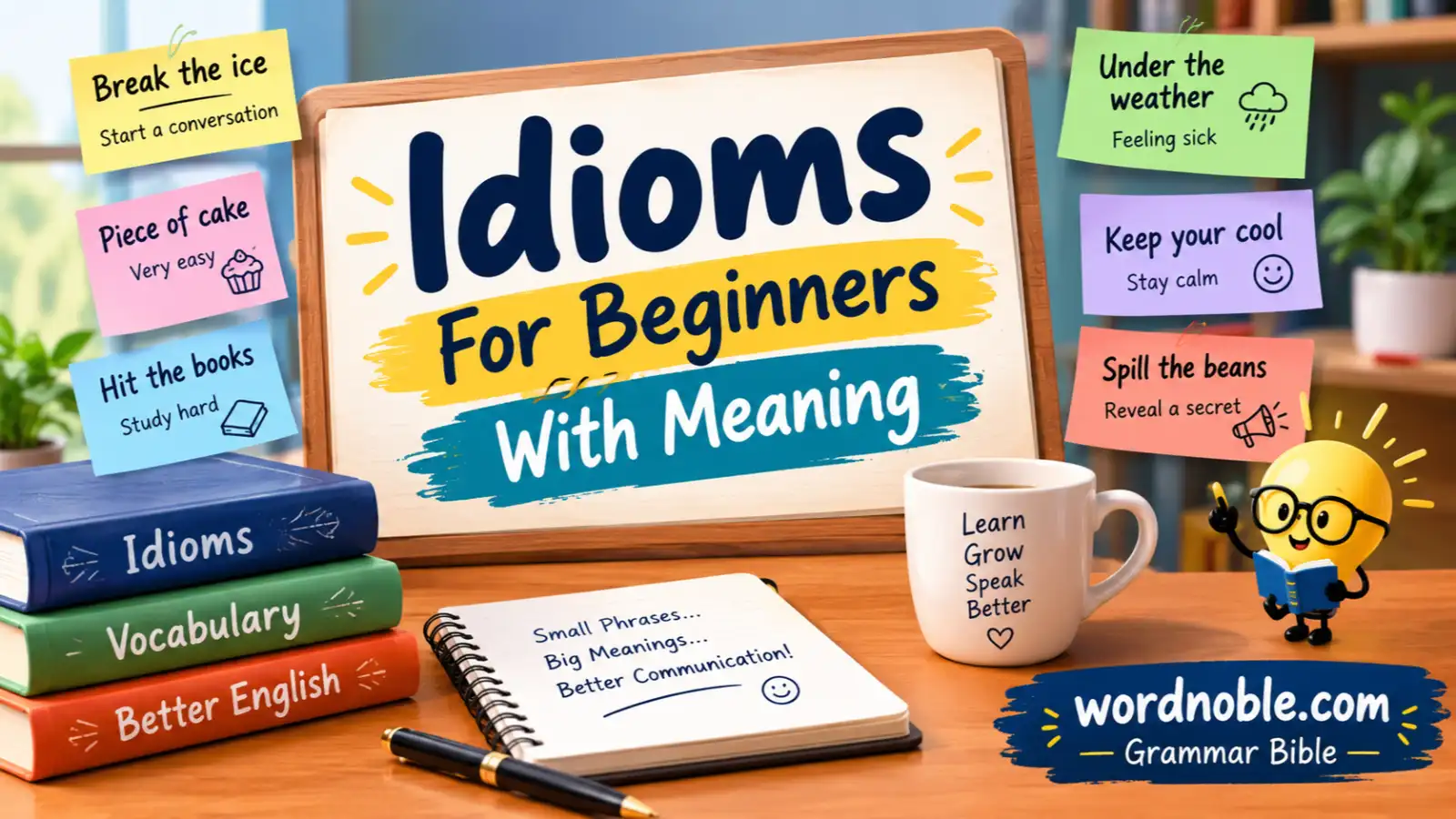
- Beginner idioms should use simple explanations that are easy to remember.
- The meaning should explain the figurative idea rather than the literal words.
- Common daily expressions are a good starting point for new learners.
- Short example sentences make unfamiliar idioms easier to understand.
- Learners should study idioms in context instead of memorizing words alone.
- Everyday conversations provide useful situations for practicing expressions.
- Grouping similar idioms can make vocabulary learning more organized.
- Beginners can keep a personal list of expressions they use frequently.
- Reading idioms in stories can show how they naturally fit into sentences.
- Listening practice can help learners recognize idioms in spoken English.
- Writing their own examples can strengthen understanding.
- Repetition helps make new expressions easier to recall.
- Learners should pay attention to the tone and situation of each idiom.
- Consistent practice can gradually improve confidence with English expressions.
Animal Idioms
| Idiom | Meaning |
|---|---|
| Busy as a bee | Very busy |
| Let the cat out of the bag | Reveal a secret |
| Hold your horses | Wait patiently |
| Black sheep | Different from the family |
| Copycat | Someone who imitates others |
| Birds of a feather | Similar people |
| The elephant in the room | An obvious problem everyone ignores |
| Wolf in sheep’s clothing | Someone pretending to be kind |
| Eagle eye | Excellent observation |
| Monkey business | Silly or dishonest behavior |
Idioms Examples
- Example sentences show readers how idioms work in real communication.
- A clear sentence can make an unfamiliar expression easier to understand.
- Examples should match the meaning of the idiom accurately.
- Everyday situations are useful for demonstrating common expressions.
- School related examples can help students understand idioms in context.
- Workplace examples can introduce useful expressions for professional communication.
- Conversation examples can show how idioms sound in natural speech.
- Writing examples can help learners use expressions correctly.
- Simple examples are especially helpful for beginners.
- Different contexts can demonstrate how an expression changes with the situation.
- Learners can rewrite examples using their own ideas.
- Comparing literal and figurative meanings can improve understanding.
- Reading several examples helps learners recognize recurring expressions.
- Practicing idioms through sentences makes vocabulary more active and useful.
Food Idioms
- Piece of cake
- Spill the beans
- Cool as a cucumber
- Butter someone up
- Big cheese
- Bread and butter
- Sell like hotcakes
- Take with a grain of salt
- Bring home the bacon
- Full of beans
Body Part Idioms
- Cost an arm and a leg
- Keep an eye on
- Give someone a hand
- Cold feet
- By heart
- Face the music
- Foot the bill
- Head over heels
- Lend a hand
- Stick your neck out
Weather Idioms
- Under the weather
- Every cloud has a silver lining
- Save for a rainy day
- Storm in a teacup
- Come rain or shine
- Chase rainbows
- Fair-weather friend
- Break the ice
- Snowed under
- Weather the storm
100 Idioms For Beginners
- A collection of 100 beginner idioms can introduce common English expressions.
- The list should focus on expressions learners are likely to encounter regularly.
- Simple meanings make each idiom easier to study.
- Short sentences provide practical context for every expression.
- Alphabetical organization can make individual idioms easier to find.
- Topic categories can help learners study related expressions together.
- Common conversation idioms can improve everyday communication skills.
- Reading idioms regularly can increase familiarity with figurative language.
- Writing practice can help learners turn passive vocabulary into active vocabulary.
- Beginners can choose a few expressions each day for focused practice.
- Flashcards can make reviewing the 100 idioms more convenient.
- Quizzes can test whether learners understand each figurative meaning.
- Keeping examples short can prevent unnecessary confusion.
- A structured list gives beginners a practical starting point for idiom learning.
Context Table
| Situation | Best Idiom | Meaning | Example |
|---|---|---|---|
| Easy homework | Piece of cake | Very easy | The homework was a piece of cake. |
| Starting a meeting | Break the ice | Begin conversation | He told a joke to break the ice. |
| Feeling ill | Under the weather | Sick | I’m under the weather today. |
| Expensive laptop | Arm and a leg | Very costly | It cost an arm and a leg. |
| Missed chance | Miss the boat | Lost opportunity | I missed the boat. |
20 Idioms With Their Meanings And Sentences
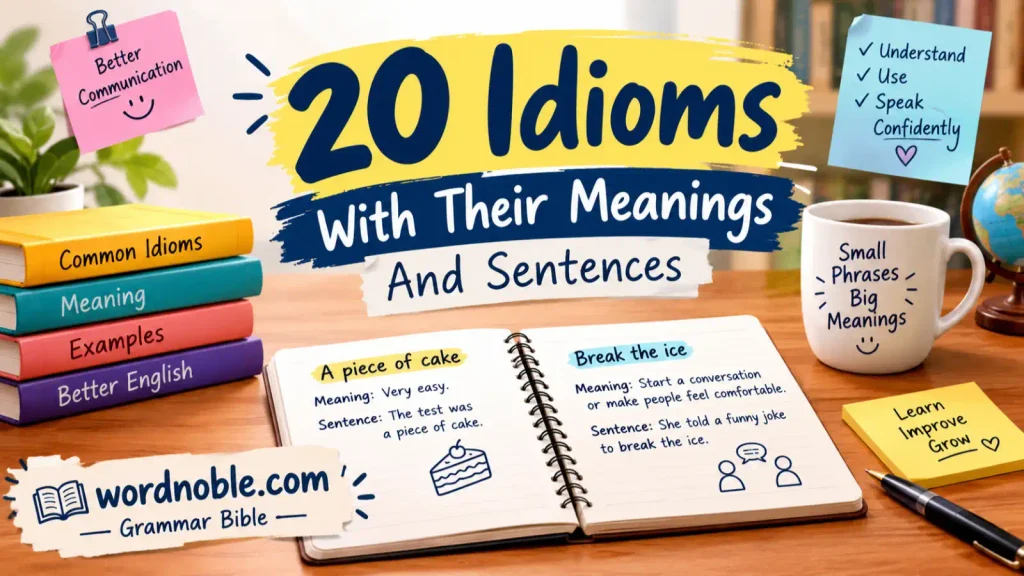
- Twenty idioms provide a manageable set for focused beginner practice.
- Each idiom should be paired with a clear meaning.
- A sentence should demonstrate the expression in a natural context.
- Simple examples make the learning process easier.
- Learners can read each sentence aloud to practice fluency.
- Writing a new sentence can reinforce the meaning of each idiom.
- Everyday situations make idioms easier to remember.
- Comparing related idioms can expand vocabulary efficiently.
- Reviewing the same twenty expressions regularly can improve recall.
- Learners should focus on understanding context rather than literal translation.
- Idioms can be practiced through conversations with classmates or friends.
- Short quizzes can help identify expressions that need more review.
- Reading examples repeatedly can improve recognition while reading.
- A small collection of idioms can build confidence before moving to larger lists.
Idioms vs. Similes vs. Metaphors vs. Proverbs
| Figure of Speech | Description | Example |
|---|---|---|
| Idiom | Fixed phrase with figurative meaning | Break the ice |
| Simile | Comparison using “like” or “as” | As brave as a lion |
| Metaphor | Direct comparison | Time is money |
| Proverb | Traditional saying with advice | Actions speak louder than words |
How to Learn Idioms Faster
- Learn 3–5 idioms each week.
- Read short stories and articles.
- Watch English movies with subtitles.
- Practice using idioms in daily conversations.
- Keep an idiom notebook.
- Review regularly using flashcards.
- Use each idiom in your own sentence.
- Learn idioms by topic instead of randomly.
1000 English Idioms With Meanings
- A collection of 1000 English idioms can provide extensive exposure to figurative language.
- Each expression should have a concise and accurate meaning.
- Example sentences can explain how idioms function in context.
- Alphabetical organization makes a large collection easier to navigate.
- Topic based categories can help learners study related expressions.
- Common idioms can be separated from less frequently used expressions.
- Context notes can explain when an idiom is appropriate.
- Formal and informal expressions can be identified clearly.
- Similar idioms can be grouped together for easier comparison.
- Learners can study the collection gradually instead of memorizing everything at once.
- Regular revision can help maintain a large vocabulary over time.
- Reading authentic English can reinforce idioms found in the collection.
- Writing practice can help learners use expressions naturally.
- A large idiom collection can serve as a long term reference for English learners.
Common Mistakes Beginners Make
Translating Idioms Literally
Idioms usually don’t mean exactly what the words say.
Memorizing Without Context
Always learn an idiom with an example sentence.
Using Too Many Idioms
Overusing idioms can make your speech sound unnatural.
Mixing Idioms
Use the exact wording because changing words often changes the meaning.
Idioms And Phrases
- Idioms and phrases are important parts of natural English communication.
- An idiom usually has a figurative meaning that differs from its literal words.
- Phrases can provide useful expressions for everyday conversations.
- Learning both can help learners understand native English more easily.
- Context is essential for understanding unfamiliar expressions.
- Example sentences show how idioms and phrases work naturally.
- Common expressions can make speaking and writing more fluent.
- Learners should study meanings together with realistic examples.
- Reading books and articles can expose learners to idiomatic language.
- Listening to conversations can improve recognition of common expressions.
- Writing practice can help learners use new phrases correctly.
- Topic based lists can make vocabulary study more organized.
- Regular review helps learners remember expressions for longer.
- Understanding idioms and phrases can make English communication more natural.
Do and Don’t
Do
- Learn meanings before using them.
- Practice with example sentences.
- Listen to native speakers.
- Use idioms naturally.
- Review regularly.
Don’t
- Translate word by word.
- Invent new idioms.
- Overuse them.
- Change important words.
- Use formal idioms in every situation.
Real-Life Conversation Examples
Friend: How was the math test?
You: It was a piece of cake!
Friend: I’m nervous about meeting everyone.
You: Just tell a joke to break the ice.
Friend: That new phone is expensive.
You: Yeah, it costs an arm and a leg.
Friend: I missed the registration deadline.
You: That’s too bad. You missed the boat.
Friend: I don’t feel well today.
You: Sorry to hear that. You look under the weather.
Related Terms
- Figurative language
- Common English expressions
- Everyday English phrases
- Similes
- Metaphors
- Proverbs
- Descriptive writing
- Creative writing techniques
- English vocabulary
- Conversational English
FAQs:
1. What are idioms for beginners?
Idioms for beginners are simple figurative expressions commonly used in everyday English. They help learners understand conversations and communicate more naturally.
2. Why should beginners learn idioms?
Idioms improve speaking, listening, reading, and writing skills. They also help learners understand native speakers and common English media.
3. What is the easiest idiom to learn?
“Piece of cake” is one of the easiest because it simply means something is very easy.
4. Are idioms used every day?
Yes. Native English speakers use idioms frequently in casual conversations, TV shows, books, and social media.
5. What’s the difference between an idiom and a proverb?
An idiom is a figurative expression, while a proverb is a traditional saying that teaches a lesson or offers advice.
6. How many idioms should beginners learn?
Learning five to ten idioms each week is a manageable pace for most learners and allows enough time for practice.
7. Can idioms improve English writing?
Yes. Using idioms appropriately makes writing more natural, engaging, and expressive, especially in creative or informal contexts.
8. Are idioms important in English literature?
Yes. Many authors use idioms to make dialogue realistic, add cultural context, and enrich storytelling.
9. How can students remember idioms?
Students can remember idioms by learning them in context, using flashcards, reading regularly, and creating their own example sentences.
10. Do idioms always have figurative meanings?
Yes. The meaning of an idiom cannot usually be understood by interpreting each word literally.
Conclusion:
Learning idioms is one of the fastest ways to make your English sound more natural and confident. These expressions go beyond literal meanings, helping you understand conversations, books, movies, and everyday communication with greater ease.
By practicing common idioms in real-life situations and using them correctly, you’ll gradually build stronger vocabulary, improve fluency, and communicate more effectively.
Start with a few simple idioms, review them often, and use them in your own sentences. With consistent practice, idioms will become a natural part of your English, making both your speaking and writing more engaging and expressive.

I am Naqash Ayub, proudly writing for WordNoble, where I focus on creating clear, informative, and SEO-friendly content. I enjoy turning detailed information into simple, trustworthy articles that help readers find the answers they need.