
When words fall short after making a mistake, the right idioms for apology can express regret in a more meaningful and memorable way.
These expressions are widely used in everyday conversations, writing, and storytelling to show sincerity, responsibility, and the desire to make things right.
Whether you’re apologizing to a friend, colleague, or family member, understanding these idioms can help you communicate with greater confidence and emotional impact.
Idioms for apology are figurative expressions used to admit mistakes, express regret, or ask for forgiveness. They make apologies sound more natural, meaningful, and expressive in everyday English.
Apology idioms are common English expressions that communicate regret, responsibility, or a desire to repair a relationship. Unlike literal apologies, these idioms add emotion, cultural meaning, and conversational fluency, making them useful in everyday communication, creative writing, and English learning.
What Are Idioms for Apology?
Idioms for apology are figurative expressions used to admit mistakes, accept responsibility, or ask someone for forgiveness. Unlike literal phrases, idioms carry meanings that cannot always be understood from the individual words alone.
For example, someone who says “eat humble pie” is not talking about food. Instead, the idiom means to admit you were wrong and apologize with humility.
These expressions are widely used in:
- Everyday conversations
- Professional communication
- Storytelling
- English literature
- Public speaking
- Movies and television
- Creative writing
Because they are part of natural English, understanding apology idioms helps learners sound more fluent and confident.
Idioms For Apology To Someone
- Break The Ice And Talk Things Through After An Argument
- Bury The Hatchet And Make Peace With Someone
- Meet Someone Halfway By Accepting Your Part In The Problem
- Clear The Air By Honestly Explaining What Went Wrong
- Make Amends By Taking Steps To Repair The Relationship
- Own Up To Your Mistake Instead Of Making Excuses
- Ask For Forgiveness With Sincerity And Respect
- Make Peace After A Disagreement Or Misunderstanding
- Swallow Your Pride And Admit That You Were Wrong
- Extend An Olive Branch To Show That You Want Peace
- Patch Things Up By Having An Honest Conversation
- Mend Fences After A Conflict Or Hurtful Situation
- Set Things Right By Correcting Your Mistake
- Make It Up To Someone Through Kind And Thoughtful Actions
Why Do People Use Idioms for Apology?
Apology idioms add emotion and personality to communication. Instead of repeating the same phrase every time, speakers can choose expressions that better match the situation.
People use apology idioms to:
- Show genuine regret
- Admit responsibility for a mistake
- Repair damaged relationships
- Express humility
- Sound more natural in English
- Make conversations more engaging
- Add variety to speech and writing
These expressions often communicate feelings more effectively than a simple “sorry.”
How Apology Idioms Work
An apology idiom usually expresses one of three ideas:
Admitting Responsibility
Some idioms show that a person accepts blame instead of making excuses.
Example:
- “It’s time to own up.”
Showing Regret
Other idioms emphasize sincere remorse and emotional honesty.
Example:
- “I owe you an apology.”
Making Things Right
Many apology idioms focus on repairing trust after a mistake.
Example:
- “Make amends.”
Together, these expressions help speakers communicate not only regret but also their intention to improve the situation.
Bury The Hatchet Idiom Sentence
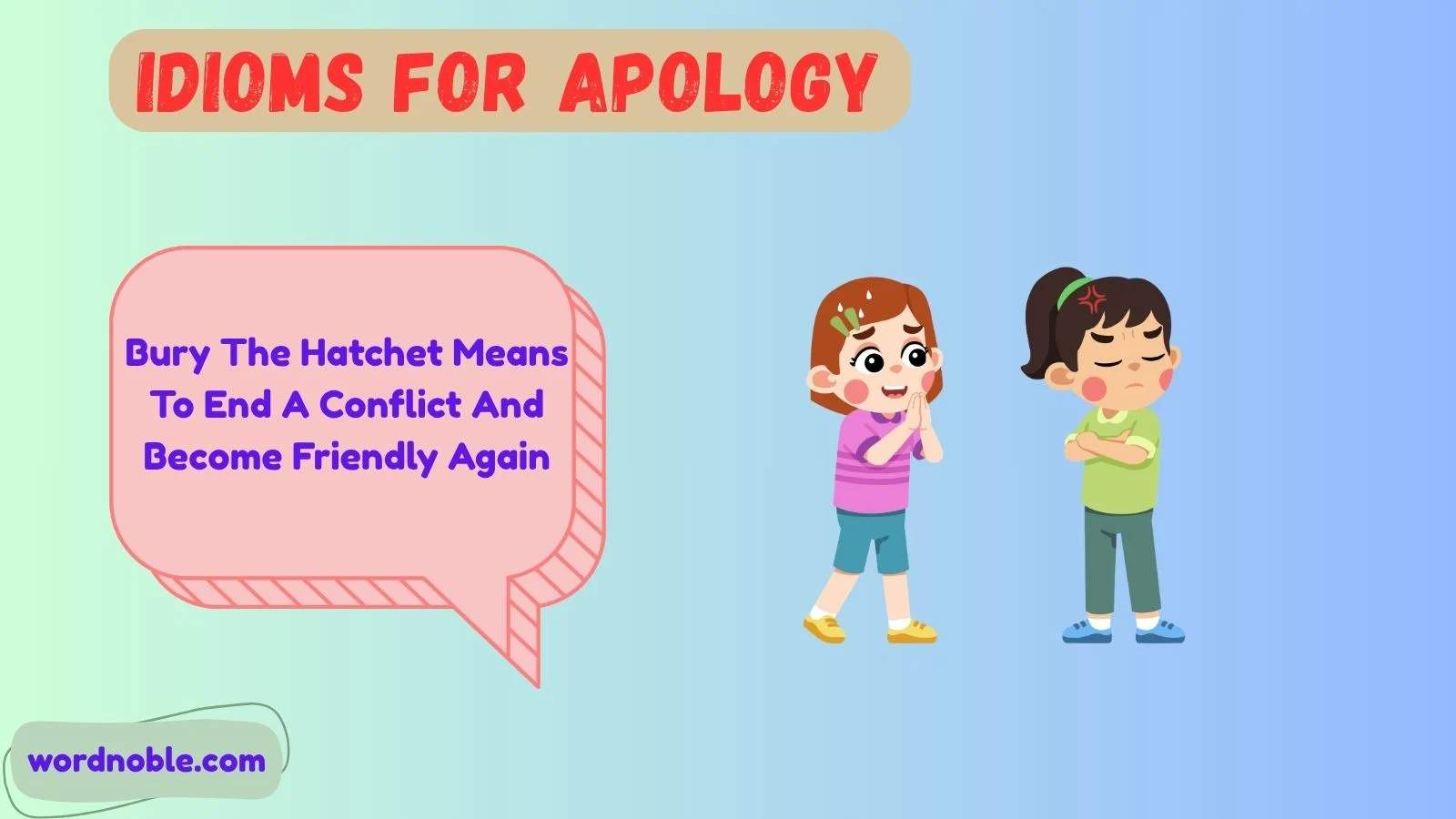
- Bury The Hatchet Means To End A Conflict And Become Friendly Again
- We Decided To Bury The Hatchet After Talking About Our Misunderstanding
- After Years Of Arguments, The Two Friends Finally Buried The Hatchet
- She Called Her Sister So They Could Bury The Hatchet
- The Team Members Buried The Hatchet And Started Working Together Again
- He Wanted To Bury The Hatchet Before The Family Celebration
- They Agreed To Bury The Hatchet And Leave The Past Behind
- After His Apology, His Friend Was Ready To Bury The Hatchet
- The Neighbors Buried The Hatchet After Resolving Their Disagreement
- We Should Bury The Hatchet And Focus On Our Friendship
- Their Honest Conversation Helped Them Bury The Hatchet
- The Brothers Decided To Bury The Hatchet After A Long Argument
- She Offered An Apology Because She Wanted To Bury The Hatchet
- Bury The Hatchet Is Useful When You Want To Describe Reconciliation
The Importance of Apology Idioms in English
Apology idioms are an important part of everyday English because they make communication more expressive and culturally natural.
They are commonly found in:
Everyday Conversations
Friends and family often use idiomatic expressions instead of formal language.
Example:
“I need to make amends.”
Workplace Communication
Professional environments value responsibility and accountability. Appropriate apology idioms can help resolve misunderstandings politely.
Creative Writing
Authors use apology idioms to reveal a character’s emotions, personality, and growth without repeating simple apology phrases.
Literature
Many novels and plays use figurative expressions involving regret, forgiveness, and redemption to deepen emotional impact.
Movies and Television
Characters frequently use apology idioms because they sound authentic and relatable, making dialogue more engaging.
What Are 10 Ways To Say Sorry?
- I Am Sorry For What I Did
- I Truly Regret Hurting You
- Please Forgive Me For My Mistake
- I Apologize For What Happened
- I Should Not Have Done That
- I Take Responsibility For My Actions
- I Did Not Mean To Hurt You
- I Wish I Could Take Back My Words
- I Hope You Can Forgive Me
- I Am Truly Sorry For Letting You Down
- A Good Apology Should Be Honest And Specific
- Avoid Making Excuses When You Are Apologizing
- Show Through Your Actions That You Mean Your Apology
- Give The Other Person Time If They Need Space
Types of Idioms for Apology
Understanding different categories helps you choose the most appropriate expression for each situation.
1. Idioms That Admit Mistakes
These expressions focus on accepting responsibility.
Typical purpose:
- Admit wrongdoing
- Accept blame
- Stop making excuses
- Show honesty
They are useful when rebuilding trust after making an error.
2. Idioms That Express Regret
These idioms emphasize sincere remorse.
They often communicate:
- Feeling guilty
- Feeling sorry
- Emotional honesty
- Compassion
They work well in personal conversations where feelings matter.
3. Idioms About Humility
Some apology idioms show that a person is willing to put aside pride.
These expressions suggest:
- Learning from mistakes
- Accepting criticism
- Being humble
- Respecting others
Humility often makes an apology feel more genuine.
4. Idioms About Repairing Relationships
These expressions focus on fixing problems rather than simply saying sorry.
They usually involve:
- Rebuilding trust
- Restoring friendships
- Solving conflicts
- Moving forward together
These idioms are common after disagreements or misunderstandings.
5. Idioms About Seeking Forgiveness
These expressions politely ask another person to forgive a mistake.
They communicate:
- Respect
- Sincerity
- Accountability
- Hope for reconciliation
They are especially useful in meaningful personal conversations.
What Is A Good Quote For Apology?
- A Good Apology Should Show Sincerity Rather Than Simply Saying Sorry
- A Simple Apology Can Help Rebuild Trust After A Mistake
- True Regret Is Shown Through Both Words And Actions
- A Meaningful Apology Accepts Responsibility Without Blaming Others
- Saying Sorry Can Open The Door To Healing And Understanding
- A Genuine Apology Focuses On The Person Who Was Hurt
- Forgiveness Often Begins With An Honest And Respectful Apology
- The Best Apologies Acknowledge The Impact Of Your Actions
- A Heartfelt Apology Can Turn A Difficult Conversation Into A Peaceful One
- Real Remorse Is Supported By Positive Changes In Behavior
- A Thoughtful Apology Can Help Repair A Damaged Relationship
- Saying Sorry Does Not Erase The Past But It Can Help Build A Better Future
- A Sincere Apology Requires Courage And Humility
- The Most Meaningful Apologies Are Followed By Actions That Show Change
Why Learning Apology Idioms Improves Your English
Mastering apology idioms offers several benefits:
- Makes your English sound more natural.
- Improves conversational fluency.
- Expands your vocabulary.
- Helps you understand native speakers.
- Enhances creative writing.
- Improves storytelling skills.
- Builds confidence in speaking and writing.
- Helps you communicate emotions more effectively.
- Strengthens cultural understanding of English.
- Makes your writing more engaging and expressive.
Rather than relying on the same apology every time, you’ll have a variety of expressions suited to different situations, from casual conversations to formal communication.
How To Say Sorry In Cool Way?
- Keep Your Apology Short And Honest
- Use Natural Language That Sounds Like You
- Say My Bad When The Mistake Is Small And Casual
- Say I Messed Up When You Want To Admit Your Mistake Directly
- Use I Owe You An Apology For A More Mature Tone
- Say I Got That Wrong When You Want To Accept Responsibility
- Add A Lighthearted Touch When The Situation Is Not Serious
- Avoid Making Your Apology Sound Forced Or Dramatic
- Focus On Fixing The Problem Instead Of Overexplaining
- Choose Words That Match Your Relationship With The Person
- Show That You Understand Why The Person Was Upset
- Follow Your Apology With A Helpful Action
- Keep Your Tone Respectful Even When Using Casual Language
- Let Your Actions Support The Apology
A. Idioms for Admitting a Mistake
1. Own Up
Meaning: Admit that you did something wrong.
Example: I need to own up to breaking your laptop.
Usage: Common in everyday conversations.
2. Eat Humble Pie
Meaning: Admit you were wrong and apologize with humility.
Example: After blaming everyone else, he had to eat humble pie.
Usage: Often used when someone was overly confident before admitting a mistake.
3. Come Clean
Meaning: Tell the truth about something you have hidden.
Example: She finally came clean about deleting the file.
Usage: Suitable for admitting secrets or mistakes.
4. Fess Up
Meaning: Confess honestly.
Example: It’s better to fess up before someone else finds out.
Usage: Informal English.
5. Face the Music
Meaning: Accept the consequences of your actions.
Example: He decided to face the music after making the mistake.
Usage: Often used when accepting responsibility.
6. Take the Blame
Meaning: Accept responsibility for something.
Example: She took the blame for the misunderstanding.
Usage: Common in work and family situations.
7. Admit Defeat
Meaning: Accept that you were wrong or unsuccessful.
Example: He admitted defeat and apologized to the team.
Usage: Often heard in competitions or disagreements.
8. Hold Your Hands Up
Meaning: Publicly admit responsibility.
Example: I hold my hands up—I made the mistake.
Usage: More common in British English.
9. Take It on the Chin
Meaning: Accept criticism without complaining.
Example: She took it on the chin and promised to improve.
Usage: Shows maturity after making a mistake.
10. Bite the Bullet
Meaning: Do something difficult even though it is unpleasant.
Example: He bit the bullet and apologized in person.
Usage: Used when apologizing requires courage.
B. Idioms for Expressing Regret
11. Be Full of Remorse
Meaning: Feel deep regret.
Example: She was full of remorse after hurting her friend.
Usage: Suitable for serious situations.
12. Feel Guilty
Meaning: Experience guilt because of a mistake.
Example: He felt guilty for forgetting her birthday.
Usage: A common expression in everyday English.
13. Have a Change of Heart
Meaning: Change your attitude and regret earlier actions.
Example: She had a change of heart and apologized.
Usage: Often used after reconsidering a decision.
14. Learn Your Lesson
Meaning: Understand your mistake and avoid repeating it.
Example: I learned my lesson and won’t make that mistake again.
Usage: Shows personal growth.
15. Turn Over a New Leaf
Meaning: Start behaving better.
Example: After apologizing, he promised to turn over a new leaf.
Usage: Indicates positive change.
16. Set Things Right
Meaning: Correct a mistake.
Example: She wanted to set things right with her colleague.
Usage: Frequently used after misunderstandings.
17. Make Peace
Meaning: End an argument or conflict.
Example: The brothers finally made peace.
Usage: Often used after disagreements.
18. Patch Things Up
Meaning: Repair a damaged relationship.
Example: They patched things up after the argument.
Usage: Common in friendships and families.
19. Bury the Hatchet
Meaning: End a long-running disagreement.
Example: The neighbors buried the hatchet after years of conflict.
Usage: Indicates reconciliation.
20. Let Bygones Be Bygones
Meaning: Forget past mistakes and move forward.
Example: Let’s let bygones be bygones and start fresh.
Usage: Used when both sides agree to forgive.
C. Idioms for Making Amends
21. Make Amends
Meaning: Repair the harm caused by your actions.
Example: She bought flowers to make amends.
Usage: One of the most common apology idioms.
22. Extend an Olive Branch
Meaning: Offer peace or reconciliation.
Example: He extended an olive branch after the disagreement.
Usage: Suitable for personal and professional settings.
23. Mend Fences
Meaning: Restore a relationship.
Example: They met for coffee to mend fences.
Usage: Often used after family disputes.
24. Clear the Air
Meaning: Resolve misunderstandings through honest discussion.
Example: Let’s clear the air before this gets worse.
Usage: Common in workplaces and friendships.
25. Right a Wrong
Meaning: Correct an unfair or hurtful action.
Example: She wanted to right a wrong from years ago.
Usage: Used in both formal and informal contexts.
26. Smooth Things Over
Meaning: Calm a tense situation.
Example: He apologized to smooth things over.
Usage: Helpful after arguments.
27. Build Bridges
Meaning: Improve relationships between people.
Example: The apology helped build bridges.
Usage: Often used in teamwork and diplomacy.
28. Reach Out
Meaning: Contact someone to repair a relationship.
Example: She reached out to apologize.
Usage: Common in modern English.
29. Meet Someone Halfway
Meaning: Compromise to solve a disagreement.
Example: Both friends agreed to meet each other halfway.
Usage: Shows willingness to cooperate.
30. Offer the Hand of Friendship
Meaning: Show a desire to rebuild a relationship.
Example: He offered the hand of friendship after the misunderstanding.
Usage: More formal and literary.
D. Idioms About Forgiveness
31. Forgive and Forget
Meaning: Stop feeling angry after an apology.
Example: They chose to forgive and forget.
Usage: A very common English idiom.
32. Leave the Past Behind
Meaning: Move on from previous mistakes.
Example: It’s time to leave the past behind.
Usage: Encourages reconciliation.
33. Turn the Page
Meaning: Begin a new chapter after resolving conflict.
Example: After apologizing, they turned the page.
Usage: Symbolizes a fresh start.
34. Start with a Clean Slate
Meaning: Begin again without holding past mistakes against someone.
Example: Let’s start with a clean slate.
Usage: Popular in workplaces and schools.
35. Wipe the Slate Clean
Meaning: Remove past problems and begin anew.
Example: The sincere apology helped wipe the slate clean.
Usage: Similar to “clean slate.”
E. Informal Apology Expressions
36. My Bad
Meaning: I admit that I made a mistake.
Example: My bad—I sent the wrong file.
Usage: Very informal.
37. I Owe You One
Meaning: I appreciate your patience and will repay your kindness.
Example: I’m sorry for the inconvenience. I owe you one.
Usage: Casual conversations.
38. No Hard Feelings
Meaning: Hope there is no remaining anger.
Example: I’m sorry. No hard feelings?
Usage: Often said after resolving conflict.
39. Water Under the Bridge
Meaning: A past problem that no longer matters.
Example: It’s all water under the bridge now.
Usage: Used after forgiveness.
40. Call It Even
Meaning: Agree that neither side owes the other anything.
Example: You apologized, so let’s call it even.
Usage: Informal and friendly.
F. Formal & Professional Apology Idioms
41. Take Responsibility
Meaning: Accept accountability for your actions.
Example: The manager took responsibility for the mistake.
Usage: Common in business communication.
42. Make Restitution
Meaning: Compensate for harm or loss.
Example: The company promised to make restitution.
Usage: Formal and legal contexts.
43. Put Things Right
Meaning: Correct an error or solve a problem.
Example: We’ll do everything we can to put things right.
Usage: Professional customer service.
44. Offer a Sincere Apology
Meaning: Give a heartfelt apology.
Example: She offered a sincere apology to the entire team.
Usage: Formal writing and speeches.
45. Express Deep Regret
Meaning: Show serious remorse.
Example: The organization expressed deep regret for the incident.
Usage: Official statements.
G. Additional Useful Expressions
46. Eat Crow
Meaning: Admit you were wrong in a humiliating way.
Example: He had to eat crow after accusing the wrong person.
Usage: Mostly American English.
47. Swallow Your Pride
Meaning: Put aside your ego to apologize.
Example: She swallowed her pride and called first.
Usage: Highlights humility.
48. Make Up for It
Meaning: Compensate for a mistake through actions.
Example: I’ll make up for it by helping you tomorrow.
Usage: Common in everyday speech.
49. Ask for Forgiveness
Meaning: Request that someone forgive your mistake.
Example: He asked for forgiveness after realizing his error.
Usage: Suitable for both personal and formal situations.
50. Put Your Cards on the Table
Meaning: Be completely honest about the situation.
Example: She put her cards on the table and apologized.
Usage: Used when openness helps rebuild trust.
How To Say Sorry In A Funny Way?
- Use Humor Only When The Situation Is Light Enough For A Joke
- Admit Your Mistake Instead Of Hiding Behind Humor
- Say I Clearly Took A Wrong Turn Here
- Say My Brain Apparently Needed A Restart
- Say I Messed Up And I Fully Admit It
- Use A Playful Apology With A Close Friend
- Make Yourself The Target Of The Joke Rather Than The Other Person
- Avoid Joking About Serious Hurt Or Sensitive Situations
- Keep The Humor Short And Follow It With A Genuine Apology
- Use Funny Comparisons To Make A Small Mistake Feel Less Awkward
- Say I Would Like To Formally Apologize To Your Patience
- Say I Have Reviewed My Mistake And The Evidence Is Against Me
- Let Your Funny Message Show That You Understand What Went Wrong
- End With A Sincere Sorry If The Situation Requires More Than A Joke
Quick Reference Table
| Idiom | Meaning | Best Used In |
|---|---|---|
| Own up | Admit a mistake | Everyday conversations |
| Eat humble pie | Admit you were wrong | Personal & professional |
| Come clean | Tell the truth | Friendships, family |
| Face the music | Accept consequences | General English |
| Make amends | Repair the damage | Formal & informal |
| Mend fences | Restore relationships | Family, friends |
| Clear the air | Resolve misunderstandings | Workplace |
| Extend an olive branch | Offer peace | Professional |
| Bury the hatchet | End a conflict | Long-term disagreements |
| My bad | Admit a small mistake | Casual speech |
| Swallow your pride | Apologize despite your ego | Personal relationships |
| Eat crow | Admit you were wrong | Informal American English |
| Turn over a new leaf | Change for the better | Self-improvement |
| Put things right | Correct a mistake | Customer service |
| Forgive and forget | Move past the issue | Reconciliation |
Context Table: How to Use Idioms for Apology
| Context | Meaning | Best Use Case | Example |
|---|---|---|---|
| Casual conversation | Admit a small mistake | Friends and family | “My bad—I forgot your message.” |
| Workplace | Accept responsibility professionally | Meetings, emails | “I take full responsibility for the oversight.” |
| Friendship | Repair a relationship | After an argument | “Let’s patch things up.” |
| Family | Rebuild trust | Personal conflicts | “I want to make amends.” |
| School | Admit an error | Teachers or classmates | “I should own up to what happened.” |
| Business | Resolve misunderstandings | Customer service | “We’ll do our best to put things right.” |
| Long-term conflict | End a disagreement | Relationships | “It’s time to bury the hatchet.” |
| Formal writing | Express sincere regret | Public statements | “We express our deepest regret for the inconvenience.” |
| Personal growth | Show you’ve learned | Self-improvement | “I’ve learned my lesson.” |
| Reconciliation | Start over | Any relationship | “Let’s start with a clean slate.” |
How To Say Sorry In A Poetic Way?
- Use Gentle Words That Express Genuine Regret
- Describe The Pain Your Actions May Have Caused
- Compare Your Regret To A Storm That You Wish You Could Calm
- Use Nature Imagery To Create A Softer Emotional Tone
- Express Your Hope For Peace And Understanding
- Mention The Value Of The Relationship In Your Apology
- Use Simple Metaphors Instead Of Complicated Language
- Let Your Words Show That You Have Reflected On Your Actions
- Describe Forgiveness As A New Beginning
- Express Regret Without Turning The Apology Into A Dramatic Performance
- Use Emotional Language That Fits The Person And Situation
- Connect Your Apology With A Promise To Do Better
- End With Hope For Healing And Reconciliation
- Keep The Poetic Style Sincere So It Does Not Feel Artificial
How to Use Idioms for Apology Naturally
Using apology idioms effectively is about choosing expressions that fit the situation and sound sincere.
1. Match the Situation
Use casual idioms with friends and family, but choose more formal expressions in professional settings.
Casual:
“My bad. I completely forgot.”
Professional:
“I sincerely apologize and will put things right.”
2. Be Genuine
An idiom should support a heartfelt apology, not replace one. If someone has been seriously hurt, combine the idiom with a direct apology.
Example:
“I’m truly sorry. I want to make amends and earn back your trust.”
3. Follow Words with Actions
The strongest apologies include action.
Instead of only saying:
“I’ll make amends.”
Actually explain how you plan to fix the problem.
4. Consider Your Audience
Some idioms are informal and may not be suitable for business emails, academic writing, or official statements.
How Do Manipulators Say Sorry?
- Manipulative Apologies May Avoid Clearly Accepting Responsibility
- Some People Use Sorry You Feel That Way Instead Of Addressing Their Actions
- A Manipulative Apology May Shift Blame Onto The Other Person
- Some Apologies Focus More On Ending The Argument Than Repairing The Harm
- A Person May Apologize While Immediately Making Excuses
- Conditional Apologies Can Make The Other Person Question Their Feelings
- Some People Use Apologies To Gain Sympathy Instead Of Showing Remorse
- Repeated Apologies Without Behavioral Change Can Be A Warning Sign
- A Person May Apologize Publicly While Avoiding A Private Conversation
- Some Apologies Include Accusations Hidden Inside Apparently Polite Words
- Genuine Apologies Usually Include Recognition Of The Harm Caused
- A Healthy Apology Does Not Require The Hurt Person To Accept Forgiveness Immediately
- Actions After An Apology Can Provide Important Context About Its Sincerity
- One Apology Alone Does Not Establish A Pattern Of Manipulation, So The Broader Behavior Matters
Tips for Improving Your Writing with Idioms
- Read novels and quality articles to see idioms used naturally.
- Learn the meaning before using an idiom.
- Practice writing short dialogues with apology idioms.
- Choose expressions that fit the tone of your writing.
- Avoid forcing idioms into every paragraph.
- Pair idioms with clear and sincere language.
- Expand your vocabulary by learning related expressions.
- Pay attention to how native speakers use idioms in context.
When NOT to Use Apology Idioms
Avoid apology idioms when:
- A simple “I’m sorry” is more appropriate.
- The situation is very serious or sensitive.
- The listener may not understand English idioms.
- The idiom sounds too casual for a formal setting.
- Clarity is more important than creativity.
- You’re writing legal, medical, or official documents that require direct language.
Idioms vs. Literal Apologies
| Idiom | Literal Apology |
|---|---|
| Uses figurative language | Uses direct language |
| Adds personality | Focuses on clarity |
| Common in conversation | Common in formal communication |
| Requires cultural understanding | Easy for everyone to understand |
| More expressive | More straightforward |
Common Mistakes
1. Using the Wrong Idiom
Not every idiom fits every situation.
❌ “My bad” in a formal business apology.
✔ “I take full responsibility for the error.”
2. Overusing Idioms
Too many idioms make writing sound unnatural.
Use one strong expression instead of several in the same sentence.
3. Ignoring Context
An idiom that works among friends may sound unprofessional at work.
Always consider your audience.
4. Forgetting the Meaning
Some learners memorize idioms without understanding them.
Always learn both the meaning and the context before using one.
5. Thinking Every Apology Is an Idiom
Expressions like “I’m sorry” are ordinary phrases, not idioms.
Idioms have figurative meanings that differ from the literal words.
Do & Don’t Guide
Do
- Choose idioms that fit the situation.
- Be sincere when apologizing.
- Learn the meaning before using an idiom.
- Use natural, conversational English.
- Support your apology with actions.
- Practice using idioms in real conversations.
Don’t
- Use informal idioms in professional documents.
- Overuse idioms in every sentence.
- Mix unrelated idioms together.
- Use an idiom if you don’t understand it.
- Replace every apology with figurative language.
- Forget to acknowledge responsibility.
Natural Chat Responses Using Apology Idioms
Conversation 1
A: You forgot our meeting.
B: My bad. I’ll make it up to you.
Conversation 2
A: Thanks for telling the truth.
B: I thought it was best to come clean.
Conversation 3
A: Are we okay now?
B: I’d really like to patch things up.
Conversation 4
A: You were right all along.
B: I guess it’s time for me to eat humble pie.
Conversation 5
A: Can we move on?
B: Let’s bury the hatchet and start fresh.
Conversation 6
A: I appreciate your apology.
B: Thank you for giving me the chance to make amends.
Related Terms (SEO Cluster Expansion)
These related topics can help you build a stronger understanding of English expressions and figurative language:
- Figurative language
- Idioms in English
- Common English idioms
- Expressions of regret
- Ways to say sorry
- Make amends
- Forgiveness expressions
- Metaphor vs. idiom
- Simile vs. idiom
- Descriptive writing techniques
- Creative writing
- English vocabulary
- Conversation skills
- Communication skills
- English literature devices
FAQs:
1. What are idioms for apology?
Idioms for apology are figurative expressions used to admit mistakes, express regret, or repair relationships. Instead of simply saying “I’m sorry,” these idioms communicate sincerity, responsibility, and a desire to make things right in a more natural and expressive way.
2. What are some common apology idioms?
Popular apology idioms include own up, eat humble pie, make amends, come clean, patch things up, clear the air, extend an olive branch, bury the hatchet, swallow your pride, and put things right.
3. Are apology idioms formal or informal?
Both. Some idioms, such as my bad, are informal and best used with friends. Others, like make amends, put things right, and take responsibility, are appropriate in professional or formal communication.
4. Why should I learn apology idioms?
Learning apology idioms improves your vocabulary, helps you understand native speakers, and makes your English sound more natural. They are useful in conversations, writing, presentations, and language exams.
5. Can I use apology idioms in business communication?
Yes, but choose carefully. Professional expressions such as take responsibility, put things right, or make amends are suitable. Avoid casual idioms like my bad in formal emails or workplace discussions.
6. What’s the difference between an idiom and a literal apology?
A literal apology directly expresses regret, such as “I’m sorry.” An idiom uses figurative language to communicate apology or responsibility in a more expressive way. The intended meaning goes beyond the literal meaning of the words.
7. Are apology idioms useful in creative writing?
Absolutely. Writers use apology idioms to create realistic dialogue, reveal a character’s personality, and add emotional depth to stories. They can make conversations feel more authentic and engaging.
8. How can students practice apology idioms?
Students can read English books, watch movies, keep a vocabulary notebook, write example sentences, and role-play conversations. Using idioms in context is the best way to remember and apply them correctly.
9. Which apology idiom is the most common?
Make amends, own up, come clean, eat humble pie, and my bad are among the most common apology-related idioms. The best choice depends on the situation and the level of formality.
10. How do I know when to use an apology idiom?
Think about your audience and the seriousness of the situation. Use informal idioms with friends and more formal expressions in professional or public settings. The goal is always to sound sincere, respectful, and appropriate.
Conclusion:
Apology idioms are more than colorful expressions—they help speakers communicate regret, responsibility, and a genuine desire to repair relationships.
By learning when and how to use these idioms, you can make your English sound more natural, expressive, and confident in both speaking and writing.
Whether you’re having a casual conversation, writing creatively, or communicating professionally, the right idiom can add warmth and authenticity to your message.
Practice these expressions in real-life situations, pay attention to their context, and remember that the most meaningful apologies combine honest words with sincere actions.

I am Naqash Ayub, proudly writing for WordNoble, where I focus on creating clear, informative, and SEO-friendly content. I enjoy turning detailed information into simple, trustworthy articles that help readers find the answers they need.