
Some people simply say, “Don’t give up.” Others use colorful idioms that paint determination as a race, a battle, or a long journey.
These expressions don’t just sound more engaging they make persistence easier to imagine and remember.
Whether you’re writing an essay, telling a story, giving a speech, or improving your English, learning idioms for determination will help your language become more vivid and expressive.
Idioms for determination are figurative expressions that describe persistence, resilience, strong will, and the ability to keep working toward a goal despite challenges or setbacks.
Idioms for determination are common English expressions used to describe people who refuse to quit, stay focused on their goals, and continue making progress despite difficulties. These idioms add emotion, imagery, and natural fluency to both spoken and written English, making communication more engaging and memorable.
What Are Idioms for Determination?
Idioms for determination are figurative language expressions that symbolize perseverance, grit, dedication, and mental strength. Instead of literally describing someone’s effort, they compare determination to actions such as fighting, climbing, pushing forward, or standing firm.
For example, saying someone “sticks to their guns” is much more expressive than simply saying they remain determined. The phrase creates a vivid mental image of someone refusing to back down from their beliefs or decisions.
Because idioms rely on figurative meaning rather than literal definitions, they make conversations, essays, speeches, and stories more engaging. They also help speakers communicate confidence, resilience, and ambition in a natural way.
Idioms For Determination And Success
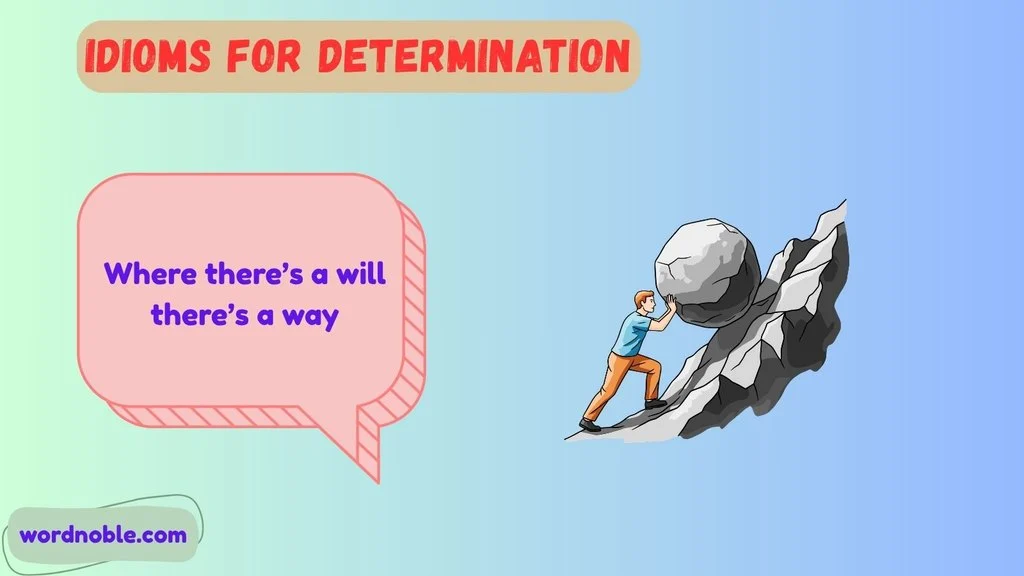
- Where there’s a will, there’s a way
- Go the extra mile
- Keep your eye on the prize
- Rise to the occasion
- Never say die
- Stick to your guns
- Stay the course
- Hang in there
- Give it your all
- Put your shoulder to the wheel
- Keep your nose to the grindstone
- Pull out all the stops
- Leave no stone unturned
- Get the ball rolling
Why Use Idioms for Determination?

Determination is one of the most common themes in literature, education, business, sports, and everyday life. Idioms allow speakers and writers to express that quality with greater impact.
They can help you:
- Make writing more vivid and memorable.
- Add personality to conversations.
- Improve storytelling.
- Strengthen speeches and motivational writing.
- Sound more fluent in English.
- Enrich creative and academic assignments with figurative language.
20 Popular Idioms for Determination (Meaning & Examples)
1. Stick to Your Guns
Meaning: Stay firm in your beliefs or decisions despite pressure.
Example:
Even when everyone disagreed, Sarah stuck to her guns and completed the project her way.
Best Used For: Confidence, leadership, decision-making.
2. Keep Your Eye on the Ball
Meaning: Stay focused on the goal.
Example:
If you want to succeed in college, keep your eye on the ball.
Best Used For: Focus, studying, business, sports.
3. Go the Extra Mile
Meaning: Put in more effort than expected.
Example:
She always goes the extra mile to satisfy her customers.
Best Used For: Work ethic, customer service, education.
4. Bite the Bullet
Meaning: Face a difficult situation with courage.
Example:
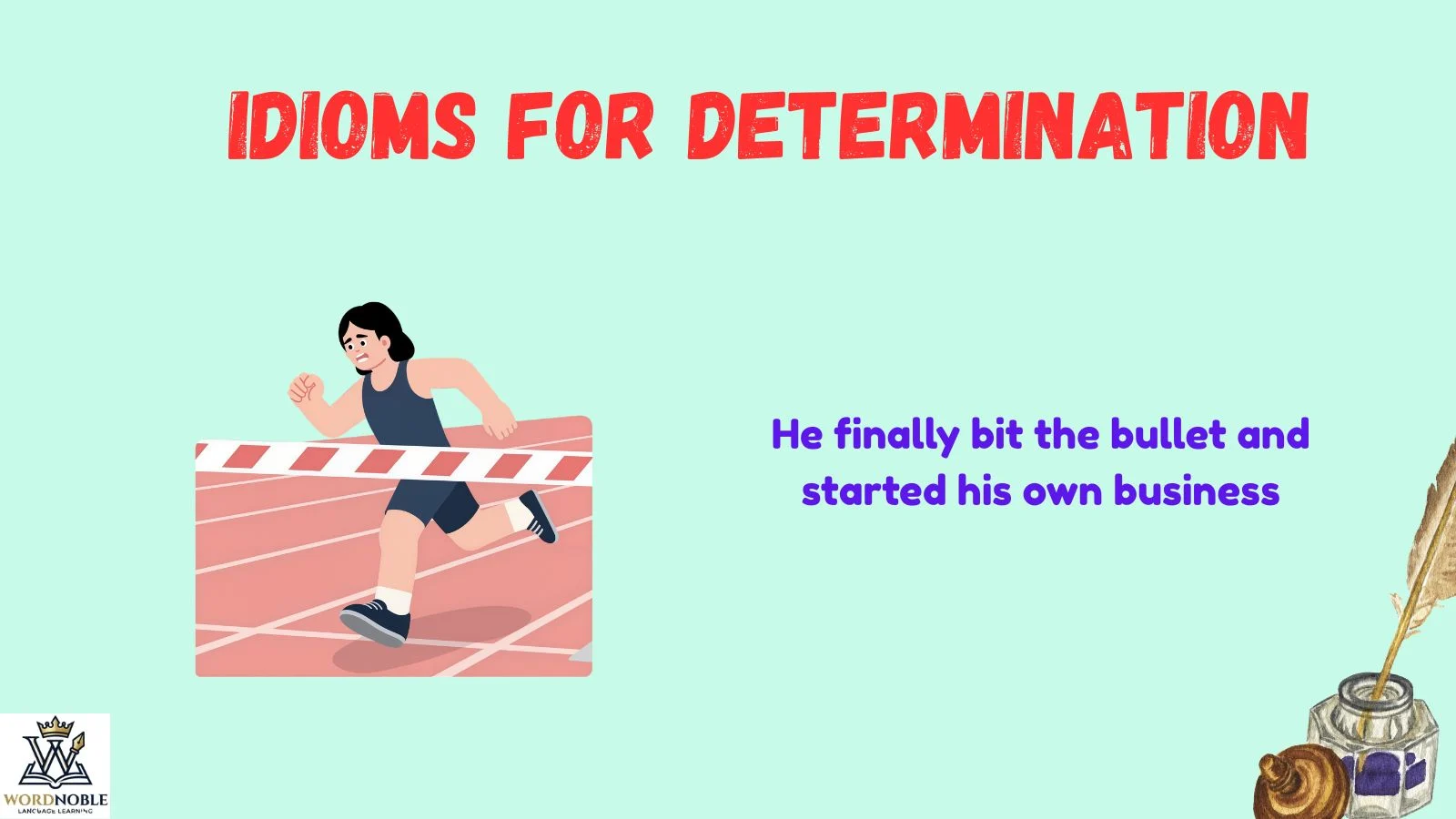
He finally bit the bullet and started his own business.
Best Used For: Tough decisions, bravery, perseverance.
5. Hang In There
Meaning: Continue despite difficulties.
Example:
The exams are almost over. Just hang in there.
Best Used For: Encouragement and motivation.
6. Keep the Ball Rolling
Meaning: Continue making progress.
Example:
Let’s keep the ball rolling until the project is complete.
Best Used For: Teamwork and productivity.
7. Hold Your Ground
Meaning: Refuse to give in.
Example:
The lawyer held her ground throughout the debate.
Best Used For: Confidence, negotiations, leadership.
8. Never Say Die
Meaning: Never give up.
Example:
His never-say-die attitude inspired the whole team.
Best Used For: Sports, motivation, challenges.
9. Weather the Storm
Meaning: Endure difficult times successfully.
Example:
The company weathered the storm and became stronger.
Best Used For: Business, life challenges, resilience.
10. Keep Fighting
Meaning: Continue trying despite obstacles.
Example:
Doctors encouraged the patient to keep fighting.
Best Used For: Motivation and emotional strength.
11. Burn the Midnight Oil
Meaning: Work late into the night.
Example:
She burned the midnight oil preparing for her final exams.
Best Used For: Studying and professional dedication.
12. Put Your Shoulder to the Wheel
Meaning: Work hard with determination.
Example:
Everyone put their shoulder to the wheel to finish the project.
Best Used For: Teamwork and effort.
13. Stay the Course
Meaning: Continue despite setbacks.
Example:
Although sales dropped, the company stayed the course.
Best Used For: Business and long-term goals.
14. Dig In Your Heels
Meaning: Refuse to change your position.
Example:
He dug in his heels and defended his proposal.
Best Used For: Strong opinions and persistence.
15. Rise to the Occasion
Meaning: Perform well when facing a challenge.
Example:
She rose to the occasion during the championship match.
Best Used For: Pressure situations.
16. Pull Out All the Stops
Meaning: Make every possible effort.
Example:
The organizers pulled out all the stops for the event.
Best Used For: Maximum effort and commitment.
17. Fight an Uphill Battle
Meaning: Face a very difficult challenge.
Example:
Starting a business without funding is often an uphill battle.
Best Used For: Challenges and perseverance.
18. Keep Your Chin Up
Meaning: Stay positive during difficult times.
Example:
Keep your chin up you’ll find another opportunity soon.
Best Used For: Encouragement and emotional resilience.
19. Press On
Meaning: Continue moving forward despite obstacles.
Example:
The hikers pressed on through heavy rain.
Best Used For: Persistence and endurance.
20. Cross the Finish Line
Meaning: Successfully complete a difficult task.
Example:
After months of hard work, she finally crossed the finish line by publishing her first novel.
Best Used For: Achieving goals and celebrating success.
Idioms For Determination And Strength
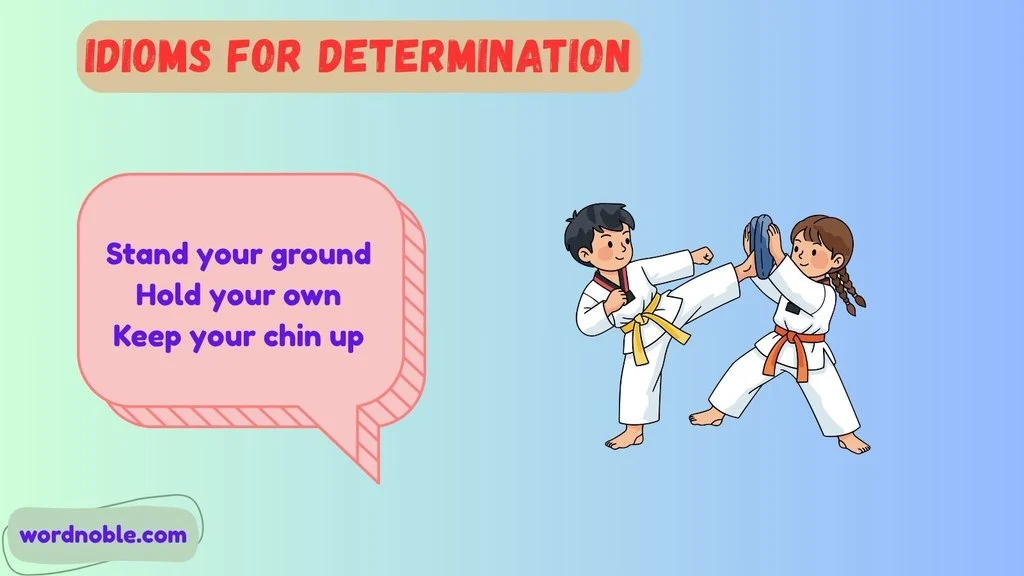
- Stand your ground
- Hold your own
- Keep your chin up
- Bite the bullet
- Weather the storm
- Keep the faith
- Dig your heels in
- Tough it out
- Hold the fort
- Take the bull by the horns
- Keep going
- Show your mettle
- Have a backbone
- Keep a stiff upper lip
Why These Idioms Matter in English
Determination is a universal human quality, and idioms provide memorable ways to express it. Instead of repeatedly using words like determined, persistent, or hardworking, these expressions create stronger imagery and make communication more engaging.
You’ll often encounter determination idioms in:
- Motivational speeches
- Business communication
- Sports commentary
- Literature and storytelling
- Classroom discussions
- Everyday conversations
Using these idioms naturally can make your English sound more fluent, expressive, and confident while helping readers and listeners connect emotionally with your message.
More Idioms for Determination
21. Keep Your Nose to the Grindstone
Meaning: Work consistently and diligently.
Example:
If you keep your nose to the grindstone, you’ll finish the project on time.
Best Used For: Hard work, studying, career growth.
22. Leave No Stone Unturned
Meaning: Make every possible effort.
Example:
The researchers left no stone unturned in their search for evidence.
Best Used For: Problem-solving, investigations, research.
23. Put Your Heart and Soul Into Something
Meaning: Give complete dedication and effort.
Example:
She put her heart and soul into writing her first novel.
Best Used For: Passion projects, creative work, personal goals.
24. Go for Broke
Meaning: Risk everything to achieve success.
Example:
The entrepreneur decided to go for broke and invest in the new venture.
Best Used For: Business, competition, major life decisions.
25. Give It Your All
Meaning: Put forth your maximum effort.
Example:
The athletes gave it their all during the championship.
Best Used For: Sports, exams, competitions.
26. Keep Moving Forward
Meaning: Continue progressing despite setbacks.
Example:
Even after several failures, he kept moving forward.
Best Used For: Personal development and resilience.
27. Stand Your Ground
Meaning: Defend your beliefs confidently.
Example:
She stood her ground during the difficult negotiation.
Best Used For: Leadership, debates, confidence.
28. Stay Strong
Meaning: Remain mentally and emotionally resilient.
Example:
Stay strong better opportunities are ahead.
Best Used For: Encouragement during difficult times.
29. Keep Pushing
Meaning: Continue making effort without giving up.
Example:
You’re almost there. Keep pushing!
Best Used For: Motivation and fitness.
30. Finish What You Started
Meaning: Complete your goal despite difficulties.
Example:
She was determined to finish what she started.
Best Used For: Long-term projects and self-discipline.
Theme Idioms
- A blessing in disguise
- Every cloud has a silver lining
- The tip of the iceberg
- A storm in a teacup
- The calm before the storm
- Break the ice
- Once in a blue moon
- Under the weather
- The grass is always greener
- A drop in the ocean
- See the light
- Chase rainbows
- Add fuel to the fire
- Make waves
Context Table
| Context | Meaning | Best Use Case | Example |
|---|---|---|---|
| School | Persistence in studying | Essays, exams | Burn the midnight oil |
| Workplace | Extra dedication | Professional communication | Go the extra mile |
| Sports | Refusing to quit | Coaching, motivation | Never say die |
| Business | Long-term commitment | Leadership | Stay the course |
| Personal Growth | Self-improvement | Inspiration | Keep moving forward |
| Debate | Standing by your beliefs | Discussions | Stick to your guns |
| Research | Thorough effort | Academic writing | Leave no stone unturned |
| Creative Work | Full dedication | Writing, art | Put your heart and soul into it |
How to Use Idioms for Determination Naturally
Using idioms effectively is about choosing the right expression for the situation rather than inserting them everywhere.
1. Match the Context
Use professional idioms in formal settings and conversational idioms in casual speech.
Formal:
“The team stayed the course despite market challenges.”
Casual:
“Hang in there you’ve got this.”
2. Don’t Overuse Idioms
One or two well-placed idioms create impact. Filling every paragraph with idioms can make writing sound forced.
3. Understand the Meaning
Never use an idiom simply because it sounds interesting. Make sure its figurative meaning matches your message.
4. Combine with Strong Writing
Idioms work best when supported by clear explanations and descriptive language.
Idioms For Being Angry
- See red
- Blow your top
- Blow a fuse
- Lose your temper
- Hit the roof
- Hit the ceiling
- Fly off the handle
- Go through the roof
- Have steam coming out of your ears
- Get bent out of shape
- Bite someone’s head off
- Have a short fuse
- Ruffle someone’s feathers
- Be up in arms
Idiom vs. Metaphor vs. Simile
| Feature | Idiom | Metaphor | Simile |
|---|---|---|---|
| Literal Meaning | No | No | No |
| Uses “like” or “as” | No | No | Yes |
| Fixed Expression | Yes | Usually No | Usually No |
| Example | Stick to your guns | He is a rock. | He is as strong as an ox. |
An idiom has a meaning that cannot be understood literally, while a metaphor directly compares two unlike things, and a simile uses words such as like or as to make a comparison.
Annoying Idioms
- Get on someone’s nerves
- Rub someone the wrong way
- Drive someone up the wall
- Be a pain in the neck
- Be a thorn in someone’s side
- Push someone’s buttons
- Bug someone
- Get under someone’s skin
- Drive someone crazy
- Wear someone down
- Make someone’s blood boil
- Ruffle someone’s feathers
- Be a nuisance
- Be a fly in the ointment
Common Mistakes
❌ Using Idioms Literally
Incorrect:
“He really had a ball in his eye.”
Correct:
“He kept his eye on the ball.”
❌ Mixing Different Idioms
Avoid combining multiple idioms into one sentence if they don’t fit together naturally.
❌ Overusing Figurative Language
Too many idioms can distract readers and reduce clarity.
❌ Choosing the Wrong Tone
Some idioms are informal and may not suit academic or professional writing.
Insect Idioms And Phrases
- Have a bee in your bonnet
- Busy as a bee
- The bee’s knees
- Put a bug in someone’s ear
- Catch the bug
- Have ants in your pants
- Ants in the pants
- Make a beeline
- A social butterfly
- Have butterflies in your stomach
- Open a can of worms
- The worm turns
- Snug as a bug in a rug
- Like a moth to a flame
Do & Don’t Guide
✅ Do
- Learn the figurative meaning.
- Use idioms naturally.
- Match the audience.
- Read examples before using new idioms.
- Practice them in conversation and writing.
❌ Don’t
- Translate idioms word for word.
- Overuse them.
- Mix unrelated idioms.
- Use them without understanding the context.
- Force idioms into every sentence.
Idioms Alphabetically
- A blessing in disguise
- Barking up the wrong tree
- Break the ice
- Cut corners
- Hit the nail on the head
- In hot water
- Jump on the bandwagon
- Keep an eye on
- Let the cat out of the bag
- Once in a blue moon
- Pull someone’s leg
- Spill the beans
- Take it with a grain of salt
- Under the weather
Natural Conversation Examples
Friend: I’m thinking of quitting after failing twice.
Reply: Don’t give up. Just hang in there success often comes after persistence.
Colleague: This project is taking forever.
Reply: Let’s stay the course. We’re making progress.
Coach: The game isn’t over yet.
Reply: Exactly. Let’s keep fighting until the final whistle.
Student: My exams are overwhelming.
Reply: Just burn the midnight oil a little longer you’ll be glad you did.
Parent: Learning a new skill takes time.
Reply: Yes, but if you keep your nose to the grindstone, you’ll improve every day.
100 Idioms With Animals
- Let the cat out of the bag
- Curiosity killed the cat
- There’s more than one way to skin a cat
- When the cat’s away, the mice will play
- Fight like cats and dogs
- Copycat
- Scaredy-cat
- Fat cat
- Cat got your tongue
- Bell the cat
- Raining cats and dogs
- Like a cat on a hot tin roof
- Top dog
- Underdog
- Every dog has its day
- Let sleeping dogs lie
- Barking up the wrong tree
- You can’t teach an old dog new tricks
- Work like a dog
- Sick as a dog
- Dog-eat-dog world
- Gone to the dogs
- Hair of the dog
- Puppy love
- Tail wagging the dog
- Hold your horses
- Straight from the horse’s mouth
- Dark horse
- Beat a dead horse
- Eat like a horse
- Trojan horse
- Don’t look a gift horse in the mouth
- Get off your high horse
- Horse around
- Stubborn as a mule
- One-trick pony
- Pony up
- Ride two horses at once
- Put the cart before the horse
- A little bird told me
- Kill two birds with one stone
- Birds of a feather flock together
- The early bird catches the worm
- A bird in the hand is worth two in the bush
- For the birds
- Free as a bird
- Watch like a hawk
- Eat like a bird
- Have a bird’s-eye view
- Chicken out
- Don’t count your chickens before they hatch
- Like a chicken with its head cut off
- Chicken-hearted
- No spring chicken
- Rule the roost
- Pecking order
- Count your chickens
- Goose egg
- Cook someone’s goose
- Wild goose chase
- What’s good for the goose is good for the gander
- Kill the goose that lays the golden eggs
- Golden goose
- Silly goose
- Ugly duckling
- Like water off a duck’s back
- Get your ducks in a row
- Sitting duck
- Lame duck
- Take to like a duck to water
- A fish out of water
- There are plenty of fish in the sea
- Something smells fishy
- Fish for compliments
- Cold fish
- Bigger fish to fry
- Drink like a fish
- A big fish in a small pond
- Other fish to fry
- Have bigger fish to fry
- Swim with the fishes
- Neither fish nor fowl
- A snake in the grass
- Snakes and ladders
- Grass snake
- Like a snake in the grass
- Open a can of worms
- Worm your way into
- The early bird catches the worm
- Bookworm
- Worm’s-eye view
- Make a mountain out of a molehill
- Blind as a bat
- Have bats in the belfry
- Like a moth to a flame
- Butterfly effect
- Social butterfly
- Have butterflies in your stomach
- Busy as a bee
- The bee’s knees
- Have a bee in your bonnet
- Bee in your ear
Related Terms
- Determination
- Perseverance
- Persistence
- Grit
- Dedication
- Commitment
- Resolve
- Tenacity
- Motivation
- Ambition
- Resilience
- Endurance
- Willpower
- Figurative language
- Idiomatic expressions
- English idioms
- Descriptive writing
- Creative writing
- Metaphors
- Similes
FAQs:
1. What are idioms for determination?
Idioms for determination are figurative expressions that describe persistence, resilience, strong will, and the refusal to give up. They help make communication more vivid and engaging than using literal words alone.
2. What is the most common idiom for determination?
One of the most common is “stick to your guns,” which means to remain firm in your beliefs or decisions despite pressure from others.
3. Which idioms encourage people not to give up?
Popular examples include hang in there, never say die, keep fighting, stay the course, and press on. These expressions all emphasize perseverance through challenges.
4. Are determination idioms used in everyday English?
Yes. Native speakers use them in conversations, workplaces, sports, schools, books, movies, and motivational speeches.
5. Can students use idioms in essays?
Yes, when used appropriately. A well-chosen idiom can make writing more engaging, but it should fit the tone and not replace clear explanations.
6. What’s the difference between an idiom and a proverb?
An idiom is a figurative expression with a non-literal meaning, while a proverb is a complete saying that offers advice or wisdom.
7. Are idioms suitable for formal writing?
Some are. Neutral expressions like stay the course or go the extra mile work well in business and professional contexts, while more informal idioms may be better suited to casual writing.
8. How can I learn idioms faster?
Read books, watch English videos, practice conversations, and write sentences using one new idiom each day. Learning idioms in context helps you remember them.
9. Why are idioms important in English?
Idioms add color, emotion, and cultural richness to language. They also help speakers sound more natural and fluent.
10. How do I know when to use an idiom?
Choose an idiom that matches the context, audience, and tone. If the figurative meaning clearly supports your message, it will enhance your communication.
Conclusion:
Idioms for determination are more than colorful expressions they capture the spirit of perseverance, resilience, and unwavering commitment in a way that literal language often cannot.
Whether you’re writing an essay, delivering a speech, improving your English, or simply encouraging someone, these idioms make your message stronger, more memorable, and more engaging.
By understanding their meanings, practicing them in context, and using them naturally, you’ll communicate with greater confidence and fluency while enriching both your spoken and written English.

I’m Sarah Collins, a passionate English language writer and content editor dedicated to making grammar simple, practical, and easy to understand. I enjoy creating clear, accurate, and engaging content that helps students, professionals, and everyday learners improve their English with confidence.
My work focuses on English grammar, vocabulary, spelling, punctuation, writing tips, word meanings, and common language mistakes. Every article is carefully researched, fact-checked, and written in a reader-friendly style to ensure accuracy and real value.
Whether you’re looking to strengthen your grammar skills, expand your vocabulary, or become a more confident writer, my goal is to provide practical guidance that makes learning English enjoyable and effective.
2 thoughts on “Idioms for Determination with Meanings and Examples”