Great teachers do far more than explain lessons—they inspire curiosity, shape character, and leave a lasting impact on their students.
But how do you describe such influence in a vivid and memorable way? That’s where similes for teachers come in.
By comparing teachers to familiar people, objects, or forces of nature using words like as or like, similes make your writing more expressive and engaging.
Whether you’re writing a school assignment, speech, poem, appreciation message, or creative story, the right simile can bring your words to life.
Similes for teachers are figurative comparisons that describe teachers using the words “like” or “as.” They help writers express a teacher’s knowledge, patience, guidance, or influence in a vivid and memorable way.
What Are Similes for Teachers?
A simile for a teacher is a figure of speech that compares a teacher to another person, object, or idea using the words “like” or “as.” These comparisons highlight qualities such as wisdom, patience, leadership, encouragement, kindness, or inspiration.
For example:
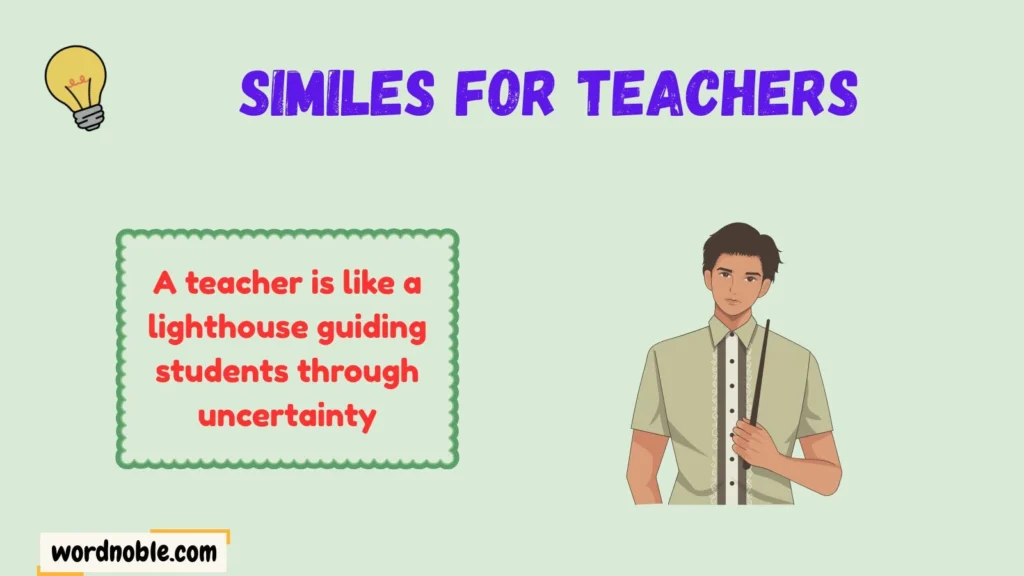
- A teacher is like a lighthouse, guiding students through uncertainty.
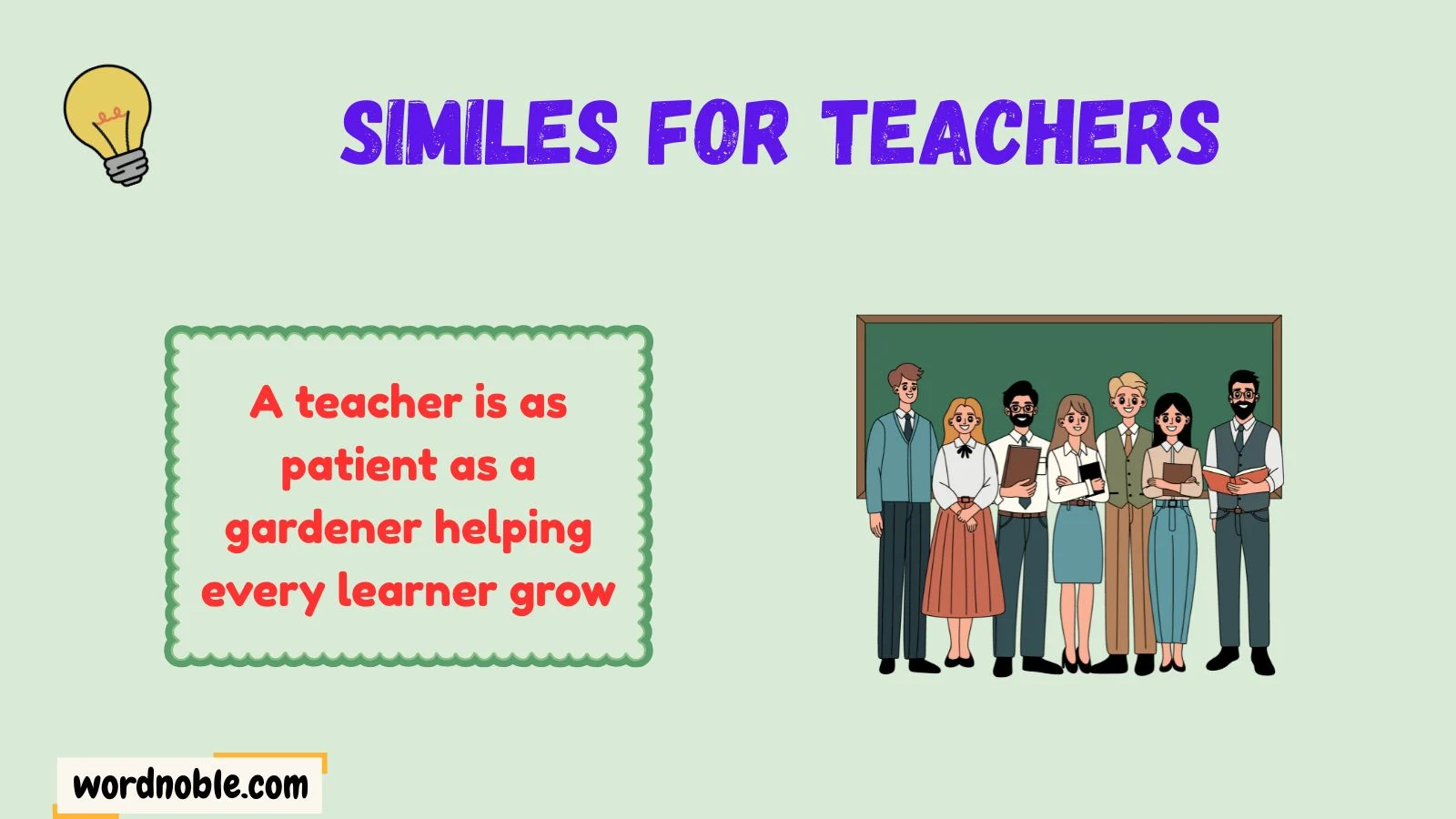
- A teacher is as patient as a gardener, helping every learner grow.
- A teacher is like a compass, pointing students toward success.
Unlike literal descriptions, similes create mental images that make writing more interesting and emotionally powerful.
Similes for teachers are descriptive comparisons used in figurative language to explain a teacher’s role, personality, or influence through familiar images. They strengthen creative writing by making ideas more vivid, emotional, and easier for readers to imagine while improving clarity and engagement.
Why Writers Use Similes for Teachers
Teachers play many roles beyond simply delivering lessons. They guide, encourage, motivate, correct mistakes, and inspire confidence. Similes help communicate these qualities in ways that plain descriptions cannot.
Writers use similes because they:
- Create stronger mental imagery
- Make essays and stories more engaging
- Add emotion to writing
- Improve descriptive language
- Help readers connect with ideas quickly
- Enhance poetry and speeches
- Develop creative writing skills
- Make school assignments more memorable
Similes are one of the simplest yet most effective figurative language techniques in English literature because they transform abstract qualities into clear visual comparisons.
How Similes for Teachers Work
A simile always compares two different things using like or as.
Structure
Teacher + like/as + comparison
Examples:
- The teacher was like a candle, spreading light everywhere.
- She was as calm as a quiet lake.
- Our teacher was like a bridge, connecting knowledge with experience.
The comparison isn’t meant to be taken literally. Instead, it emphasizes a shared characteristic such as guidance, wisdom, patience, or encouragement.
How Similes for Teachers Change Meaning in Different Writing Contexts
In Storytelling
Similes help readers imagine a teacher’s personality and actions more clearly.
Example:
A teacher was like a lighthouse standing strong during every storm.
In Poetry
Poets use similes to express appreciation, inspiration, hope, and admiration through beautiful imagery.
Example:
A teacher bloomed like spring after a long winter.
In Casual Conversation
People naturally use simple similes to compliment educators.
Example:
“My math teacher is like Google—she knows everything.”
In Humor
Funny comparisons make descriptions entertaining without being disrespectful.
Example:
“Our teacher was as organized as a robot.”
In Academic Writing
Students often use similes in descriptive essays and speeches to create vivid explanations while demonstrating figurative language skills.
Simile Taxonomy: Different Types of Similes for Teachers
🐾 Animal-Based Similes
Animals symbolize natural qualities that match many teaching characteristics.
| Simile | Meaning |
|---|---|
| As wise as an owl | Highly knowledgeable |
| Like a mother bird | Caring and protective |
| As patient as a tortoise | Calm and never rushed |
| Like a hardworking bee | Always busy helping students |
| As gentle as a dove | Kind and peaceful |
🌿 Nature-Based Similes
Nature offers powerful imagery for describing educators.
| Simile | Meaning |
| Like the sun | Brings light and hope |
| As steady as a mountain | Reliable and dependable |
| Like a river | Constantly sharing knowledge |
| As refreshing as rain | Inspiring new ideas |
| Like a tree | Provides shelter and growth |
📡 Technology-Based Similes
Modern comparisons make writing relatable.
| Simile | Meaning |
| Like a GPS | Guides students correctly |
| Like Google | Full of knowledge |
| Like Wi-Fi | Keeps everyone connected |
| Like a search engine | Finds every answer |
| Like a computer | Organized and efficient |
😂 Humorous Similes
These light-hearted comparisons work well in speeches and classroom activities.
| Simile | Meaning |
| Like a walking encyclopedia | Knows almost everything |
| As busy as a traffic controller | Manages many students |
| Like a magician | Makes difficult lessons simple |
| As energetic as popcorn | Full of excitement |
| Like a superhero | Solves classroom problems |
🎭 Emotional and Behavioral Similes
These focus on personality traits.
| Simile | Meaning |
| Like a best friend | Supportive |
| As encouraging as sunshine | Motivating |
| Like a coach | Builds confidence |
| As calm as morning dew | Peaceful under pressure |
| Like a mentor | Guides toward success |
15 Best Similes for Teachers with Meanings
1. A teacher is like a lighthouse.
Meaning: Guides students through challenges.
Category: Nature
Explanation: Just as ships rely on a lighthouse, students rely on teachers for direction.
2. A teacher is as patient as a gardener.
Meaning: Helps every student grow over time.
Category: Nature
Explanation: Learning requires care, attention, and patience.
3. A teacher is like a candle.
Meaning: Shares knowledge without expecting anything in return.
Category: Object
Explanation: A candle lights other candles without losing its own flame.
4. A teacher is as wise as an owl.
Meaning: Extremely knowledgeable.
Category: Animal
Explanation: Owls traditionally symbolize wisdom.
5. A teacher is like a bridge.
Meaning: Connects students with opportunities.
Category: Object
Explanation: Teachers help learners move from ignorance to understanding.
6. A teacher is like the sun.
Meaning: Brightens students’ futures.
Category: Nature
7. A teacher is as dependable as a mountain.
Meaning: Always reliable.
Category: Nature
8. A teacher is like a compass.
Meaning: Shows the right direction.
Category: Object
9. A teacher is as hardworking as a bee.
Meaning: Constantly helping and preparing.
Category: Animal
10. A teacher is like a key.
Meaning: Unlocks knowledge.
Category: Object
11. A teacher is as calm as still water.
Meaning: Stays composed during challenges.
Category: Nature
12. A teacher is like a coach.
Meaning: Encourages success through practice.
Category: Human Role
13. A teacher is like a GPS.
Meaning: Provides guidance step by step.
Category: Technology
14. A teacher is as inspiring as sunrise.
Meaning: Brings hope and motivation.
Category: Nature
15. A teacher is like a treasure map.
Meaning: Leads students toward valuable knowledge.
Category: Object
Context Table
| Context | Meaning | Use Case | Example |
| Essay | Guidance | School writing | A teacher is like a lighthouse. |
| Speech | Inspiration | Teacher appreciation | She is as bright as the sun. |
| Poetry | Beauty | Creative writing | Like spring after winter. |
| Storytelling | Character description | Fiction | He was as patient as a gardener. |
| Classroom | Humor | Fun activities | Like Google with glasses. |
How to Use Similes Naturally in Writing
Good similes should feel natural and match the situation. Choose comparisons that readers already understand and connect them to the teacher’s qualities.
Tips
- Compare one quality at a time.
- Keep the comparison simple.
- Match the tone of your writing.
- Use fresh imagery instead of clichés when possible.
- Explain the comparison if your audience is young.
Creative writers often observe real teachers before creating original similes. Notice how they encourage students, solve problems, and inspire confidence.
Simile vs. Metaphor
| Simile | Metaphor |
| Uses “like” or “as.” | Does not use “like” or “as.” |
| A teacher is like a lighthouse. | A teacher is a lighthouse. |
| Makes an explicit comparison. | States the comparison directly. |
Both are forms of figurative language, but similes make the comparison more obvious and are often easier for students to understand.
Common Mistakes When Using Similes for Teachers
Even though similes are simple to create, many writers make mistakes that reduce the quality of their writing. Understanding these common errors will help you write more naturally and effectively.
1. Overusing Similes
Adding a simile to every sentence can make your writing feel repetitive and distracting. Use them only where they add meaning or emotion.
Poor Example:
- The teacher was like the sun.
- She was like a river.
- She was like a tree.
- She was like a bird.
Better Approach:
Choose one strong simile that best fits the context instead of stacking several comparisons together.
2. Making Illogical Comparisons
A simile should compare two things that share a clear characteristic. Random comparisons confuse readers.
Weak Simile:
- A teacher is like a pizza.
Unless you explain the connection, this comparison feels meaningless.
Better Simile:
- A teacher is like a bridge because they connect students with new opportunities.
3. Confusing Similes with Metaphors
Many students accidentally mix these two figures of speech.
Simile
- A teacher is like a lighthouse.
Metaphor
- A teacher is a lighthouse.
Remember that similes always use like or as to make the comparison clear.
4. Using Clichés Too Often
Classic similes such as “as wise as an owl” are still useful, but relying only on common expressions can make your writing less original.
Try creating fresh comparisons based on modern life, nature, technology, or everyday experiences.
5. Ignoring the Writing Context
A funny simile may work in a classroom speech but feel inappropriate in a formal essay. Always match the comparison to your audience and purpose.
Do and Don’t Guide
✅ Do
- Use like or as correctly.
- Compare similar qualities.
- Keep comparisons easy to understand.
- Use vivid but natural imagery.
- Match the tone of your writing.
- Choose comparisons your readers can easily imagine.
- Use similes to support your message rather than replace it.
❌ Don’t
- Overuse similes in every paragraph.
- Create confusing or unrelated comparisons.
- Mix similes and metaphors incorrectly.
- Force a comparison that doesn’t fit the context.
- Repeat the same simile throughout your writing.
- Use complicated comparisons that require lengthy explanations.
Natural Chat Responses Using Similes for Teachers
These conversational examples show how similes can appear naturally in everyday speech.
Friend: What do you think about your science teacher?
Reply: She’s like a lighthouse—she always helps us find the right direction when we’re confused.
Friend: Your English teacher seems amazing.
Reply: Absolutely! He’s as patient as a gardener and helps every student improve step by step.
Friend: Why does everyone like your history teacher?
Reply: He’s like Google, but even more encouraging because he explains everything so clearly.
Friend: Your teacher never gets angry.
Reply: She’s as calm as a quiet lake, even when the whole class gets noisy.
Friend: Why did you thank your teacher today?
Reply: Because she’s like a key that unlocked my confidence.
Friend: What’s special about your math teacher?
Reply: He’s like a compass that always points us toward the correct solution.
Related Terms (SEO Topic Cluster)
Learning these related concepts will strengthen your understanding of similes and descriptive writing.
- Figurative language
- Metaphor vs. simile
- Descriptive writing
- Sensory language
- Visual imagery
- Auditory imagery
- Creative writing techniques
- Literary devices
- Personification
- Hyperbole
- Symbolism
- Analogy
- Imagery in English literature
- Writing with comparisons
- Descriptive vocabulary
These topics frequently appear alongside similes in English classes, literature lessons, and creative writing assignments.
FAQs:
1. What are similes for teachers?
Similes for teachers are comparisons that describe teachers using the words “like” or “as.” They highlight qualities such as wisdom, patience, guidance, kindness, and inspiration. Writers use them to make descriptions more vivid, memorable, and engaging in essays, poems, speeches, and stories.
2. What are some examples of similes for teachers?
Popular examples include:
- A teacher is like a lighthouse.
- A teacher is as patient as a gardener.
- A teacher is like a candle.
- A teacher is as wise as an owl.
- A teacher is like a compass.
Each comparison emphasizes a different positive quality.
3. Why are similes useful in writing?
Similes create clear mental images that help readers understand ideas more easily. They make descriptions more emotional, memorable, and engaging while improving creative writing, storytelling, and poetry.
4. Can students use similes in school assignments?
Yes. Teachers often encourage students to use similes because they demonstrate creativity, descriptive language, and an understanding of figurative language. They can improve essays, speeches, stories, and classroom presentations.
5. What is the difference between a simile and a metaphor?
A simile compares two things using “like” or “as.” A metaphor compares them directly without those words. For example, “A teacher is like a lighthouse” is a simile, while “A teacher is a lighthouse” is a metaphor.
6. What are some funny similes for teachers?
Here are a few lighthearted examples:
- A teacher is like Google with a smile.
- A teacher is as organized as a robot.
- A teacher is like a superhero without a cape.
- A teacher is as busy as an air traffic controller.
- A teacher is like a magician who makes difficult lessons disappear.
7. How do poets use similes for teachers?
Poets use similes to express gratitude, admiration, hope, and inspiration. Comparing a teacher to the sun, a tree, or a guiding star creates emotional imagery that helps readers appreciate the teacher’s influence and lasting impact.
8. Why are similes important in English literature?
Similes enrich literature by making descriptions more expressive and imaginative. They help readers visualize people, emotions, and experiences while adding beauty, depth, and creativity to stories, poems, and speeches.
9. How can I create my own similes for teachers?
Start by identifying one quality of the teacher, such as patience or wisdom. Then think of a person, object, animal, or part of nature that shares the same characteristic. Finally, connect them using “like” or “as.”
10. When should I avoid using similes?
Avoid similes in highly technical or formal writing where direct language is more appropriate. Also avoid forcing comparisons, overusing them, or choosing images that may confuse your audience instead of making your meaning clearer.
Conclusion:
Similes for teachers do much more than make sentences sound interesting—they bring appreciation, wisdom, and guidance to life through vivid comparisons.
Whether you’re writing an essay, poem, classroom speech, or creative story, thoughtful similes help readers picture the qualities that make great teachers unforgettable.
By choosing meaningful comparisons, using them naturally, and understanding the difference between similes and metaphors, you can make your writing more engaging and expressive.
Practice creating original similes inspired by nature, animals, everyday objects, and real experiences, and you’ll develop stronger descriptive writing skills that enrich both academic and creative work.

I am Naqash Ayub, proudly writing for WordNoble, where I focus on creating clear, informative, and SEO-friendly content. I enjoy turning detailed information into simple, trustworthy articles that help readers find the answers they need.
2 thoughts on “Similes for Teachers for Essays Poems and Creative Writing”