Equality is more than giving everyone the same chance it is the idea that every person deserves equal value, dignity, and opportunity.
But how can you make such a powerful concept easier to understand and more memorable? Metaphors for equality turn this abstract idea into vivid images, comparing fairness to a level playing field, a balanced scale, or a bridge that connects people across differences.
Whether you are writing an essay, speech, poem, story, or social message, the right metaphor can make equality feel clear, emotional, and powerful.
What Are Metaphors for Equality?
Metaphors for equality are figurative expressions that describe fairness or equal treatment by saying one thing is another thing symbolically. They help readers understand abstract ideas such as justice, inclusion, human dignity, equal opportunity, and social balance through concrete images.
For example:
Equality is a level playing field.
This does not mean equality literally involves a sports field. The metaphor suggests that everyone should have a fair opportunity without one person receiving an unfair advantage.
Metaphors for equality are common in figurative language, speeches, essays, poetry, literature, social commentary, and everyday communication.
A metaphor for equality is a symbolic comparison that represents fairness, equal rights, equal opportunity, or equal human value through a familiar image such as a balanced scale, level field, shared table, or bridge.
How Metaphors for Equality Work
Equality is an abstract concept. We cannot see “fairness” in the same way we see a tree, a road, or a balance scale. Metaphors solve this problem by giving equality a concrete image.
Consider:
Equality is a balanced scale.
The image of a balanced scale immediately suggests fairness and equal weight. The metaphor allows the reader to understand a complex social or moral idea through a familiar physical object.
A strong metaphor for equality usually does one or more of the following:
- Shows that people deserve equal treatment.
- Represents equal opportunities.
- Suggests balance or fairness.
- Shows inclusion and belonging.
- Challenges unfair advantages or barriers.
- Represents equal human value.
- Makes a social or political idea emotionally memorable.
Equality as Fairness
A metaphor may focus on justice:
Equality is a balanced scale.
The central idea is fairness and equal consideration.
Equality as Opportunity
Another metaphor may focus on access:
Equality is an open door for everyone.
The image suggests that everyone should have the same chance to enter, participate, or succeed.
Equality as Shared Human Worth
Some metaphors emphasize the value of every person:
Humanity is a garden where every flower matters.
The flowers may be different, but each one has value.
Why Writers Use Metaphors for Equality
Writers use these metaphors because abstract arguments can sometimes feel distant or overly academic. A vivid comparison makes the idea easier to understand and remember.
A metaphor can turn:
Everyone deserves equal opportunity.
into:
Everyone deserves a place on the same starting line.
The second version creates a visual image. Readers can imagine runners standing together before a race. The metaphor communicates fairness more powerfully than a plain statement.
Metaphors for equality are especially useful in:
- Essays
- Speeches
- Poetry
- Novels
- Social commentary
- School assignments
- Inspirational writing
- Campaigns and public communication
They also connect with other creative writing techniques, including symbolism, imagery, personification, analogy, and contrast.
Short Metaphors For Equality
- Equality is a level playing field where everyone gets a fair chance.
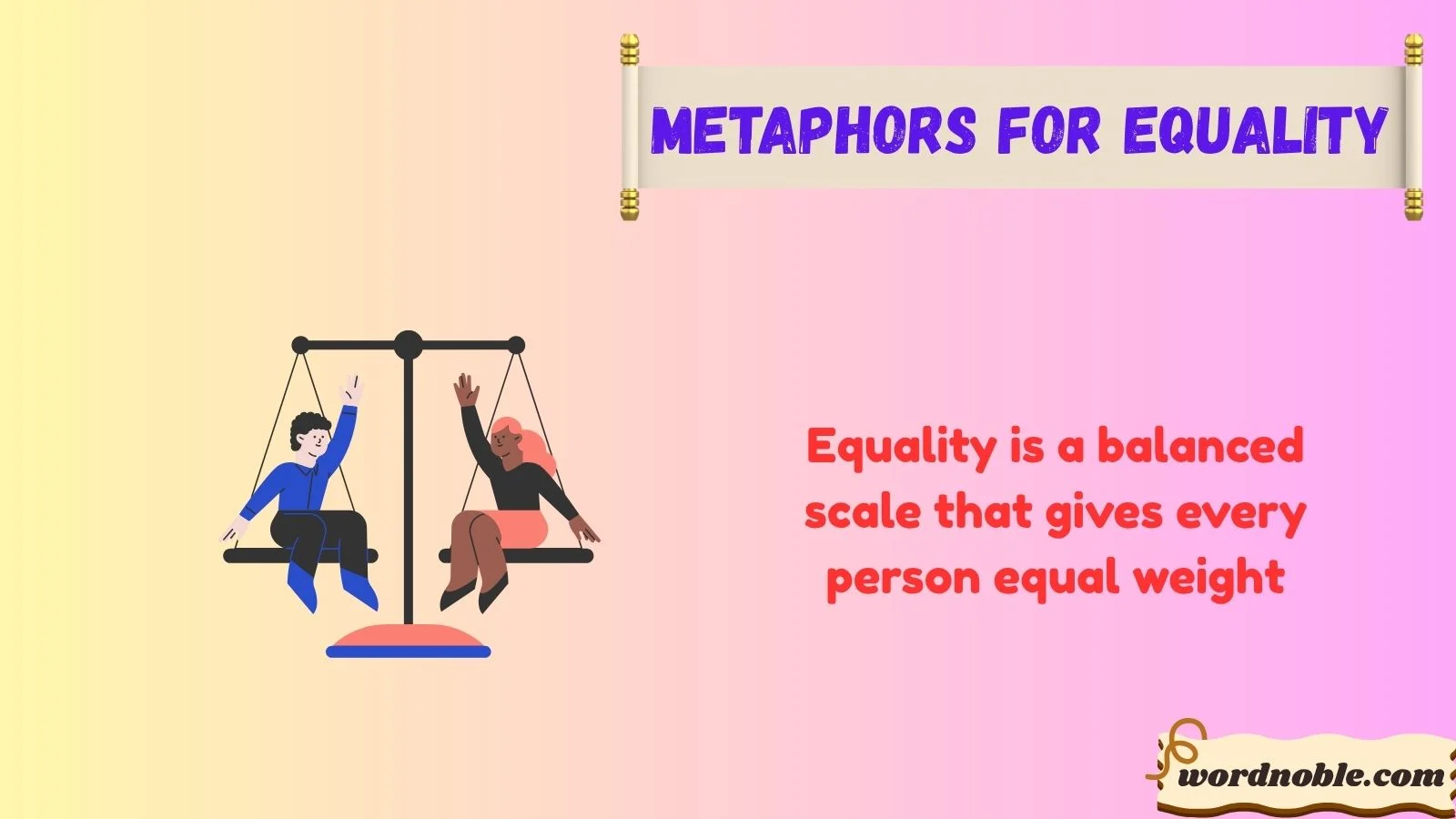
- Equality is a balanced scale that gives every person equal weight.
- Equality is a bridge connecting people across differences.
- Equality is a shared table where every seat matters.
- Equality is a straight road open to everyone.
- Equality is a common umbrella protecting everyone from the same storm.
- Equality is a doorway wide enough for everyone to enter.
- Equality is a team where every player has a place.
- Equality is a mirror that reflects every person with equal worth.
- Equality is a garden where every flower is valued.
- Equality is a ladder with room for everyone to climb.
- Equality is a race where everyone starts from the same line.
- Equality is a circle with no one standing outside.
- Equality is a key that opens the same opportunities for everyone.
25 Metaphors for Equality With Meanings
1. Equality Is a Level Playing Field
Meaning: Everyone receives a fair chance without unfair advantages or disadvantages.
This is one of the clearest metaphors for equality because a level field suggests that no one begins the competition on higher ground.
Category: Object-based / sports metaphor
2. Equality Is a Balanced Scale
Meaning: Everyone should be treated fairly and given equal consideration.
The scale represents justice and balance. If one side is unfairly weighed down, equality has been lost.
Category: Object-based metaphor
3. Equality Is an Open Door
Meaning: Everyone should have equal access to opportunities.
The open door symbolizes inclusion and access. It suggests that no one should be unfairly prevented from entering.
Category: Object-based metaphor
4. Equality Is a Shared Table
Meaning: Everyone deserves a place, a voice, and a chance to participate.
A shared table creates an image of people gathering together rather than being excluded.
Category: Social metaphor
5. Equality Is a Bridge
Meaning: Equality connects people by overcoming barriers and creating shared opportunities.
A bridge allows people to cross from one side to another. Symbolically, it can connect communities separated by inequality.
Category: Nature/object-based metaphor
6. Equality Is the Same Starting Line
Meaning: Everyone should begin with a fair opportunity.
The metaphor is particularly effective when discussing education, careers, competition, or social opportunity.
Category: Sports metaphor
7. Equality Is a Common Ground
Meaning: People can meet and interact on equal terms.
The phrase suggests a shared place where differences do not create an unfair hierarchy.
Category: Nature-based metaphor
8. Equality Is a Quilt Made of Different Pieces
Meaning: Different people can remain unique while belonging equally to the same community.
Each piece may look different, but every piece contributes to the whole.
Category: Object-based metaphor
9. Equality Is a Garden Where Every Flower Can Bloom
Meaning: Everyone should have the opportunity to grow and flourish.
The flowers may differ in color, shape, and size, but each has the right to develop.
Category: Nature-based metaphor
10. Equality Is a Circle With No Higher Seat
Meaning: No person is inherently more valuable than another.
A circle has no obvious top or bottom, making it a powerful image of equal status.
Category: Geometric metaphor
11. Equality Is a Shared Sky
Meaning: Everyone exists under the same basic human rights and dignity.
The sky is broad and open, creating an image of universal belonging.
Category: Nature-based metaphor
12. Equality Is a Key That Opens Every Door
Meaning: Equal rights and opportunity should give everyone access to possibilities.
This metaphor works especially well in discussions about education, employment, and social progress.
Category: Object-based metaphor
13. Equality Is a Choir Where Every Voice Matters
Meaning: Every individual contributes value, even though people may have different voices and experiences.
The metaphor emphasizes inclusion without requiring everyone to be identical.
Category: Artistic metaphor
14. Equality Is a Road Wide Enough for Everyone
Meaning: Society should create space for all people to move forward.
The road represents opportunity, progress, and shared access.
Category: Journey metaphor
15. Equality Is a Mirror That Reflects Every Face
Meaning: Every person deserves to be recognized as equally valuable.
The mirror symbolizes visibility and equal recognition.
Category: Object-based metaphor
16. Equality Is a Puzzle With Every Piece Needed
Meaning: Every person has value and contributes to the complete community.
Removing one piece leaves the picture incomplete.
Category: Object-based metaphor
17. Equality Is a River With Many Streams Joining One Course
Meaning: People may come from different backgrounds but can share equal belonging and direction.
This metaphor celebrates diversity while emphasizing unity.
Category: Nature-based metaphor
18. Equality Is a Ladder With Every Rung Within Reach
Meaning: Everyone should have a genuine opportunity to progress.
The metaphor is useful when discussing social mobility and access to success.
Category: Object-based metaphor
19. Equality Is a Bridge Without a Toll
Meaning: Everyone should be able to access opportunity without unfair barriers.
The “toll” represents obstacles that prevent certain people from participating equally.
Category: Object-based metaphor
20. Equality Is a Game Where No One Gets Extra Points
Meaning: Fairness requires removing unjust advantages.
This is a simple and slightly humorous metaphor suitable for casual speech or educational writing.
Category: Humorous / sports metaphor
21. Equality Is a Puzzle Where No Piece Is More Human Than Another
Meaning: People may have different roles or characteristics, but all possess equal human worth.
The metaphor separates difference from superiority.
Category: Object-based metaphor
22. Equality Is a Sunrise That Reaches Every Window
Meaning: Opportunity and dignity should not belong only to a privileged few.
The sunrise represents something shared and broadly accessible.
Category: Nature-based metaphor
23. Equality Is a Blank Page Given to Every Writer
Meaning: Everyone should receive the opportunity to create, participate, and shape their future.
This metaphor works particularly well in discussions of education and personal opportunity.
Category: Writing-based metaphor
24. Equality Is a Team Where Every Player Counts
Meaning: Every individual has importance and deserves recognition.
The metaphor suggests that a successful group depends on the contribution of all its members.
Category: Sports metaphor
25. Equality Is a Scale That Refuses to Lean
Meaning: True fairness does not deliberately favor one group over another.
This metaphor presents equality as active balance rather than passive sameness.
Category: Object-based metaphor
Metaphors For Equality Pdf
- Equality is a book where every person deserves a page.
- Equality is a map that gives everyone a path forward.
- Equality is a bridge built from fairness and respect.
- Equality is a balanced scale representing equal treatment.
- Equality is a classroom where every voice can be heard.
- Equality is a window that lets everyone see the same opportunities.
- Equality is a garden where every seed receives a chance to grow.
- Equality is a road with equal access for every traveler.
- Equality is a team jersey that gives everyone a place.
- Equality is a table where every person has an equal seat.
- Equality is a sunrise shining on everyone without preference.
- Equality is a doorway that welcomes people from every background.
- Equality is a common roof sheltering people under the same principles.
- Equality is a bridge that turns differences into connection.
Metaphor Taxonomy: Different Ways to Represent Equality
🐾 Animal-Based Metaphors
Animal-based imagery can represent equality through cooperation, shared movement, or collective strength.
Example:
Equality is a flock flying beneath the same sky.
Meaning: Every individual belongs to the same larger community and shares the same space.
Another example:
A fair society is a pack where every voice matters.
This can suggest that community strength depends on participation rather than one individual dominating everyone else.
Animal metaphors should be used thoughtfully because different animals carry different cultural meanings. A metaphor involving bees, wolves, birds, or ants may suggest cooperation, hierarchy, independence, or collective action.
📡 Technology-Based Metaphors
Technology-based metaphors represent equality through connection, access, and shared systems.
Example:
Equality is a network where every voice has a connection.
Meaning: Everyone should have access to communication and participation.
Another example:
Equality is a system with no locked users.
This metaphor represents inclusion and equal access.
Technology metaphors work well in modern essays, articles, speeches, and discussions about digital access or social participation.
🌿 Nature-Based Metaphors
Nature is one of the richest sources of equality imagery.
Example:
Equality is a garden where every flower has room to bloom.
Meaning: People can be different while still receiving the opportunity to grow.
Another example:
Equality is rain falling on every field.
Meaning: Opportunity or support should not be reserved for only a few.
Nature-based metaphors are especially effective in poetry because they create strong visual imagery and emotional associations.
😂 Humorous and Exaggerated Metaphors
Humor can make equality easier to understand in casual conversation.
Example:
Equality is a pizza where nobody gets to claim the whole box.
Meaning: Everyone should receive a fair share.
Another example:
Equality is a race where nobody secretly starts ten miles ahead.
Meaning: Fairness requires removing unfair advantages.
These metaphors are less formal but can be memorable and useful in conversations, classroom explanations, or social media writing.
🎭 Emotional and Behavioral Metaphors
These metaphors focus on how equality feels and how people behave toward one another.
Example:
Equality is a room where nobody has to whisper to be heard.
Meaning: Everyone should have an equal opportunity to express themselves.
Another example:
Equality is a conversation where every voice gets a turn.
Meaning: Fairness includes listening as well as speaking.
These metaphors connect equality with attention, awareness, listening behavior, empathy, and participation.
Metaphors For Equality And Equity
- Equality is giving everyone the same key, while equity is giving each person the key they need.
- Equality is a level field, while equity is making sure everyone can reach it.
- Equality is the same ladder for everyone, while equity provides support when someone needs a boost.
- Equality is one size for all, while equity is the right fit for each person.
- Equality is sharing the same road, while equity removes obstacles along the way.
- Equality is giving every student the same book, while equity provides extra help where needed.
- Equality is the same starting line, while equity helps address unequal starting conditions.
- Equality is an identical pair of shoes, while equity provides shoes that actually fit.
- Equality is opening the same door, while equity makes sure everyone can reach the doorway.
- Equality is the same portion, while equity considers different needs.
- Equality is giving everyone a seat, while equity ensures everyone can comfortably reach one.
- Equality is planting seeds equally, while equity gives each plant the care it needs.
- Equality is providing the same tools, while equity provides appropriate tools for different challenges.
- Equality is fairness through sameness, while equity is fairness through balance.
15 Quick Examples of Metaphors for Equality
| # | Metaphor Sentence | Meaning | Category |
|---|---|---|---|
| 1 | Equality is a level playing field. | Everyone has a fair chance. | Sports |
| 2 | Equality is a balanced scale. | Everyone receives fair treatment. | Object |
| 3 | Equality is an open door. | Everyone has access to opportunity. | Object |
| 4 | Equality is a shared table. | Everyone belongs and participates. | Social |
| 5 | Equality is a bridge. | Barriers are overcome. | Object |
| 6 | Equality is the same starting line. | Everyone begins fairly. | Sports |
| 7 | Equality is a garden where every flower blooms. | Everyone deserves the chance to grow. | Nature |
| 8 | Equality is a choir where every voice matters. | Every person has value. | Artistic |
| 9 | Equality is a road wide enough for everyone. | Opportunity is shared. | Journey |
| 10 | Equality is a puzzle with every piece needed. | Everyone contributes value. | Object |
| 11 | Equality is a shared sky. | Everyone belongs equally. | Nature |
| 12 | Equality is a mirror reflecting every face. | Everyone deserves recognition. | Object |
| 13 | Equality is a team where every player counts. | Every person matters. | Sports |
| 14 | Equality is rain falling on every field. | Support should be widely available. | Nature |
| 15 | Equality is a conversation where every voice gets a turn. | Everyone deserves to be heard. | Behavioral |
Funny Metaphors For Equality
- Equality is a pizza where nobody gets to steal the biggest slice.
- Equality is a group selfie where everyone gets to stand in the picture.
- Equality is a pizza party where even the crust gets respect.
- Equality is musical chairs when everyone somehow gets a seat.
- Equality is a classroom where the teacher cannot play favorites.
- Equality is a cookie jar with a strict no-double-dipping policy.
- Equality is a tug-of-war where everyone gets the same rope.
- Equality is a birthday cake cut so nobody starts a dessert rebellion.
- Equality is a buffet where everyone gets a fair turn at the good stuff.
- Equality is a soccer team where nobody hogs the ball.
- Equality is a group project where everyone actually does their share.
- Equality is a queue where cutting in line is officially banned.
- Equality is a family remote where everyone gets a turn to choose the channel.
- Equality is a game where nobody secretly changes the rules halfway through.
Metaphors for Equality in Different Contexts
| Context | Meaning | Use Case | Example |
| Storytelling | Characters receive equal dignity or opportunity | Novels and narratives | Equality is a bridge connecting divided communities. |
| Poetry | Equality becomes an emotional or visual symbol | Poems and spoken word | We stand beneath one shared sky. |
| Casual Speech | A complex idea becomes easy to understand | Conversations | Fairness means everyone starts on the same line. |
| Humor | Inequality is explained through exaggeration | Jokes and informal writing | Equality is a pizza nobody gets to eat alone. |
| Academic Writing | Social ideas become clearer and more memorable | Essays and analysis | Equality functions as a level playing field for opportunity. |
| Speeches | Abstract values become emotionally powerful | Public speaking | We must build a bridge wide enough for everyone. |
What Are 10 Examples Of Metaphors?
- Equality is a level playing field.
- Time is a thief that quietly takes moments away.
- Knowledge is a key that opens new doors.
- Life is a journey filled with different paths.
- Hope is a light shining through darkness.
- Her smile is sunshine brightening the room.
- The classroom was a zoo during lunchtime.
- His words were arrows that deeply hurt her.
- The world is a stage where people play different roles.
- Ideas are seeds that can grow into powerful results.
How to Use Metaphors for Equality in Your Writing
1. Begin With the Exact Idea
First decide what kind of equality you mean.
Are you discussing:
- Equal rights?
- Equal opportunity?
- Equal treatment?
- Equal access?
- Equal human value?
- Social inclusion?
- Fairness?
The best metaphor matches the specific meaning.
For example, “an open door” is better for access, while “a balanced scale” is better for justice.
2. Choose a Familiar Image
Readers understand metaphors more quickly when the comparison is recognizable.
Strong images include:
- A scale
- A door
- A bridge
- A road
- A garden
- A team
- A table
- A starting line
3. Make the Comparison Specific
Weak:
Equality is something good.
Stronger:
Equality is a shared table where everyone has a seat.
The second metaphor gives the reader a clear image and a clear meaning.
4. Use Contrast
A powerful metaphor can show what happens when equality is absent.
For example:
Equality is a level playing field; discrimination tilts the ground beneath certain players.
The contrast makes the concept easier to understand.
5. Connect the Metaphor to the Main Point
Do not insert a metaphor simply because it sounds poetic. Explain or support the idea it represents.
In an essay, you might write:
Education should be a level playing field, giving every student a genuine opportunity to learn and succeed.
The metaphor directly supports the argument.
What Can I Say Instead Of Equality?
- Equal treatment
- Fairness
- Equal opportunity
- Impartiality
- Justice
- Balance
- Evenness
- Equal rights
- Fair treatment
- Equal access
- Parity
- Non-discrimination
- Equal standing
- Fair opportunity
Metaphor vs. Simile: What Is the Difference?
A metaphor directly says that one thing is another thing symbolically.
Equality is a bridge.
A simile compares two things using like or as.
Equality is like a bridge between divided communities.
Both are forms of figurative language, but metaphors are generally more direct and compact.
| Metaphor | Simile |
| Equality is a bridge. | Equality is like a bridge. |
| Equality is a balanced scale. | Equality is like a balanced scale. |
| Everyone deserves the same starting line. | Everyone should be treated like runners on the same starting line. |
Neither form is automatically better. Choose the one that fits your tone and purpose.
What Is A Good Metaphor For Leadership?
- Leadership is a compass that guides people toward a shared destination.
- Leadership is a lighthouse helping others navigate difficult waters.
- Leadership is a bridge connecting people with a common purpose.
- Leadership is a captain steering a ship through uncertain seas.
- Leadership is a torch that lights the path for others.
- Leadership is a gardener who helps people grow.
- Leadership is an anchor that keeps a team steady during challenges.
- Leadership is a conductor bringing different instruments into harmony.
- Leadership is a map that helps a team understand where it is going.
- Leadership is a rudder guiding a ship toward its destination.
- Leadership is a coach who brings out the best in every player.
- Leadership is a window that helps people see new possibilities.
- Leadership is a foundation supporting a strong and united team.
- Leadership is a wind that gives people momentum to move forward.
Common Mistakes When Writing Metaphors for Equality
1. Overusing Metaphors
Too many metaphors can make writing confusing.
Weak:
Equality is a bridge, a river, a door, a scale, a garden, and a race all in one paragraph.
Choose one or two strong images instead.
2. Using an Illogical Comparison
A metaphor should have a meaningful connection to equality.
For example:
Equality is a thunderstorm.
This may be creative, but the reader may not understand how the storm represents fairness unless the context explains it.
3. Confusing Metaphors With Similes
Remember:
- Metaphor: Equality is a bridge.
- Simile: Equality is like a bridge.
4. Choosing a Metaphor That Suggests Sameness
Equality does not always mean that everyone is identical.
A garden metaphor can communicate this well:
Equality is a garden where different flowers receive room to grow.
The flowers remain different, but they all have value and opportunity.
5. Explaining the Metaphor Too Much
Sometimes the image is powerful enough on its own. Avoid explaining every detail until the metaphor loses its natural impact.
Usage Guide: Do and Don’t
👍 Do
- Choose a metaphor that matches your exact meaning.
- Use familiar images.
- Connect the metaphor to your main argument.
- Use nature, objects, journeys, sports, and social settings creatively.
- Consider your audience and tone.
- Use metaphors to make abstract ideas concrete.
❌ Don’t
- Mix too many unrelated metaphors.
- Use a comparison that has no clear connection to equality.
- Repeat the same metaphor unnecessarily.
- Assume equality means everyone must be identical.
- Confuse metaphors with similes.
- Sacrifice clarity just to sound poetic.
What Are 20 Metaphors?
- Life is a journey.
- Time is a thief.
- Knowledge is power.
- Hope is a light.
- Love is a flame.
- Anger is a storm.
- The world is a stage.
- Ideas are seeds.
- Friendship is a shelter.
- Success is a mountain.
- Fear is a shadow.
- Her voice is music.
- His heart is stone.
- The classroom is a zoo.
- Words are weapons.
- Opportunity is a door.
- Memory is a treasure chest.
- Leadership is a compass.
- Equality is a level playing field.
- Dreams are seeds waiting to grow.
Natural Chat Responses Using Metaphors for Equality
Friend: What does equality really mean?
Reply: Equality is like a level playing field everyone should get a fair chance to play.
Friend: Why is inclusion important?
Reply: Because equality is a shared table, and nobody should be left standing outside.
Friend: How would you explain equal opportunity?
Reply: I’d say opportunity should be an open door, not a gate that only some people can pass through.
Friend: Are people supposed to be exactly the same?
Reply: Not at all. Equality is more like a garden different flowers can still have equal value.
Friend: What does fairness look like?
Reply: Like a balanced scale where nobody is unfairly pushed down.
Related Figurative Language Terms
Understanding metaphors for equality also connects to several broader English literature concepts.
Figurative Language
Language that communicates meaning beyond literal definitions. Metaphors, similes, symbolism, personification, and hyperbole are all examples.
Auditory Imagery
Language that creates a sense of sound. For example, a writer might describe equality as a choir where every voice can be heard. This uses sound-related imagery to represent inclusion.
Sensory Writing
Writing that appeals to the senses sight, sound, touch, taste, and smell. Equality metaphors often use visual imagery, but sensory language can make them more memorable.
Descriptive Writing
Writing that uses precise details and imagery to help readers visualize an idea.
Metaphor vs. Simile
Both create comparisons, but metaphors make direct symbolic comparisons while similes use words such as like or as.
FAQs:
1. What are metaphors for equality?
Metaphors for equality are symbolic comparisons that represent fairness, equal opportunity, equal rights, or equal human value through familiar images. Common examples include “Equality is a level playing field,” “Equality is a balanced scale,” and “Equality is a shared table.” These comparisons make the abstract idea of equality easier to visualize, understand, and remember.
2. What is the best metaphor for equality?
One of the clearest metaphors for equality is “Equality is a level playing field.” It suggests that everyone should have a fair opportunity without unfair advantages or disadvantages. However, the best metaphor depends on your meaning. A balanced scale suits justice, an open door represents access, and a shared table represents inclusion and belonging.
3. What are some examples of metaphors for equality?
Examples include “Equality is a balanced scale,” “Equality is an open door,” “Equality is a shared table,” “Equality is a bridge,” and “Equality is a garden where every flower can bloom.” Each metaphor emphasizes a slightly different idea, including fairness, access, connection, belonging, opportunity, and personal growth.
4. What are some funny metaphors for equality?
Funny metaphors can make equality easier to explain in casual conversation. For example, “Equality is a pizza where nobody gets to claim the whole box” humorously represents fair sharing. Another example is “Equality is a race where nobody secretly starts ten miles ahead.” These comparisons are informal but can communicate fairness clearly.
5. What are poetic metaphors for equality?
Poetic metaphors for equality often use nature, light, music, and journeys. Examples include “Equality is a shared sky,” “Equality is a garden where every flower blooms,” and “Equality is a choir where every voice matters.” These images are effective in poetry because they create emotional associations while expressing abstract ideas through vivid imagery.
6. What is the difference between a metaphor and a simile about equality?
A metaphor makes a direct symbolic comparison, while a simile uses like or as. For example, “Equality is a bridge” is a metaphor. “Equality is like a bridge” is a simile. Both express comparison, but metaphors usually sound more direct and compact, while similes make the comparison more explicit.
7. How can I use metaphors for equality in writing?
Use a metaphor after deciding exactly what you want to express. If your focus is fairness, use a balanced scale or level playing field. If your focus is opportunity, use an open door or shared starting line. Choose one clear image, connect it to your main idea, and avoid filling every sentence with figurative language.
8. Why are metaphors for equality important in English literature?
Metaphors for equality are important because they turn abstract social and moral ideas into memorable images. Writers can explore justice, discrimination, inclusion, dignity, and opportunity through symbolic language. In English literature, metaphors often create deeper meaning, emotional impact, symbolism, and imagery that allows readers to think about complex issues in more personal and memorable ways.
9. How can students use metaphors for equality?
Students can use them in essays, speeches, creative writing, poetry, presentations, and classroom assignments. A student might write, “Equality is a level playing field where every learner deserves a fair chance.” The key is to choose a metaphor that clearly supports the topic rather than adding a comparison that sounds creative but has no meaningful connection.
10. Can equality be represented by different metaphors?
Yes. Equality can be represented by many different metaphors because equality includes several related ideas. A scale can represent fairness, a bridge can represent connection, a door can represent access, and a garden can represent equal opportunity to grow. The most effective metaphor depends on the specific aspect of equality that the writer wants to emphasize.
Conclusion:
Metaphors for equality make an abstract idea easier to see, feel, and understand. A level playing field represents fair opportunity, a balanced scale suggests justice, an open door symbolizes access, and a shared table communicates inclusion.
The strongest metaphors do more than sound creative: they clarify a specific idea and help readers remember it. When writing about equality, choose an image that matches your message, use it naturally, and avoid confusing equality with sameness.
With thoughtful figurative language, writers can transform complex ideas about fairness, dignity, opportunity, and human worth into clear and powerful imagery.
I’m Sarah Collins, a passionate English language writer and content editor dedicated to making grammar simple, practical, and easy to understand. I enjoy creating clear, accurate, and engaging content that helps students, professionals, and everyday learners improve their English with confidence.
My work focuses on English grammar, vocabulary, spelling, punctuation, writing tips, word meanings, and common language mistakes. Every article is carefully researched, fact-checked, and written in a reader-friendly style to ensure accuracy and real value.
Whether you’re looking to strengthen your grammar skills, expand your vocabulary, or become a more confident writer, my goal is to provide practical guidance that makes learning English enjoyable and effective.
2 thoughts on “Metaphors for Equality: Powerful Examples and Meanings”