

Growth rarely feels like a straight line it’s messier, slower, and stranger than we admit. That’s exactly why similes for growth work so well: they capture what plain description can’t, turning something abstract into images we instantly recognize. A seed cracking open in the dark. A muscle tearing so it can rebuild stronger. Growth isn’t tidy, and the best comparisons embrace that truth instead of glossing over it.
Whether you’re writing a personal essay, a motivational speech, or just searching for the right words to describe your own journey, similes give you a shortcut to meaning.
They help readers feel the struggle and the payoff at once, without you having to explain every step. Related phrases like growth metaphors and expressions about personal development often show up alongside these comparisons, and understanding the difference can sharpen your writing even further.
In this list, you’ll find similes that capture everything from slow, quiet progress to sudden breakthroughs. Let’s start with the ones that describe growth as a gradual, natural process.
Similes for growth are comparisons that describe development, progress, or change by using words such as “like” or “as.” They make growth easier to visualize and understand.
What Do Similes for Growth Mean?
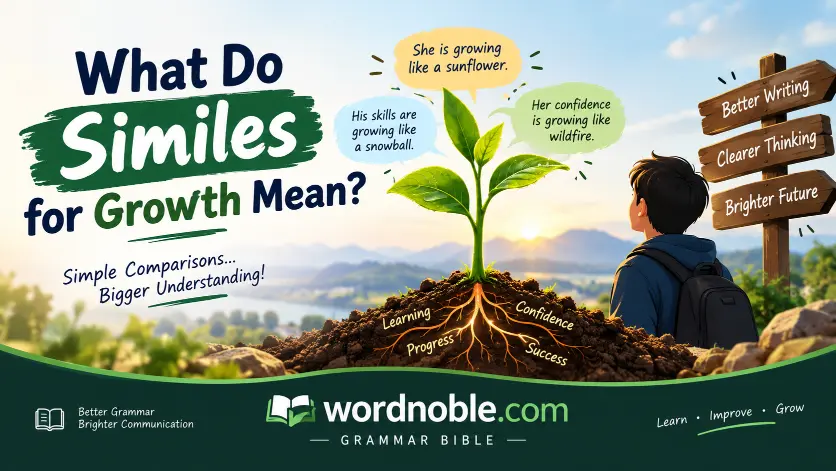
Similes for growth are examples of figurative language used to compare growth with something familiar. The comparison may involve nature, animals, technology, emotions, objects, or everyday experiences.
For example:
- Her confidence grew like a flower opening in the morning.
- His skills developed like a tree growing stronger each year.
- The small business expanded like a river after heavy rain.
These sentences do more than say that something became larger or better. They give the reader an image to imagine.
Growth does not always mean physical size. It can describe:
- Personal development
- Emotional maturity
- Knowledge
- Confidence
- Relationships
- Skills
- Businesses
- Plants and animals
- Communities
- Ideas
- Creative abilities
Because growth can take many forms, writers can use different comparisons to communicate its speed, direction, strength, beauty, or difficulty.
How Do Similes for Growth Work?
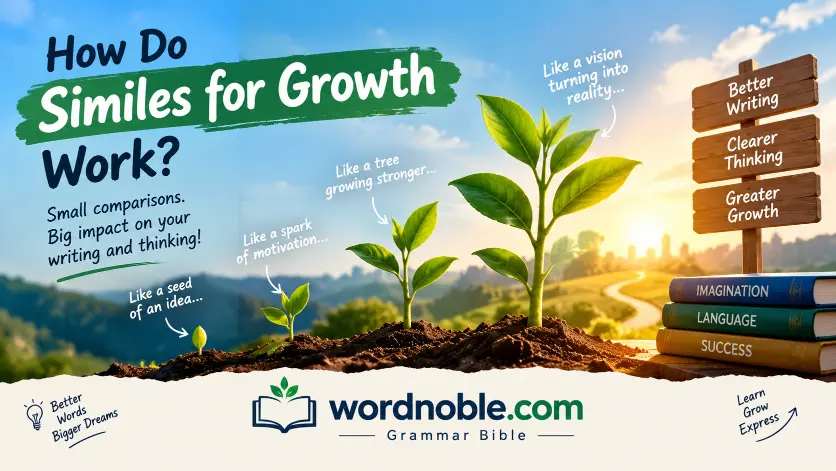
A simile connects an unfamiliar or abstract idea with something readers already understand.
The basic pattern is:
Growth + like/as + familiar comparison
For instance, saying “Her confidence grew” is clear but simple. Saying “Her confidence grew like a sunflower reaching toward the sun” creates a stronger mental picture.
The comparison can communicate several qualities at once. A tree may suggest stability and gradual development. A flame may suggest rapid expansion. A seed may represent potential. A river may suggest continuous movement.
This makes similes especially useful in creative writing, descriptive writing, poetry, storytelling, speeches, and English literature.
Why Do Writers Use Similes for Growth?
Writers use similes for growth because growth is often an abstract concept. Readers cannot always see emotional, intellectual, or personal development directly.
A strong comparison makes that invisible process easier to imagine.
Similes can:
- Create vivid mental pictures
- Make abstract ideas concrete
- Add emotional depth
- Improve descriptive writing
- Make sentences memorable
- Show the speed of development
- Communicate feelings indirectly
- Add personality to storytelling
- Strengthen poetry and creative prose
A simile can also reveal how something grows, not merely that it grows.
For example, “His knowledge grew like a library filling with books” suggests steady accumulation. In contrast, “Her popularity spread like wildfire” suggests extremely rapid expansion.
Similes for growth are figurative comparisons that describe development, progress, expansion, or transformation by connecting growth to a familiar person, object, animal, natural process, or experience. They help readers visualize how something changes over time.
Contextual Meaning of Growth Similes
The meaning of a growth simile depends heavily on context. The same comparison can communicate different ideas when used in different forms of writing.
Storytelling
In stories, growth similes can show how characters develop.
His courage grew like a small flame becoming a steady fire.
The comparison suggests that courage developed gradually.
Poetry
Poets often use nature-based comparisons to make growth emotional and symbolic.
Her dreams rose like flowers after spring rain.
Here, growth represents hope and possibility.
Casual Speech
In everyday conversation, simple comparisons can make an idea easier to explain.
Your confidence is growing like control.
This sounds informal and emphasizes noticeable progress.
Humor
Exaggerated comparisons can make growth funny.
His collection of sneakers grew like rabbits.
The unusual comparison creates humor while suggesting rapid expansion.
Academic Writing
Academic writing generally requires careful and controlled figurative language. A simple simile can make an explanation accessible without making the writing overly decorative.
A child’s vocabulary can grow like a tree, with new words developing from previously learned language.
Types of Similes for Growth
🐾 Animal-Based Similes
Animal comparisons can communicate speed, persistence, reproduction, strength, or natural development.
Examples:
- His confidence grew like a lion finding its strength.
- The team improved like young wolves learning to hunt.
- Her audience grew like birds gathering around food.
- Their friendship grew like puppies growing into loyal dogs.
Meaning: Animal-based comparisons are useful when growth involves energy, instinct, strength, loyalty, or rapid development.
📡 Technology-Based Similes
Technology-based similes can describe modern growth, especially in business, skills, communication, and digital popularity.
Examples:
- The app’s popularity grew like a viral video.
- Her online audience expanded like a network gaining new connections.
- His coding skills developed like software receiving regular updates.
- The company grew like a platform adding millions of users.
Meaning: These comparisons suggest speed, expansion, connectivity, or continuous improvement.
🌿 Nature-Based Similes
Nature is one of the strongest sources of growth imagery because plants, rivers, seasons, and landscapes naturally represent change.
Examples:
- Her confidence grew like a flower in spring.
- His knowledge grew like the branches of a tree.
- Their friendship grew like roots beneath the soil.
- The small idea expanded like a river after rain.
Meaning: Nature-based similes often suggest gradual, organic, healthy, or continuous growth.
😂 Humorous and Exaggerated Similes
Humorous similes deliberately exaggerate growth to make the description entertaining.
Examples:
- His homework pile grew like a monster under the bed.
- Her shopping list grew like a never-ending scroll.
- My snack collection grew like rabbits at a picnic.
- His beard grew like it had somewhere to be.
Meaning: These comparisons emphasize growth through exaggeration and are especially useful in casual writing and comedy.
🎭 Emotional and Behavioral Similes
These similes describe invisible forms of growth, such as confidence, patience, wisdom, courage, or emotional maturity.
Examples:
- Her confidence grew like a quiet sunrise.
- His patience developed like a muscle through practice.
- Their trust grew like roots beneath a strong tree.
- Her wisdom deepened like a river carving through stone.
Meaning: Emotional similes help readers visualize personal development that cannot be physically observed.
15 Examples of Similes for Growth
| Simile Sentence | Meaning | Category | Clarity Explanation |
|---|---|---|---|
| Her confidence grew like a flower opening to the sun. | Her confidence developed beautifully. | Nature | The flower represents gradual positive growth. |
| His knowledge grew like branches spreading from a tree. | He gained more knowledge over time. | Nature | Branches represent expanding understanding. |
| Their friendship grew like roots beneath the ground. | Their relationship became stronger. | Nature | Roots suggest hidden strength and stability. |
| The company expanded like a river after heavy rain. | The company grew quickly. | Nature | A swollen river suggests rapid expansion. |
| Her skills developed like software receiving new updates. | Her abilities improved continuously. | Technology | Updates represent improvement over time. |
| His confidence grew like a young lion finding its strength. | He became more confident and courageous. | Animal | The lion symbolizes developing strength. |
| The audience grew like birds gathering in a field. | More people gradually joined. | Animal | Gathering birds represent increasing numbers. |
| His homework pile grew like a monster under the bed. | His homework increased dramatically. | Humor | The monster makes the exaggeration funny. |
| My shopping list grew like a never-ending scroll. | The list became extremely long. | Humor | The comparison emphasizes excessive length. |
| Her dreams grew like seeds after spring rain. | Her ambitions developed with encouragement. | Nature | Seeds symbolize potential and development. |
| His patience grew like a muscle through exercise. | He became more patient through practice. | Emotional | A muscle becomes stronger with repeated effort. |
| Their trust grew like a tree becoming deeply rooted. | Their relationship became stable and strong. | Emotional | Deep roots symbolize lasting trust. |
| The idea spread like a spark becoming a fire. | A small idea became influential. | Nature | Fire suggests increasing power and reach. |
| Her creativity grew like a garden after rain. | Her creative ability flourished. | Nature | A thriving garden represents flourishing creativity. |
| His business grew like a snowball rolling downhill. | The business increased rapidly. | Object/Nature | The snowball becomes larger as it moves. |
Context Table for Similes for Growth
| Context | Meaning | Use Case | Example |
|---|---|---|---|
| Personal development | Becoming stronger or wiser | Essays, stories | Her confidence grew like a flower. |
| Education | Increasing knowledge | School writing | His knowledge grew like branches on a tree. |
| Business | Expansion or success | Articles, reports | The company grew like a river after rain. |
| Friendship | Developing closeness | Stories, messages | Their friendship grew like deep roots. |
| Creativity | Increasing imagination | Poetry, creative writing | Her creativity grew like a garden. |
| Confidence | Becoming more self-assured | Personal essays | His confidence grew like a flame. |
| Technology | Rapid development | Modern writing | The platform grew like a digital network. |
| Humor | Exaggerated development | Casual writing | My workload grew like a monster. |
| Nature | Organic development | Poetry | The seed grew like a tiny promise. |
| Skills | Improving through practice | School or professional writing | Her skills grew like muscles through training. |
How to Use Similes for Growth in Writing
A good simile should add meaning rather than simply decorate a sentence.
1. Identify What Is Growing
First determine whether you are describing:
- Confidence
- Knowledge
- A plant
- A relationship
- A business
- A skill
- An idea
- A dream
- Emotional maturity
2. Identify the Quality of Growth
Ask whether the growth is:
- Slow
- Fast
- Powerful
- Natural
- Difficult
- Beautiful
- Unexpected
- Continuous
- Unstable
3. Choose a Matching Comparison
A seed works well for potential and gradual development. A wildfire suggests rapid expansion. Roots suggest stability. A rising river suggests increasing force.
4. Keep the Comparison Logical
The comparison should help the reader understand the subject.
Instead of choosing an impressive image randomly, choose one that reflects the actual quality of growth.
5. Avoid Explaining Too Much
A strong simile can often stand by itself.
Her confidence grew like a flower reaching for sunlight.
The reader can understand the comparison without several extra sentences explaining it.
How Similes Make Growth More Creative
Ordinary language tells readers what happened. Figurative language can help show what that change felt or looked like.
Compare:
His confidence increased.
with:
His confidence grew like a small flame becoming a steady fire.
The second version gives the reader an image of gradual strengthening.
This is why similes are powerful creative writing techniques. They combine ordinary information with imagery and sensory associations.
Nature-based imagery can make growth feel organic. Animal imagery can make it energetic. Technology imagery can make it modern. Emotional comparisons can make invisible development easier to understand.
Simile vs. Metaphor
A simile and metaphor both create comparisons, but they usually signal those comparisons differently.
Simile:
Her confidence grew like a flower.
Metaphor:
Her confidence was a flower opening to the sun.
A simile generally uses comparison words such as like or as. A metaphor directly describes one thing as another.
Both devices are forms of figurative language, but their structure and effect differ.
Common Mistakes When Using Growth Similes
Overusing Similes
Using a simile in every sentence can make writing feel forced.
Use comparisons where they genuinely improve the image.
Choosing an Illogical Comparison
The comparison should have a meaningful connection to the type of growth being described.
For example, comparing slow personal development to something famous for instant expansion may confuse the reader.
Confusing Similes and Metaphors
Remember that a sentence containing “like” is not automatically a good simile. The comparison must connect two ideas meaningfully.
Making Comparisons Too Complicated
A long comparison can hide the main idea. Keep the language clear enough for the intended audience.
Using Clichés Too Often
Common expressions can be useful, but original comparisons often make writing more memorable.
Do and Don’t: Using Growth Similes
Do
- Choose comparisons that match the type of growth.
- Use familiar images when clarity matters.
- Experiment with nature, animals, technology, and objects.
- Use sensory language to make comparisons vivid.
- Keep the sentence natural.
- Consider your audience and writing purpose.
Don’t
- Add similes simply to make writing sound complicated.
- Use several comparisons in every sentence.
- Mix unrelated images.
- Explain an obvious comparison repeatedly.
- Force a simile into formal writing where it does not belong.
- Sacrifice clarity for creativity.
Natural Chat Responses Using Similes for Growth
“Your confidence is growing like a flower finally getting sunlight.”
“Wow, your skills are growing like control!”
“Our friendship has grown like roots beneath the ground.”
“That project grew like a snowball once everyone joined.”
“Your vocabulary is growing like branches on a tree.”
“My to-do list is growing like it has a life of its own.”
Related Terms and Semantic Concepts
Understanding related concepts can help writers use growth similes more effectively.
Figurative Language
Figurative language communicates ideas beyond their most literal meaning. Similes and metaphors are two common forms.
Sensory Writing
Sensory writing uses descriptions connected to sight, sound, touch, taste, or smell to make ideas more vivid.
Auditory Imagery
Auditory imagery focuses specifically on sound. Although growth is often represented visually through plants or landscapes, writers can also describe growth through sounds such as an increasing crowd or a gradually rising melody.
Descriptive Writing
Descriptive writing uses precise details and imagery to help readers visualize people, places, objects, emotions, and experiences.
Metaphor vs. Simile
Both compare ideas, but similes usually use comparison words such as “like” or “as,” while metaphors make a more direct comparison.
English Literature
Similes are important in English literature because they allow writers to create imagery, communicate emotion, establish tone, and make abstract ideas more concrete.
FAQs:
What Are Similes for Growth?
Similes for growth are figurative comparisons that describe development, improvement, expansion, or transformation. They connect growth to something familiar by using words such as “like” or “as.” For example, confidence may be described as growing like a flower reaching toward sunlight. Such comparisons help readers visualize changes that may otherwise be difficult to see or explain.
What Is a Good Simile for Growth?
A good simile for growth should match the kind of development being described. For gradual development, a growing tree or flower works well. And for rapid expansion, a river after heavy rain may be effective. For personal improvement, comparing skills to a muscle becoming stronger through practice can communicate steady progress clearly.
What Are Some Examples of Similes for Personal Growth?
Examples include “Her confidence grew like a flower reaching toward the sun” and “His wisdom deepened like a river carving through stone.” These comparisons describe personal development through familiar images. The first emphasizes gradual and positive confidence, while the second suggests that experience and time have created deeper understanding.
What Are Funny Similes for Growth?
Funny growth similes often exaggerate how quickly or dramatically something develops. Examples include “My homework pile grew like a monster under the bed” and “His beard grew like it had somewhere to be.” Humor comes from treating ordinary growth as though it were unusually powerful, independent, or impossible to control.
What Are Poetic Similes for Growth?
Poetic similes for growth often use nature, light, seasons, water, or plants. For example, “Her dreams grew like seeds after spring rain” creates an image of hope developing under favorable conditions. Poetic comparisons work particularly well when the writer wants growth to represent emotional change, possibility, healing, creativity, or renewal.
How Are Similes Used in Writing?
Similes are used to make descriptions more vivid and understandable. Instead of simply stating that someone became more confident, a writer can compare that confidence to a flower opening or a flame becoming stronger. This gives readers an image to visualize and can communicate emotion, speed, strength, or gradual development more effectively.
What Is the Difference Between a Simile and a Metaphor?
A simile usually makes a comparison with words such as “like” or “as.” For example, “Her confidence grew like a flower.” A metaphor makes a direct comparison, such as “Her confidence was a flower opening to the sun.” Both are forms of figurative language, but their grammatical structures are different.
Why Are Similes Important in English Literature?
Similes help literary writers create imagery and communicate ideas in memorable ways. They can describe emotions, characters, settings, actions, and abstract concepts. Growth similes are particularly useful because development is often gradual or invisible. A carefully chosen comparison allows readers to imagine the process rather than simply receive a factual statement about it.
How Can Students Use Similes for Growth?
Students can use growth similes in creative writing, descriptive essays, poetry, narratives, speeches, and classroom assignments. A student might write, “My understanding grew like a tree adding new branches.” The comparison makes intellectual development easier to visualize while also demonstrating knowledge of figurative language and descriptive writing.
Can Similes for Growth Describe More Than Physical Growth?
Yes. Growth similes can describe physical, emotional, intellectual, social, creative, and professional development. A writer can describe confidence, knowledge, friendship, creativity, patience, skills, businesses, ideas, or dreams as growing. This flexibility makes growth a useful subject for figurative language in both everyday communication and creative writing.
Conclusion:
Similes for growth make the idea of development easier to see, feel, and understand. Instead of simply saying that something becomes stronger, larger, wiser, or more successful, a writer can compare that process with a growing tree, opening flower, spreading river, strengthening muscle, or expanding network. These comparisons add imagery without sacrificing meaning.
The strongest growth similes are purposeful, clear, and connected to the type of change being described.
Whether you are writing a poem, school assignment, story, speech, or everyday message, choose an image that naturally reflects the growth. When the comparison fits, a simple sentence can become much more vivid and memorable.

I am Naqash Ayub, proudly writing for WordNoble, where I focus on creating clear, informative, and SEO-friendly content. I enjoy turning detailed information into simple, trustworthy articles that help readers find the answers they need.