
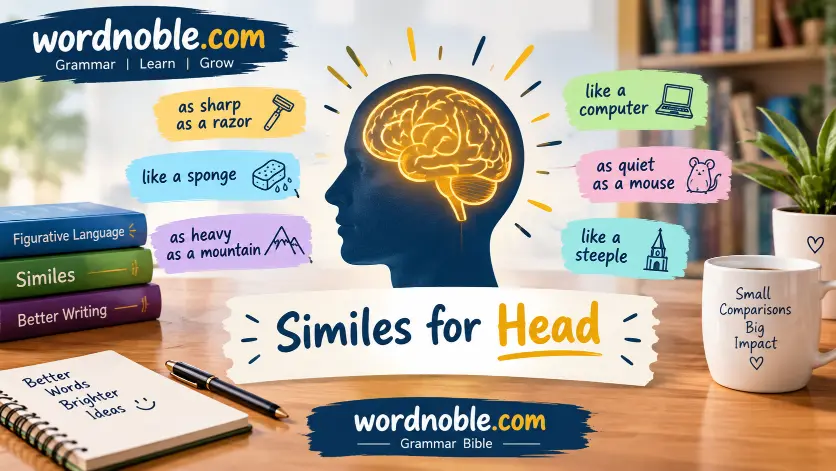
Your character is staring at a blank page, and “his head hurt” just isn’t doing the job. Sound familiar? Fresh similes for head pain, shape, or thoughts can fix that in one line. Whether you’re describing a pounding headache, a sharp mind, or a bald scalp shining under stage lights, the right comparison makes the image stick.
Most writers grab the same tired phrases. “Head like a rock” shows up everywhere, and readers skim right past it. Better figurative language works differently. It gives the reader a sensation, a picture, or a personality in just a few words.
Below, you’ll find examples sorted by what you actually need: pain and pressure, intelligence and confusion, size and shape, and hair or the lack of it. Each one is short, easy to adapt, and ready for your story, poem, or essay. You’ll also learn a simple way to build your own comparisons from scratch.
Let’s start with the most common need: a head that just won’t stop aching.
Similes for head are comparisons that describe a person’s head, thoughts, appearance, or mental activity using words such as “like” or “as.”
What Are Similes for Head?
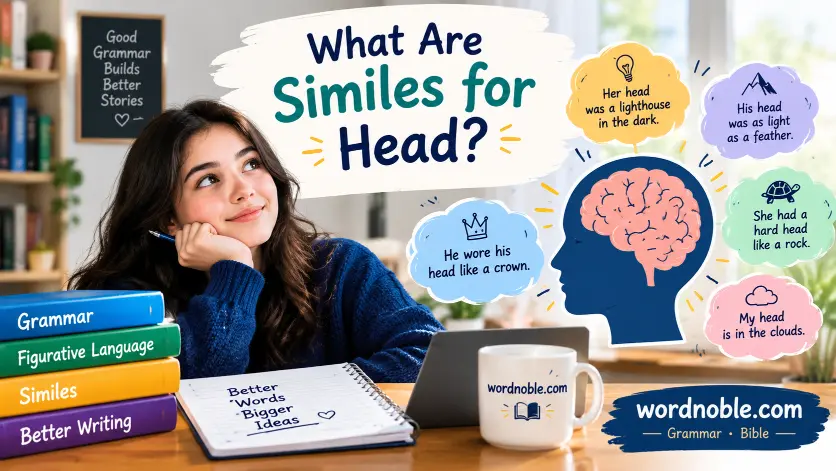
Similes for head are examples of figurative language used to compare the head or something associated with it to another object, animal, place, force, or idea.
For example:
- His head was like a busy marketplace.
- Her head was as hard as stone.
- His thoughts moved like racing trains.
- The child’s head was round like a ball.
These comparisons make descriptions more visual and memorable. Instead of simply saying that someone has a round head, a writer can compare it to a ball. Instead of saying that someone has many thoughts, a writer can describe their head as being like a crowded room.
The word “like” or the structure “as…as” often signals a simile, although not every sentence containing these words is a simile. The comparison should create a meaningful connection between two different things.
Similes for head can describe:
- Physical shape
- Size
- Hair
- Thoughts
- Confusion
- Intelligence
- Attention
- Pain
- Memory
- Emotions
- Listening and awareness
- Personality and behavior
They are especially useful in creative writing, poetry, storytelling, descriptive essays, and school assignments.
How Do Similes for Head Work?
A strong head simile connects a familiar image with a less obvious quality.
For example, saying “His head was like a crowded room” does not mean that his head literally contains a room. The comparison suggests that many thoughts are competing for his attention.
Similarly, “Her head was as hard as a rock” can describe physical hardness, stubbornness, or resistance depending on the context.
This gives similes two important functions:
- They create imagery.
- They communicate meaning beyond literal words.
A good simile should make the reader understand something more clearly rather than simply adding decorative language.
Why Do Writers Use Similes for Head?
Writers use head similes because the head can represent much more than physical appearance. It can symbolize thought, memory, intelligence, imagination, attention, identity, and emotion.
A character’s head might be compared to a:
- Machine to suggest constant activity
- Library to suggest knowledge
- Storm to suggest confusion
- Computer to suggest processing information
- Balloon to suggest lightness or emptiness
- Rock to suggest hardness or stubbornness
- Garden to suggest imagination and ideas
These comparisons add sensory language and emotional depth to ordinary descriptions.
In English literature, figurative language helps writers communicate abstract ideas through concrete images. A reader may not be able to see someone’s thoughts directly, but a comparison can make those thoughts easier to imagine.
Similes for head are figurative comparisons used to describe a person’s head, thoughts, appearance, mental activity, or related behavior by comparing it with something familiar. They commonly use “like” or “as” to create clearer imagery and communicate qualities such as size, shape, confusion, intelligence, stubbornness, or imagination.
Contextual Meaning of Similes for Head
The meaning of a head simile depends heavily on context.
In Storytelling
A simile can help readers visualize a character quickly.
His head was like a polished stone.
This may describe a smooth or bald head, depending on the surrounding details.
In Poetry
Poets can use unusual comparisons to create emotional or symbolic imagery.
Her thoughts floated through her head like autumn leaves.
The comparison suggests movement, change, and perhaps uncertainty.
In Casual Speech
Everyday similes can make conversation more expressive.
My head is like a computer with too many tabs open.
This suggests mental overload.
In Humor
Funny comparisons exaggerate a quality for comic effect.
My head felt like a microwave full of popcorn.
The image humorously suggests frantic or chaotic thoughts.
In Academic Writing
Similes should be used carefully. Formal writing usually benefits from precise language, but an appropriate comparison can help explain an abstract idea.
For example, a teacher might explain memory as being like a filing system to make a difficult concept easier to understand.
Types of Similes for Head
🐾 Animal-Based Similes
Animal comparisons can describe physical features, movement, alertness, or behavior.
Examples
- His head was round like a turtle’s shell.
- She turned her head like an alert owl.
- His head moved like a curious puppy.
- Her eyes and head stayed focused like a hunting eagle.
Meaning
Animal-based comparisons are useful when the writer wants to emphasize instinct, alertness, curiosity, movement, or a distinctive physical quality.
An owl can suggest watchfulness, while a puppy can suggest curiosity. An eagle may communicate intense focus.
📡 Technology-Based Similes
Technology is especially useful for describing thoughts and mental activity.
Examples
- His head was like a computer processing thousands of files.
- My mind felt like a phone with too many apps running.
- Her head was like a search engine full of questions.
- His thoughts raced like messages traveling through a network.
Meaning
Technology-based similes are ideal for modern writing because readers understand digital systems easily.
They can describe:
- Overthinking
- Fast thinking
- Information overload
- Memory
- Concentration
- Confusion
- Creativity
🌿 Nature-Based Similes
Nature offers some of the most poetic comparisons.
Examples
- Her head was like a garden full of new ideas.
- His thoughts moved like clouds across the sky.
- Her mind was like a calm lake.
- His head felt like a stormy sky.
Meaning
Nature-based similes can communicate mood and emotion without directly naming the feeling.
A calm lake can suggest peace. A stormy sky can suggest confusion or emotional turmoil.
😂 Humorous and Exaggerated Similes
Funny similes often use exaggeration.
Examples
- My head felt like a blender full of thoughts.
- His hair made his head look like a fuzzy coconut.
- My head was like a balloon about to pop.
- Her thoughts were like squirrels running through her head.
Meaning
These comparisons are not intended to be scientifically or literally accurate. Their purpose is entertainment and vivid expression.
🎭 Emotional and Behavioral Similes
These comparisons describe what is happening inside someone’s mind or how they behave.
Examples
- His head was like a battlefield of competing ideas.
- Her mind was like a quiet library.
- His thoughts were like racing horses.
- My head felt like a tangled ball of thread.
Meaning
These similes help writers describe invisible mental states through familiar physical images.
15 Similes for Head With Meanings
| Simile | Meaning | Category |
|---|---|---|
| His head was like a busy marketplace. | He had many competing thoughts. | Nature/Place |
| Her head was as hard as stone. | She was physically hard-headed or stubborn. | Object |
| His thoughts raced like horses. | His thoughts moved very quickly. | Animal |
| Her mind was like a quiet library. | She felt calm and focused. | Place |
| His head was like a computer with too many programs running. | He was mentally overloaded. | Technology |
| Her thoughts floated like clouds. | Her thinking was relaxed, dreamy, or unfocused. | Nature |
| His head was like a stormy sky. | His mind was confused or troubled. | Nature |
| My head felt like a balloon ready to burst. | I felt overwhelmed or had intense pressure. | Humorous |
| His head was round like a ball. | His head had a rounded shape. | Object |
| Her mind was like a garden full of ideas. | She was imaginative and creative. | Nature |
| His thoughts buzzed like bees. | Many thoughts were active at once. | Animal |
| My head felt like a crowded train station. | Too many thoughts or distractions were present. | Place |
| His head was like a locked box. | He kept his thoughts or feelings private. | Object |
| Her mind moved like a flowing river. | Her thoughts developed smoothly and continuously. | Nature |
| His head was like a spinning wheel. | He was thinking repeatedly or overthinking. | Object |
Similes for Head and Ears
Because the ears are part of the head, writers sometimes use sensory similes that connect head descriptions with hearing, attention, and auditory imagery.
For example:
- His ears were like radar dishes, catching every sound.
- Her ears were as sharp as an owl’s, listening carefully.
- His head turned like a satellite searching for a signal.
- Her ears seemed like open windows to the world.
These comparisons are useful when describing listening behavior, awareness, or sensitivity to sound.
The key idea is auditory imagery. Instead of merely telling readers that a character heard something, a writer can use comparison to help readers imagine how strongly the character noticed the sound.
Similes for Head in Different Writing Situations
| Context | Meaning | Use Case | Example |
|---|---|---|---|
| Storytelling | Describes character appearance or thoughts | Fiction | His head was like a polished stone. |
| Poetry | Creates symbolic imagery | Poems | Her thoughts drifted like clouds. |
| School writing | Makes descriptions vivid | Essays | His mind was like a busy library. |
| Humor | Creates exaggeration | Comedy | My head was like a blender. |
| Casual speech | Expresses feelings naturally | Conversation | My head feels like a crowded station. |
| Character description | Shows personality | Fiction | His mind was like a locked room. |
| Sensory writing | Connects thought and perception | Creative writing | Her ears were like radar. |
| Descriptive writing | Builds a visual image | Assignments | His head was round like a ball. |
How to Use Similes for Head Naturally
A simile should have a purpose. Before adding one, decide exactly what you want the reader to understand.
1. Identify the Quality
Ask what you are describing:
- Shape?
- Size?
- Hair?
- Intelligence?
- Confusion?
- Memory?
- Creativity?
- Stubbornness?
- Attention?
2. Choose a Familiar Comparison
Pick something readers can easily visualize.
For example:
Crowded head → crowded marketplace
Fast thoughts → racing horses
Calm mind → quiet lake
3. Keep the Comparison Logical
The comparison does not need to be literally possible, but it should share a recognizable quality with the subject.
4. Match the Tone
A serious poem may need a poetic comparison, while a funny conversation can use exaggeration.
5. Avoid Explaining Too Much
A strong simile can communicate its meaning naturally. Let the image do some of the work.
How Similes Improve Creative Writing
Similes make ordinary descriptions more memorable because they activate the reader’s imagination.
Compare:
His thoughts were confusing.
with:
His thoughts were like tangled wires.
The second sentence gives the reader a concrete mental image.
Similes can also improve:
- Character development
- Emotional description
- Scene building
- Poetry
- Storytelling
- School assignments
- Descriptive essays
- Creative nonfiction
The best comparisons are specific rather than random.
Simile vs. Metaphor
A simile directly compares two things, commonly using “like” or “as.”
His head was like a crowded room.
A metaphor makes the comparison more directly.
His head was a crowded room.
Both forms can communicate a similar idea, but their structures differ.
| Simile | Metaphor |
|---|---|
| Uses an explicit comparison | Makes a direct comparison |
| Often uses like or as | Usually does not use like or as |
| His mind is like a storm. | His mind is a storm. |
| Her thoughts are like waves. | Her thoughts are waves. |
Neither form is automatically better. The choice depends on the tone and purpose of the writing.
Common Mistakes With Head Similes
Overusing Similes
Adding a comparison to every sentence can make writing feel crowded.
Use similes where they add meaning.
Choosing an Illogical Comparison
A comparison should have a recognizable connection.
A random comparison may confuse the reader instead of helping them.
Mixing Up Similes and Metaphors
Remember that a simile usually signals comparison directly.
Simile: His head was like a rock.
Metaphor: His head was a rock.
Using Clichés Too Often
Some comparisons are so familiar that they may feel predictable. When appropriate, create fresh comparisons that still make sense.
Forgetting the Context
A humorous simile may not fit a serious scene. Always match the comparison to the writing situation.
Usage Guide: Do and Don’t
👍 Do
- Use comparisons that clarify an idea.
- Choose familiar images.
- Match the simile to your tone.
- Use sensory details.
- Experiment with nature, animals, and objects.
- Make the comparison meaningful.
- Use similes to show emotion indirectly.
❌ Don’t
- Add similes to every sentence.
- Use confusing comparisons.
- Mix up similes and metaphors.
- Force a comparison just to sound creative.
- Use an exaggerated image when the context is formal.
- Choose a comparison that has no connection to the intended meaning.
Natural Chat Responses Using Similes for Head
Here are some natural ways people might use head-related similes in everyday conversation:
“My head feels like a computer with twenty tabs open right now.”
“After that exam, my head was like a crowded train station.”
“Your head is like a library; you remember everything.”
“I couldn’t concentrate because my thoughts were like bees buzzing around.”
“My head feels like a balloon about to burst after all that studying.”
“His head was spinning like a wheel after hearing all the new information.”
Related Figurative Language Terms
Understanding related concepts can help you use head similes more effectively.
Figurative Language
Language that communicates ideas beyond their strictly literal meaning.
Auditory Imagery
Language that helps readers imagine sounds or hearing experiences.
Sensory Writing
Writing that appeals to senses such as sight, sound, touch, smell, and taste.
Descriptive Writing
Writing that uses details to help readers visualize a person, place, object, experience, or idea.
Metaphor vs. Simile
Two related forms of figurative comparison that differ mainly in how the comparison is expressed.
Creative Writing Techniques
Methods writers use to create imagery, emotion, atmosphere, characterization, and reader engagement.
FAQs:
1. What Are Similes for Head?
Similes for head are figurative comparisons that describe a person’s head, thoughts, appearance, or mental activity by comparing them with something familiar. They commonly use “like” or “as.” For example, saying that a head is “like a crowded room” can suggest that someone has many thoughts competing for attention. These comparisons make descriptions more visual and expressive.
2. What Is a Good Simile for Head?
A good simile depends on what you want to describe. For physical appearance, “His head was round like a ball” is simple and clear. For mental activity, “Her mind was like a busy marketplace” suggests many thoughts. A strong simile should create a recognizable image and have a clear connection to the quality being described.
3. What Are Some Funny Similes for Head?
Funny head similes often use exaggeration and unexpected comparisons. Examples include “My head is like a blender full of thoughts,” “His hair made his head look like a fuzzy coconut,” and “My head feels like a balloon about to pop.” These comparisons work well in casual conversation, humorous stories, captions, and lighthearted creative writing.
4. What Are Poetic Similes for Head?
Poetic similes use imaginative images to express appearance, thoughts, or emotion. Examples include “Her mind was like a moonlit lake,” “His thoughts drifted like clouds,” and “Her head was like a garden full of ideas.” These comparisons create atmosphere while allowing writers to communicate abstract feelings through concrete natural images.
5. What Is the Difference Between a Simile and a Metaphor?
A simile makes an explicit comparison, often using “like” or “as.” For example, “His mind was like a storm” is a simile. A metaphor makes the comparison directly: “His mind was a storm.” Both are forms of figurative language, but a simile signals the comparison more clearly.
6. How Can I Use Similes for Head in Writing?
First decide what quality you want to describe, such as appearance, confusion, creativity, memory, or concentration. Then choose something familiar that shares that quality. For example, if a character has too many thoughts, you might write, “His head was like a crowded station.” Make sure the comparison fits the tone and adds useful imagery.
7. Why Are Similes Important in English Literature?
Similes help writers transform abstract ideas into concrete images. Thoughts, emotions, memories, and mental states can be difficult to describe literally. A carefully chosen comparison gives readers something familiar to visualize. In English literature, similes can contribute to imagery, characterization, atmosphere, symbolism, tone, and emotional expression.
8. How Can Students Use Similes for Head?
Students can use head similes in descriptive essays, creative writing, poetry, stories, and language assignments. They can describe physical appearance or use comparisons to explain thoughts and emotions. For example, “Her mind was like a library filled with ideas” can communicate intelligence or creativity more vividly than a simple statement.
9. Can Similes for Head Describe Thoughts?
Yes. Head-related similes are especially useful for describing thoughts because thoughts cannot be physically seen. Comparisons can turn mental activity into recognizable images. For example, “His thoughts raced like horses” suggests speed, while “Her mind was like a quiet lake” suggests calmness. The surrounding context determines the exact meaning.
10. Can Similes for Head Include the Ears?
Yes. Because ears are part of the head, writers can use related sensory comparisons to describe listening and awareness. For example, “His ears were like radar” suggests that he noticed sounds quickly. These comparisons can introduce auditory imagery and help readers imagine how a character hears, listens, or responds to sounds.
Conclusion:
Similes for head give writers a simple way to turn ordinary descriptions into memorable imagery. They can describe the physical shape of a head, but they can also represent thoughts, emotions, creativity, confusion, attention, and memory.
Comparisons involving animals, technology, nature, objects, and places offer many possibilities for creative expression. The strongest similes are clear, purposeful, and appropriate for their context.
Whether you are writing a poem, story, school assignment, or casual message, a well-chosen comparison can help readers visualize an idea instantly.
Use similes naturally, avoid unnecessary repetition, and choose images that genuinely strengthen your meaning. That is what makes figurative language both effective and memorable.

I am Naqash Ayub, proudly writing for WordNoble, where I focus on creating clear, informative, and SEO-friendly content. I enjoy turning detailed information into simple, trustworthy articles that help readers find the answers they need.