Darkness has a way of turning writers into poets. One good simile can transform a plain sentence like “it was dark outside” into something a reader actually feels cold, quiet, a little uneasy.
That’s the power of similes for night: they borrow familiar images, like ink, velvet, or a held breath, to make an ordinary scene stick in someone’s memory.
Whether you’re writing a poem, a novel, a song, or just a caption for a moody photo, the right comparison can say more in five words than a paragraph of description ever could.
Below, you’ll find a wide range of night-time similes and metaphors, sorted by mood and use case, so you can match the tone you’re going for, whether that’s peaceful, eerie, romantic, or mysterious.
Each one is ready to use as is, or as a starting point for your own version. No need to stare at a blank page hoping inspiration strikes. Let’s start with the classics: the simplest, most versatile similes for describing night that work in almost any piece of writing.
Similes for night are comparisons that describe nighttime by relating it to another person, object, animal, or natural scene, usually with “like” or “as.” They make descriptions more vivid, emotional, and memorable.
What Do Similes for Night Mean?
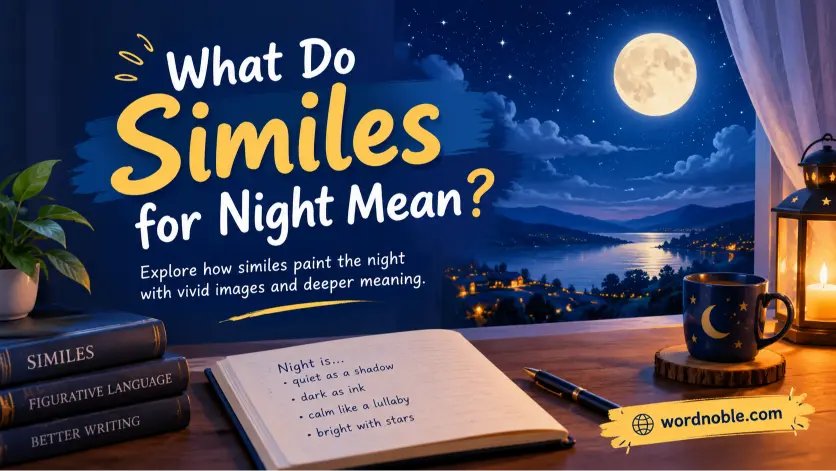
A simile for night is a form of figurative language used to compare nighttime with something else. The comparison may focus on darkness, silence, stars, mystery, beauty, loneliness, stillness, or fear.
For example:
The night was as dark as a deep cave.
This does not mean the night literally became a cave. Instead, the writer compares the darkness of night with the darkness associated with a cave.
Similes help readers see, feel, and imagine a scene rather than simply receive a factual description.
Compare these two sentences:
- The night was dark.
- The night was as dark as a forgotten tunnel.
The first gives information. The second creates an image.
That difference is the power of figurative language.
How Similes for Night Work
Similes for night usually highlight one particular quality rather than describing everything about nighttime at once.
A writer might compare night to:
- an animal to suggest movement or mystery
- an object to emphasize darkness or stillness
- nature to create beauty
- technology to suggest an unusual visual effect
- something humorous to create exaggeration
- an emotional experience to communicate mood
The comparison should have a clear connection to the quality being described.
Why Writers Use Similes for Night
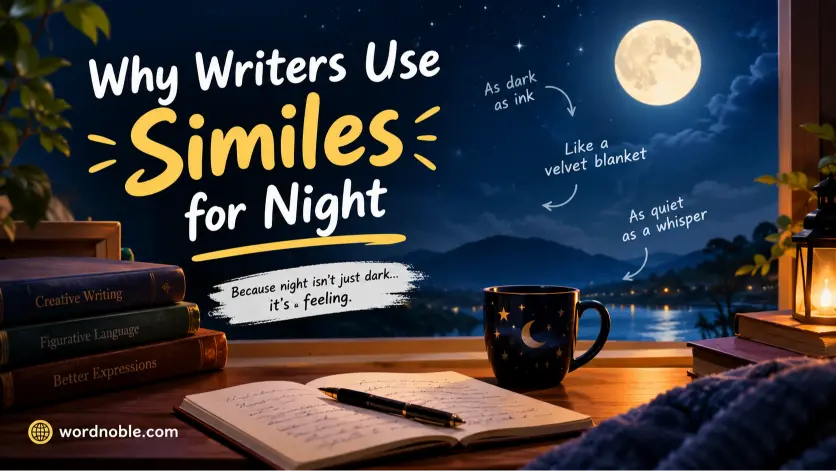
Writers use nighttime similes to:
- Create strong visual imagery
- Establish mood and atmosphere
- Make descriptions more memorable
- Add emotion to ordinary scenes
- Help readers imagine darkness and silence
- Make poetry more expressive
- Improve descriptive writing
- Give stories a stronger sense of place
Nighttime is especially suitable for figurative language because it can represent many different ideas: mystery, rest, danger, loneliness, romance, imagination, and the unknown.
Similes for night are figurative comparisons used to describe nighttime through familiar images, qualities, or experiences. They make descriptions of darkness, silence, stars, mystery, beauty, and nighttime atmosphere more vivid and emotionally meaningful.
Contextual Meaning of Similes for Night
The same nighttime comparison can serve different purposes depending on the type of writing.
Storytelling
In fiction, similes for night can establish atmosphere quickly.
The night spread across the village like a black curtain.
This creates a visual setting and can prepare readers for a mysterious or dramatic event.
Poetry
Poetry often uses more imaginative and emotional comparisons.
The night was like a velvet blanket covering the sleeping earth.
Here, the comparison creates softness, beauty, and tranquility.
Casual Speech
Everyday conversations usually benefit from simple, understandable similes.
It was as dark as a closet in there.
The comparison is familiar and easy to understand.
Humor
Funny similes deliberately exaggerate a quality.
The night was darker than my phone screen after I forgot to charge it.
The unusual comparison adds personality and humor.
Academic Writing
Similes can be useful in essays and literary analysis, but they should be used carefully. Academic writing generally favors precise language, so figurative comparisons should support the explanation rather than replace it.
Types of Similes for Night
🐾 Animal-Based Similes
Animals can make nighttime descriptions feel mysterious, alive, or threatening.
1. The night was like a silent owl.
Meaning: The night felt quiet and watchful.
2. The darkness crept in like a black cat.
Meaning: Night seemed to arrive quietly and gradually.
3. The night moved like a hunting wolf.
Meaning: The nighttime atmosphere felt powerful, mysterious, or threatening.
4. The darkness spread like a flock of bats.
Meaning: Darkness seemed to expand rapidly across the sky.
Animal comparisons work particularly well in storytelling because they can give an otherwise still night a sense of movement or personality.
📡 Technology-Based Similes
Modern comparisons can make nighttime descriptions feel fresh and relatable.
5. The night was dark like a screen after the power went out.
Meaning: The comparison emphasizes complete darkness.
6. The stars blinked like tiny notification lights.
Meaning: The stars appeared to flash or sparkle repeatedly.
7. The moon glowed like a night-light in a dark room.
Meaning: The moon provided a small but comforting source of light.
Technology-based similes can be especially effective in contemporary fiction, social media writing, and informal creative work.
🌿 Nature-Based Similes
Nature provides some of the most natural comparisons for nighttime.
8. The night was as quiet as a forest after snowfall.
Meaning: The night felt exceptionally peaceful and silent.
9. The sky was like a blanket scattered with diamonds.
Meaning: The stars appeared bright and numerous.
10. The moon shone like a silver coin.
Meaning: The moon looked bright, round, and silvery.
11. The night wrapped around the town like a thick fog.
Meaning: Darkness seemed to surround everything.
Nature-based similes are common in poetry because they create strong visual and sensory imagery.
😂 Humorous and Exaggerated Similes
Funny comparisons can make nighttime descriptions more memorable.
12. The night was darker than my future before morning coffee.
Meaning: The writer humorously exaggerates how dark or hopeless the night feels.
13. It was as dark as my room when I lose my glasses.
Meaning: The comparison jokingly emphasizes extreme difficulty seeing.
14. The night was as quiet as a classroom during a surprise test.
Meaning: The comparison humorously suggests complete silence.
Humorous similes work best when the writing has a casual, playful, or conversational tone.
🎭 Emotional and Behavioral Similes
Night can represent emotions as well as physical darkness.
15. The night felt like an old memory.
Meaning: The night created a reflective, nostalgic mood.
16. The darkness was like loneliness sitting beside me.
Meaning: The comparison connects nighttime with emotional isolation.
17. The night was as peaceful as a sleeping child.
Meaning: The night felt calm, gentle, and safe.
These comparisons are particularly useful when nighttime is being used symbolically in poetry or emotional storytelling.
15 Best Similes for Night With Meanings
| Simile | Meaning | Category |
|---|---|---|
| The night was as dark as a cave. | It was extremely dark. | Nature |
| The night spread like a black blanket. | Darkness covered everything. | Object |
| The stars sparkled like diamonds. | The stars looked bright and beautiful. | Nature |
| The moon shone like a silver lamp. | The moon provided gentle light. | Object |
| The night was quiet like an empty forest. | Everything felt peaceful and silent. | Nature |
| Darkness crept in like a cat. | Night arrived quietly. | Animal |
| The sky was like black velvet. | The sky looked dark, smooth, and beautiful. | Object |
| The stars blinked like tiny lights. | The stars appeared to twinkle. | Technology |
| The night wrapped around us like a cloak. | Darkness surrounded the people. | Object |
| The moon looked like a pearl. | The moon appeared small, bright, and beautiful. | Nature |
| The night moved like a shadow. | Darkness seemed to spread silently. | Abstract |
| The darkness was as deep as the ocean. | The darkness felt vast and intense. | Nature |
| The night was like a sleeping giant. | The night felt powerful but still. | Animal/Personification |
| The night felt like a quiet dream. | The atmosphere was peaceful and unreal. | Emotional |
| The darkness fell like a curtain. | Night seemed to close over the landscape. | Object |
Context Table: Choosing the Right Simile
| Context | Meaning | Use Case | Example |
|---|---|---|---|
| Peaceful night | Calm and quiet | Poetry, reflective writing | The night was as peaceful as a sleeping garden. |
| Frightening night | Fear or danger | Horror, suspense | The night was like a locked room. |
| Beautiful night | Visual beauty | Poetry, descriptions | The sky was like velvet sprinkled with diamonds. |
| Lonely night | Isolation | Emotional writing | The night felt like an empty house. |
| Mysterious night | Unknown or suspenseful | Fiction | The darkness crept like a silent stranger. |
| Starry night | Bright stars | Poetry, essays | The stars shone like scattered jewels. |
| Quiet night | Lack of sound | Descriptive writing | The night was as quiet as a deserted street. |
| Humorous night | Exaggerated darkness | Casual writing | It was darker than my room during a power cut. |
How to Use Similes for Night in Writing
A good simile should feel like part of the sentence rather than something added simply to make the writing sound sophisticated.
1. Decide what quality you want to describe
Ask yourself:
Is the night dark, peaceful, frightening, beautiful, lonely, mysterious, or magical?
Once you know the quality, choose a comparison that reinforces it.
2. Choose a familiar image
Readers understand comparisons faster when the second image is recognizable.
For example:
The night was as dark as a cave.
The reader immediately understands the intended quality.
3. Use sensory language
Strong descriptive writing appeals to the senses.
Nighttime can involve:
- Sight: darkness, moonlight, stars
- Sound: silence, crickets, distant wind
- Touch: cool air, cold darkness
- Emotion: fear, peace, loneliness
- Movement: shadows, clouds, fading light
4. Match the mood
A peaceful story needs a different comparison from a horror story.
Peaceful:
The night was like a soft blanket over the sleeping town.
Frightening:
The darkness crept like a predator through the empty streets.
The subject is the same, but the emotional effect is completely different.
Simile vs. Metaphor: What’s the Difference?
A simile makes a comparison using words such as like or as.
The night was like a black blanket.
A metaphor makes a direct comparison without using “like” or “as.”
The night was a black blanket.
Both are forms of figurative language, but their grammatical structures differ.
Easy way to remember
Simile: Night is like something.
Metaphor: Night is something.
Neither technique is automatically better. The best choice depends on the tone, rhythm, and purpose of the writing.
When Not to Use Similes
Similes are useful, but adding too many can make writing feel forced.
Avoid a simile when:
- The comparison does not clarify anything.
- The image is confusing.
- The comparison is unrelated to the subject.
- You are writing a sentence that needs direct factual information.
- Several similes appear in every sentence.
- A simpler description would be stronger.
For example, instead of adding multiple comparisons:
The night was like velvet, like a blanket, like a cave, and like an ocean.
Choose the strongest image:
The night was like a vast black ocean.
One effective comparison is often better than four weak ones.
Common Mistakes With Similes for Night
1. Overusing Similes
Too many comparisons can distract readers from the main idea.
Better: Use one memorable simile where it has the greatest effect.
2. Using Illogical Comparisons
The comparison should share a recognizable quality with nighttime.
A comparison should have a reason behind it.
3. Confusing Similes With Metaphors
If the sentence says:
The night was a blanket.
That is a metaphor.
If it says:
The night was like a blanket.
That is a simile.
4. Choosing Clichés Without Purpose
Some comparisons are so familiar that they may feel predictable. Common imagery can still work, but adding a specific detail can make it fresher.
Instead of:
The stars were like diamonds.
You could write:
The stars glittered like scattered diamonds across black velvet.
Usage Guide: Do and Don’t
👍 Do
- Choose comparisons that have a clear meaning.
- Match the simile to the mood.
- Use familiar imagery when clarity matters.
- Experiment with nature, animals, objects, and emotions.
- Use similes to strengthen descriptive writing.
- Read the sentence aloud to check its rhythm.
👎 Don’t
- Force a simile into every sentence.
- Mix unrelated images.
- Use complicated comparisons just to sound intelligent.
- Forget the main purpose of the paragraph.
- Confuse metaphors and similes.
- Let figurative language make your meaning unclear.
Natural Chat-Style Responses Using Similes
Here are some casual ways someone might naturally use a nighttime simile in conversation:
1. “It’s dark outside like someone switched off the whole world.”
2. “The sky looks like black velvet tonight.”
3. “It’s as quiet as a sleeping village out there.”
4. “Those stars look like tiny lights scattered across the sky.”
5. “The moon is shining like a lamp tonight.”
These work because they sound conversational rather than overly literary.
Why Similes for Night Matter in English Literature
Night has always been a powerful setting in literature because it can carry several meanings at once. It may represent mystery, danger, peace, loneliness, sleep, imagination, or the unknown.
Similes help writers communicate those meanings without explaining every emotion directly.
A writer can describe a frightening night by comparing darkness to something threatening. A poet can create tranquility by comparing night to a soft blanket. A storyteller can build suspense by describing darkness as something that slowly moves through a setting.
This makes similes an important creative writing technique and part of the broader study of figurative language, imagery, symbolism, and descriptive writing.
Related Figurative Language Terms
Understanding similes for night also connects to several related English literature concepts.
Figurative Language
Language that communicates meaning beyond its most literal interpretation.
Auditory Imagery
Language that helps readers imagine sounds, which can be particularly useful when describing the silence or nighttime sounds of a setting.
Sensory Language
Words and descriptions that appeal to sight, sound, touch, smell, taste, or emotion.
Descriptive Writing
Writing that uses precise details and imagery to help readers visualize a person, place, object, or experience.
Metaphor
A direct comparison between two unlike things without using “like” or “as.”
Personification
Giving human characteristics to something nonhuman, such as describing the night as if it can creep, whisper, or embrace.
FAQs:
1. What are similes for night?
Similes for night are comparisons that describe nighttime using another familiar image, person, object, animal, or natural phenomenon. They commonly use “like” or “as” to make the comparison. For example, a writer might compare darkness to a cave or the night sky to black velvet. These comparisons make ordinary descriptions more vivid and help readers imagine the scene more clearly.
2. What are some good examples of similes for night?
Good examples include “The night was as dark as a cave,” “The sky was like black velvet,” and “The stars sparkled like diamonds.” Each comparison emphasizes a different quality of nighttime. A cave highlights darkness, velvet creates a visual and luxurious image, and diamonds emphasize the brightness of stars. The best simile depends on the mood and purpose of your writing.
3. What are some funny similes for night?
Funny nighttime similes use exaggeration and unexpected comparisons. For example, “The night was darker than my room when I lose my glasses” creates a humorous image. Another could be, “It was as quiet as everyone pretending to understand a difficult math problem.” Funny similes work especially well in casual conversations, social posts, humorous stories, and creative writing with a playful tone.
4. What are some poetic similes for night?
Poetic similes often focus on beauty, emotion, atmosphere, and sensory imagery. Examples include “The night was like a velvet blanket over the earth” and “The stars glittered like scattered jewels.” These comparisons create visual pictures while also giving the night an emotional quality. Poetic similes are particularly effective in poems, romantic descriptions, reflective writing, and literary storytelling.
5. What is the difference between a simile and a metaphor for night?
A simile compares night with something else using “like” or “as,” while a metaphor makes the comparison directly. For example, “The night was like a blanket” is a simile. “The night was a blanket” is a metaphor. Both are forms of figurative language, but a simile signals the comparison more explicitly, while a metaphor presents the comparison as a direct statement.
6. How can I use similes for night in writing?
Start by identifying the quality of night you want to communicate. Decide whether it is dark, peaceful, frightening, beautiful, mysterious, or lonely. Then choose a familiar image that shares that quality. Add the comparison naturally to your sentence rather than forcing it into the paragraph. One strong simile can make a descriptive passage more memorable without overwhelming the reader.
7. Why are similes important in English literature?
Similes help literary writers create imagery, atmosphere, emotion, and symbolism. Night can have many meanings in literature, and a carefully selected comparison can reveal those meanings quickly. Instead of merely telling readers that a night is frightening or peaceful, a writer can create an image that allows readers to experience the atmosphere themselves. This makes figurative language an important creative writing tool.
8. How can students use similes for night?
Students can use nighttime similes in creative writing assignments, descriptive paragraphs, poems, short stories, and English literature exercises. They can begin with a simple description such as “The night was dark” and improve it with a meaningful comparison. For example, “The night was as dark as a forgotten tunnel.” The goal should be clarity and imagery rather than adding complicated language.
9. Can similes for night describe emotions?
Yes. Night can be compared with images that communicate loneliness, peace, fear, nostalgia, comfort, or mystery. For example, “The night felt like an old memory” suggests reflection and nostalgia. Emotional similes allow writers to connect the physical appearance of nighttime with an internal feeling. This technique is particularly useful in poetry, personal writing, and character-focused storytelling.
10. How do similes make descriptions of night better?
Similes make nighttime descriptions more specific and imaginative. Instead of simply saying that the night is dark, a writer can compare the darkness with something readers already understand. This creates a mental picture and adds emotional context. Effective similes also help establish atmosphere, making a scene feel peaceful, mysterious, frightening, romantic, or magical depending on the comparison selected.
Conclusion:
Similes for night give writers a simple way to transform ordinary descriptions into vivid imagery. By comparing darkness, stars, moonlight, silence, mystery, or emotion with familiar things, writers can help readers see and feel the nighttime atmosphere more clearly.
The strongest similes are not necessarily the most complicated they are the ones that create an immediate, meaningful image.
Whether you are writing a poem, story, school assignment, or casual description, choose a comparison that matches your intended mood. Once you understand how similes connect figurative language, sensory imagery, and emotion, describing the night becomes far more creative, precise, and memorable.

I am Naqash Ayub, proudly writing for WordNoble, where I focus on creating clear, informative, and SEO-friendly content. I enjoy turning detailed information into simple, trustworthy articles that help readers find the answers they need.