
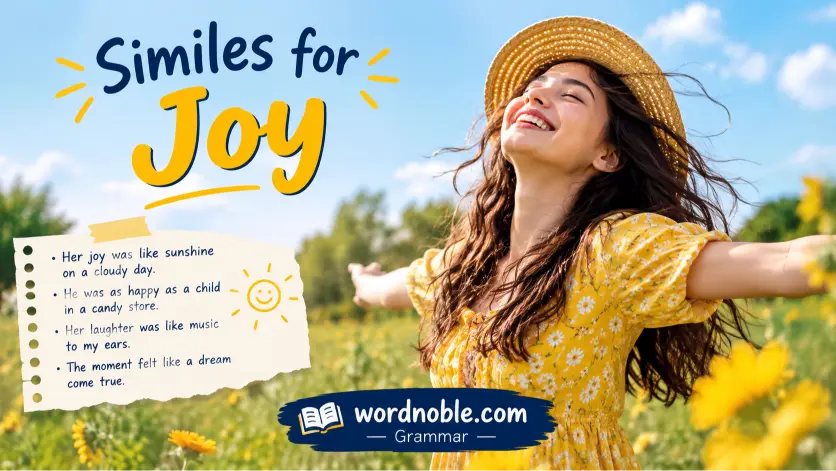
Joy feels “as bright as sunlight on fresh snow.” Great similes for joy work like that: they let readers see a feeling instead of just hearing its name.
Saying someone is “very happy” tells us little. Comparing their smile to a sunrise, or their heart to a kite in strong wind, makes the feeling real. Readers don’t just understand the emotion. They feel it too.
Below, you’ll find fresh, easy examples grouped by mood: quiet contentment, wild excitement, childlike delight, and deep relief. Each one works for stories, poems, captions, speeches, or school assignments.
Every example is short, vivid, and easy to borrow. You’ll also learn how to build your own comparisons and skip tired lines like “happy as a clam” that readers skim past.
Some of these will make you smile. A few might even match a memory of your own.
Let’s start with the ones that capture pure, bubbling happiness, the kind that makes you laugh out loud.
Similes for joy are comparisons that describe happiness by using “like” or “as.” They make feelings of delight, excitement, and pleasure easier to imagine..
What Are Similes for Joy?
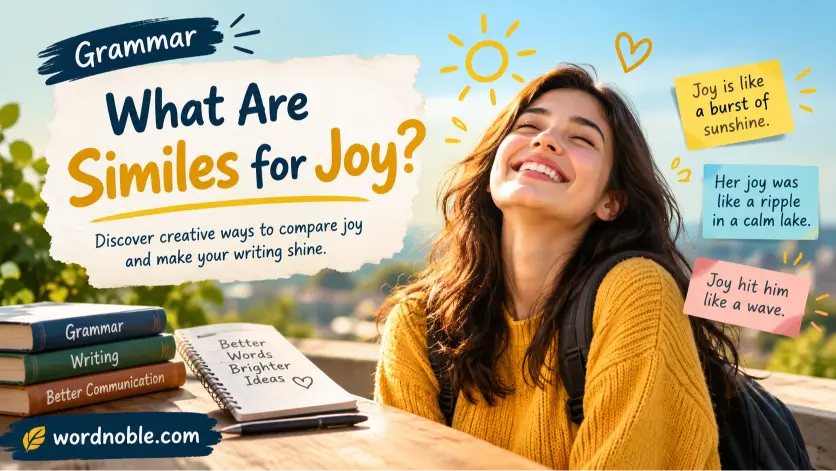
Similes for joy are examples of figurative language that compare happiness or delight to something familiar. They commonly use words such as like or as to make the comparison clear.
For example:
- Her joy was like sunshine breaking through clouds.
- He was as happy as a child on a holiday.
- Their laughter sounded like birds singing at dawn.
The purpose is not to say that joy literally becomes sunlight, a child, or birdsong. Instead, the comparison helps the reader understand the quality, intensity, or feeling of the emotion.
A strong joy simile can communicate several ideas at once. It may suggest brightness, freedom, energy, warmth, excitement, peace, or celebration.
Why Do Writers Use Similes for Joy?
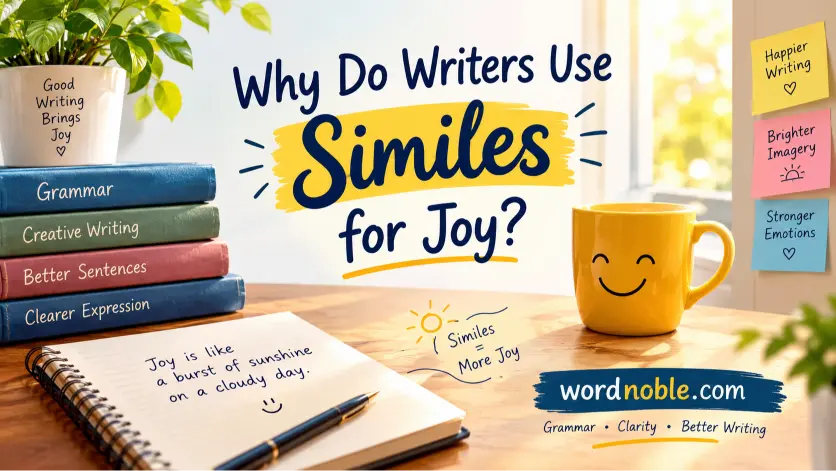
Joy is an abstract emotion. Readers cannot physically hold or see happiness itself, so writers often use familiar images to make it more concrete.
Similes for joy can:
- Create vivid mental pictures
- Make emotional writing more memorable
- Show the intensity of happiness
- Add warmth and personality to a sentence
- Strengthen poetry and storytelling
- Help readers connect emotionally with characters
- Make simple descriptions more creative
- Improve sensory language and imagery
Compare these two sentences:
Plain:
She was very happy.
With a simile:
Her happiness was like sunlight filling a dark room.
The second sentence gives the reader something to imagine. It suggests that her joy brought brightness and warmth into an otherwise difficult situation.
Similes for joy are figurative comparisons used to describe happiness, delight, excitement, or emotional pleasure through familiar images. They help readers understand an abstract feeling by connecting it with recognizable qualities such as brightness, warmth, freedom, energy, or celebration.
How Similes for Joy Create Emotional and Sensory Imagery
A good simile does more than replace the word “happy.” It gives the emotion a recognizable shape.
Visual Imagery
Visual comparisons can make joy seem bright, colorful, or expansive.
Example:
Her joy was like a rainbow appearing after a storm.
The rainbow suggests beauty, hope, and a positive change after difficulty.
Auditory Imagery
Sound-based comparisons can show excitement or celebration.
Example:
His laughter was like bells ringing on a festival morning.
The reader can almost hear the cheerful sound.
Nature-Based Imagery
Nature provides some of the strongest emotional comparisons because sunlight, flowers, birds, rivers, and spring often carry positive associations.
Example:
Her happiness spread like flowers blooming in spring.
Movement and Energy
Some forms of joy feel active and energetic.
Example:
He was like a child running through an open field.
The comparison suggests freedom, excitement, and carefree happiness.
50+ Similes for Joy With Meanings
1. Nature-Based Similes for Joy
Nature is especially useful when you want joy to feel peaceful, beautiful, warm, or refreshing.
1. Joyful like sunshine after rain
Meaning: Happiness that arrives after a difficult or sad period.
Category: Nature-based
2. As happy as a flower in spring
Meaning: Fresh, natural, and uplifting happiness.
Category: Nature-based
3. Her joy was like a rainbow after a storm
Meaning: A beautiful feeling following hardship.
Category: Nature-based
4. His happiness was like a warm summer breeze
Meaning: Gentle, pleasant, and comforting joy.
Category: Nature-based
5. She smiled like the sun rising over the hills
Meaning: Her happiness seemed bright and hopeful.
Category: Nature-based
6. Their joy spread like sunlight across the valley
Meaning: Happiness gradually reached everyone around them.
Category: Nature-based
7. He felt as free as a bird in the open sky
Meaning: His joy came from freedom and release.
Category: Nature-based
8. Her excitement was like waves dancing along the shore
Meaning: Her happiness was lively and continuously moving.
Category: Nature-based
9. His heart felt light like a leaf carried by the wind
Meaning: He felt free, relaxed, and joyful.
Category: Nature-based
10. Their happiness bloomed like wildflowers
Meaning: Their joy developed naturally and beautifully.
Category: Nature-based
2. Animal-Based Similes for Joy
Animals can make emotional descriptions playful, energetic, and easy to visualize.
11. He was as happy as a puppy chasing a ball
Meaning: He showed innocent and energetic happiness.
Category: Animal-based
12. She jumped around like a lamb in a meadow
Meaning: She was extremely cheerful and energetic.
Category: Animal-based
13. He grinned like a cat that had found a sunny window
Meaning: He looked comfortably pleased and satisfied.
Category: Animal-based
14. The children were like birds released from a cage
Meaning: They felt excited and free.
Category: Animal-based
15. She danced like a butterfly in the sunshine
Meaning: Her movements showed lighthearted happiness.
Category: Animal-based
16. He was as cheerful as a songbird at sunrise
Meaning: He was naturally bright and happy.
Category: Animal-based
17. They scattered like excited puppies at playtime
Meaning: They moved with playful energy.
Category: Animal-based
18. Her laughter bubbled like a bird singing in spring
Meaning: Her happiness sounded natural and lively.
Category: Animal-based
3. Object-Based and Technology-Based Similes for Joy
Modern writing can use familiar objects and technology to create fresh comparisons.
19. His smile was like a light switching on in a dark room
Meaning: His happiness immediately created a sense of brightness.
Category: Object-based
20. Her joy was like a balloon rising into the sky
Meaning: Her happiness felt light, exciting, and unrestricted.
Category: Object-based
21. His excitement was like fireworks lighting up the night
Meaning: His happiness was dramatic and energetic.
Category: Object-based
22. She was as cheerful as a window opening on a sunny morning
Meaning: Her mood felt refreshing and uplifting.
Category: Object-based
23. His happiness spread like a notification popping up on every screen
Meaning: His excitement quickly became noticeable to everyone.
Category: Technology-based
24. Her smile was like a bright screen in a dark room
Meaning: Her smile stood out and brought brightness.
Category: Technology-based
25. Their excitement was like a phone buzzing with good news
Meaning: Their happiness was sudden and energetic.
Category: Technology-based
4. Funny and Exaggerated Similes for Joy
Humorous similes deliberately exaggerate happiness to make writing entertaining.
26. He was as happy as a kid who just found money in an old jacket
Meaning: He was unexpectedly delighted.
27. She smiled like someone who had just won the world’s biggest pizza
Meaning: Her happiness was exaggerated for comic effect.
28. He was bouncing around like popcorn in a hot pan
Meaning: He was extremely energetic and excited.
29. She was as cheerful as a dog hearing the word “walk”
Meaning: She became instantly excited.
30. He looked like a child who had discovered an unlimited candy shop
Meaning: He was overwhelmingly delighted.
31. Their excitement was like confetti exploding in every direction
Meaning: Their happiness was energetic, colorful, and impossible to contain.
32. He grinned like he had just been handed a lifetime supply of ice cream
Meaning: He looked extraordinarily pleased.
5. Emotional and Behavioral Similes for Joy
These comparisons focus on how happiness affects behavior and emotional expression.
33. She smiled like someone carrying wonderful news
Meaning: Her expression revealed hidden excitement.
34. His heart felt as light as a feather
Meaning: He felt carefree and emotionally relieved.
35. She laughed like she had forgotten every worry
Meaning: Her laughter showed complete emotional freedom.
36. He was as bright as a child on a birthday morning
Meaning: His happiness was obvious and innocent.
37. Her excitement rose like a wave
Meaning: Her joy gradually became stronger.
38. His happiness spread like laughter through a crowd
Meaning: His positive mood affected other people.
39. She felt like she was floating on air
Meaning: She was extremely happy and carefree.
40. His smile was as wide as a crescent moon
Meaning: He had an especially large, noticeable smile.
Best Similes for Joy in One Quick List
For quick reference, here are some of the most useful choices:
- Joyful like sunshine after rain
- Happy as a flower in spring
- Joy like a rainbow after a storm
- Happiness like a warm summer breeze
- Free as a bird in the open sky
- Happy as a puppy chasing a ball
- Cheerful as a songbird at sunrise
- Joy like sunlight filling a dark room
- Excitement like fireworks in the night
- Happiness like a balloon rising into the sky
- Lighthearted like a feather floating in the wind
- Happy like a child on a birthday morning
- Joy spreading like flowers blooming in spring
- Excited like popcorn in a hot pan
- Happiness like confetti filling the air
Context Table: How to Use Similes for Joy
| Context | Meaning | Use Case | Example |
|---|---|---|---|
| Storytelling | Character happiness | Fiction | Her joy was like sunlight after rain. |
| Poetry | Beauty and emotion | Poems | His happiness bloomed like spring flowers. |
| Casual speech | Simple happiness | Conversations | I feel as happy as a kid on vacation. |
| Humor | Exaggerated excitement | Funny writing | He was bouncing like popcorn in a pan. |
| School writing | Clear emotional imagery | Assignments | Her joy was like a rainbow after a storm. |
| Descriptive writing | Strong mental imagery | Creative work | His smile was like a light in a dark room. |
| Romantic writing | Warm emotional connection | Love writing | Her smile was like sunrise after a long night. |
| Celebration | Excitement | Cards and messages | Their happiness burst like fireworks. |
How to Use Similes for Joy Naturally in Writing
A simile works best when it adds information rather than simply decorating a sentence.
1. Identify the Type of Joy
Ask what kind of happiness you want to communicate.
Is it:
- Peaceful?
- Exciting?
- Childlike?
- Relieved?
- Romantic?
- Energetic?
- Unexpected?
- Humorous?
Then choose an image that matches that specific emotion.
For example, “joy like fireworks” suggests excitement, while “joy like a warm breeze” suggests calm pleasure.
2. Choose a Familiar Image
Readers understand familiar things quickly. Sunlight, flowers, birds, music, fireworks, balloons, and waves can create immediate mental pictures.
3. Match the Comparison to the Character
A child’s happiness might be compared with a puppy or birthday morning. A poet might choose sunrise, spring, or birdsong.
4. Use Sensory Language
Think beyond what happiness looks like.
Ask:
- What would joy sound like?
- What would it feel like?
- What would it look like?
- How would it move?
- What could represent its warmth?
This creates richer sensory writing.
5. Avoid Explaining Too Much
A strong comparison should often speak for itself.
Instead of:
She was happy like sunshine, which meant she felt very cheerful and positive.
Try:
Her joy was like sunshine after rain.
The second version is cleaner and more powerful.
Simile vs. Metaphor: What’s the Difference?
A simile makes a comparison using words such as like or as.
Simile:
Her joy was like sunshine.
A metaphor makes the comparison directly without “like” or “as.”
Metaphor:
Her joy was sunshine.
Both are forms of figurative language, but their grammatical structures are different.
A simile usually makes the comparison more explicit, which can be especially helpful for students and readers learning descriptive writing.
When Not to Use a Simile
Similes are useful, but more comparisons do not always make writing better.
Avoid a simile when:
- The comparison feels forced.
- The meaning is already perfectly clear.
- It distracts from an important action.
- You use several similes in every sentence.
- The comparison has no logical connection.
- The image is confusing for the reader.
- A simpler sentence would be stronger.
Good writing depends on precision, not the number of figurative expressions used.
Common Mistakes When Writing Similes for Joy
Overusing Similes
Using one strong comparison can be effective. Using five in one sentence can overwhelm the reader.
Choosing an Unclear Comparison
The reader should understand why two things are being compared.
Confusing Similes With Metaphors
Remember:
Simile: Her joy was like sunshine.
Metaphor: Her joy was sunshine.
Using Clichés Without Purpose
Some comparisons are familiar because they are effective, but overly predictable phrases can make writing feel ordinary. When appropriate, develop a fresh comparison connected to the scene.
Ignoring Context
A peaceful scene may not fit a comparison involving fireworks. Match the simile to the mood.
Do and Don’t: Using Joy Similes
Do
- Choose comparisons that fit the emotion.
- Use familiar images when clarity matters.
- Create sensory details.
- Match the simile to the context.
- Use fresh comparisons when they improve the writing.
- Keep the sentence easy to understand.
Don’t
- Add a simile to every sentence.
- Force an unrelated comparison.
- Mix several comparisons confusingly.
- Use “like” automatically without making a meaningful comparison.
- Sacrifice clarity for creativity.
- Explain a simple simile unnecessarily.
Natural Chat Responses Using Similes for Joy
Here are some casual ways people might naturally use joy similes in messages:
1. “I’m as happy as a kid on the first day of summer vacation!”
2. “You just made my day. I feel like sunshine after a rainy week.”
3. “She was bouncing around like popcorn after hearing the good news.”
4. “That message made me smile like I had just won something amazing.”
5. “I feel as light as a feather today.”
6. “His excitement was like fireworks there was no hiding it.”
Related Terms and Semantic Concepts
Understanding related language concepts can help you use similes more effectively.
Figurative Language
Figurative language communicates ideas beyond their literal meaning. Similes and metaphors are two common examples.
Auditory Imagery
Auditory imagery describes sounds in a way that helps readers imagine hearing them.
Sensory Writing
Sensory writing appeals to sight, sound, touch, taste, and smell to make descriptions more vivid.
Descriptive Writing
Descriptive writing uses specific details and imagery to help readers picture a person, place, object, or emotion.
Metaphor vs. Simile
Both compare ideas, but similes generally use “like” or “as,” while metaphors make a direct comparison.
FAQs:
1. What are similes for joy?
Similes for joy are comparisons that describe happiness, delight, excitement, or pleasure using “like” or “as.” They turn an abstract emotion into something readers can imagine. For example, saying “her joy was like sunshine after rain” suggests brightness, warmth, and emotional relief. These comparisons are useful in stories, poems, school assignments, speeches, captions, and descriptive writing.
2. What is a good simile for joy?
A good simile for joy is “joyful like sunshine after rain.” It works because sunshine suggests warmth, brightness, and positive change after a difficult period. Other useful choices include “happy as a child on a birthday,” “joy like a rainbow after a storm,” and “excited like fireworks in the night.” The best choice depends on the exact type of happiness you want to express.
3. What are some funny similes for joy?
Funny similes exaggerate happiness to create humor. Examples include “as happy as a dog hearing the word walk,” “bouncing like popcorn in a hot pan,” and “grinning like someone who just discovered an unlimited candy shop.” These comparisons work particularly well in casual messages, humorous stories, social posts, and playful descriptions because they make ordinary happiness more entertaining.
4. What are some poetic similes for joy?
Poetic similes often connect joy with beautiful natural images. Examples include “her happiness bloomed like wildflowers,” “his joy was like sunlight across a quiet valley,” and “her smile rose like the morning sun.” These comparisons create visual and emotional imagery. Poetic similes are especially useful when a writer wants happiness to feel gentle, beautiful, hopeful, or emotionally meaningful.
5. What is the difference between a simile and a metaphor?
A simile explicitly compares two things, usually with “like” or “as.” For example, “Her joy was like sunshine.” A metaphor makes the comparison directly: “Her joy was sunshine.” Both are forms of figurative language, but a simile makes the relationship between the two ideas more obvious to the reader.
6. How can I use similes for joy in writing?
Start by deciding what kind of joy you want to show. Then choose an image that shares that quality. For peaceful happiness, nature can work well. For energetic excitement, fireworks or movement may fit better. Add the comparison naturally to the sentence and avoid explaining it excessively. A strong simile should clarify or intensify the emotion rather than distract from it.
7. Why are similes important in English literature?
Similes help writers communicate abstract emotions and ideas through familiar images. Joy, sadness, fear, love, and anger cannot always be described effectively with literal vocabulary alone. A well-chosen simile gives readers something concrete to imagine and can strengthen characterization, mood, imagery, and emotional impact. Because of this, similes are an important creative writing and English literature technique.
8. How can students use similes for joy?
Students can use joy similes in essays, creative writing, poems, journal entries, narratives, and descriptive assignments. Instead of writing “the character was happy,” a student could write, “The character was as happy as a child on a birthday morning.” The comparison gives the reader more information about the character’s emotional state while demonstrating an understanding of figurative language.
9. Can similes for joy be used in poetry?
Yes. Similes are especially effective in poetry because they create vivid images using relatively few words. A poet can compare joy with sunlight, flowers, birdsong, waves, or other sensory experiences. The best poetic similes usually fit the poem’s mood and theme rather than appearing simply because the writer wants to add figurative language.
10. Can a simile describe different kinds of joy?
Yes. Different comparisons can communicate different forms of happiness. A simile involving sunshine may suggest warmth or hope, while fireworks can suggest intense excitement. A flower may represent gentle growth, and a bird may suggest freedom. Choosing the right comparison allows a writer to show not only that a character feels joy, but also what that joy feels like.
Conclusion:
Similes for joy make an abstract emotion easier to see, hear, and feel. Instead of simply telling readers that someone is happy, a well-chosen comparison can show whether that happiness feels peaceful like a warm breeze, bright like sunshine, or explosive like fireworks.
The key is to choose an image that matches the exact emotion and context. Use nature, animals, objects, movement, or sensory details to create meaningful comparisons, but avoid forcing a simile into every sentence.
When used carefully, similes strengthen figurative language, descriptive writing, poetry, storytelling, and English literature. The best simile is not necessarily the most complicated one it is the comparison that makes the reader instantly understand the feeling.

I am Naqash Ayub, proudly writing for WordNoble, where I focus on creating clear, informative, and SEO-friendly content. I enjoy turning detailed information into simple, trustworthy articles that help readers find the answers they need.