
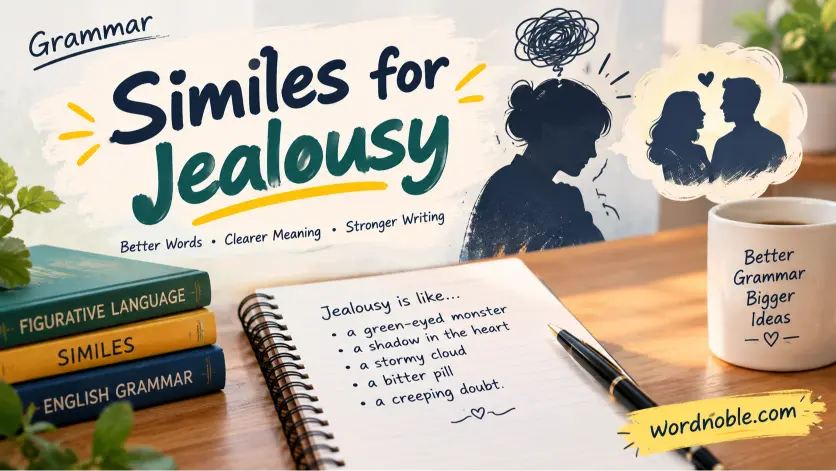
Jealousy burns, twists, and whispers all at once. The best similes for jealousy capture that chaos in a single line. And you don’t need to be a poet to write them.
A simile compares jealousy to something familiar, using “like” or “as.” Jealousy is like a splinter you can’t reach. It spreads like ink in clear water. The right comparison makes readers nod and think, “Yes, exactly.”
Whether you’re writing a story, a poem, or a caption, you need figurative language that feels fresh. The old “green-eyed monster” has been used a thousand times. Readers notice.
Below, you’ll find jealousy comparisons sorted by mood and intensity, from quiet envy to bitter rage. A few are even funny. Each one is easy to copy, adapt, or use as inspiration. You’ll also learn how to build your own original similes and avoid the mistakes that make them fall flat.
Let’s start with the classics that still work, and how to give each one a fresh twist.
Similes for jealousy are comparisons that describe jealousy using “like” or “as,” making the emotion more vivid, memorable, and easier to visualize.
For example, “Her jealousy spread like wildfire” compares the rapid growth of jealousy to the uncontrollable spread of fire.
What Do Similes for Jealousy Mean?
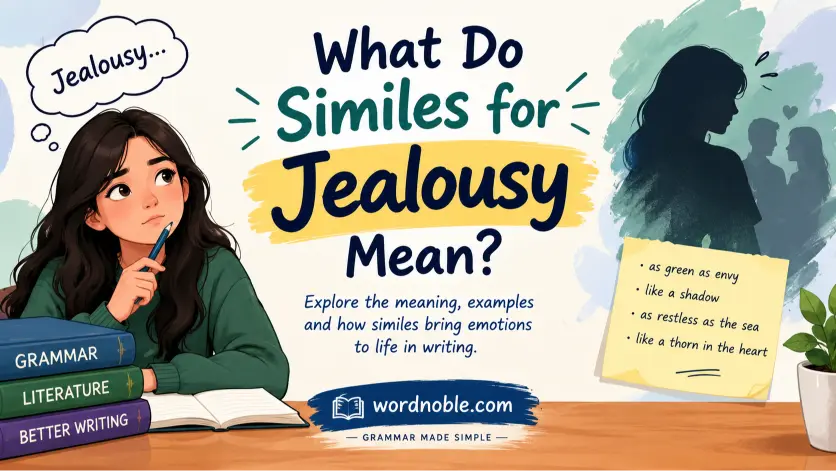
Similes for jealousy are a form of figurative language used to describe envy, insecurity, possessiveness, suspicion, or resentment through comparison.
Instead of simply writing:
He was jealous.
A writer might say:
His jealousy burned like a hidden fire.
The second sentence creates a stronger mental image. Readers can imagine something hot, dangerous, and difficult to control.
A simile usually uses words such as like or as to connect two different things. The comparison does not need to be literally true. Its purpose is to communicate an emotion or idea through imagery.
Jealousy can be compared with:
- Fire
- Storms
- Shadows
- Wild animals
- Thorns
- Green plants
- Poison
- Smoke
- Waves
- Claws
- Machines
- Lightning
- Ice
These comparisons help writers communicate different shades of jealousy. One simile may suggest anger, while another may emphasize insecurity, fear, obsession, or silent resentment.
Similes for jealousy are figurative comparisons that make jealousy easier to understand by connecting the emotion with a familiar object, creature, natural force, behavior, or experience. They add sensory and emotional detail to descriptive writing without stating that the comparison is literally true.
How Do Similes for Jealousy Work?
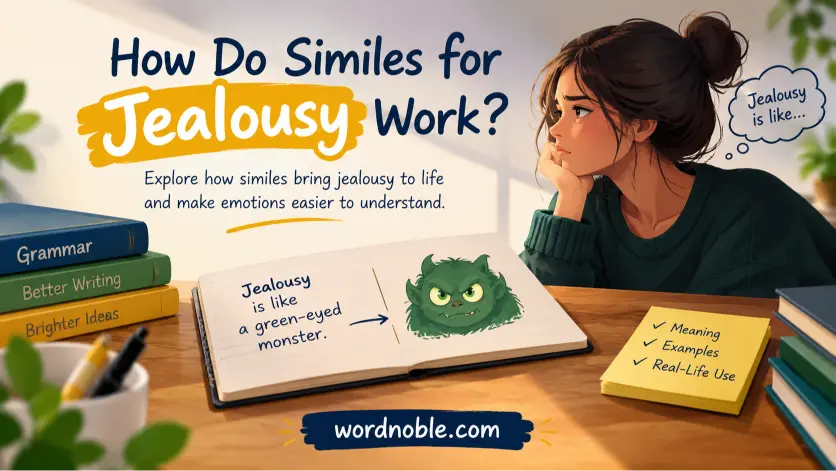
Jealousy is an abstract emotion. You cannot physically hold jealousy, see it sitting on a table, or measure it with a ruler.
Similes make that invisible feeling more concrete.
Consider:
“Her jealousy was like a storm gathering over the sea.”
This comparison suggests that the emotion is becoming stronger and may soon become difficult to control.
Another example is:
“His jealousy clung to him like a shadow.”
This creates a different feeling. Instead of sudden anger, it suggests a persistent emotion that follows someone everywhere.
The best similes do more than decorate a sentence. They communicate mood, intensity, behavior, and emotional meaning.
Why Writers Use Similes for Jealousy
Writers use them to:
- Make abstract emotions easier to visualize
- Create stronger emotional imagery
- Show rather than simply tell
- Establish mood
- Add personality to characters
- Make poetry more expressive
- Improve descriptive writing
- Make stories more memorable
- Communicate subtle emotional differences
Why Are Similes for Jealousy Useful in Figurative Language?
Similes are an important part of figurative language because they allow writers to connect unfamiliar or abstract ideas with familiar experiences.
Jealousy can be complicated. Someone might feel jealous because they are afraid of losing someone, comparing themselves with another person, feeling ignored, or wanting something another person has.
A carefully chosen comparison can reveal that complexity.
For example:
- Jealousy like fire → suggests heat, anger, or destruction.
- Jealousy like a shadow → suggests something persistent and difficult to escape.
- Jealousy like poison → suggests gradual emotional harm.
- Jealousy like a storm → suggests emotional turbulence.
- Jealousy like thorns → suggests pain and irritation.
This makes similes particularly useful in English literature, poetry, storytelling, speeches, essays, and creative writing.
Types of Similes for Jealousy
🐾 Animal-Based Similes
Animals can represent instinct, aggression, possessiveness, or relentless behavior.
Examples
1. His jealousy was like a wolf stalking its prey.
Meaning: His jealousy was watchful, persistent, and potentially threatening.
2. Her jealousy clawed at her like a trapped tiger.
Meaning: She felt powerful but uncomfortable emotional pressure.
3. His jealousy followed her like a jealous guard dog.
Meaning: He was overly protective and suspicious.
4. Jealousy crept through him like a snake in tall grass.
Meaning: The feeling developed quietly and secretly.
Animal comparisons work particularly well in stories because they can make a character’s emotional behavior feel instinctive or intense.
📡 Technology-Based Similes
Modern writing can use technology to create fresh and relatable comparisons.
Examples
5. His jealousy spread through his thoughts like a computer virus.
Meaning: The feeling infected his thinking and became difficult to remove.
6. Her jealousy flashed through her mind like a warning notification.
Meaning: Something triggered an immediate emotional reaction.
7. His jealousy kept running like an app in the background.
Meaning: The emotion remained present even when he was not consciously thinking about it.
Technology-based similes are useful in contemporary stories, social-media writing, blogs, and informal communication.
🌿 Nature-Based Similes
Nature provides some of the most powerful imagery for emotional writing.
Examples
8. Her jealousy grew like weeds in an untended garden.
Meaning: The feeling became stronger when it was ignored.
9. His jealousy spread like wildfire through the group.
Meaning: The emotion became intense and spread rapidly.
10. Jealousy rose like dark clouds before a storm.
Meaning: A troubling emotional situation was developing.
11. Her jealousy moved like a cold wind through the room.
Meaning: Her negative emotion affected the atmosphere around her.
Nature-based comparisons are especially effective in poetry and descriptive fiction because they provide strong visual and sensory imagery.
😂 Humorous and Exaggerated Similes
Not every expression of jealousy needs to sound serious. Humor can make jealousy relatable.
Examples
12. He was as jealous as a cat watching someone touch its favorite toy.
Meaning: He was comically possessive.
13. Her jealousy was like a toddler guarding the last cookie.
Meaning: Her possessiveness was obvious and exaggerated.
14. He looked as jealous as a rooster watching another bird steal the spotlight.
Meaning: His jealousy was dramatic and amusing.
15. His jealousy exploded like popcorn in a microwave.
Meaning: His emotional reaction grew quickly and dramatically.
Funny similes are useful in conversations, social posts, comedy writing, and lighthearted stories.
🎭 Emotional and Behavioral Similes
These comparisons focus directly on how jealousy feels or behaves.
Examples
16. Her jealousy burned like a secret fire.
Meaning: She felt intense jealousy but tried to hide it.
17. His jealousy was like a shadow that followed him everywhere.
Meaning: He could not easily escape the feeling.
18. Jealousy settled over him like a heavy blanket.
Meaning: The emotion became overwhelming and difficult to shake.
19. Her jealousy was like poison slowly entering her thoughts.
Meaning: The emotion gradually damaged her thinking and feelings.
20. His jealousy tightened around him like a rope.
Meaning: The feeling made him feel trapped or controlled.
20 Powerful Similes for Jealousy
| Simile | Meaning | Category |
|---|---|---|
| Jealousy burned like fire. | Intense emotional heat | Nature |
| Jealousy followed him like a shadow. | Persistent insecurity | Emotional |
| Her jealousy spread like wildfire. | Rapidly increasing emotion | Nature |
| His jealousy was like a storm. | Emotional turbulence | Nature |
| Jealousy crept in like a snake. | Quiet, hidden suspicion | Animal |
| Her jealousy grew like weeds. | Increasing resentment | Nature |
| His jealousy was like poison. | Emotion causing gradual harm | Emotional |
| Jealousy clawed at her like a wild animal. | Painful emotional pressure | Animal |
| His jealousy flashed like lightning. | Sudden emotional reaction | Nature |
| Her jealousy hung like dark clouds. | Heavy emotional tension | Nature |
| His jealousy ran like a background app. | Constant underlying thought | Technology |
| Jealousy stuck to him like glue. | Difficulty letting go | Object |
| Her jealousy was as sharp as a thorn. | Painful resentment | Nature |
| His jealousy rose like a wave. | Emotion becoming stronger | Nature |
| Jealousy wrapped around her like chains. | Feeling trapped by insecurity | Object |
| His jealousy was like an alarm bell. | Strong warning or fear | Object |
| Her jealousy spread like ink in water. | Emotion affecting everything | Object/Nature |
| His jealousy was like a locked cage. | Emotional restriction | Object |
| Jealousy hovered like a dark cloud. | Constant negative mood | Nature |
| Her jealousy was like a fire with no end. | Uncontrolled emotional intensity | Nature |
How Similes for Jealousy Change by Context
| Context | Meaning | Use Case | Example |
|---|---|---|---|
| Storytelling | Shows character emotion | Fiction | His jealousy followed him like a shadow. |
| Poetry | Creates emotional imagery | Poems | Jealousy burned like a hidden flame. |
| Casual Speech | Makes feelings relatable | Conversation | I was jealous like a kid guarding his favorite toy. |
| Humor | Exaggerates emotion | Comedy | His jealousy exploded like popcorn. |
| Academic Writing | Explains figurative language | Schoolwork | The writer compares jealousy to a storm. |
| Descriptive Writing | Creates sensory detail | Essays | Jealousy spread like smoke through the room. |
| Romance | Shows insecurity or possessiveness | Fiction | Her jealousy clung to her like a shadow. |
| Drama | Builds emotional tension | Scripts | His jealousy rose like thunder before rain. |
How to Use Similes for Jealousy in Writing
A strong simile should feel natural rather than forced.
1. Identify the Type of Jealousy
First ask what kind of jealousy you want to communicate.
Is it:
- Quiet?
- Angry?
- Fearful?
- Possessive?
- Funny?
- Sudden?
- Persistent?
- Destructive?
- Secret?
Then select a comparison that matches the emotion.
For example, “like a shadow” works well for persistent jealousy, while “like lightning” works better for a sudden reaction.
2. Match the Comparison to the Mood
Do not choose an image simply because it sounds dramatic.
A peaceful story may benefit from:
“Jealousy drifted through her thoughts like a gray cloud.”
A tense scene might use:
“His jealousy burned like a fire beneath dry leaves.”
The comparison should support the surrounding scene.
3. Use Sensory Language
Sensory language helps readers imagine the emotion.
You can describe jealousy through:
- Sight
- Sound
- Touch
- Movement
- Temperature
- Color
For example:
“Jealousy spread through him like cold water.”
The reader can almost feel the emotion.
4. Avoid Explaining Too Much
A strong simile often allows the reader to understand the emotion without a long explanation.
Instead of:
She was extremely jealous because she was worried that her friend would leave her.
Try:
Her jealousy clung to her like a shadow.
The surrounding context can explain the reason.
Simile vs. Metaphor for Jealousy
Similes and metaphors both use comparisons, but they structure those comparisons differently.
Simile
A simile usually uses like or as.
“His jealousy was like a burning fire.”
The writer says jealousy is similar to fire.
Metaphor
A metaphor directly identifies one thing with another.
“His jealousy was a burning fire.”
Here, the comparison is presented more directly.
Simple Difference
Simile = comparison using like or as.
Metaphor = direct comparison without like or as.
Both can create powerful imagery. The choice depends on the tone and style of the writing.
Common Mistakes When Using Similes for Jealousy
1. Overusing Comparisons
A paragraph filled with similes can become distracting.
Instead of using five comparisons in every sentence, choose one strong image that communicates the emotion clearly.
2. Choosing an Illogical Comparison
A simile should make sense within its context.
For example, comparing quiet jealousy to an exploding volcano may create a confusing emotional signal if the character is deliberately hiding the feeling.
3. Confusing Similes With Metaphors
Remember that a simile normally signals its comparison with like or as.
Simile: Jealousy spread like smoke.
Metaphor: Jealousy was smoke.
4. Using Clichés Without Purpose
Common comparisons can work, but fresh imagery often makes writing more memorable.
Instead of repeatedly saying:
Jealousy was like fire.
You could write:
Jealousy spread through his thoughts like ink dropped into clear water.
The image gives the reader something more specific to visualize.
👍 Usage Guide: Do and Don’t
Do
- Choose comparisons that match the emotion.
- Use simple language when possible.
- Make your imagery specific.
- Consider the character and setting.
- Use sensory details.
- Let the simile support the main idea.
- Experiment with nature, animals, objects, and technology.
Don’t
- Add a simile to every sentence.
- Force a comparison that does not fit.
- Mix several unrelated images together.
- Explain an obvious comparison repeatedly.
- Use complicated vocabulary just to sound impressive.
- Forget the tone of your audience.
Natural Chat-Style Examples
Here are some casual ways people might use jealousy-related similes naturally:
1. “I got jealous like a kid watching someone eat the last slice of pizza.”
2. “His jealousy came out of nowhere, like lightning.”
3. “She was jealous as a cat guarding its favorite spot.”
4. “That little comment spread jealousy through the group like wildfire.”
5. “I tried to ignore it, but the jealousy stuck to me like glue.”
These sound more conversational than highly literary expressions and can work well in texts, social media, dialogue, and informal writing.
Why Are Similes for Jealousy Important in English Literature?
English literature frequently uses figurative language to represent emotions that are difficult to describe literally.
Jealousy is particularly suitable for figurative expression because it can involve multiple emotions at once: desire, insecurity, anger, fear, comparison, and possessiveness.
A writer can therefore use imagery to show how jealousy affects a character rather than simply naming the emotion.
For students, analyzing a jealousy simile can also reveal:
- Character development
- Tone
- Mood
- Symbolism
- Emotional conflict
- Imagery
- Authorial style
- Figurative language
This makes similes useful not only for creative writing but also for literary analysis and English assignments.
How Students Can Use Similes for Jealousy
Students can use these comparisons in:
- Creative writing assignments
- Poetry
- Short stories
- Character descriptions
- Descriptive essays
- Dialogue
- Literary analysis
- Figurative-language exercises
For schoolwork, the strongest approach is to explain both the comparison and its effect.
For example:
“The author compares jealousy to a storm.”
Then explain:
“This suggests that the character’s jealousy is powerful, unpredictable, and difficult to control.”
That demonstrates understanding rather than simply identifying the figurative device.
Related Figurative Language Terms
Understanding jealousy similes becomes easier when you know the related concepts.
Figurative Language
Language that communicates ideas beyond literal meaning.
Auditory Imagery
Language that creates an impression of sound or hearing. It is one type of sensory imagery and can be combined with emotional comparisons.
Sensory Writing
Writing that appeals to the senses to make descriptions more vivid.
Metaphor
A direct comparison between unlike things without using “like” or “as.”
Descriptive Writing
Writing that uses carefully selected details to help readers imagine a person, place, object, feeling, or experience.
Imagery
Language that creates a mental picture or sensory impression.
FAQs:
Similes for jealousy are figurative comparisons that describe jealousy by connecting it to something familiar. They often use “like” or “as” to make an abstract emotion easier to imagine. For example, jealousy can be compared to fire, a storm, a shadow, poison, or a wild animal. The specific comparison changes the emotional meaning and helps readers understand how jealousy affects a character.
What are some examples of similes for jealousy?
Examples include “His jealousy burned like fire,” “Her jealousy followed her like a shadow,” and “Jealousy spread through the group like wildfire.” Each comparison emphasizes a different quality. Fire suggests intensity, a shadow suggests persistence, and wildfire suggests rapid growth. Writers should choose the example that best matches the emotion and situation they want to communicate.
What are some funny similes for jealousy?
Funny similes can compare jealousy to everyday situations or exaggerated behavior. For example, someone might be “as jealous as a kid guarding the last cookie” or have jealousy that “exploded like popcorn in a microwave.” Humorous comparisons make emotional situations feel lighter and work especially well in casual dialogue, social media posts, comedy, and entertaining stories.
What are some poetic similes for jealousy?
Poetic similes often use nature, light, darkness, weather, or movement. Examples include “Jealousy rose like a storm over the sea” and “Her jealousy burned like a hidden flame.” These comparisons create emotional imagery rather than simply naming the feeling. Poetic similes are especially effective when a writer wants to create atmosphere, symbolism, or a strong emotional mood.
What is the difference between a simile and a metaphor for jealousy?
A simile compares jealousy with something else using words such as “like” or “as.” For example, “His jealousy was like fire.” A metaphor makes the comparison directly: “His jealousy was fire.” Both forms of figurative language can communicate intensity or emotional meaning. The main structural difference is how directly the comparison is expressed.
How can I use similes for jealousy in writing?
Start by deciding what kind of jealousy your character feels. Then choose an image that matches it. A shadow can represent persistent jealousy, while fire can represent intensity. Place the comparison where it strengthens the description rather than adding it unnecessarily. A well-chosen simile should clarify the emotion, contribute to the mood, and fit naturally with the surrounding sentences.
Why are similes for jealousy useful in English literature?
They help writers represent an abstract emotion through concrete imagery. Jealousy can involve anger, insecurity, fear, desire, and possessiveness, so a single literal word may not communicate its full effect. A simile allows readers to visualize or sense the emotion. In literary analysis, studying these comparisons can also reveal characterization, tone, mood, symbolism, and the writer’s creative choices.
How can students use jealousy similes in assignments?
Students can use them in creative writing, poetry, character descriptions, descriptive essays, and figurative-language exercises. In literary analysis, students should explain not only what the simile is but also what it suggests. For example, if jealousy is compared with a storm, the comparison may suggest emotional turbulence or an approaching conflict. Explaining the effect demonstrates deeper understanding.
Can similes for jealousy be used in poetry?
Yes. Similes are especially useful in poetry because they can communicate complicated emotions in very few words. A poet might compare jealousy to a shadow, thorn, flame, storm, or wave. The chosen image can create rhythm, mood, symbolism, and sensory detail. Strong poetic similes usually support the poem’s broader theme rather than appearing only as decorative language.
Can I create my own similes for jealousy?
Absolutely. Creating original similes is often more effective than relying on familiar comparisons. Think about how jealousy behaves and find something with a similar quality. If jealousy grows slowly, compare it with something that grows gradually. If it appears suddenly, choose something sudden. This approach produces comparisons that feel natural, specific, and connected to the character or situation.
Conclusion:
Similes for jealousy give writers a creative way to turn an abstract emotion into something readers can see, feel, and understand. A comparison with fire can suggest intensity, while a shadow can represent persistence, and a storm can communicate emotional turbulence.
The key is choosing an image that genuinely matches the feeling you want to express. Used carefully, similes strengthen figurative language, sensory writing, poetry, storytelling, and literary analysis.
They also help students move beyond simple statements and create more vivid descriptions. Whether you are writing a poem, developing a fictional character, or completing an English assignment, the right simile can make jealousy feel much more real and memorable.

I am Naqash Ayub, proudly writing for WordNoble, where I focus on creating clear, informative, and SEO-friendly content. I enjoy turning detailed information into simple, trustworthy articles that help readers find the answers they need.