
Cheating rarely begins with a confession. More often, it starts as a crack in trust, a hidden door, or a shadow growing quietly between two people.
That is why metaphors for cheating can express the emotional damage of betrayal more powerfully than a simple definition ever could.
They turn dishonesty, secrecy, broken promises, and unfaithfulness into vivid images readers can instantly understand.
Whether you are writing a story, poem, essay, or trying to describe betrayal in a more creative way, the right metaphor can make the feeling sharper and more memorable.
Metaphors for cheating are figurative comparisons that describe unfaithfulness, deception, or betrayal by presenting them as something else, such as a broken promise, a hidden thief, or a crack in trust.
What Are Metaphors for Cheating?
A metaphor for cheating describes cheating indirectly by saying or suggesting that it is something different from its literal meaning.
For example:
Cheating is a crack in the foundation of trust.
Cheating is not literally a crack in a building. However, the metaphor suggests that cheating weakens the relationship at its very foundation.
Another example is:
He planted a seed of betrayal.
The person did not literally plant a seed. The metaphor compares the act of cheating to something that begins small but can grow into a much larger problem.
Metaphors for cheating are useful because cheating is an abstract idea, while images such as cracks, thieves, traps, poison, storms, and shadows are easier to visualize.
Simple formula:
Abstract idea + concrete image = powerful metaphor
For example:
- Cheating → a hidden thief
- Betrayal → a knife in the back
- Broken trust → a shattered bridge
- Deception → a mask
- Repeated unfaithfulness → a spreading disease
These comparisons give emotional weight to writing without simply repeating words such as cheating, lying, or betrayal.
Idioms For Cheating In A Relationship
- Two timing someone
- Playing someone for a fool
- Having someone on the side
- Sneaking around behind someone’s back
- Playing both sides
- Leading someone on
- Living a double life
- Keeping a secret affair
- Straying from the relationship
- Fooling around behind someone’s back
- Having a wandering eye
- Breaking someone’s trust
- Crossing the line
- Being unfaithful to someone
Metaphors for cheating use figurative language to represent unfaithfulness, deception, or betrayal through concrete images. They may compare cheating to damage, theft, poison, darkness, broken objects, traps, or natural forces to communicate emotional consequences and the loss of trust.
Why Writers Use Metaphors for Cheating
A direct sentence can communicate information:
He cheated on her.
A metaphor can communicate the emotional meaning behind that action:
He turned their promise into a house of cards.
The second sentence creates imagery. It suggests that the relationship looked stable but could collapse because it was built on dishonesty.
Writers use metaphors for cheating to:
1. Show betrayal emotionally
A metaphor can help readers understand how deeply cheating affects someone.
Her trust became a shattered window.
The image suggests damage that may never be completely repaired.
2. Make abstract ideas visible
Trust, loyalty, dishonesty, and betrayal cannot be physically seen. Metaphors give these ideas a physical form.
3. Create stronger imagery
Metaphors are an important part of figurative language, sensory language, and descriptive writing.
A cheating partner may be described as:
- a shadow hiding behind a smile
- a thief stealing trust
- a snake in the grass
- a storm destroying peace
- a crack spreading through a wall
Each image creates a different emotional response.
4. Make writing more memorable
Readers are more likely to remember:
Cheating is a slow leak in the boat of trust.
than:
Cheating slowly damages a relationship.
The metaphor gives the idea a visual shape.
Funny Metaphors For Cheating
- Cheating is like having two tabs open and hoping nobody checks your browser.
- Cheating is like ordering two pizzas and claiming you are not hungry.
- Cheating is like playing relationship hide and seek with terrible hiding skills.
- Cheating is like running two Wi Fi networks and forgetting the passwords.
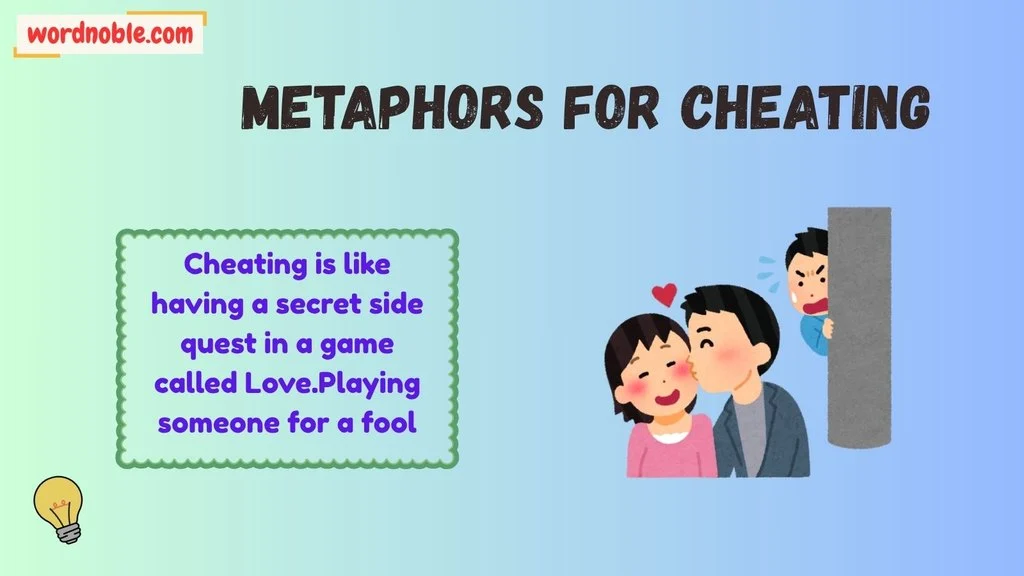
- Cheating is like having a secret side quest in a game called Love.
- Cheating is like juggling two balls while pretending you only own one.
- Cheating is like keeping two calendars and praying the dates never collide.
- Cheating is like being the CEO of a very suspicious relationship.
- Cheating is like subscribing to two streaming services for the same show.
- Cheating is like cooking two dinners and hoping nobody smells the other one.
- Cheating is like trying to keep two secrets with one very bad memory.
- Cheating is like playing double agent without receiving the salary.
- Cheating is like carrying two umbrellas and getting caught in both storms.
- Cheating is like trying to hide a giant elephant behind a tiny relationship curtain.
25 Powerful Metaphors for Cheating
Below are examples organized by meaning and imagery.
1. Cheating Is a Thief in the Night
Meaning: Cheating secretly steals trust, security, and emotional confidence.
This metaphor presents cheating as something that operates secretly. The person may appear normal while quietly taking something valuable from the relationship.
Example:
His cheating was a thief in the night, stealing her trust while she slept peacefully beside him.
Category: Object-based / betrayal imagery
2. Cheating Is a Crack in the Foundation
Meaning: Cheating weakens the basic structure of a relationship.
A foundation supports a building. In the same way, trust supports a relationship.
Example:
The affair was a crack in the foundation of their marriage.
Category: Object-based metaphor
3. Cheating Is a Poisonous Seed
Meaning: Cheating may begin as a small act but grow into widespread emotional damage.
Example:
One secret became a poisonous seed that slowly destroyed everything they had built.
Category: Nature-based metaphor
4. Cheating Is a Knife in the Back
Meaning: Cheating represents unexpected and painful betrayal.
This is one of the strongest metaphors for betrayal because it suggests that the victim trusted the person who caused the harm.
Example:
His affair felt like a knife in the back after years of loyalty.
Category: Object-based metaphor
5. Cheating Is a Mask
Meaning: Cheating can hide behind false affection, promises, or appearances.
Example:
Her loving smile became a mask hiding a secret life.
Category: Object-based metaphor
6. Cheating Is a Snake in the Grass
Meaning: Cheating can represent hidden danger from someone who appears harmless.
Example:
He was a snake in the grass, smiling warmly while betraying everyone around him.
Category: Animal-based metaphor
7. Cheating Is a House of Cards
Meaning: A relationship built on deception is unstable and can collapse suddenly.
Example:
Their perfect relationship was only a house of cards built on lies.
Category: Object-based metaphor
8. Cheating Is a Shadow
Meaning: Cheating may remain hidden but continue to follow a relationship.
Example:
The secret affair became a shadow that followed them everywhere.
Category: Nature-based metaphor
9. Cheating Is a Broken Promise
Meaning: Cheating is presented as the destruction of a commitment or agreement.
Example:
His betrayal was a broken promise written across their entire relationship.
Category: Abstract-to-concrete metaphor
10. Cheating Is a Double-Edged Sword
Meaning: Cheating may harm multiple people, including the person who cheats.
Example:
His deception was a double-edged sword that wounded both his partner and himself.
Category: Object-based metaphor
11. Cheating Is a Storm
Meaning: Cheating creates emotional chaos, conflict, and destruction.
Example:
The affair arrived like a storm and tore through their peaceful life.
Category: Nature-based metaphor
12. Cheating Is a Slow Leak
Meaning: Repeated dishonesty gradually drains trust from a relationship.
Example:
Every lie was a slow leak draining the relationship of trust.
Category: Object-based metaphor
13. Cheating Is a Fire Behind the Walls
Meaning: Hidden betrayal may continue causing damage even when everything appears normal.
Example:
The secret was a fire behind the walls, quietly destroying the home they had built.
Category: Object-based metaphor
14. Cheating Is a Broken Compass
Meaning: Cheating represents a loss of moral direction or loyalty.
Example:
His broken compass led him away from every promise he had made.
Category: Object-based metaphor
15. Cheating Is a Web
Meaning: Lies and deception can become increasingly complicated and difficult to escape.
Example:
One lie became a web of deception that trapped everyone involved.
Category: Animal-based metaphor
16. Cheating Is a Rotting Fruit
Meaning: A relationship may appear healthy on the outside while corruption grows within it.
Example:
Their perfect romance was a piece of rotting fruit beneath a beautiful skin.
Category: Nature-based metaphor
17. Cheating Is a Broken Bridge
Meaning: Cheating destroys the connection between two people.
Example:
The betrayal burned the bridge between them.
Category: Object-based metaphor
18. Cheating Is a Wolf in Sheep’s Clothing
Meaning: A person may appear loyal and harmless while secretly acting deceptively.
Example:
He was a wolf in sheep’s clothing, hiding betrayal behind a gentle personality.
Category: Animal-based metaphor
19. Cheating Is a Hidden Trap
Meaning: Deception may lead someone into emotional pain without warning.
Example:
The relationship became a hidden trap disguised as love.
Category: Object-based metaphor
20. Cheating Is a Disease
Meaning: Repeated dishonesty can spread through a relationship and damage its emotional health.
Example:
Deception became a disease that infected every part of their relationship.
Category: Biological metaphor
21. Cheating Is a Leaking Ship
Meaning: Dishonesty gradually causes a relationship to lose its stability.
Example:
Their relationship was a leaking ship, and every new lie pulled it closer to sinking.
Category: Object-based metaphor
22. Cheating Is a False Echo
Meaning: Words of love or loyalty may sound meaningful but lack truth behind them.
Example:
His promises were only false echoes bouncing through an empty relationship.
Category: Auditory imagery
23. Cheating Is a Puppet Show
Meaning: One person may manipulate appearances while secretly controlling the truth.
Example:
Their romance became a puppet show, with lies pulling every string.
Category: Humorous / object-based metaphor
24. Cheating Is a Game with Loaded Dice
Meaning: Deception creates an unfair situation in which one person secretly controls the outcome.
Example:
He treated their relationship like a game with loaded dice.
Category: Humorous / object-based metaphor
25. Cheating Is a Masked Thief
Meaning: Cheating combines secrecy, deception, and the theft of trust.
Example:
The affair was a masked thief that entered their relationship and stole its peace.
Category: Combined metaphor
Metaphors For Cheating On Someone
- Cheating is like planting a secret garden behind your partner’s back.
- Cheating is like walking two roads while pretending to follow one.
- Cheating is like opening a hidden door in a committed relationship.
- Cheating is like building a second life behind a locked curtain.
- Cheating is like putting cracks in a glass heart.
- Cheating is like carrying a secret flame into someone else’s home.
- Cheating is like stealing pages from a shared love story.
- Cheating is like sailing a second ship while promising loyalty to the first.
- Cheating is like wearing a mask while hiding your true intentions.
- Cheating is like watering a forbidden flower while your own garden dries.
- Cheating is like digging a hole beneath the foundation of trust.
- Cheating is like playing two songs while pretending there is only one melody.
- Cheating is like turning a promise into a broken bridge.
- Cheating is like lighting a match in a house built on trust.
Metaphor Taxonomy: Different Types of Metaphors for Cheating
🐾 Animal-Based Metaphors
Animal imagery often suggests secrecy, danger, manipulation, or predatory behavior.
Examples include:
- a snake in the grass hidden danger
- a wolf in sheep’s clothing deceptive appearance
- a spider’s web complicated lies
- a fox in the henhouse a dangerous person trusted in the wrong place
These metaphors are especially effective in storytelling because animals immediately create recognizable behavioral associations.
📡 Technology-Based Metaphors
Technology-based comparisons can make modern writing feel fresh and relatable.
Examples:
- Cheating is a virus in the relationship.
- His lies were corrupted files in the memory of their love.
- The affair was a system breach in their private world.
- Their trust had been hacked.
These metaphors work particularly well in contemporary fiction, social commentary, and informal writing.
🌿 Nature-Based Metaphors
Nature imagery can describe gradual growth, destruction, darkness, and emotional change.
Examples:
- a poisonous seed
- a spreading storm
- a shadow
- a dying garden
- a wildfire
Nature metaphors are common in poetry because they connect human emotions with universal physical processes.
😂 Humorous and Exaggerated Metaphors
Humorous metaphors can describe cheating without creating an overly dramatic tone.
Examples:
- His loyalty was a rental car with unlimited mileage.
- Her promises were a disappearing magic trick.
- Their relationship was a game where someone kept changing the rules.
- His honesty had gone on vacation without leaving a forwarding address.
These work best in casual conversation, comedy, satire, and light creative writing.
🎭 Emotional and Behavioral Metaphors
These metaphors focus on the psychological effects of cheating.
Examples:
- a wound that refuses to close
- a storm inside the heart
- a broken compass
- a wall between two people
- a shadow over every memory
These are especially useful in poetry, reflective essays, novels, and emotional narratives.
What’s A Fancy Word For Cheating?
- Infidelity sounds more formal than cheating.
- Unfaithfulness describes a lack of romantic loyalty.
- Adultery is commonly used when a married person has a sexual relationship outside the marriage.
- Betrayal emphasizes the violation of trust involved.
- Deception focuses on deliberately hiding the truth.
- Disloyalty highlights a failure to remain faithful.
- Unfaithfulness can describe romantic or sexual betrayal.
- Extramarital involvement refers to a relationship outside marriage.
- Marital infidelity specifically describes cheating within a marriage.
- Romantic betrayal focuses on the emotional side of cheating.
- Deceit highlights dishonesty and concealment.
- Breach of trust describes the damage caused by dishonest behavior.
- Double dealing suggests dishonest behavior involving two sides.
- Unfaithful conduct is a more formal way to describe cheating behavior.
Metaphors for Cheating in Different Contexts
| Context | Meaning | Use Case | Example |
|---|---|---|---|
| Storytelling | Hidden betrayal | Character development | His secret was a shadow following every conversation. |
| Poetry | Emotional pain | Expressing heartbreak | Love became a garden poisoned at the roots. |
| Casual speech | Simple deception | Everyday conversation | His loyalty was full of holes. |
| Humor | Light criticism | Comedy or satire | Her promises were a disappearing magic trick. |
| Academic writing | Symbolic analysis | Literary interpretation | The betrayal functions as a crack in the social foundation. |
| Romance fiction | Emotional conflict | Relationship drama | The affair became a storm over their future. |
| Personal writing | Broken trust | Reflection or journaling | The lie was a door that could never fully close. |
What Can I Say Instead Of Cheating?
- Being unfaithful
- Being dishonest in the relationship
- Breaking someone’s trust
- Having an affair
- Two timing someone
- Seeing someone behind your partner’s back
- Being romantically involved with someone else
- Straying from the relationship
- Hiding another relationship
- Betraying your partner
- Crossing relationship boundaries
- Maintaining a secret affair
- Getting involved with someone else
- Violating the trust of your partner
How to Use Metaphors for Cheating Naturally
A strong metaphor should make the meaning clearer, not more confusing.
1. Start with the emotion
Ask what the cheating represents:
- betrayal
- secrecy
- loss of trust
- deception
- emotional pain
- instability
- moral failure
Then choose an image that matches the emotion.
For example:
Loss of trust → broken bridge
Secrecy → hidden shadow
Deception → mask
Repeated lies → spreading web
2. Choose familiar images
The best metaphors are often easy to understand.
A phrase such as:
Cheating is a crack in trust
is immediately clear.
An overly complicated comparison may distract the reader from the meaning.
3. Use specific imagery
Instead of writing:
Cheating damaged the relationship.
Try:
Each lie widened the crack in their relationship.
The metaphor makes the damage easier to imagine.
4. Match the tone
A serious poem may use:
a wound in the heart
A humorous conversation may use:
a relationship with more plot twists than a television drama
The image should fit the situation.
What Are Some Cheating Quotes?
- Trust takes years to build but moments to break.
- A hidden relationship can turn a beautiful promise into a painful secret.
- Cheating does not only break hearts, it damages trust.
- Loyalty means being honest even when nobody is watching.
- A secret can grow into a wound when it is built on betrayal.
- Love needs honesty because trust cannot survive constant deception.
- A broken promise can leave a deeper mark than a broken heart.
- Betrayal often hurts because it comes from someone you trusted.
- Faithfulness is choosing honesty when temptation appears.
- A relationship cannot grow where secrets are constantly planted.
- Trust is fragile, and dishonesty can shatter it quickly.
- Love loses its meaning when loyalty becomes optional.
- The deepest betrayal is often the truth hidden behind a smile.
- When trust disappears, even simple words can start to feel suspicious.
How to Make Metaphors More Creative
To improve your figurative language, explore different sensory categories.
Visual imagery
- a cracked mirror
- a dark shadow
- a broken bridge
Auditory imagery
- a false echo
- a broken record
- an empty promise ringing in the air
Natural imagery
- a poisonous seed
- a spreading storm
- a dying garden
Physical imagery
- a knife in the back
- a broken chain
- a leaking ship
Using sensory language helps readers experience an abstract idea through sight, sound, movement, and physical sensation.
What Is A Metaphor For Betrayal?
- Betrayal is a knife hidden behind a smile.
- Betrayal is a bridge collapsing beneath your feet.
- Betrayal is a crack spreading through a once perfect mirror.
- Betrayal is a storm arriving from a clear blue sky.
- Betrayal is a locked door where you expected an open welcome.
- Betrayal is a shadow following a relationship everywhere.
- Betrayal is a wound caused by someone you trusted to protect you.
- Betrayal is a house losing its foundation from underneath.
- Betrayal is a beautiful painting ruined by one careless stroke.
- Betrayal is a ship sinking because of a hidden leak.
- Betrayal is a broken compass that makes trust lose its direction.
- Betrayal is a mask falling off at the worst possible moment.
- Betrayal is a fire started inside a home you thought was safe.
- Betrayal is a shattered window in a house built on trust.
Metaphor vs Simile: What Is the Difference?
A metaphor directly identifies one thing with another:
Cheating is a thief.
A simile compares two things using like or as:
Cheating is like a thief stealing trust.
Both are forms of figurative language, but their structures are different.
| Metaphor | Simile |
| Cheating is a thief. | Cheating is like a thief. |
| Trust became a broken bridge. | Trust was like a broken bridge. |
| His lies were poison. | His lies spread like poison. |
A metaphor is often more direct and powerful, while a simile makes the comparison more explicit.
Common Mistakes When Writing Metaphors for Cheating
1. Overusing metaphors
Too many metaphors can make writing feel dramatic or confusing.
Avoid:
Cheating was a storm, a knife, a snake, a fire, a disease, and a broken bridge.
Choose the image that best fits your meaning.
2. Using an illogical comparison
A metaphor should have a clear connection to the idea.
Weak:
Cheating was a purple refrigerator of sadness.
Unless the context explains the comparison, the image is confusing.
3. Mixing metaphors
Avoid combining unrelated images:
The affair was a snake that sank the ship and planted a garden of lies.
The sentence uses too many competing images.
4. Confusing metaphor with simile
Cheating is a thief = metaphor
Cheating is like a thief = simile
The comparison may express a similar idea, but the grammatical structure is different.
5. Choosing drama over clarity
A metaphor should strengthen meaning rather than simply sound impressive.
Clear writing is usually more powerful than exaggerated writing.
Metaphors for Cheating: Do and Don’t
Do:
- Choose one strong central image.
- Match the metaphor to the emotion.
- Use familiar comparisons when clarity matters.
- Add sensory details.
- Consider the audience and writing context.
- Use metaphors to deepen meaning.
Don’t:
- Mix several unrelated metaphors.
- Use an image that has no clear connection.
- Repeat the same comparison too often.
- Make every sentence figurative.
- Confuse metaphors with similes.
- Sacrifice clarity for dramatic language.
Natural Chat Responses Using Metaphors for Cheating
Here are a few natural ways to use these metaphors in everyday conversation:
“Cheating is basically a crack in the foundation of trust.”
“His lies became a web, and eventually he got tangled in it.”
“That betrayal felt like a knife in the back.”
“The relationship looked perfect, but it was really a house of cards.”
“Her secret was like a shadow following everything they did.”
These sound more natural than forcing an elaborate metaphor into every conversation.
Related Figurative Language Terms
If you are studying metaphors for cheating, these related concepts can expand your understanding of creative writing:
Figurative Language
Language that communicates meaning beyond literal definitions. Metaphors, similes, personification, and hyperbole are common examples.
Auditory Imagery
Language that creates an impression of sound. For example, describing promises as a false echo creates an auditory image.
Sensory Writing
Writing that appeals to the senses, including sight, sound, touch, taste, and smell.
Descriptive Writing
Writing that uses carefully chosen details and imagery to help readers visualize an idea.
Metaphor vs Simile
Both compare ideas, but metaphors make direct comparisons while similes use words such as like or as.
English Literature Devices
Metaphor, symbolism, imagery, personification, irony, alliteration, and foreshadowing are important literary devices used to create deeper meaning.
FAQs:
1. What are metaphors for cheating?
Metaphors for cheating are figurative expressions that describe unfaithfulness, deception, or betrayal through another image or idea. Common comparisons include a crack in a foundation, a hidden thief, a poisonous seed, a mask, or a broken bridge. These metaphors make abstract emotional experiences easier to visualize and can make writing more powerful and memorable.
2. What is a good metaphor for someone who cheats?
A good metaphor depends on the meaning you want to express. A thief suggests that the person steals trust. A snake in the grass suggests hidden danger. A wolf in sheep’s clothing emphasizes deception. A broken compass suggests a loss of moral direction. The best metaphor matches the specific emotion or behavior you want readers to understand.
3. What are some metaphors for betrayal?
Common metaphors for betrayal include a knife in the back, a broken bridge, a crack in the foundation, a poisonous seed, and a shattered mirror. Each creates a slightly different meaning. A knife emphasizes pain, a broken bridge suggests separation, and a crack in a foundation suggests damage to the basic structure of trust.
4. What are funny metaphors for cheating?
Funny metaphors can make the subject lighter or more satirical. For example, you might say, “His loyalty was a rental car with unlimited mileage,” or “Her promises were a disappearing magic trick.” Humorous metaphors work best in casual conversations, comedy, satire, and informal creative writing where a serious emotional tone is not required.
5. What are poetic metaphors for cheating?
Poetic metaphors for cheating often use nature, darkness, damage, and emotional imagery. Examples include “a poisonous seed in the garden of love,” “a shadow over every memory,” and “a storm tearing through a quiet home.” Poetic metaphors are effective because they suggest complex emotions without explaining every feeling directly.
6. What is the difference between a metaphor and a simile about cheating?
A metaphor makes a direct comparison, such as “Cheating is a thief.” A simile makes the comparison using like or as, such as “Cheating is like a thief stealing trust.” Both are figurative language techniques, but metaphors usually sound more direct, while similes clearly signal that a comparison is being made.
7. How can I use metaphors for cheating in writing?
Start by identifying the central idea you want to express, such as secrecy, betrayal, emotional pain, or broken trust. Then choose an image that naturally represents that idea. For example, use a mask for hidden deception or a broken bridge for damaged connection. Keep the metaphor consistent and avoid mixing too many unrelated images.
8. Why are metaphors important in English literature?
Metaphors are important because they allow writers to express complex ideas through concrete images. In literature, cheating may symbolize betrayal, moral conflict, secrecy, or the collapse of trust. A metaphor gives readers something they can visualize and interpret. This creates deeper meaning and allows a short phrase to communicate emotional ideas that would otherwise require lengthy explanation.
9. How can students use metaphors for cheating?
Students can use metaphors for cheating in creative writing, poetry, literary analysis, essays, and descriptive assignments. They should choose comparisons that clearly connect to the subject. For example, “The betrayal was a crack in their foundation” can represent damaged trust. Students should also explain the meaning of the metaphor when analyzing it in academic writing.
10. Can metaphors for cheating describe both romantic and academic cheating?
Yes. Metaphors can describe different types of cheating as long as the comparison fits the context. In a relationship, cheating may be described as a broken promise. In an academic setting, dishonest behavior may be described as a shortcut built on borrowed answers. The central idea remains deception or unfairness, but the imagery should match the situation.
Conclusion:
The strongest metaphors for cheating transform an abstract idea such as betrayal or deception into something readers can see, feel, or imagine. Cheating can become a thief that steals trust, a crack in a foundation, a poisonous seed, a hidden trap, or a storm that destroys peace.
The right metaphor depends on the emotion and context you want to communicate. For students and writers, the key is to choose one clear image and develop it naturally. Strong figurative language improves descriptive writing because it gives abstract emotions a concrete form.
When used with clarity and purpose, metaphors for cheating make writing more vivid, memorable, and emotionally powerful.

I am Naqash Ayub, proudly writing for WordNoble, where I focus on creating clear, informative, and SEO-friendly content. I enjoy turning detailed information into simple, trustworthy articles that help readers find the answers they need.
2 thoughts on “Metaphors for Cheating: Powerful Ways to Describe Betrayal and Deception”