Victory is more than just crossing the finish line—it’s the feeling of overcoming obstacles, proving your strength, and turning hard work into success.
That’s why writers often use metaphors for winning to make achievements feel more powerful, emotional, and memorable.
Instead of simply saying someone won, a well-chosen metaphor can paint success as a shining crown, a mountain conquered, or a key that unlocks new opportunities.
Metaphors for winning are figurative expressions that describe success by comparing it to another object, journey, force, or experience. They make writing more vivid, emotional, and memorable without using the words “like” or “as.”
A metaphor for winning is a figure of speech that describes victory through symbolic comparison rather than literal language. It helps writers communicate achievement, perseverance, confidence, or success in a more imaginative and emotionally powerful way. Winning metaphors appear frequently in literature, motivational writing, speeches, sports commentary, and everyday communication.
What Are Metaphors for Winning?
A metaphor for winning compares victory to something entirely different in order to emphasize its meaning or emotional effect.
Instead of saying:
She won the competition.
A metaphor might say:
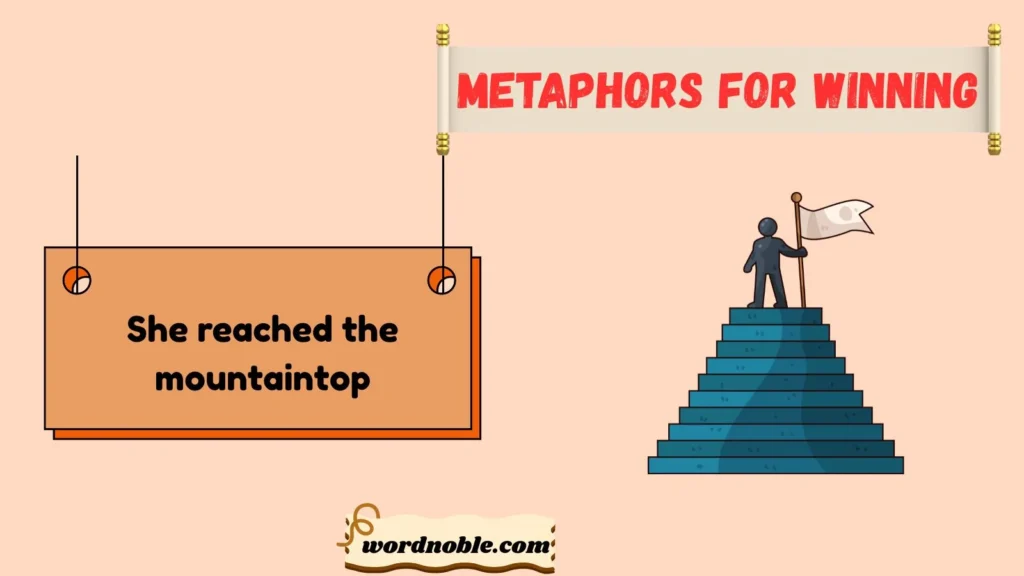
She reached the mountaintop.
Here, the person did not literally climb a mountain. The mountain symbolizes effort, determination, and ultimate success.
Unlike literal language, metaphors invite readers to visualize achievement through imagery, making the message more engaging and memorable.
Simple Meaning
A metaphor for winning is a creative way to describe success by saying it is something else rather than simply stating that someone achieved a goal.
Examples include:
- Victory is the sunrise after a long night.
- Success is a golden key.
- Winning is the summit of the climb.
Each comparison adds emotional depth that plain language cannot provide.
Why Writers Use Metaphors for Winning
Winning often involves emotions such as hope, resilience, confidence, relief, and celebration. Metaphors transform these emotions into vivid images that readers instantly understand.
Writers use winning metaphors to:
- Create memorable imagery.
- Add emotional depth.
- Inspire readers.
- Make speeches more persuasive.
- Strengthen storytelling.
- Improve descriptive writing.
- Make poetry more expressive.
- Avoid repetitive language.
Instead of repeating “success” or “victory,” metaphors provide fresh and meaningful alternatives.
How Metaphors for Winning Work
Metaphors connect the idea of success with familiar experiences.
For example:
Victory is a sunrise.
The comparison suggests:
- darkness represents struggle
- sunrise represents hope
- light represents achievement
Readers naturally understand the emotional journey without lengthy explanations.
This is why metaphors are common in English literature, motivational speeches, sports journalism, business writing, and creative storytelling.
The Emotional Power of Winning Metaphors
Victory is rarely just about the final result.
It often represents:
- persistence
- courage
- confidence
- growth
- resilience
- hope
- transformation
- fulfillment
A carefully chosen metaphor allows readers to feel these emotions instead of simply reading about them.
For example:
After years of setbacks, graduation became her sunrise.
The metaphor communicates far more than “she graduated.”
It suggests a difficult journey ending in hope and new beginnings.
Metaphors for Winning Across Different Types of Writing
Storytelling
Novelists use winning metaphors to reveal character growth.
Example:
The championship became the bridge to his new life.
The bridge symbolizes transition and opportunity.
Poetry
Poets often use symbolic images to describe triumph.
Example:
Victory bloomed like spring inside her heart.
Although this example contains a simile (“like”), a metaphorical version would be:
Victory was spring itself.
This creates stronger imagery.
Speeches
Motivational speakers rely on metaphors because they inspire audiences.
Example:
Every challenge is another mountain, and every victory is another summit.
This encourages perseverance.
Business Writing
Professional communication also benefits from subtle metaphors.
Example:
Closing the deal opened a new chapter for the company.
The chapter represents future opportunities.
Everyday Conversation
People naturally use metaphors without realizing it.
Examples include:
- We finally crossed the finish line.
- This promotion is my golden ticket.
- That success opened every door.
These expressions make ordinary conversations more engaging.
Types of Metaphors for Winning
Organizing metaphors into themes makes them easier to understand and use naturally.
🏔 Journey and Adventure Metaphors
Journey metaphors describe success as reaching a destination after effort.
Examples include:
- Reaching the summit
- Crossing the finish line
- Finding the treasure
- Arriving at the destination
- Completing the voyage
Meaning
These metaphors emphasize perseverance, determination, and personal growth.
👑 Royalty Metaphors
Winning is often associated with honor and leadership.
Examples:
- Wearing the crown
- Sitting on the throne
- Claiming the kingdom
- Holding the scepter
- Becoming royalty
Meaning
These symbolize authority, excellence, and ultimate achievement.
🌅 Nature Metaphors
Nature offers timeless symbols of success.
Examples:
- A rising sun
- A blooming flower
- A flowing river
- A towering oak
- A rainbow after the storm
Meaning
These represent hope, renewal, resilience, and accomplishment.
🔥 Fire and Light Metaphors
Light symbolizes clarity and achievement.
Examples:
- A shining star
- A guiding flame
- A blazing torch
- A spark that became a fire
- A beacon of hope
Meaning
These metaphors emphasize inspiration, leadership, and success.
💎 Treasure Metaphors
Treasure imagery highlights the value of achievement.
Examples:
- A hidden gem
- A chest of gold
- A golden key
- A priceless jewel
- A diamond earned through pressure
Meaning
These suggest that success is valuable because it requires effort.
15 Powerful Metaphors for Winning (Examples with Meanings)
| Metaphor | Meaning | Category | Explanation |
|---|---|---|---|
| Victory is the sunrise. | Success after hardship | Nature | Darkness ends and hope begins. |
| Success is a golden key. | Achievement unlocks opportunities | Treasure | Winning creates new possibilities. |
| He reached the summit. | Achieved a major goal | Journey | Represents determination and perseverance. |
| She wore the crown. | Became the best | Royalty | Symbolizes excellence and leadership. |
| Winning was a blooming flower. | Success developed over time | Nature | Growth through patience and effort. |
| Victory became his lighthouse. | Success gave direction | Light | Achievement provided clarity and purpose. |
| The trophy was the final puzzle piece. | Goal completed | Object | Everything finally came together. |
| Success opened every door. | Achievement created opportunities | Opportunity | Winning leads to new beginnings. |
| Victory became a bridge. | Success led to a better future | Journey | Symbolizes transition and progress. |
| Winning was a roaring fire. | Powerful momentum | Fire | Represents passion and unstoppable energy. |
| Success was a treasure chest. | Valuable achievement | Treasure | Hard work produced a rewarding outcome. |
| The medal became his passport. | Victory created new experiences | Travel | Success opened future opportunities. |
| Winning was the harvest. | Rewards followed hard work | Nature | Effort eventually produced results. |
| Success became the North Star. | Achievement guided future goals | Navigation | Victory inspired continued progress. |
| The championship was the mountain peak. | Highest accomplishment | Journey | Represents reaching the ultimate objective. |
Why These Metaphors Are Effective
The strongest metaphors for winning share three important qualities:
- They create vivid mental images that readers can easily imagine.
- They connect success with universal experiences such as climbing, growing, shining, or discovering treasure.
- They add emotional meaning beyond simply saying someone succeeded.
Because of these qualities, winning metaphors are widely used in literature, motivational speeches, sports writing, business communication, and everyday conversation.
20 More Metaphors for Winning (With Meanings)
The following metaphors expand your vocabulary and help you describe success in different contexts, from sports and academics to business, personal growth, and creative writing.
| Metaphor | Meaning | Category | Explanation |
|---|---|---|---|
| Victory is a rising tide. | Success lifts everything around you. | Nature | One achievement creates more opportunities. |
| Success is a bridge. | Winning leads to new possibilities. | Journey | Achievement connects one goal to the next. |
| Winning is a beacon. | Success inspires others. | Light | It serves as a guiding example. |
| Victory is fertile soil. | Success creates room for future growth. | Nature | One accomplishment nurtures many more. |
| Success is a rocket launch. | Rapid progress after preparation. | Technology | Hard work results in powerful momentum. |
| Winning is a masterpiece. | Excellence achieved through dedication. | Art | Great success requires patience and skill. |
| Victory is a heartbeat. | Success gives life to dreams. | Human Experience | It keeps motivation alive. |
| Success is an open gate. | New opportunities become available. | Object | Winning removes barriers. |
| Winning is a lighthouse. | Achievement provides guidance. | Light | Others follow your example. |
| Victory is an eagle in flight. | Freedom through achievement. | Animal | Success allows you to soar higher. |
| Success is a roaring lion. | Confidence and strength. | Animal | Winning builds courage. |
| Winning is a sturdy oak. | Long-lasting achievement. | Nature | Strong roots create lasting success. |
| Victory is a flowing river. | Continuous progress. | Nature | Success keeps moving forward. |
| Success is a compass. | Achievement gives direction. | Journey | Winning clarifies future goals. |
| Winning is a crown jewel. | Highest accomplishment. | Treasure | Represents exceptional value. |
| Victory is a flame. | Passion fuels success. | Fire | Determination keeps burning. |
| Success is a doorway. | Beginning of a new chapter. | Object | Winning opens fresh possibilities. |
| Winning is a sunrise after the storm. | Triumph follows hardship. | Nature | Difficult times eventually end. |
| Victory is a seed becoming a tree. | Small efforts lead to great achievements. | Nature | Growth takes time and persistence. |
| Success is a symphony. | Every effort works together perfectly. | Music | Achievement is built from many parts. |
Context Table
| Context | Meaning | Best Use Case | Example |
|---|---|---|---|
| Sports | Achievement through competition | Game reports, speeches | The championship was the summit of years of effort. |
| School | Academic success | Essays, presentations | Graduation became her golden key. |
| Business | Professional achievement | Leadership writing | The deal opened a new chapter. |
| Personal Growth | Overcoming challenges | Blogs, self-improvement | Success became my sunrise. |
| Literature | Symbolic victory | Stories and novels | The crown rested upon the worthy. |
| Poetry | Emotional triumph | Creative writing | Hope bloomed into victory. |
| Motivation | Encouragement | Speeches | Every mountain climbed reveals another horizon. |
| Everyday Conversation | Casual success | Daily speech | That promotion opened every door. |
How to Use Metaphors for Winning Naturally
Metaphors are most effective when they fit the tone and purpose of your writing. A well-chosen metaphor should enhance meaning rather than distract the reader.
1. Match the Context
Choose imagery that suits the situation.
- Sports → mountains, finish lines, trophies
- Business → bridges, doors, keys
- School → ladders, milestones, journeys
- Personal growth → sunrises, gardens, rivers
2. Keep One Central Image
Avoid mixing unrelated metaphors.
Weak Example
Success opened the door, climbed the mountain, and sailed the ocean.
Better Example
Success opened a new door, revealing opportunities that once seemed impossible.
3. Use Fresh Imagery
Instead of repeating common expressions, create original comparisons.
Instead of:
He reached the top.
Try:
He became the lighthouse everyone followed.
4. Let the Metaphor Support the Message
The comparison should make the meaning clearer, not more confusing.
How to Create Your Own Metaphors for Winning
Creating original metaphors is easier than it seems.
Step 1
Think about what winning feels like.
Examples:
- Freedom
- Relief
- Growth
- Joy
- Confidence
- Hope
Step 2
Find something that shares those qualities.
Examples:
- Sunrise
- Eagle
- Diamond
- River
- Garden
- Crown
Step 3
Connect the two.
Examples:
- Victory is a sunrise.
- Success is fertile soil.
- Winning is an eagle taking flight.
- Achievement is a bridge to tomorrow.
Metaphor vs. Simile
Many people confuse metaphors with similes because both compare two things. However, they do so in different ways.
| Metaphor | Simile |
|---|---|
| Says one thing is another. | Compares using like or as. |
| Victory is a sunrise. | Victory is like a sunrise. |
| Stronger and more direct. | More explicit and literal. |
| Common in poetry and persuasive writing. | Common in descriptive writing and teaching. |
Quick Rule
- Metaphor: Winning is a crown.
- Simile: Winning is like wearing a crown.
Common Mistakes to Avoid
Overusing Metaphors
Using too many metaphors in one paragraph can overwhelm readers.
Better: Use one strong metaphor at a time.
Mixing Metaphors
Avoid combining unrelated images.
Incorrect
Victory sailed across the mountain and unlocked the ocean.
Correct
Victory carried us safely across the finish line.
Using Confusing Comparisons
Choose images readers can understand immediately.
Instead of:
Success is a sideways shadow.
Use:
Success is a guiding light.
Forgetting the Audience
Simple metaphors work best for general readers, while more symbolic imagery may suit poetry or literary analysis.
Do & Don’t Guide
✅ Do
- Use metaphors to add emotion.
- Choose clear, meaningful imagery.
- Match the metaphor to the context.
- Keep comparisons consistent.
- Revise for clarity.
❌ Don’t
- Mix multiple metaphors.
- Force complicated comparisons.
- Repeat the same metaphor throughout the article.
- Confuse metaphors with similes.
- Sacrifice clarity for creativity.
Natural Conversation Examples
These examples show how metaphors for winning can sound in everyday speech.
- “After years of hard work, this promotion is my golden key.”
- “Winning that scholarship was the sunrise I had been waiting for.”
- “The championship became our bridge to bigger opportunities.”
- “Your success is a lighthouse for everyone on the team.”
- “That award was the spark that ignited her confidence.”
- “Graduation felt like reaching the summit after a long climb.”
Related Terms
Understanding these concepts will strengthen your figurative language skills.
- Figurative language
- Metaphor
- Simile
- Symbolism
- Imagery
- Descriptive writing
- Creative writing
- Literary devices
- Personification
- Hyperbole
- Idioms about success
- Motivational language
FAQs:
1. What are metaphors for winning?
Metaphors for winning are figurative expressions that describe success by comparing it directly to something else, such as a sunrise, a crown, or a mountain summit. These comparisons help writers express achievement in a more vivid and memorable way.
2. Why are metaphors for winning useful?
They make writing more engaging by adding imagery and emotional depth. Instead of simply stating that someone succeeded, metaphors help readers visualize the journey, effort, and significance behind the achievement.
3. What is an example of a metaphor for winning?
A common example is:
“Victory is a sunrise.”
This metaphor suggests that success brings hope, renewal, and a fresh beginning after difficult times.
4. Are metaphors for winning used in literature?
Yes. Authors frequently use metaphors to symbolize triumph, courage, resilience, and transformation. These comparisons make characters and themes more meaningful while creating memorable imagery for readers.
5. What’s the difference between a metaphor and a simile?
A metaphor states that one thing is another, while a simile compares two things using like or as.
Example:
- Metaphor: Success is a bridge.
- Simile: Success is like a bridge.
6. Can students use metaphors for winning in school assignments?
Absolutely. Metaphors improve essays, speeches, creative writing, poetry, and classroom presentations by making ideas more descriptive, engaging, and expressive.
7. Can metaphors for winning be used in motivational speeches?
Yes. Motivational speakers often use metaphors because they inspire audiences and make messages easier to remember. Comparing success to a journey or a sunrise creates strong emotional impact.
8. How do I create my own winning metaphor?
Start by identifying what success feels like—hope, growth, confidence, or freedom. Then compare that feeling to something that shares the same qualities, such as a blooming garden, a guiding star, or a flowing river.
9. Are winning metaphors suitable for everyday conversations?
Yes. People naturally use figurative language in daily life. Expressions like “That opportunity opened every door” or “This promotion is my golden ticket” make conversations more expressive and engaging.
10. How can I make my metaphors sound more original?
Avoid relying only on familiar clichés. Instead, draw inspiration from nature, travel, music, art, or personal experiences to create fresh comparisons that fit the message and audience.
Conclusion:
Metaphors for winning transform ordinary descriptions of success into vivid, meaningful expressions that capture both achievement and the journey behind it.
Whether you’re writing a story, crafting a speech, composing poetry, or simply looking for a more creative way to describe victory, the right metaphor can make your message more memorable and emotionally powerful.
By choosing clear imagery, matching metaphors to your context, and avoiding common mistakes, you can communicate success with greater impact.
Practice creating your own comparisons, explore different categories of metaphors, and let figurative language elevate your writing from ordinary to unforgettable.

I am Naqash Ayub, proudly writing for WordNoble, where I focus on creating clear, informative, and SEO-friendly content. I enjoy turning detailed information into simple, trustworthy articles that help readers find the answers they need.
1 thought on “Powerful Metaphors for Winning to Inspire Success and Victory”