
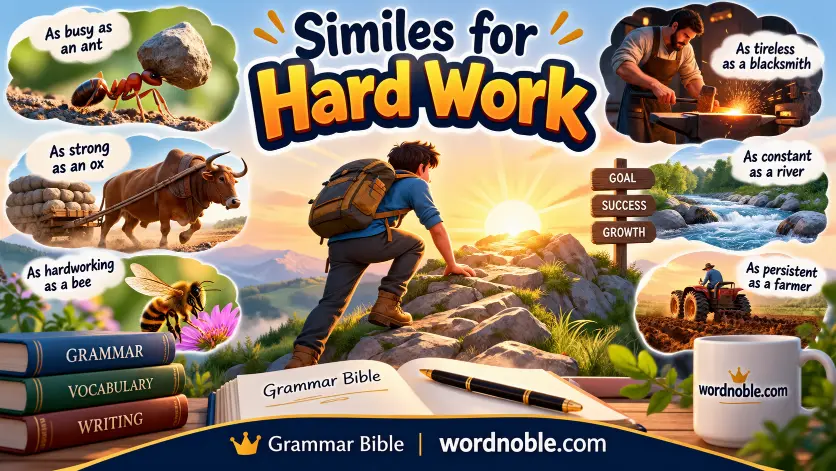
Picture someone hunched over a desk at midnight, eyes burning, coffee gone cold still typing. That image alone tells a story words sometimes struggle to capture, which is exactly why similes for hard work exist.
They turn ordinary effort into something vivid, something you can almost feel. Whether you’re writing a resume, crafting a speech, telling a story, or just trying to describe your own grind to a friend, plain language like “worked really hard” often falls flat.
A good simile does the heavy lifting instead, painting a picture that sticks in the reader’s mind long after they’ve finished reading.
This article pulls together a wide range of similes for describing diligence, dedication, and relentless effort from classic comparisons to fresher, more creative options you won’t find everywhere else.
You’ll also see how tone, context, and audience shape which simile fits best, whether you’re going for something professional, poetic, or playful. Ready to swap dull descriptions for language that actually lands? Let’s start with the most popular and effective options.
Similes for hard work are comparisons that use words such as “like” or “as” to describe intense effort, persistence, dedication, or determination in a vivid way.
What Are Similes for Hard Work?
Similes for hard work are examples of figurative language that compare someone’s effort, dedication, or persistence to a familiar person, animal, object, force of nature, or activity.
For example:
She worked like a machine to finish the project.
The comparison does not mean she literally became a machine. It emphasizes that she worked continuously, efficiently, and with great energy.
A simile makes an abstract idea such as effort easier to imagine. Instead of saying someone “worked very hard,” a writer can create a stronger mental picture through comparison.
Simple Formula
Person + action + like/as + comparison
For example:
- He worked like a machine.
- She was as persistent as an ant.
- They worked like bees in a hive.
- He pushed forward like a runner approaching the finish line.
These comparisons are useful in creative writing, essays, speeches, poetry, storytelling, conversations, and school assignments.
Similes for hard work are figurative comparisons that describe effort, persistence, dedication, or determination by connecting them to something familiar. They commonly use “like” or “as” to create a clear mental image and make descriptions of hard work more vivid and memorable.
How Do Similes for Hard Work Work?
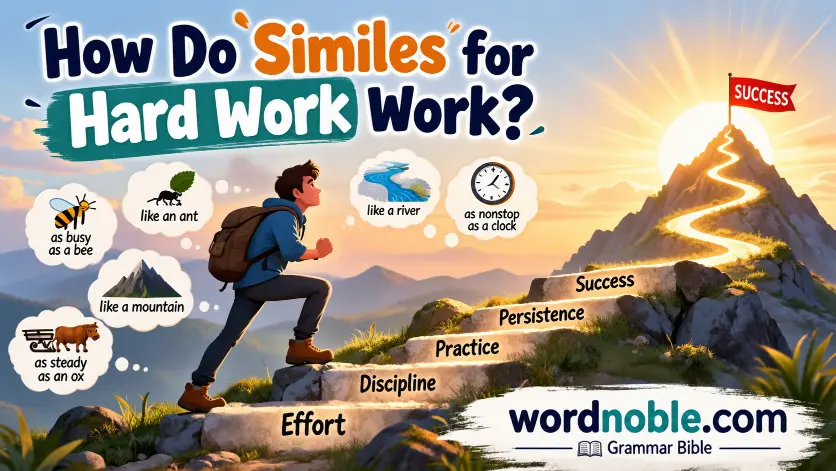
Hard work is an abstract concept. You cannot physically hold “dedication” or see “determination” itself. Writers therefore use comparisons to give these ideas a concrete image.
Consider the difference:
Plain:
He worked very hard.
With a simile:
He worked like a machine that never needed to stop.
The second sentence gives the reader a stronger impression of continuous effort.
Similes for hard work can communicate different qualities, including:
- Persistence
- Discipline
- Patience
- Strength
- Energy
- Focus
- Determination
- Consistency
- Endurance
- Commitment
The comparison you choose changes the emotional meaning of the sentence.
Why Do Writers Use Similes for Hard Work?
Writers use these comparisons because they make descriptions more specific and memorable.
1. They Create Imagery
A comparison such as “worked like an ant carrying a heavy load” gives the reader a visual image of effort.
2. They Show Persistence
A simile can communicate that someone continues working even when a task becomes difficult.
3. They Add Emotion
A simple statement can become inspirational, humorous, dramatic, or poetic depending on the comparison.
4. They Improve Descriptive Writing
Similes help students and creative writers move beyond repetitive words such as “hard,” “difficult,” and “busy.”
5. They Make Ideas Memorable
A familiar comparison can stay in a reader’s mind longer than a plain description.
Similes for Hard Work by Category
🐜 Animal-Based Similes
Animals are useful comparisons because many are associated with persistence, strength, teamwork, speed, or endurance.
😊Worked like an ant carrying a mountain
Meaning: The person continued working despite a huge challenge.
😊Worked like a bee in a hive
Meaning: The person was busy, productive, and focused.
Worked like a horse pulling a heavy cart
Meaning: The person put tremendous physical or mental effort into the task.
Worked like a beaver building a dam
Meaning: The person worked patiently and continuously toward a goal.
Persistent as an ant on a long journey
Meaning: The person kept going despite obstacles.
Animal comparisons are especially effective in storytelling because readers already understand many familiar animal behaviors.
📡 Technology-Based Similes
Technology can create modern comparisons that communicate speed, consistency, or nonstop activity.
He worked like a machine.
Meaning: He worked continuously and efficiently.
She worked like a computer processing information.
Meaning: She handled a large amount of work with concentration and speed.
They worked like engines running without a break.
Meaning: They maintained a high level of effort.
He was as focused as a programmer debugging difficult code.
Meaning: He concentrated intensely on solving a problem.
Technology-based similes can work particularly well in modern articles, business writing, dialogue, and contemporary fiction.
🌿 Nature-Based Similes
Nature provides powerful images of endurance and gradual progress.
She worked like a river cutting through stone.
Meaning: Her consistent effort slowly overcame resistance.
He pushed forward like a tree growing through cracked concrete.
Meaning: He continued developing despite difficult circumstances.
They worked as steadily as rain filling a river.
Meaning: Their effort accumulated gradually and consistently.
She was as persistent as sunlight breaking through clouds.
Meaning: She continued despite obstacles or setbacks.
Nature-based comparisons often have a poetic quality and work well in reflective writing.
😂 Humorous and Exaggerated Similes
Humorous similes can make hard work sound entertaining.
He worked like a squirrel preparing for ten winters.
Meaning: He prepared excessively and worked intensely.
She worked like a robot whose battery had been replaced every five minutes.
Meaning: She seemed to have endless energy.
He worked like someone who had accidentally promised to finish everything before lunch.
Meaning: He was working extremely quickly and intensely.
They worked like ants who had discovered free pizza.
Meaning: Everyone suddenly became extremely active and enthusiastic.
These comparisons should match the tone of the writing. They are better suited to casual conversation, humorous stories, social content, and informal writing than serious academic work.
🎭 Emotional and Behavioral Similes
Some comparisons focus on a person’s mental attitude rather than physical effort.
She worked with the determination of a runner nearing the finish line.
Meaning: She became increasingly focused because the goal was close.
He worked like someone chasing a lifelong dream.
Meaning: His effort was driven by strong personal motivation.
She was as persistent as someone refusing to give up on a difficult puzzle.
Meaning: She continued trying despite frustration.
He worked like a person with something important to prove.
Meaning: His effort was intense and emotionally motivated.
These similes are useful when the writer wants to emphasize motivation, ambition, or emotional commitment.
15 Similes for Hard Work With Meanings
| Simile | Meaning | Category | Clarity |
|---|---|---|---|
| He worked like a machine. | He worked continuously and efficiently. | Technology | Shows nonstop effort. |
| She worked like a bee in a hive. | She stayed busy and productive. | Animal | Suggests constant activity. |
| He worked like an ant carrying a heavy load. | He continued despite difficulty. | Animal | Highlights persistence. |
| She worked like a horse pulling a heavy cart. | She used tremendous effort. | Animal | Emphasizes strength and endurance. |
| They worked like ants building a colony. | They worked steadily toward a shared goal. | Animal | Shows teamwork and persistence. |
| He worked like a river cutting through stone. | His consistent effort overcame resistance. | Nature | Highlights patience. |
| She worked like a tree growing through concrete. | She succeeded despite obstacles. | Nature | Suggests resilience. |
| He worked like an engine that never stopped. | He maintained continuous effort. | Technology | Emphasizes endurance. |
| She worked as steadily as falling rain. | Her effort was consistent over time. | Nature | Shows gradual progress. |
| He worked like a marathon runner nearing the finish line. | He became intensely focused on completing the task. | Behavioral | Shows determination. |
| She worked like a beaver building a dam. | She worked patiently and persistently. | Animal | Highlights continuous effort. |
| They worked like a well-oiled machine. | The group worked smoothly and efficiently. | Technology | Emphasizes teamwork. |
| He worked like a farmer preparing a field. | He put in patient, practical effort. | Nature | Suggests preparation and patience. |
| She worked like someone chasing a dream. | Strong motivation drove her effort. | Emotional | Highlights ambition. |
| He worked like a clock ticking through the night. | He continued working steadily for a long time. | Object | Emphasizes consistency. |
Context Table
| Context | Meaning | Use Case | Example |
|---|---|---|---|
| School | Academic effort | Essays and assignments | She studied like a student preparing for the biggest exam of her life. |
| Workplace | Professional dedication | Reports and presentations | He worked like a machine to complete the project. |
| Sports | Training and endurance | Motivational writing | She trained like a marathon runner preparing for race day. |
| Poetry | Emotional persistence | Poems and reflective writing | He worked like a river carving its path through stone. |
| Storytelling | Character development | Fiction | The farmer worked like an ant carrying a burden twice its size. |
| Conversation | Everyday effort | Casual speech | You have been working like a machine today! |
| Humor | Exaggeration | Funny writing | She worked like a robot powered by unlimited coffee. |
| Motivation | Determination | Speeches and posts | Keep working like a runner approaching the finish line. |
How to Use Similes for Hard Work Naturally
A good simile should strengthen the sentence rather than distract from it.
1. Match the Comparison to the Situation
Use a machine comparison when you want to emphasize nonstop productivity. Use an ant when you want to emphasize persistence or carrying a difficult burden.
2. Consider the Tone
A poetic sentence may benefit from nature imagery, while a humorous conversation may benefit from an exaggerated comparison.
3. Make the Connection Clear
The reader should quickly understand why the comparison represents hard work.
4. Avoid Random Comparisons
Do not choose an object simply because it sounds interesting. Ask what quality it represents.
5. Use Specific Imagery
Instead of:
He worked hard like an animal.
Try:
He worked like an ant carrying a load several times its size.
The second version gives the reader a clearer image.
How Similes Improve Creative Writing
Similes can transform ordinary descriptions into vivid scenes.
Compare:
Maria studied hard for the examination.
with:
Maria studied like a marathon runner training for the final mile.
The second sentence suggests discipline, endurance, and a clear goal.
This technique is particularly useful in descriptive writing, where the writer wants readers to visualize a person’s actions.
Similes can also support characterization. A character who works “like a machine” may appear highly focused, while a character who works “like an ant carrying a heavy load” may appear patient and persistent.
Simile vs. Metaphor
A simile directly compares two different things using words such as like or as.
Simile:
He worked like a machine.
A metaphor makes a direct comparison without using “like” or “as.”
Metaphor:
He was a machine at work.
Both forms of figurative language can communicate intense effort, but they structure the comparison differently.
Quick Difference
Simile: He worked like a machine.
Metaphor: He was a machine.
Remember that a metaphor does not mean the person literally became the thing being described. Both are forms of figurative language.
When Not to Use Similes
Similes are useful, but they are not appropriate for every sentence.
Avoid them when:
- The comparison makes the sentence harder to understand.
- The subject requires precise technical language.
- The comparison feels forced.
- You have already used several similes in nearby sentences.
- The comparison does not logically connect to the quality being described.
- A simple statement communicates the idea more clearly.
Academic writing sometimes benefits from direct explanations rather than decorative imagery, especially when precision is more important than style.
Common Mistakes With Similes for Hard Work
Overusing Similes
Using a simile in every sentence can make writing feel crowded. One strong comparison is often more effective than five weak ones.
Choosing an Illogical Comparison
A comparison should share a meaningful quality with hard work. If the connection is unclear, readers may become confused.
Confusing Similes With Metaphors
If you write “He is a machine,” you are using a metaphor. If you write “He works like a machine,” you are using a simile.
Making Every Comparison Extreme
Not every hardworking person needs to be compared to someone conquering a mountain. Sometimes a subtle comparison creates a more natural effect.
Forgetting Context
A humorous simile may be perfect for a conversation but inappropriate for a serious academic essay.
Usage Guide: Do and Don’t
Do
- Choose comparisons with a clear connection to effort.
- Match the simile to your audience.
- Use familiar images when clarity matters.
- Experiment with animals, nature, objects, and technology.
- Use similes to create sensory imagery.
- Keep the comparison natural.
- Vary your figurative language.
Don’t
- Add similes just to make a sentence longer.
- Use confusing comparisons.
- Repeat the same simile throughout an article.
- Mix literal and figurative meanings accidentally.
- Use humor when the context requires a serious tone.
- Assume every reader will understand an obscure reference.
Natural Chat Responses Using Similes for Hard Work
Here are some natural ways people might use these comparisons in everyday conversation:
“You have been working like a machine today!”
“She studies like an ant preparing for a huge journey.”
“He works like a horse when a deadline is coming.”
“We were working like bees trying to finish everything before the event.”
“You worked like a marathon runner heading toward the finish line.”
These sound more conversational than simply saying, “You worked very hard.”
Related Figurative Language Terms
Understanding related concepts can help you use similes more effectively.
Figurative Language
Figurative language uses words in creative ways to communicate ideas beyond their most literal meaning. Similes and metaphors are common examples.
Sensory Language
Sensory language describes experiences through sight, sound, touch, taste, or smell. Although hard work is abstract, a carefully chosen comparison can give it a more physical quality.
Descriptive Writing
Descriptive writing uses specific details and imagery to help readers picture people, places, actions, or experiences.
Auditory Imagery
Auditory imagery creates an impression of sound. It can be combined with figurative language when describing the sounds surrounding someone who is working.
Metaphor vs. Simile
Both create comparisons, but similes normally use “like” or “as,” while metaphors make a direct comparison.
FAQs:
1. What Are Similes for Hard Work?
Similes for hard work are comparisons that describe effort, persistence, dedication, or determination by connecting them with something familiar. They usually use “like” or “as.” For example, “He worked like a machine” compares a person’s continuous effort with a machine’s ability to keep operating. These expressions make ordinary descriptions more vivid and useful in creative writing.
2. What Is a Good Simile for Hard Work?
A good simile depends on the quality you want to emphasize. “Worked like a machine” suggests continuous effort, while “worked like an ant carrying a heavy load” suggests persistence despite difficulty. “Worked like a river cutting through stone” emphasizes patience and gradual progress. The strongest comparison is the one that clearly matches the situation.
3. What Are Some Funny Similes for Hard Work?
Funny similes exaggerate someone’s effort to create humor. Examples include “He worked like a robot with unlimited batteries” and “She worked like an ant that had discovered a mountain of snacks.” These comparisons are intentionally exaggerated, so they work best in casual conversations, humorous stories, social posts, and informal writing.
4. What Are Some Poetic Similes for Hard Work?
Poetic similes often use nature and emotional imagery. Examples include “She worked like a river carving its path through stone” and “He worked as steadily as rain filling a river.” These comparisons emphasize patience, endurance, and gradual progress. They are especially useful in poetry, reflective writing, inspirational passages, and literary descriptions.
5. What Is the Difference Between a Simile and a Metaphor?
A simile makes a comparison using words such as “like” or “as.” For example, “He worked like a machine.” A metaphor makes a direct comparison without those words, as in “He was a machine.” Both are forms of figurative language, but the grammatical structure of the comparison is different.
6. How Can I Use Similes for Hard Work in Writing?
Choose a comparison that represents the exact quality you want to communicate. If you want to show persistence, consider an ant or a river. If you want to show nonstop activity, a machine may work better. Place the simile where it adds imagery or emotion, and avoid adding one when a direct statement would be clearer.
7. Why Are Similes Important in English Literature?
Similes help literature communicate abstract emotions and ideas through familiar images. A writer can describe persistence, suffering, ambition, fear, love, or determination by comparing those experiences with concrete things. This creates imagery and can influence the emotional tone of a passage. Similes are therefore an important creative-writing and figurative-language technique.
8. How Can Students Use Similes for Hard Work?
Students can use similes in essays, creative writing, speeches, stories, poems, and descriptive paragraphs. For example, “The students worked like bees preparing for a busy day” can communicate group activity and productivity. Students should choose comparisons that clearly match their intended meaning rather than adding figurative language simply to make an assignment sound complicated.
9. Can Similes Make Writing More Interesting?
Yes. A well-chosen simile can make an ordinary description more vivid by giving readers a recognizable mental image. Instead of saying “She worked hard,” a writer might say, “She worked like a marathon runner approaching the finish line.” The comparison adds information about persistence, focus, and determination while making the sentence more memorable.
10. Can I Use Similes for Hard Work in Everyday Speech?
Yes. Similes are common in casual conversation because they can make ordinary comments more expressive or humorous. Someone might say, “You have been working like a machine today!” or “They were working like bees.” Everyday similes do not need to sound literary. Simple, familiar comparisons are often the most natural in conversation.
Conclusion:
Similes for hard work give writers a creative way to describe effort, persistence, discipline, and determination. A comparison such as “worked like a machine” highlights continuous effort, while “worked like an ant carrying a heavy load” emphasizes persistence through difficulty. Nature, animals, technology, and everyday objects can all provide useful imagery.
The key is to choose a comparison that matches the exact quality you want to show. A strong simile should clarify an idea rather than make it confusing.
Whether you are writing a school assignment, poem, story, speech, or everyday message, thoughtful figurative language can make your description more vivid. In simple terms, the best simile is not the most complicated one. It is the one that helps the reader instantly understand the effort behind the words.

I am Naqash Ayub, proudly writing for WordNoble, where I focus on creating clear, informative, and SEO-friendly content. I enjoy turning detailed information into simple, trustworthy articles that help readers find the answers they need.