
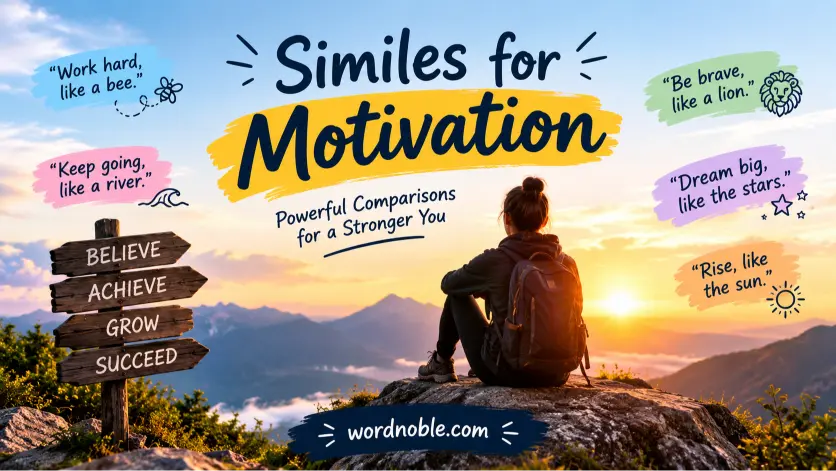
Motivation rarely shows up as a straight line it moves like weather, like tides, like a flame that flickers before it catches. That’s exactly why similes for motivation work so well: they turn an abstract feeling into something you can picture, feel, and hold onto.
A good comparison does more than decorate a sentence. It reframes struggle as temporary, effort as fuel, and progress as movement, even when it’s slow. Coaches use them. Writers use them. Speakers lean on them to make a room sit up and listen.
Think about it “push through like a runner nearing the finish line” hits differently than simply saying “keep going.” That’s the quiet power of figurative language: it speaks to emotion, not just logic.
In this collection, you’ll find motivational similes and inspiring comparisons sorted by mood and purpose some for grit, some for fresh starts, some for bouncing back after setbacks.
Whether you’re writing a speech, journaling, or just need a mental reset, these lines are built to spark momentum. Let’s start with the ones that capture pure, unstoppable drive.
Similes for motivation are figurative expressions that compare motivation or determination to something else using words such as “like” or “as.” They help readers visualize energy, ambition, persistence, confidence, and the desire to achieve a goal.
Meaning and Deep Explanation
A simile is a figure of speech that makes a direct comparison between two different things, usually with like or as.
When writers use similes for motivation, they compare an inner feeling such as ambition, courage, persistence, or enthusiasm to something readers can easily imagine.
For example:
Her motivation was like a roaring fire that refused to die.
The motivation is not literally fire. The comparison suggests that her determination is powerful, energetic, and difficult to extinguish.
Motivational similes are especially useful because motivation is an abstract idea. You cannot physically hold ambition or measure determination with a ruler. A vivid comparison gives that invisible feeling a concrete image.
How Motivation Similes Work
A strong motivation simile usually connects motivation with one of these qualities:
- Energy
- Strength
- Movement
- Persistence
- Growth
- Heat
- Light
- Speed
- Courage
- Resilience
This creates figurative language that appeals to the reader’s imagination.
Why Writers Use Similes for Motivation
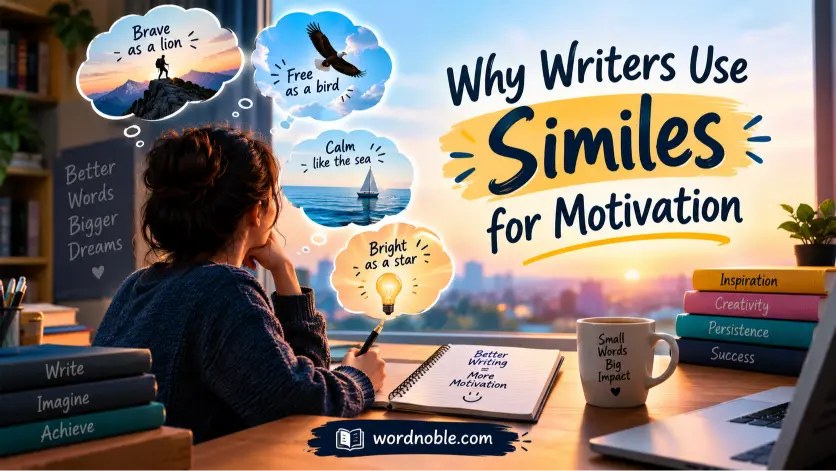
Writers use these comparisons to:
- Make abstract emotions easier to understand
- Create memorable imagery
- Add personality to descriptions
- Strengthen persuasive writing
- Make stories more emotionally engaging
- Improve poetry and creative writing
- Help students avoid repetitive descriptions
- Give readers a stronger sense of determination
Motivation can therefore become something readers can almost see, feel, hear, or imagine.
Similes for motivation are comparisons that describe determination, ambition, enthusiasm, or persistence by relating them to a familiar person, object, animal, natural force, or experience. They use figurative language to make an abstract feeling more vivid, specific, and emotionally understandable.
Contextual Meaning Expansion
The same motivational simile can serve different purposes depending on the context.
Storytelling
In stories, similes can reveal a character’s determination without simply stating that the character is motivated.
Example:
His determination burned like a furnace as he prepared for the final challenge.
This makes the character’s motivation feel intense and active.
Poetry
Poetry often uses imaginative and emotional comparisons.
Example:
Her hope rose like the morning sun.
The comparison creates an image of renewal and optimism.
Casual Speech
Simple similes can make everyday conversations more expressive.
Example:
I’m motivated like never before.
Casual language generally works best when the comparison is easy to understand.
Humor
Exaggerated comparisons can make motivation funny.
Example:
He was as motivated as a puppy chasing a squeaky toy.
The comparison creates a playful image rather than a serious one.
Academic Writing
Similes can occasionally strengthen essays and explanations, particularly in reflective or literary writing. However, academic writing usually benefits from precise language rather than excessive figurative expressions.
Types of Similes for Motivation
🐾 Animal-Based Similes
Animals can represent energy, persistence, speed, courage, and determination.
Examples
- As motivated as a racehorse at the starting gate extremely eager to begin.
- Like a lion chasing its prey focused and determined.
- As persistent as a woodpecker refusing to give up.
- Like an eagle soaring toward the sky ambitious and confident.
- As energetic as a puppy full of enthusiasm.
- Like an ant carrying food across a vast field persistent despite difficulty.
Animal comparisons work particularly well when you want motivation to feel instinctive, energetic, or relentless.
📡 Technology-Based Similes
Technology offers modern comparisons for focus, speed, and continuous energy.
Examples
- His motivation was like a fully charged battery. He had plenty of energy.
- She worked like a computer running at full speed. She was highly focused and productive.
- His ambition was like a rocket preparing for launch. He was ready to move toward a major goal.
- Her determination was like an engine that never stopped. She kept going continuously.
Technology-based similes are especially effective in contemporary writing because they feel familiar and modern.
🌿 Nature-Based Similes
Nature provides some of the strongest images for motivation.
Examples
- Like a sunrise after a dark night motivation brings renewed hope.
- As strong as a mountain powerful and steady determination.
- Like a river flowing toward the sea continuously moving toward a goal.
- As bright as sunlight positive and energizing.
- Like a seed pushing through the soil growing despite obstacles.
- As fierce as a storm intense and powerful.
Nature-based comparisons are particularly useful in poetry and inspirational writing.
😂 Humorous and Exaggerated Similes
Humorous similes use exaggeration to make motivation entertaining.
- As motivated as a kid chasing an ice-cream truck.
- Like a squirrel that just discovered an endless supply of nuts.
- As determined as someone hunting for the last slice of pizza.
- Like a student five minutes before an important deadline.
- As energetic as a toddler who refuses to take a nap.
- Like a dog chasing a ball across an empty field.
These comparisons work best in casual writing, social posts, dialogue, and humorous stories.
🎭 Emotional and Behavioral Similes
These similes focus on the psychological side of motivation.
- Her motivation was like a quiet voice telling her to keep going.
- His determination was as steady as a heartbeat.
- She was like a runner who could see the finish line.
- His ambition burned like a hidden flame.
- Her confidence grew like a rising tide.
- His motivation returned like hope after a difficult season.
These comparisons are useful when motivation is gradual, emotional, or connected to personal growth.
15 Powerful Similes for Motivation With Meanings
| Simile | Meaning | Category |
|---|---|---|
| Her motivation was like a roaring fire. | She had intense energy and determination. | Nature |
| He was as motivated as a racehorse at the starting gate. | He was eager to begin. | Animal |
| His ambition was like a rocket ready for launch. | He was prepared to pursue a major goal. | Technology |
| Her determination was as strong as a mountain. | She remained firm despite challenges. | Nature |
| His motivation was like a fully charged battery. | He had plenty of energy. | Technology |
| She pursued her dream like an eagle chasing the horizon. | She was ambitious and focused. | Animal |
| His persistence was like a river flowing toward the sea. | He kept moving toward his goal. | Nature |
| Her motivation grew like a seed breaking through the soil. | Her determination developed despite difficulties. | Nature |
| He was as determined as a woodpecker. | He refused to stop trying. | Animal |
| Her confidence rose like the morning sun. | She became increasingly hopeful and confident. | Nature |
| His motivation was like an engine that never stopped. | He continued working without giving up. | Technology |
| She was as energetic as a puppy. | She was enthusiastic and full of energy. | Animal |
| His ambition burned like a bright flame. | His desire to succeed was powerful. | Nature |
| Her determination was steady as a heartbeat. | Her motivation remained consistent. | Emotional |
| He was as motivated as someone chasing the last slice of pizza. | He was humorously eager and determined. | Humorous |
More Short Similes for Motivation
If you need quick expressions for captions, assignments, or creative writing, try these:
- Like a fire that keeps burning
- Like a rocket at launch
- Like sunlight after rain
- Like a river that never stops
- Like a runner nearing the finish line
- Like a seed reaching for sunlight
- Like an engine running nonstop
- Like a lion on the hunt
- Like a mountain standing firm
- Like a spark becoming a flame
- Like a wave moving toward shore
- Like a compass pointing north
- Like a train rushing toward its destination
- Like a bird spreading its wings
- Like a candle refusing to go out
Context Table: How to Use Motivation Similes
| Context | Meaning | Use Case | Example |
|---|---|---|---|
| School essay | Determination | Describing a hardworking student | Her motivation was like a steady flame. |
| Inspirational speech | Hope and energy | Encouraging an audience | Your motivation can rise like the sun. |
| Poetry | Emotional ambition | Creating imagery | His dreams burned like stars. |
| Storytelling | Character development | Showing determination | She moved forward like a river. |
| Casual conversation | Enthusiasm | Expressing excitement | I’m motivated like never before. |
| Humor | Exaggerated enthusiasm | Making readers laugh | He was as motivated as a dog chasing a ball. |
| Personal journal | Self-determination | Reflecting on goals | My motivation feels like a new sunrise. |
| Creative writing | Strong imagery | Building atmosphere | His ambition roared like a storm. |
How to Use Similes for Motivation in Writing
A simile becomes effective when it adds meaning rather than simply decorating a sentence.
1. Identify the Type of Motivation
Ask what you are actually describing.
Is it:
- Excitement?
- Ambition?
- Persistence?
- Courage?
- Hope?
- Discipline?
- Confidence?
A comparison should match the specific emotion.
2. Choose a Familiar Image
Select something readers immediately understand.
For persistence, a river, mountain, or woodpecker can work well.
For energy, consider a fire, rocket, or charged battery.
3. Match the Intensity
Do not describe mild motivation as an explosive force unless you want deliberate exaggeration.
For example:
Mild:
Her motivation was like a small candle.
Strong:
Her motivation was like a roaring wildfire.
The comparison changes the emotional intensity.
4. Avoid Forced Comparisons
A simile should feel natural.
Instead of adding a random comparison to every sentence, use one when it makes the idea clearer or more memorable.
5. Use Sensory Language
Strong creative writing often combines similes with sensory language.
Motivation can be described through images of:
- Brightness
- Heat
- Movement
- Sound
- Texture
- Size
- Speed
This gives abstract emotions a physical quality.
Simile vs. Metaphor: What’s the Difference?
A simile makes a comparison using words such as like or as.
Simile:
Her motivation was like a blazing fire.
A metaphor makes the comparison directly.
Metaphor:
Her motivation was a blazing fire.
Both expressions communicate intensity, but the grammatical structure is different.
Quick Rule
Simile = comparison with “like” or “as.”
Metaphor = direct comparison without “like” or “as.”
Both are important English literature concepts and creative writing techniques.
Common Mistakes When Using Motivation Similes
1. Overusing Similes
Using a simile in every sentence can make writing feel crowded.
Better: Use strong comparisons selectively.
2. Choosing an Illogical Comparison
A comparison should share a meaningful quality with motivation.
For example, comparing motivation to something completely unrelated may confuse the reader.
3. Making Every Simile Extreme
Not every motivational feeling needs to be described as a “wildfire,” “explosion,” or “hurricane.”
Sometimes a quiet image is more powerful.
4. Confusing Similes With Metaphors
Remember that a simile normally signals comparison with like or as, while a metaphor states the comparison directly.
5. Explaining Too Much
A vivid simile often speaks for itself.
Instead of writing a long explanation after every comparison, let the image communicate the feeling.
👍 Do and Don’t Usage Guide
Do
- Choose comparisons that match the emotion.
- Use familiar images.
- Vary your comparisons.
- Combine similes with sensory details.
- Consider your audience.
- Use stronger images for stronger emotions.
- Keep the comparison easy to understand.
Don’t
- Force a simile into every sentence.
- Mix several unrelated comparisons together.
- Use confusing or obscure references.
- Repeat the same image throughout an article.
- Turn every sentence into exaggerated language.
- Confuse a metaphor with a simile.
- Sacrifice clarity just to sound creative.
Natural Chat-Style Responses Using Motivation Similes
“I’m feeling motivated like a runner who can finally see the finish line.”
“My motivation is like a phone at 100% I’m ready to get things done.”
“She’s motivated like a rocket waiting for liftoff.”
“After that speech, my motivation came back like sunlight after rain.”
“I’m as motivated as a kid chasing an ice-cream truck!”
“His motivation is like a fire that just keeps burning.”
These casual expressions sound natural because they connect an abstract feeling to familiar experiences.
Related Figurative Language Terms
Understanding motivation similes becomes easier when you know the surrounding concepts.
Figurative Language
Language that communicates ideas beyond their literal meaning. Similes and metaphors are common examples.
Sensory Language
Words that appeal to the senses and help readers imagine an experience.
Auditory Imagery
Language that creates an impression of sound. Although motivation itself is abstract, sound-based imagery can describe the emotional atmosphere surrounding determination.
Descriptive Writing
Writing that uses specific details, imagery, and carefully selected language to create a vivid picture.
Metaphor vs. Simile
Both compare ideas, but a simile generally uses like or as, while a metaphor makes a direct comparison.
Imagery
Descriptive language that helps readers form mental pictures or sensory impressions.
FAQs:
1. What are similes for motivation?
Similes for motivation are comparisons that make determination, ambition, enthusiasm, or persistence easier to imagine. They usually connect motivation with something familiar using “like” or “as.” For example, describing motivation as being “like a roaring fire” suggests strong energy and determination. These expressions are useful in creative writing, speeches, essays, poetry, captions, and everyday conversation.
2. What is a good simile for motivation?
A strong general simile is “Motivation is like a roaring fire.” It suggests energy, strength, and persistence. Another useful comparison is “His motivation was like a fully charged battery,” which emphasizes energy and readiness. The best simile depends on the specific type of motivation you want to express, such as ambition, hope, discipline, excitement, or persistence.
3. What are some funny similes for motivation?
Funny motivation similes use familiar or exaggerated situations to create humor. Examples include “as motivated as a kid chasing an ice-cream truck” and “like a squirrel discovering an endless supply of nuts.” These comparisons are not meant to sound formal. They work especially well in casual conversations, humorous writing, social media captions, character dialogue, and lighthearted motivational content.
4. What are some poetic similes for motivation?
Poetic similes often use natural images such as sunlight, stars, rivers, fire, seeds, and mountains. For example, “Her motivation rose like the morning sun” suggests renewed hope, while “His ambition burned like a hidden flame” suggests powerful inner desire. Poetic comparisons work well because they transform an abstract emotion into an image that readers can visualize and feel.
5. What is the difference between a simile and a metaphor?
A simile explicitly compares two things, commonly using “like” or “as.” For example, “Her motivation was like a fire.” A metaphor makes the comparison directly: “Her motivation was a fire.” Both are forms of figurative language, but the structure is different. Recognizing this difference helps students and writers use literary devices accurately.
6. How can I use motivation similes in writing?
First, identify the exact feeling you want to describe. Then choose an image that shares that quality. For example, use a fire for intensity, a mountain for strength, or a river for persistence. Place the simile where it improves the description instead of adding it randomly. A well-chosen comparison should make the reader understand the emotion more clearly.
7. Why are similes important in English literature?
Similes help writers turn abstract ideas into vivid images. Motivation, fear, love, anger, and hope can be difficult to describe literally because they cannot be physically seen. A simile gives readers something concrete to imagine. In English literature, this technique can strengthen characterization, atmosphere, emotional expression, imagery, and the overall impact of creative writing.
8. How can students use similes for motivation?
Students can use motivation similes in essays, creative stories, poetry, speeches, journal entries, and assignments. They can describe a character’s determination, explain their own ambition, or make an inspirational paragraph more vivid. For example, a student might write, “Her motivation was like a seed pushing through the soil.” This shows determination despite obstacles without simply stating it.
9. Can motivation similes be used in poetry?
Yes. Similes are especially effective in poetry because poems often depend on imagery and emotional compression. A short comparison can communicate a large idea. For instance, “His motivation rose like dawn” immediately creates an image of renewal and hope. Poets can combine similes with rhythm, symbolism, sensory language, and other forms of figurative language.
10. What makes a motivation simile effective?
An effective motivation simile is clear, relevant, memorable, and appropriate for the context. The comparison should share a recognizable quality with the motivation being described. A powerful image is not automatically a good one; it must make sense within the sentence. The strongest similes give readers a quick mental picture while adding emotional meaning to the original idea.
Conclusion:
Similes for motivation turn an invisible feeling into something readers can picture, understand, and remember. A comparison to a roaring fire can show intensity, while a river can represent persistence and a sunrise can suggest renewed hope.
The strongest similes are not simply decorative; they reveal the quality and strength of a person’s motivation. When writing essays, stories, poems, speeches, or everyday messages, choose comparisons that naturally match the emotion you want to express. Most importantly, use them with purpose.
A clear, relevant simile can transform a simple statement about motivation into an image that stays in the reader’s mind.

I am Naqash Ayub, proudly writing for WordNoble, where I focus on creating clear, informative, and SEO-friendly content. I enjoy turning detailed information into simple, trustworthy articles that help readers find the answers they need.