
A mountain doesn’t just sit there it broods, it towers, it sleeps like some ancient giant waiting to wake. That’s the power of a good simile: it turns a pile of rock and snow into something with personality.
Writers have leaned on similes for mountains for centuries, comparing peaks to castles, sleeping dragons, and jagged teeth against the sky, because plain description just doesn’t cut it when you’re trying to capture something that massive.
Maybe you’re crafting a poem, polishing a novel’s setting, or hunting for fresh mountain metaphors to make your writing less flat.
Whatever brought you here, you’re about to find exactly what you need. This list pulls together vivid, varied comparisons some peaceful, some fierce, some downright poetic so you can pick the one that fits your tone. No filler, no recycled clichés you’ve read a hundred times before.
Just a solid collection of mountain imagery organized so you can scan, choose, and get back to writing. Ready to see mountains in a whole new light? Let’s start with the classics.
Similes for mountains are comparisons that describe mountains by using “like” or “as” to create vivid images of their size, shape, strength, beauty, or appearance.
For example: “The mountain stood like a giant guarding the valley.”
Meaning of Similes for Mountains
A simile is a type of figurative language that compares two different things using words such as like or as.
When describing mountains, similes help readers imagine qualities that are difficult to express through literal description alone. Instead of simply saying that a mountain is tall, a writer might compare it to a giant, tower, or sleeping creature.
The comparison gives the reader an immediate mental picture.
For example:
- The mountain was as tall as a skyscraper.
- The peaks rose like frozen waves.
- The mountain stood like a silent guardian.
Each sentence communicates more than physical size. It can also suggest power, movement, mystery, danger, beauty, or stillness.
How Do Similes for Mountains Work?
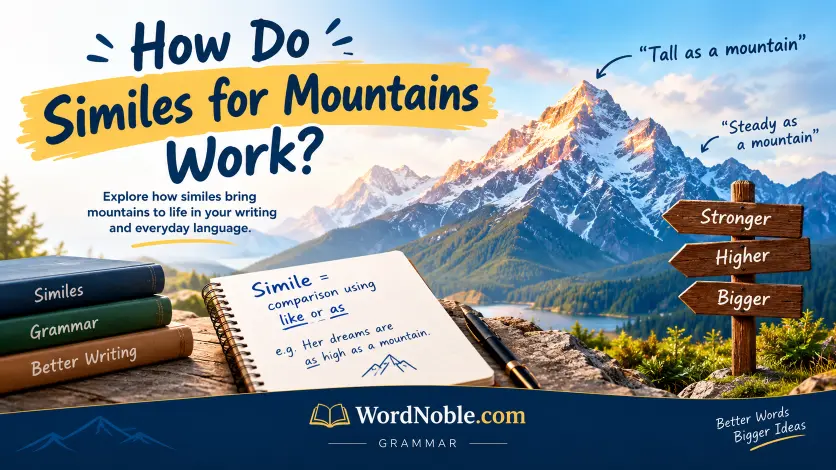
Mountain similes usually focus on recognizable qualities such as:
- Height
- Size
- Strength
- Shape
- Color
- Texture
- Beauty
- Age
- Stillness
- Danger
- Majesty
- Isolation
A writer chooses something familiar and connects it with the mountain. This makes the description easier for the reader to visualize.
Why Do Writers Use Mountain Similes?
Writers use similes for mountains because a literal description can sometimes feel flat.
Compare:
Literal:
“The mountain was very large.”
With a simile:
“The mountain towered like a giant above the village.”
The second sentence creates a stronger visual image. It also gives the mountain a sense of personality and power.
Similes are particularly useful in descriptive writing, poetry, storytelling, travel writing, creative essays, and English literature.
Similes for mountains are forms of figurative language that compare mountains with familiar people, animals, objects, or natural features using “like” or “as.” They help communicate a mountain’s physical appearance and emotional impression by creating clear sensory images for the reader.
Contextual Meaning of Mountain Similes
The same mountain can feel completely different depending on the context.
In Storytelling
Mountain similes can establish atmosphere and setting.
Example:
“The mountain loomed like a giant over the tiny village.”
This makes the landscape feel powerful and possibly threatening.
In Poetry
Poets often use imaginative comparisons to make mountains seem alive.
Example:
“The snowy peaks glittered like diamonds beneath the moon.”
The comparison emphasizes beauty and light.
In Casual Speech
Simple similes can make everyday descriptions more expressive.
Example:
“That mountain is like a wall we still have hours to climb.”
In Humor
Exaggerated comparisons can make descriptions funny.
Example:
“That mountain of laundry looked like Mount Everest.”
The comparison is humorous because an ordinary pile is presented as an enormous mountain.
In Academic Writing
Similes should be used carefully in academic work. A clear comparison can make a complex description easier to understand, but overly poetic language may reduce precision.
Simile Taxonomy: Types of Similes for Mountains
🐾 Animal-Based Similes
Animal comparisons can make mountains seem powerful, alive, or imposing.
- The mountain stood like a sleeping giant.
Meaning: It looked huge and still. - The peak curled like a dragon’s back.
Meaning: The shape of the mountain resembles a dragon. - The mountain rose like an eagle spreading its wings.
Meaning: The mountain appears broad and majestic. - The cliffs towered like elephants above the plain.
Meaning: The cliffs looked enormous and imposing.
Animal-based similes are especially effective in fantasy, adventure stories, poetry, and imaginative descriptions.
📡 Technology-Based Similes
Modern objects can provide unexpected comparisons.
- The mountain stood like a giant skyscraper.
Meaning: It emphasized the mountain’s extraordinary height. - The peaks looked like antennas reaching toward the sky.
Meaning: The peaks appeared thin and tall. - The mountain rose like a natural fortress.
Meaning: It suggested strength and protection.
Technology-based comparisons work well when a writer wants a modern or unexpected tone.
🌿 Nature-Based Similes
Nature provides some of the most natural mountain comparisons.
- The peaks floated like clouds above the valley.
Meaning: They appeared distant and dreamlike. - The snowy slopes shimmered like ice under the sun.
Meaning: The snow looked bright and reflective. - The mountain range stretched like a river across the horizon.
Meaning: The range appeared long and continuous. - The peaks rose like waves frozen in place.
Meaning: Their shapes resembled enormous waves.
Nature-based similes are ideal for landscape writing and poetry.
😂 Humorous and Exaggerated Similes
Funny comparisons can make mountain descriptions memorable.
- The mountain was as tall as my list of unfinished homework.
Meaning: The height is humorously exaggerated. - That hill looked like it had been inflated overnight.
Meaning: The hill seems unusually large. - The mountain was like a giant who forgot to sit down.
Meaning: It humorously emphasizes its enormous height. - The pile of snow looked like a mountain wearing a white blanket.
Meaning: Snow covers the mountain like a blanket.
These work especially well in humorous stories, informal writing, captions, and creative exercises.
🎭 Emotional and Behavioral Similes
These comparisons give mountains human-like emotional qualities without turning the sentence into a direct metaphor.
- The mountain stood like a patient guardian.
Meaning: It seemed protective and watchful. - The peak looked as lonely as a forgotten traveler.
Meaning: The isolated mountain creates a feeling of loneliness. - The mountain waited like a silent witness.
Meaning: It seemed to have observed events for a long time. - The cliffs stood like proud sentinels.
Meaning: The cliffs appeared strong and watchful.
15 Powerful Similes for Mountains With Meanings
| Simile | Meaning | Category | Clarity |
|---|---|---|---|
| The mountain stood like a giant. | It was enormous and imposing. | Animal/character | Shows great size and strength. |
| The peaks rose like frozen waves. | The peaks had wave-like shapes. | Nature | Creates a visual landscape. |
| The mountain was as tall as a skyscraper. | It seemed extremely tall. | Object | Gives readers a familiar height comparison. |
| The snowy peak glittered like a diamond. | The snow reflected bright light. | Object | Highlights beauty and brightness. |
| The mountain stood like a silent guardian. | It seemed protective and watchful. | Emotional | Gives the landscape personality. |
| The cliffs looked like a dragon’s back. | Their shape resembled a dragon. | Animal | Creates a fantasy-like image. |
| The range stretched like a giant wall. | It extended across the horizon. | Object | Emphasizes length and scale. |
| The peak pierced the clouds like a spear. | It rose sharply into the sky. | Object | Emphasizes a pointed shape. |
| The mountain slept like a tired giant. | It looked quiet and motionless. | Animal | Creates a peaceful image. |
| The slopes rolled like waves. | The slopes had flowing curves. | Nature | Highlights their shape. |
| The mountain was as solid as a fortress. | It appeared strong and unmovable. | Object | Emphasizes strength. |
| The peaks glowed like golden crowns. | Sunlight illuminated their tops. | Object | Suggests beauty and majesty. |
| The mountain looked like a sleeping beast. | It appeared huge and mysterious. | Animal | Creates an adventurous mood. |
| The snow fell like white feathers. | Snow appeared soft and delicate. | Nature | Creates a gentle visual image. |
| The mountain loomed like a shadow over the valley. | It appeared large and dominant. | Emotional | Creates a dramatic atmosphere. |
More Creative Similes for Mountains
If you need a larger vocabulary bank, these comparisons can inspire your own sentences:
- Like a giant rising from the earth
- Like a tower touching the clouds
- Like a wall guarding the valley
- Like a sleeping dragon
- Like waves frozen in time
- Like a crown above the landscape
- Like a fortress carved from stone
- Like an ancient king watching the land
- Like a white blanket under the sun
- Like a staircase leading into heaven
- Like a ship sailing through clouds
- Like a giant’s shoulder
- Like a stone wave reaching upward
- Like a needle piercing the sky
- Like a dark silhouette against the sunset
- Like a silver pyramid in the distance
- Like an enormous sculpture
- Like a guardian standing at the border
- Like a sleeping elephant
- Like a frozen ocean wave
- Like a castle above the clouds
- Like an ancient monument
- Like a giant hand reaching toward heaven
- Like a fortress of ice and stone
- Like a staircase made of rock
Context Table: Choosing the Right Mountain Simile
| Context | Meaning | Use Case | Example |
|---|---|---|---|
| Adventure story | Power and danger | Fiction | The mountain rose like a fortress. |
| Poetry | Beauty and mystery | Poems | The peaks glittered like diamonds. |
| School essay | Size and shape | Academic/educational | The mountain stood like a giant wall. |
| Travel writing | Wonder | Travel descriptions | The peaks appeared like frozen waves. |
| Fantasy | Magic and mystery | Creative fiction | The mountain slept like an ancient dragon. |
| Humor | Exaggeration | Funny writing | The hill looked like Mount Everest. |
| Nature description | Shape | Descriptive writing | The slopes rolled like ocean waves. |
| Emotional writing | Loneliness | Reflective writing | The mountain stood like a lonely guardian. |
How to Use Similes for Mountains Naturally
A good simile should add meaning, not simply decorate a sentence.
1. Identify the quality you want to describe
Ask yourself:
- Is the mountain tall?
- Is it dangerous?
- Is it beautiful?
- Is it peaceful?
- Is it mysterious?
- Is it covered with snow?
- Is it isolated?
2. Choose a familiar comparison
Think about objects, animals, people, or natural features that share the same quality.
For height, consider:
tower, skyscraper, giant, wall
For strength:
fortress, rock, warrior, castle
For beauty:
diamond, crown, jewel
For mystery:
sleeping dragon, shadow, ancient guardian
3. Connect the ideas with “like” or “as”
For example:
Mountain + height + tower
becomes:
“The mountain rose like a tower above the valley.”
4. Match the tone
A children’s story may need:
“The mountain stood like a giant.”
A poem might use:
“The snowy peaks shimmered like silver crowns beneath the moon.”
The best simile fits the voice and purpose of the writing.
How Similes Improve Creative Writing
Similes make descriptive writing more visual, memorable, and emotionally engaging.
Instead of giving readers a list of facts, they invite readers to form a mental picture.
Compare:
Basic:
“The mountain was covered in snow.”
More vivid:
“The mountain wore snow like a white blanket.”
The second sentence encourages the reader to imagine the snow as something soft and covering.
This is why similes are closely connected with sensory language and imagery. They can help readers visualize color, shape, movement, texture, atmosphere, and emotion.
Simile vs. Metaphor
The two devices are closely related but not identical.
Simile
A simile makes an explicit comparison using like or as.
“The mountain was like a giant.”
Metaphor
A metaphor directly identifies one thing with another.
“The mountain was a giant.”
The simile signals that this is a comparison. The metaphor presents the comparison more directly.
Easy Way to Remember
Simile = comparison with like/as
Metaphor = direct comparison
Both are important forms of figurative language used in English literature and creative writing.
Common Mistakes When Writing Mountain Similes
1. Using Too Many Similes
A sentence packed with comparisons can become difficult to read.
Instead of:
The mountain was like a giant, like a tower, like a wall, and like a dragon.
Choose the strongest comparison.
Better:
“The mountain rose like a sleeping dragon above the valley.”
2. Making an Illogical Comparison
The comparison should share a meaningful quality with the mountain.
A random comparison may confuse readers.
Ask:
“What exactly do these two things have in common?”
If the answer is unclear, choose another comparison.
3. Forgetting “Like” or “As”
If your assignment specifically asks for a simile, make the comparison clear.
Simile: The mountain stood like a fortress.
Metaphor: The mountain was a fortress.
Both can be effective, but they are different literary devices.
4. Explaining the Obvious
A simile should contribute something useful.
If “the mountain was like a mountain” adds no new image, it does not help the reader.
5. Using Clichés Too Often
Common comparisons can work, but original comparisons often create stronger writing.
Instead of always using “as tall as a giant,” consider:
“The peak rose like a stone needle through the clouds.”
Usage Guide: Do and Don’t
👍 Do
- Choose comparisons that have a clear connection.
- Use sensory details.
- Match the simile to your writing’s tone.
- Prefer vivid and understandable images.
- Use original comparisons when appropriate.
- Explain the meaning when writing for students.
👎 Don’t
- Fill every sentence with a simile.
- Choose a comparison only because it sounds fancy.
- Mix up similes and metaphors.
- Use confusing or unrelated comparisons.
- Sacrifice clarity for creativity.
- Repeat the same comparison throughout an article.
Natural Chat-Style Responses Using Mountain Similes
Here are some natural ways people might use mountain similes in conversation:
“That mountain looks like a giant standing over the town.”
“The snowy peak is like a diamond in the sunlight.”
“That climb felt like walking up a wall!”
“Those mountains look like waves frozen in the distance.”
“The peak was as sharp as a needle against the sky.”
“That mountain is like a fortress you can see it from miles away.”
Related Terms and Concepts
Understanding mountain similes becomes easier when you connect them with related English-language concepts.
Figurative Language
Figurative language uses words beyond their strictly literal meanings to create stronger expression and imagery.
Auditory Imagery
Auditory imagery describes sounds. It is one form of sensory imagery, although mountain descriptions more commonly emphasize visual imagery.
Sensory Writing
Sensory writing uses details connected with sight, sound, touch, taste, and smell to make descriptions more immersive.
Descriptive Writing
Descriptive writing focuses on creating a clear picture of a person, place, object, or experience.
Metaphor vs. Simile
Both create comparisons, but a simile generally uses “like” or “as,” while a metaphor makes a direct comparison.
FAQs:
1. What are similes for mountains?
Similes for mountains are comparisons that describe mountains by connecting them to familiar things using words such as like or as. They can describe a mountain’s height, shape, strength, beauty, movement, or emotional effect. For example, saying “the mountain stood like a giant” helps readers imagine something enormous, powerful, and imposing rather than simply stating that the mountain was large.
2. What is a good simile for a mountain?
A strong mountain simile depends on the quality you want to emphasize. For height, “the mountain rose like a tower” works well. For strength, “the mountain stood like a fortress” is effective. And for beauty, “the snowy peak glittered like a diamond” creates a vivid image. The best simile is specific, easy to understand, and connected logically to the mountain.
3. What are some funny similes for mountains?
Funny mountain similes usually rely on exaggeration or unexpected comparisons. For example, “the mountain was as tall as my homework pile” humorously exaggerates size. Another is “the mountain looked like a giant who forgot to sit down.” These comparisons work well in casual writing, children’s stories, humorous essays, captions, and creative writing exercises.
4. What are some poetic similes for mountains?
Poetic mountain similes often focus on beauty, mystery, movement, and emotion. Examples include “the snowy peaks glittered like diamonds,” “the mountains rose like frozen waves,” and “the peak stood like a silent guardian.” These comparisons create visual imagery and emotional atmosphere, making them especially useful in poems, descriptive passages, reflective writing, and literary compositions.
5. What is the difference between a simile and a metaphor for a mountain?
A simile explicitly compares a mountain to something else, usually with “like” or “as.” For example, “the mountain stood like a giant” is a simile. A metaphor makes the comparison directly: “the mountain was a giant.” Both are forms of figurative language, but the grammatical structure makes the distinction clear.
6. How can I use mountain similes in writing?
First, decide what quality of the mountain you want to emphasize, such as height, beauty, strength, shape, or mystery. Then choose something familiar that shares that quality. Connect the two with “like” or “as.” Finally, check whether the comparison fits your tone. A well-chosen simile should make the description clearer rather than simply making it sound more complicated.
7. Why are similes important in English literature?
Similes help writers create imagery, emotion, and memorable descriptions. They allow readers to understand unfamiliar or abstract ideas through familiar comparisons. In English literature, similes can also establish mood, reveal a character’s perspective, strengthen themes, and make descriptions more vivid. They are therefore an important creative writing technique as well as a common literary device.
8. How do students use similes for mountains?
Students can use mountain similes in descriptive essays, poetry, stories, assignments, and classroom exercises. They can describe the mountain’s physical appearance or use it to create a particular mood. For example, a student writing about an adventure might describe a mountain as “a fortress guarding the valley,” while a poetry assignment might use “peaks like frozen waves.”
9. Can a mountain simile describe emotions?
Yes. Similes can describe the emotional impression a mountain creates rather than only its physical appearance. For example, “the mountain stood like a lonely guardian” suggests isolation and quietness. “The peak loomed like a warning” creates tension. This technique allows writers to connect landscapes with feelings such as fear, peace, loneliness, wonder, or hope.
10. How do I make a mountain simile more creative?
Start with the quality you want to show instead of searching randomly for a comparison. Then look beyond obvious objects. Animals, architecture, weather, mythology, technology, and everyday experiences can all inspire useful comparisons. For example, instead of simply calling a mountain “tall,” you could describe its peak as “a stone needle piercing the clouds.” Specific imagery usually makes a simile more memorable.
Conclusion:
Similes for mountains give writers a simple way to transform ordinary landscape descriptions into vivid imagery. A mountain can become a sleeping giant, a frozen wave, a stone fortress, or a crown above the clouds, depending on the feeling and image you want to create.
The strongest comparisons are not simply decorative they help readers understand the mountain’s size, shape, beauty, strength, or emotional presence.
Whether you’re writing a poem, school assignment, story, travel description, or creative passage, choose a comparison that feels natural and meaningful.
Most importantly, remember that effective figurative language improves clarity as well as creativity. When a reader can instantly picture what you mean, your writing becomes more memorable.

I am Naqash Ayub, proudly writing for WordNoble, where I focus on creating clear, informative, and SEO-friendly content. I enjoy turning detailed information into simple, trustworthy articles that help readers find the answers they need.