
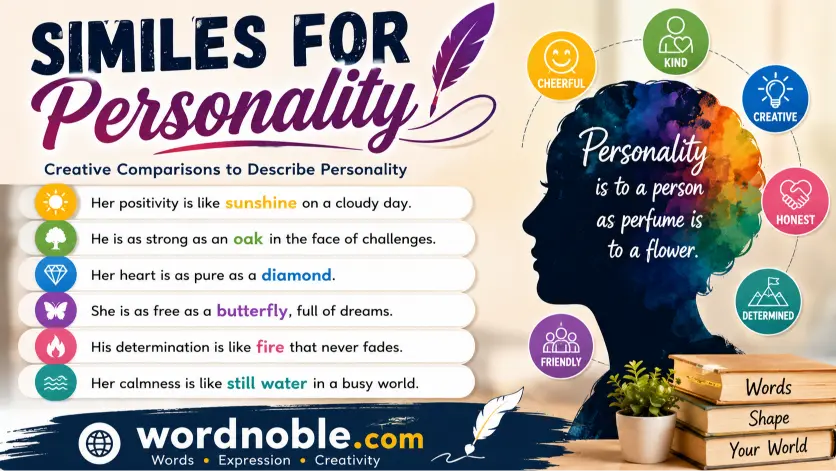
Someone calls you “stubborn as a mule” and it stings a little more than “you’re not very flexible” ever would. That’s the strange power of comparison it sticks. Similes for personality work the same way: they turn flat descriptions into pictures people actually remember.
A person isn’t just kind; she’s “warm as sunlight on a cold morning.” Someone isn’t just moody; he’s “unpredictable as an April sky.” Writers, teachers, and anyone building character sketches reach for these phrases because plain adjectives fall flat on the page.
Below, you’ll find personality similes sorted by trait confidence, kindness, stubbornness, curiosity, and more so you can grab exactly what fits your character or your friend’s next birthday card.
Each one is built to paint a clear mental image, not just fill space. You’ll also see quick notes on when a comparison feels fresh versus when it’s been used a thousand times before. Start with the traits below, and you’ll never struggle to describe someone’s character again.
What Are Similes for Personality?
Similes for personality are comparisons that use words such as “like” or “as” to describe a person’s character, behavior, or temperament vividly.
For example, “She was as gentle as a dove” compares a gentle personality to the peaceful nature traditionally associated with a dove.
Similes for personality compare a person’s character or behavior to something familiar using “like” or “as,” making traits such as kindness, confidence, humor, or stubbornness easier to visualize.
Meaning of Similes for Personality
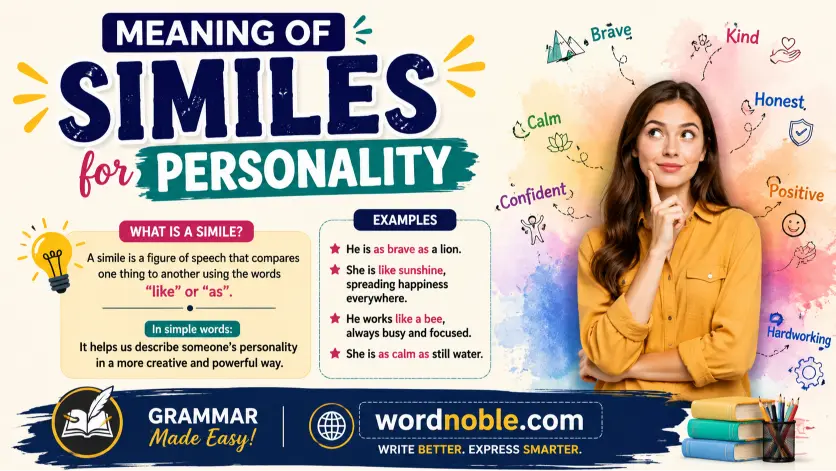
A personality simile takes an abstract quality and connects it to something readers already understand.
Words such as kind, confident, shy, energetic, stubborn, friendly, serious, cheerful, or mysterious describe personality directly. However, these words can sometimes feel plain. Figurative language gives them more personality and emotional color.
Compare these two sentences:
- She was very cheerful.
- She was as cheerful as a bird singing at sunrise.
The first sentence tells the reader about her personality. The second creates an image.
This is why similes are valuable creative writing techniques. They combine description, comparison, sensory language, emotion, and imagery to make characterization stronger.
A personality simile can describe:
- A person’s emotional nature
- Social behavior
- Confidence
- Kindness
- Intelligence
- Humor
- Patience
- Energy
- Courage
- Stubbornness
- Shyness
- Friendliness
- Seriousness
- Curiosity
- Mysterious behavior
Similes for personality are a form of figurative language used to describe someone’s character by comparing a personality trait or behavior with a familiar person, animal, object, or natural element. They make character descriptions more vivid by turning abstract qualities into understandable mental images.
Why Use Similes to Describe Personality?
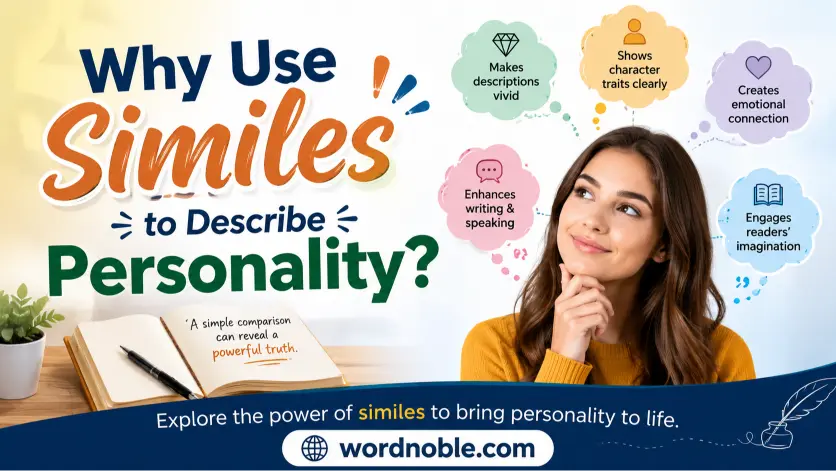
Personality is invisible. You cannot physically see kindness, confidence, patience, or curiosity, but you can describe these qualities through recognizable comparisons.
Similes help writers communicate personality in a more memorable way.
1. They make descriptions vivid
Instead of simply calling someone energetic, you can compare their energy to something constantly moving.
2. They create mental imagery
A strong comparison gives the reader something concrete to picture.
3. They reveal character
A character described as “as stubborn as a mule” immediately feels different from one described as “as gentle as a lamb.”
4. They add emotional depth
The comparison can communicate admiration, affection, humor, criticism, or even sarcasm.
5. They strengthen creative writing
Similes are especially useful in stories, poetry, character sketches, essays, and descriptive writing.
Types of Similes for Personality
🐾 Animal-Based Similes
Animals are excellent sources of personality comparisons because readers already associate them with recognizable behaviors.
- As gentle as a lamb very kind and harmless.
- As brave as a lion courageous and fearless.
- As busy as a bee constantly active and productive.
- As stubborn as a mule unwilling to change an opinion.
- As quiet as a mouse extremely shy or silent.
- As wise as an owl intelligent and thoughtful.
- As playful as a puppy cheerful, energetic, and fun-loving.
- As sly as a fox clever, strategic, or cunning.
- As loyal as a dog dependable and faithful.
- As curious as a cat eager to discover and understand things.
Animal-based comparisons work particularly well when describing fictional characters because they provide an immediate behavioral image.
📡 Technology-Based Similes
Modern technology can create fresh, contemporary personality comparisons.
- He was like a phone with endless notifications constantly active and difficult to ignore.
- She was as quick as a search engine mentally fast and knowledgeable.
- His mind was like a computer with dozens of tabs open always processing many thoughts.
- She was like a Wi-Fi signal everyone wanted to connect to naturally attractive and socially appealing.
- He was as unpredictable as a glitchy app his behavior could change unexpectedly.
Technology-based similes can make writing feel modern and relatable, especially in informal writing and contemporary fiction.
🌿 Nature-Based Similes
Nature offers some of the most poetic comparisons for personality.
- As calm as a still lake peaceful and composed.
- As bright as sunshine cheerful and optimistic.
- As steady as a mountain dependable and emotionally strong.
- As free as the wind independent and unrestricted.
- As gentle as a summer breeze soft, pleasant, and kind.
- As restless as the sea constantly changing or unable to settle.
- As warm as sunlight comforting and welcoming.
- As mysterious as a moonlit forest difficult to understand or predict.
Nature-based similes are particularly effective in poetry and literary descriptions because they naturally create imagery.
😂 Funny and Exaggerated Similes
Humorous comparisons can make a personality description memorable.
- He was as stubborn as a password reset that never works.
- She was as talkative as a radio with no off switch.
- He was as energetic as a toddler after three desserts.
- She was as dramatic as a movie trailer.
- He was as forgetful as a browser with too many tabs open.
- She was as impatient as someone waiting for slow Wi-Fi.
Funny similes are best suited to casual speech, comedy, social media, and lighthearted storytelling.
🎭 Emotional and Behavioral Similes
These comparisons focus directly on how someone behaves or responds emotionally.
- As patient as a saint exceptionally patient.
- As confident as a champion extremely self-assured.
- As nervous as a bird in a storm highly anxious or uneasy.
- As cold as ice emotionally distant or unfriendly.
- As warm as a fireplace welcoming and comforting.
- As stubborn as a locked door extremely resistant to change.
- As cheerful as a child on vacation genuinely happy and enthusiastic.
- As serious as a judge focused and rarely playful.
15 Similes for Personality With Meanings
| Simile Sentence | Meaning | Category | Clarity |
|---|---|---|---|
| She was as gentle as a lamb. | She was kind and soft-hearted. | Animal | Suggests harmless kindness. |
| He was as brave as a lion. | He was courageous. | Animal | Highlights fearlessness. |
| Maya was as bright as sunshine. | Maya was cheerful and positive. | Nature | Creates a warm emotional image. |
| He was as stubborn as a mule. | He refused to change his mind. | Animal | Emphasizes determination in a negative way. |
| She was as quiet as a mouse. | She was very shy or reserved. | Animal | Suggests little social attention. |
| His personality was like a calm lake. | He was peaceful and composed. | Nature | Creates a tranquil image. |
| She was as busy as a bee. | She was constantly active. | Animal | Shows energetic productivity. |
| He was as wise as an owl. | He was thoughtful and intelligent. | Animal | Associates him with wisdom. |
| She was like a ray of sunshine. | She made people feel happy. | Nature | Shows a positive influence. |
| He was as free as the wind. | He valued independence. | Nature | Suggests a strong desire for freedom. |
| She was as playful as a puppy. | She was fun-loving and energetic. | Animal | Creates a youthful image. |
| His attitude was as cold as ice. | He was emotionally distant. | Emotional | Shows a lack of warmth. |
| She was as steady as a mountain. | She was reliable and strong. | Nature | Suggests stability. |
| He was like a radio with no off switch. | He talked constantly. | Humorous | Creates a funny exaggeration. |
| She was as curious as a cat. | She wanted to know everything. | Animal | Highlights curiosity. |
Context Table: When to Use Personality Similes
| Context | Meaning | Use Case | Example |
|---|---|---|---|
| Storytelling | Builds character quickly | Fiction | He was as brave as a lion. |
| Poetry | Creates imagery and emotion | Poems | Her spirit was like sunshine. |
| Casual Speech | Makes descriptions natural | Conversation | He’s as stubborn as a mule. |
| Humor | Adds exaggeration | Comedy | She’s like a phone with endless notifications. |
| Academic Writing | Supports descriptive analysis | Literature essays | The character is compared to a calm lake. |
| Character Profiles | Establishes personality | Creative writing | She was as quiet as a mouse. |
How to Use Similes for Personality in Writing
The best personality similes do more than decorate a sentence. They should help readers understand the person being described.
Start with the personality trait
First decide what you want to communicate.
Is the character:
- Kind?
- Aggressive?
- Funny?
- Shy?
- Intelligent?
- Confident?
- Nervous?
- Independent?
- Stubborn?
- Mysterious?
Once you identify the trait, search for something that naturally represents it.
Choose a recognizable comparison
A comparison should make sense to the reader.
For example:
“He was as stubborn as a mule.”
The comparison is immediately understandable because the mule is commonly associated with stubbornness.
Make the comparison specific
Instead of writing:
She was like an animal.
write:
She was as playful as a puppy.
The second version gives the reader a much clearer picture.
Consider the emotional effect
Different comparisons create different feelings.
“He was as cold as ice.”
This sounds negative.
“He was as calm as a still lake.”
This sounds peaceful and positive.
Choose an image that matches the emotion you want your reader to experience.
How to Make Personality Similes More Creative
Avoid automatically choosing the first comparison that comes to mind. Creativity often comes from connecting a familiar personality trait with an unexpected image.
For example, instead of:
She was very energetic.
you might write:
She was like a spark that refused to go out.
This creates a stronger sense of energy and persistence.
You can draw comparisons from:
- Animals
- Weather
- Landscapes
- Food
- Technology
- Music
- Objects
- Sports
- Seasons
- Light and darkness
- Everyday experiences
The key is relevance. A creative comparison should still be understandable.
Simile vs. Metaphor: What Is the Difference?
A simile explicitly compares two things using words such as like or as.
Simile:
She was as gentle as a dove.
A metaphor makes a direct comparison without using “like” or “as.”
Metaphor:
She was a dove among strangers.
Both forms of figurative language can describe personality, but they create slightly different effects.
| Simile | Metaphor |
|---|---|
| Uses like or as | Makes a direct comparison |
| More explicit | Often more powerful or compressed |
| Easy for beginners to recognize | Can feel more literary |
| “He was as brave as a lion.” | “He was a lion.” |
Common Mistakes to Avoid
1. Overusing similes
A paragraph filled with comparisons can become distracting.
Use a strong simile where it genuinely improves the description.
2. Choosing an illogical comparison
The comparison should have a clear connection to the personality trait.
If readers have to stop and wonder what the comparison means, it may need revision.
3. Mixing up similes and metaphors
Remember:
Simile = like/as comparison.
Metaphor = direct comparison.
4. Using clichés too often
Common expressions can be useful, but original comparisons can make your writing stand out.
5. Forgetting context
A funny simile may work beautifully in casual dialogue but sound inappropriate in a serious academic essay.
Usage Guide: Do and Don’t
👍 Do
- Choose comparisons that clearly communicate the personality trait.
- Use familiar images when clarity matters.
- Match the simile to the tone of your writing.
- Experiment with animals, nature, objects, and technology.
- Use sensory and emotional imagery.
- Keep comparisons natural.
- Revise weak comparisons.
👎 Don’t
- Add a simile to every sentence.
- Use comparisons that have no logical connection.
- Force a rhyme or comparison.
- Confuse a metaphor with a simile.
- Use complicated imagery when a simple comparison works better.
- Let figurative language hide the main meaning.
Natural Chat-Style Examples
Personality similes can also sound natural in everyday conversation.
Friend: “How would you describe your new teacher?”
You: “She’s as patient as a saint.”
Friend: “What is your brother like?”
You: “He’s like a radio with no off switch. He never stops talking!”
Friend: “Why does everyone like Sarah?”
You: “She’s like a ray of sunshine. She makes everyone feel better.”
Friend: “Is Tom easy to convince?”
You: “Not at all. He’s as stubborn as a mule.”
Friend: “What is your best friend like?”
You: “She’s as playful as a puppy and twice as energetic.”
Related Figurative Language Terms
Understanding personality similes becomes easier when you know the broader concepts connected to them.
Figurative Language
Language that communicates ideas beyond purely literal meanings. Similes and metaphors are major examples.
Auditory Imagery
Language that creates an impression of sound. It is particularly useful when personality descriptions involve voices, laughter, silence, or speech.
Sensory Writing
Writing that appeals to the senses to create vivid experiences.
Descriptive Writing
Writing that uses specific details and imagery to help readers visualize people, places, objects, or experiences.
Characterization
The way a writer develops a character’s personality, behavior, appearance, motivations, and relationships.
English Literature Devices
Techniques such as simile, metaphor, personification, symbolism, imagery, irony, and alliteration help writers create meaning and emotional impact.
Why Are Similes Important in English Literature?
Similes are important because literature often needs to communicate complex emotions and personalities quickly.
A character described simply as “angry” gives readers information. A character whose anger is compared to a storm gathering over a quiet town creates an atmosphere as well as information.
This makes similes valuable for characterization, imagery, tone, symbolism, and emotional storytelling.
Writers can also use recurring comparisons to reinforce a character’s identity. A character repeatedly associated with storms may gradually seem intense or unpredictable, while one associated with sunlight may feel optimistic or comforting.
How Students Can Use Personality Similes
Students can use personality similes in many types of assignments, including:
- Character descriptions
- Creative writing
- Narrative essays
- Poetry
- Descriptive paragraphs
- Book reports
- Literature analysis
- Short stories
- Personal essays
- Classroom exercises
For school writing, the best approach is to choose a comparison that is clear, relevant, and easy to explain.
For example:
“The main character was as stubborn as a mule, showing that he refused to accept advice from others.”
This works because the simile is followed by an explanation of its meaning.
FAQs:
What are similes for personality?
Similes for personality are figurative comparisons used to describe someone’s character, behavior, or temperament. They commonly use like or as to connect a personality trait with a familiar image. For example, “as gentle as a lamb” describes someone who is kind and harmless. These comparisons make abstract personality traits easier to visualize and more memorable.
What are some examples of personality similes?
Examples include “as brave as a lion,” “as quiet as a mouse,” “as stubborn as a mule,” “as busy as a bee,” “as wise as an owl,” and “as bright as sunshine.” Each comparison connects a personality characteristic with something familiar. The best choice depends on whether you want to communicate kindness, courage, shyness, intelligence, energy, or another trait.
What are some funny similes for personality?
Funny personality similes often exaggerate familiar behavior. Examples include “as talkative as a radio with no off switch,” “as energetic as a toddler after dessert,” and “as impatient as someone waiting for slow Wi-Fi.” These comparisons are especially useful in casual conversations, humorous stories, character descriptions, and social media because they create an immediate and playful image.
What are some poetic similes for personality?
Poetic personality similes often use nature, light, weather, or landscapes to create emotional imagery. Examples include “her spirit was like sunshine,” “his heart was as steady as a mountain,” and “her mood was as restless as the sea.” These comparisons are especially effective in poetry and literary writing because they communicate personality while also creating atmosphere.
What is the difference between a simile and a metaphor?
A simile compares two things explicitly using “like” or “as.” For example, “He was as brave as a lion.” A metaphor makes a direct comparison without those words, such as “He was a lion.” Both are forms of figurative language, but a simile makes the relationship between the two ideas more obvious to the reader.
How do I use personality similes in writing?
Start by identifying the personality trait you want to describe. Then choose a familiar object, animal, natural element, or experience that represents that quality. Connect them using “like” or “as.” Finally, check whether the comparison fits your tone and meaning. A strong simile should make the character easier to imagine rather than simply adding decorative language.
Why are similes important in English literature?
Similes help literature communicate personality, emotion, atmosphere, and abstract ideas through concrete imagery. Instead of simply telling readers that a character is kind, brave, mysterious, or stubborn, writers can create comparisons that allow readers to visualize those qualities. This makes characterization more memorable and gives literary descriptions greater emotional and sensory impact.
How can students use similes for personality?
Students can use personality similes in creative writing, poetry, descriptive essays, character analysis, and storytelling. A student might write, “The character was as quiet as a mouse, rarely speaking during class.” The comparison provides an immediate image, while the additional detail explains the character’s behavior. Students should prioritize clear and relevant comparisons over complicated ones.
Can personality similes describe negative traits?
Yes. Similes can describe positive, negative, or neutral personality traits. For example, “as stubborn as a mule” can describe someone who refuses to change their mind, while “as cold as ice” can describe emotional distance. Writers should choose comparisons carefully because the same personality trait can sound humorous, affectionate, critical, or poetic depending on the image.
Can I create my own personality similes?
Absolutely. Creating original similes is one of the best ways to make writing distinctive. Start with a trait such as confidence, curiosity, patience, or nervousness. Think about an object, animal, place, sound, or natural event that behaves similarly. Then form a comparison using “like” or “as.” The comparison should remain understandable even if it is imaginative.
Conclusion:
Similes for personality give writers a simple but powerful way to transform ordinary character descriptions into vivid images. Instead of merely saying someone is kind, brave, shy, stubborn, cheerful, or mysterious, a well-chosen comparison lets readers see the personality through imagery.
Animal, nature, technology, emotional, and humorous comparisons can all work when they naturally match the trait being described.
The key is not to use as many similes as possible, but to choose comparisons that make meaning clearer and writing more memorable.
Whether you are writing a poem, story, essay, or everyday message, a strong personality simile can turn a basic description into something readers remember.

I am Naqash Ayub, proudly writing for WordNoble, where I focus on creating clear, informative, and SEO-friendly content. I enjoy turning detailed information into simple, trustworthy articles that help readers find the answers they need.