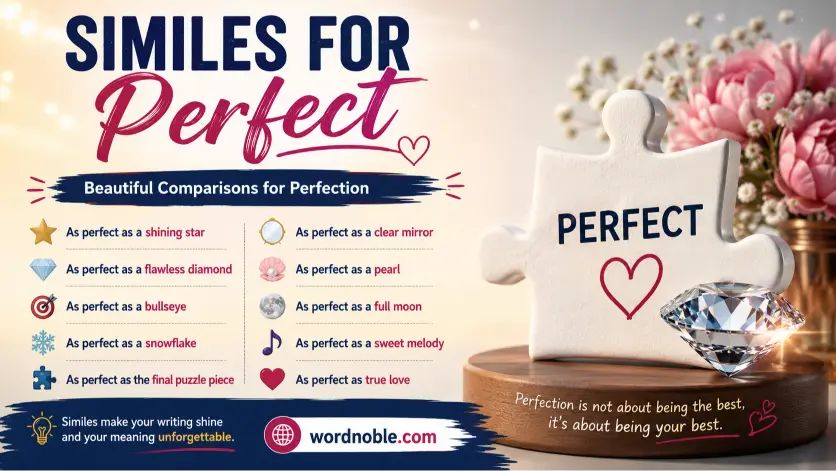
Perfect is a powerful word, but using it again and again can make your writing feel plain. Similes for perfect give you a more vivid way to describe something flawless, beautiful, precise, or exactly right. Instead of simply saying “the moment was perfect,” you can compare it to something readers instantly recognize and picture.
From a perfectly timed opportunity to an ideal smile, a polished performance, or a flawless piece of work, the right comparison can add color and personality to your words. These expressions are useful for creative writing, poetry, storytelling, school assignments, captions, and everyday conversation.
You’ll find a range of comparisons that capture different shades of perfection, including elegance, accuracy, beauty, harmony, and completeness. Some are simple and natural, while others have a more poetic feel. Choosing the right one depends on what you want your reader to imagine.
Ready to make “perfect” sound more memorable? Let’s explore creative similes that can bring your descriptions to life.
What Are Similes for Perfect?
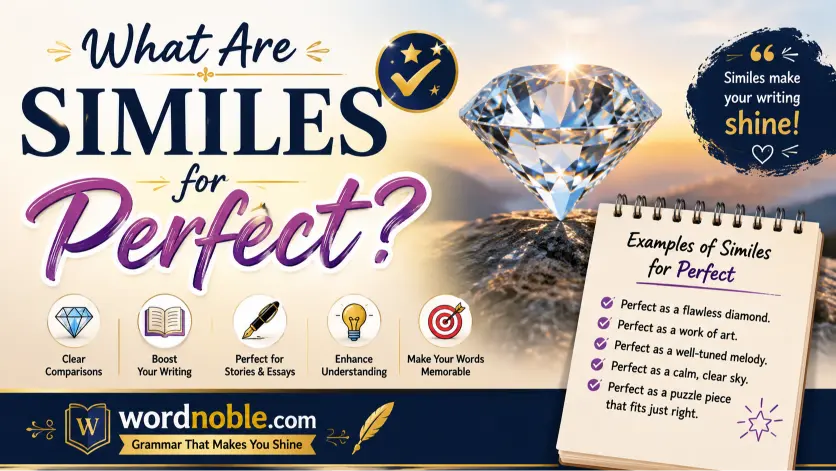
Similes for perfect are comparisons that describe something as flawless, ideal, beautiful, precise, or exceptionally good by using words such as “like” or “as.”
For example: “Her performance was as perfect as a sunrise.” The comparison makes the idea of perfection more vivid than simply saying “Her performance was perfect.”
Quick examples
- As perfect as a flawless diamond
- Like a picture painted by a master
- As perfect as a cloudless sky
- Like a perfectly tuned instrument
- As flawless as polished glass
- Like a puzzle with every piece in place
- As perfect as a peaceful morning
- Like a star shining in a clear sky
These comparisons can make ordinary descriptions more expressive and memorable.
Meaning of “Perfect” in Figurative Language
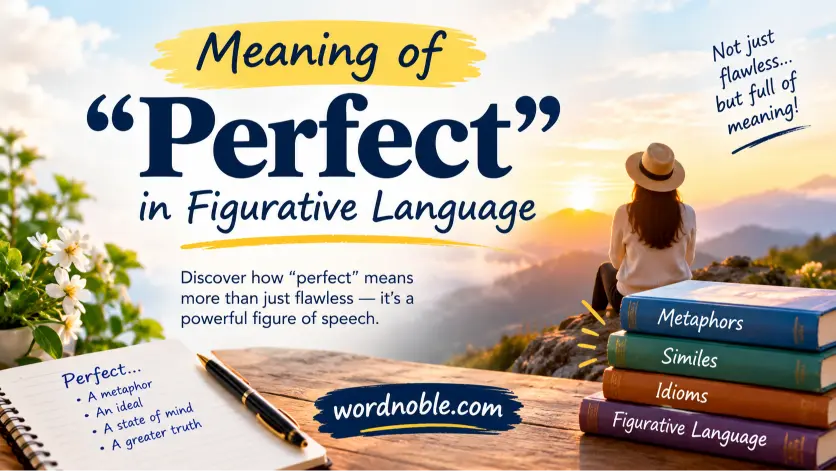
The word perfect can describe many different qualities. Something may be perfect because it is:
- Completely flawless
- Beautifully designed
- Exactly right
- Carefully completed
- Emotionally satisfying
- Exceptionally impressive
- Balanced and harmonious
- Ideal for a particular situation
Because perfection can mean different things, the best simile depends on what you want readers to notice.
For instance, comparing something to a diamond emphasizes flawlessness, while comparing it to a sunset emphasizes beauty. Comparing it to a perfectly tuned instrument emphasizes precision and harmony.
This is why similes are useful creative writing techniques: they transform an abstract quality into a concrete image.
Similes for perfect are figurative comparisons used to express flawlessness, beauty, precision, harmony, or ideal quality by comparing something to another familiar thing, usually with “like” or “as.”
They help readers understand perfection through recognizable images rather than through the adjective “perfect” alone.
Why Use Similes for Perfect?
A simile gives the reader something specific to imagine.
Compare these two sentences:
The wedding was perfect.
The wedding was as perfect as a scene from a beautiful dream.
The first statement gives information. The second creates imagery.
Similes can add:
1. Visual imagery
They help readers see what perfection looks like.
2. Emotional depth
A comparison can make perfection feel peaceful, exciting, romantic, joyful, or powerful.
3. Personality
A creative comparison can reveal the writer’s individual voice.
4. Sensory language
Similes can connect perfection with things people see, hear, touch, taste, or experience.
5. Memorability
A vivid comparison is often easier to remember than a simple adjective.
Simile Taxonomy: Types of Similes for Perfect
🐾 Animal-Based Similes
Animal comparisons can describe perfection through elegance, precision, beauty, or natural ability.
- As graceful as a swan beautifully elegant and controlled.
- As precise as an eagle’s aim extremely accurate.
- As elegant as a dancing horse graceful and impressive.
- Like a butterfly emerging perfectly formed beautiful and complete.
- As poised as a cat balanced, confident, and controlled.
Animal-based similes work especially well in storytelling and character descriptions.
💎 Object-Based Similes
Objects often represent precision, craftsmanship, cleanliness, or flawlessness.
- As perfect as a flawless diamond completely without visible faults.
- Like a puzzle with every piece in place complete and exactly right.
- As smooth as polished glass flawless and refined.
- Like a perfectly crafted sculpture carefully designed and beautiful.
- As precise as a finely made clock accurate and carefully constructed.
These are particularly useful for academic descriptions and creative writing.
🌿 Nature-Based Similes
Nature provides some of the strongest imagery for beauty and harmony.
- As perfect as a cloudless sky clear, peaceful, and flawless.
- Like a sunrise painted across the horizon exceptionally beautiful.
- As perfect as a quiet spring morning peaceful and refreshing.
- Like a flower blooming at exactly the right moment naturally beautiful and timely.
- As flawless as fresh snow clean, untouched, and pure.
Nature-based comparisons are especially effective in poetry.
😂 Humorous and Exaggerated Similes
Sometimes “perfect” is better expressed with playful exaggeration.
- As perfect as a pizza arriving exactly when you are hungry wonderfully satisfying.
- Like getting every green light on the way home unusually fortunate.
- As perfect as finding money in an old jacket unexpectedly delightful.
- Like a weekend with no alarm clock extremely enjoyable.
- As perfect as getting the last slice without having to ask amusingly ideal.
Humorous similes are useful in casual writing, social posts, dialogue, and friendly conversations.
🎭 Emotional and Behavioral Similes
These comparisons describe perfection in relationships, actions, experiences, or feelings.
- As perfect as a heartfelt apology emotionally appropriate and sincere.
- Like two people finishing each other’s sentences naturally harmonious.
- As perfect as the right words at the right moment exceptionally appropriate.
- Like a friendship that never needs explanation deeply comfortable and natural.
- As perfect as a smile after good news genuinely joyful.
These are excellent for character development, romance, personal essays, and storytelling.
55 Similes for Perfect With Meanings
| # | Simile | Meaning | Category |
|---|---|---|---|
| 1 | As perfect as a flawless diamond | Completely flawless | Object |
| 2 | As perfect as a cloudless sky | Clear and beautiful | Nature |
| 3 | Like a puzzle with every piece in place | Complete and correct | Object |
| 4 | As graceful as a swan | Elegantly perfect | Animal |
| 5 | Like a masterpiece on display | Exceptionally beautiful | Art |
| 6 | As smooth as polished glass | Flawless and refined | Object |
| 7 | Like a sunrise painted by an artist | Exceptionally beautiful | Nature |
| 8 | As precise as a finely made clock | Extremely accurate | Object |
| 9 | Like a dream come true | Exactly what was desired | Emotional |
| 10 | As pure as fresh snow | Clean and untouched | Nature |
| 11 | Like every note in perfect harmony | Balanced and coordinated | Music |
| 12 | As elegant as a royal portrait | Beautiful and refined | Art |
| 13 | Like a perfectly fitted glove | Exactly suitable | Object |
| 14 | As bright as a star on a clear night | Strikingly beautiful | Nature |
| 15 | Like a carefully painted masterpiece | Carefully executed | Art |
| 16 | As balanced as a perfectly still scale | Completely harmonious | Object |
| 17 | Like the final piece of a puzzle | Exactly what was needed | Object |
| 18 | As beautiful as a spring morning | Fresh and pleasing | Nature |
| 19 | Like a perfectly tuned piano | Harmonious and precise | Music |
| 20 | As crisp as freshly folded paper | Neat and flawless | Object |
| 21 | Like a painting without a single misplaced stroke | Carefully executed | Art |
| 22 | As peaceful as a quiet lake | Calm and harmonious | Nature |
| 23 | Like a story with the perfect ending | Completely satisfying | Literature |
| 24 | As polished as a professional performance | Highly refined | Performance |
| 25 | Like stars arranged across a clear sky | Beautifully ordered | Nature |
| 26 | As exact as a mathematical answer | Completely correct | Academic |
| 27 | Like a key fitting perfectly into a lock | Exactly suited | Object |
| 28 | As fresh as morning rain | Fresh and appealing | Nature |
| 29 | Like a song with every note in place | Harmonious | Music |
| 30 | As graceful as a dancer in perfect rhythm | Elegant and coordinated | Movement |
| 31 | Like a photograph captured at the perfect moment | Ideally timed | Visual |
| 32 | As clean as freshly polished silver | Spotless and refined | Object |
| 33 | Like a garden in full bloom | Beautiful and complete | Nature |
| 34 | As calm as a still pond | Peaceful and balanced | Nature |
| 35 | Like a perfectly written sentence | Clear and well-constructed | Writing |
| 36 | As bright as a summer morning | Cheerful and beautiful | Nature |
| 37 | Like a flawless piece of craftsmanship | Expertly made | Object |
| 38 | As neat as lines drawn with a ruler | Precise and orderly | Object |
| 39 | Like two halves of the same whole | Perfectly compatible | Relationship |
| 40 | As stunning as a sunset over the sea | Exceptionally beautiful | Nature |
| 41 | Like a carefully composed poem | Beautifully arranged | Literature |
| 42 | As steady as a perfectly balanced scale | Stable and harmonious | Object |
| 43 | Like a door opening at exactly the right moment | Perfectly timed | Situational |
| 44 | As delightful as finding your favorite song | Extremely satisfying | Humorous |
| 45 | Like getting every green light | Exceptionally fortunate | Humorous |
| 46 | As satisfying as the last piece of a puzzle | Completely fulfilling | Object |
| 47 | Like a weekend without an alarm | Extremely enjoyable | Humorous |
| 48 | As sweet as good news on a difficult day | Emotionally wonderful | Emotional |
| 49 | Like a smile appearing at exactly the right moment | Perfectly appropriate | Emotional |
| 50 | As memorable as a once-in-a-lifetime sunset | Exceptionally special | Nature |
| 51 | Like a friendship that feels effortless | Naturally harmonious | Emotional |
| 52 | As accurate as a carefully measured answer | Precisely correct | Academic |
| 53 | Like a perfectly organized bookshelf | Neat and orderly | Object |
| 54 | As elegant as a flawless piece of jewelry | Beautiful and refined | Object |
| 55 | Like everything falling into place | Completely right and satisfying | Situational |
15 Example Sentences Using Similes for Perfect
1. Her wedding dress was as perfect as a flawless diamond.
Meaning: The dress looked exceptionally beautiful and had no noticeable imperfections.
Category: Object-based
2. The morning was as perfect as a cloudless sky.
Meaning: The morning felt peaceful, beautiful, and ideal.
Category: Nature-based
3. His answer was as exact as a mathematical solution.
Meaning: His answer was completely accurate.
Category: Academic
4. Their voices blended like every note in perfect harmony.
Meaning: Their voices sounded beautifully coordinated.
Category: Music-based
5. The final scene was like a story with the perfect ending.
Meaning: The conclusion was satisfying and appropriate.
Category: Literary
6. She moved as gracefully as a swan.
Meaning: Her movements were elegant and controlled.
Category: Animal-based
7. The photograph was like a painting captured at exactly the right moment.
Meaning: The image was exceptionally beautiful and well-timed.
Category: Visual
8. The solution fit the problem like a key fitting a lock.
Meaning: The solution was exactly suitable.
Category: Object-based
9. His speech was as polished as a professional performance.
Meaning: His speech was highly prepared and refined.
Category: Performance
10. The garden looked like a masterpiece in full bloom.
Meaning: The garden was exceptionally beautiful.
Category: Nature-based
11. The timing was as perfect as getting every green light.
Meaning: Everything happened at an unusually convenient time.
Category: Humorous
12. Their friendship was like two halves of the same whole.
Meaning: The friends complemented each other extremely well.
Category: Emotional
13. The room was as clean as polished glass.
Meaning: The room was exceptionally clean and neat.
Category: Object-based
14. Her smile was as bright as a star on a clear night.
Meaning: Her smile was striking and beautiful.
Category: Nature-based
15. Everything worked out like the final pieces of a puzzle falling into place.
Meaning: Events came together exactly as hoped.
Category: Situational
Similes for Perfect in Different Contexts
| Context | Meaning | Use Case | Example |
|---|---|---|---|
| Storytelling | Ideal or flawless | Character and scene descriptions | His plan was as perfect as a puzzle with every piece in place. |
| Poetry | Beauty and harmony | Emotional imagery | Her voice was like a melody in perfect harmony. |
| Casual speech | Extremely good | Conversation | That timing was as perfect as getting every green light. |
| Humor | Playful perfection | Jokes and dialogue | The pizza arrived exactly when I was hungry—perfect as ever. |
| Academic writing | Accuracy or precision | Descriptive assignments | The solution was as precise as a mathematical answer. |
| Romance | Beauty and compatibility | Love writing | Being with her felt like finding the final piece of a puzzle. |
| Reviews | Exceptional quality | Product or experience descriptions | The service was as smooth as polished glass. |
| Creative writing | Vivid perfection | Fiction and essays | The garden looked like a masterpiece after the rain. |
How to Use Similes for Perfect Naturally
A good simile should support your meaning rather than decorate a sentence unnecessarily.
1. Identify what is perfect
Ask yourself what quality you want to emphasize.
Is it:
- Beauty?
- Accuracy?
- Timing?
- Cleanliness?
- Harmony?
- Completeness?
- Emotional satisfaction?
Then choose a comparison that represents that specific quality.
2. Choose a familiar image
Readers understand familiar comparisons quickly. Diamonds, sunsets, clear skies, music, puzzles, flowers, and polished objects can communicate ideas without lengthy explanations.
3. Match the tone
A poetic sentence may need a graceful nature comparison, while a humorous conversation may benefit from an exaggerated everyday comparison.
4. Avoid forcing the comparison
If the simile sounds unnatural, simplify it. The goal is clarity first and creativity second.
5. Use sensory language
The strongest similes allow readers to see, hear, feel, or imagine something.
Instead of merely writing:
The performance was perfect.
You could write:
The performance was like a perfectly tuned instrument, with every movement and note working together.
Simile vs. Metaphor
A simile compares two things using words such as like or as.
Her smile was as bright as a star.
A metaphor makes a direct comparison without “like” or “as.”
Her smile was a star.
Both are forms of figurative language, but they create comparisons differently.
Easy way to remember
Simile = comparison using like/as.
Metaphor = direct comparison.
For descriptive writing, both devices can make abstract ideas such as perfection easier to visualize.
Common Mistakes When Using Similes for Perfect
Overusing comparisons
Too many similes can make writing feel crowded. Choose the strongest comparison rather than adding one to every sentence.
Using an illogical comparison
A simile should have a recognizable connection to the quality you are describing.
For example, comparing perfect accuracy to something famously inaccurate can confuse readers unless you are deliberately being humorous.
Confusing similes with metaphors
If you write “Her performance was a masterpiece,” that is a metaphor, not a traditional simile.
Choosing clichés too often
Common comparisons can work, but original images often make writing more memorable.
Explaining the simile too much
Once a clear comparison has communicated the idea, move forward. Repeating its meaning can weaken the writing.
Do and Don’t Usage Guide
👍 Do
- Choose comparisons that match the intended meaning.
- Use familiar images when clarity matters.
- Adapt similes to your audience.
- Use sensory imagery.
- Make creative comparisons when appropriate.
- Read the sentence aloud to check its natural flow.
👎 Don’t
- Add similes to every sentence.
- Use confusing comparisons.
- Mix unrelated images.
- Force “like” or “as” into a sentence.
- Use exaggerated language in formal writing without purpose.
- Forget the actual quality you want “perfect” to describe.
Natural Chat Responses Using Similes
Here are some natural ways to use similes for perfect in everyday conversation:
- That timing was as perfect as getting every green light on the way home.
- Your outfit looks like it was made for you.
- That was as perfect as finding your favorite dessert after a long day.
- The weather today is like a picture-perfect postcard.
- Your explanation was as clear as a perfectly written instruction manual.
- Everything came together like the final pieces of a puzzle.
Related Terms and Semantic Concepts
Understanding related literary concepts can help you use similes more effectively.
Figurative language
A broad category that includes similes, metaphors, personification, hyperbole, and other nonliteral techniques.
Auditory imagery
Language that creates an impression of sound. It is particularly useful when describing music, voices, performances, or peaceful environments.
Sensory writing
Writing that appeals to sight, sound, smell, taste, touch, or other sensory experiences.
Descriptive writing
Writing that uses specific details and imagery to help readers visualize a person, place, object, or experience.
Metaphor vs. simile
Two related comparison techniques that differ mainly in how the comparison is expressed.
English literature devices
Techniques such as imagery, symbolism, alliteration, personification, metaphor, and simile that help writers communicate ideas creatively.
FAQs:
1. What are similes for perfect?
Similes for perfect are figurative comparisons that describe something as flawless, ideal, beautiful, accurate, complete, or exceptionally good. They commonly use “like” or “as” to connect the subject with a familiar image. For example, comparing something to a flawless diamond emphasizes its lack of imperfections, while comparing it to a peaceful sunrise emphasizes beauty and harmony.
2. What are some good examples of similes for perfect?
Good examples include “as perfect as a flawless diamond,” “as perfect as a cloudless sky,” “like a puzzle with every piece in place,” and “like a perfectly tuned instrument.” Each comparison highlights a different aspect of perfection. Choose the one that matches your intended meaning, such as beauty, completeness, precision, harmony, or emotional satisfaction.
3. What are funny similes for perfect?
Funny similes can compare perfection to ordinary situations that feel unusually satisfying. For example, something can be “as perfect as getting every green light,” “like finding money in an old jacket,” or “as perfect as getting the last slice of pizza.” These playful comparisons are especially useful in casual conversation, humorous writing, social media, and character dialogue.
4. What are poetic similes for perfect?
Poetic similes for perfect often use nature, music, light, and beauty to create emotional imagery. Examples include “as perfect as a sunrise over a quiet sea,” “like every note in perfect harmony,” and “as flawless as fresh snow.” These comparisons work well because they allow readers to experience perfection through visual and sensory images rather than simply being told something is perfect.
5. What is the difference between a simile and a metaphor?
A simile makes a comparison using words such as “like” or “as,” while a metaphor makes a direct comparison. For example, “Her smile was as bright as a star” is a simile. “Her smile was a star” is a metaphor. Both are forms of figurative language and can make descriptive writing more vivid and expressive.
6. How can I use similes for perfect in writing?
First, decide what aspect of perfection you want to communicate. Then choose an image that clearly represents that quality. Use a diamond for flawlessness, a puzzle for completeness, music for harmony, or nature for beauty. Place the comparison where it strengthens the sentence instead of adding it simply for decoration. A relevant simile should make the reader understand or visualize your meaning more easily.
7. Why are similes important in English literature?
Similes help writers transform abstract ideas into concrete images. Perfection, love, fear, happiness, and sadness can be difficult to visualize when described with adjectives alone. A well-crafted comparison gives readers a recognizable image and can create emotional or sensory depth. For this reason, similes are widely used in poetry, fiction, essays, speeches, and other forms of creative writing.
8. How can students use similes for perfect?
Students can use similes in descriptive essays, creative writing assignments, poetry, speeches, and literary exercises. A student might describe an excellent performance as “like a perfectly tuned instrument” or a beautiful scene as “as perfect as a cloudless sky.” The key is to explain or imply the specific quality represented by the comparison rather than using “perfect” repeatedly.
9. Can similes for perfect be used in poetry?
Yes. Similes are especially effective in poetry because they create vivid imagery with relatively few words. A poet can compare perfection to a sunrise, flower, melody, star, or peaceful landscape to create an emotional atmosphere. The best poetic similes are not only beautiful but also meaningful: the comparison should contribute to the poem’s mood, theme, or message.
10. Can I use similes for perfect in everyday conversation?
Absolutely. Everyday similes can make casual speech more expressive and sometimes humorous. You might say that someone’s timing was “as perfect as getting every green light” or that a plan came together “like the final pieces of a puzzle.” Casual similes do not need to sound literary; familiar, natural comparisons often work best in ordinary conversation.
Conclusion:
Similes for perfect give writers a more vivid way to describe something flawless, beautiful, precise, harmonious, or completely satisfying. Instead of relying on the word “perfect” alone, you can compare an experience to a flawless diamond, a peaceful sunrise, a completed puzzle, or a perfectly tuned instrument.
The strongest comparison depends on the quality you want readers to notice.
Whether you are writing a poem, school assignment, story, review, or casual message, a well-chosen simile can strengthen imagery and make your language more memorable. When perfection is difficult to explain, choose an image that lets your reader see it.

I am Naqash Ayub, proudly writing for WordNoble, where I focus on creating clear, informative, and SEO-friendly content. I enjoy turning detailed information into simple, trustworthy articles that help readers find the answers they need.