
Picture your favorite teacher. Now try describing her in one line, and “kind” just feels flat. That’s the exact moment similes for people earn their keep.
A good comparison “patient as a lighthouse keeper,” “sharp as a tack” does more work than three adjectives combined, because it hands the reader an image instead of a label.
Writers reach for these comparisons constantly, whether they’re sketching a character in a novel, punching up a wedding toast, or trying to make a LinkedIn bio sound less robotic.
The trouble is, most people default to the same tired handful: busy as a bee, strong as an ox. Nothing wrong with the classics, but they’ve lost their spark from overuse.
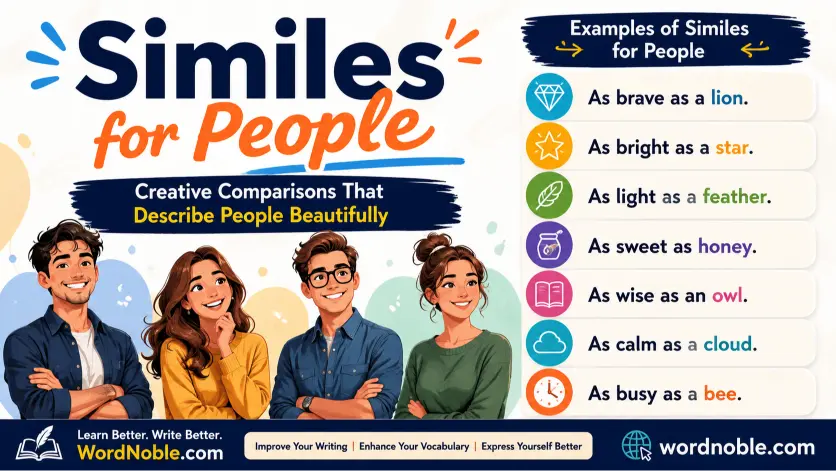
Similes for people are comparisons that describe someone’s appearance, personality, behavior, emotions, or abilities using words such as “like” or “as.” They make descriptions more vivid, memorable, and expressive.
Meaning and Deep Explanation
A simile is a form of figurative language that compares two different things to highlight a shared quality. When the subject of the comparison is a person, the comparison can reveal something about how that person looks, acts, feels, speaks, listens, or interacts with others.
For example:
- She is as gentle as a dove.
- He runs like a deer.
- She is as busy as a bee.
- He listens like a hawk watching its surroundings.
These statements are not normally intended to say that a person literally becomes an animal. Instead, the comparison helps the reader quickly understand a particular characteristic.
How Similes for People Work
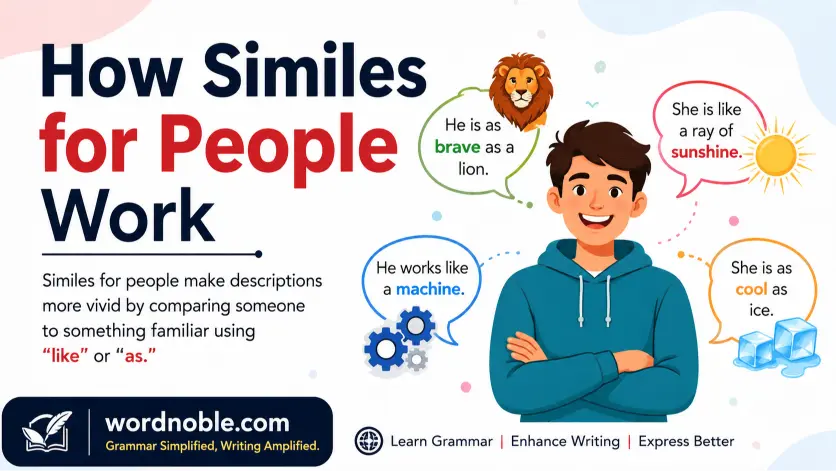
A useful simile usually contains three parts:
- The person being described
- The quality being emphasized
- The comparison
For example, in “He is as quiet as a mouse,” the person is being described as quiet, while the mouse provides a familiar image associated with quietness.
The strongest similes choose comparisons that readers can immediately visualize, hear, feel, or understand.
Why Writers Use Similes for People
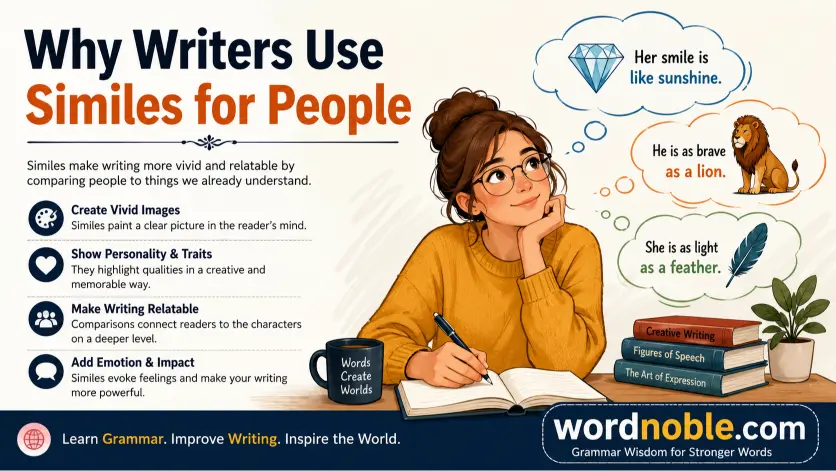
Writers use similes because they can:
- Make character descriptions more vivid
- Show personality without lengthy explanations
- Create emotional imagery
- Strengthen storytelling
- Add humor or exaggeration
- Improve poetry and creative writing
- Help readers visualize characters
- Make school assignments more descriptive
- Communicate complicated feelings simply
Similes can also work with sensory language. A person may be described through how they look, sound, move, listen, or make others feel.
Similes for people are figurative comparisons used to describe a person’s qualities, appearance, behavior, emotions, or abilities by relating them to another familiar thing. They make character descriptions more vivid and help readers understand an individual through recognizable imagery.
Contextual Meaning: How Similes for People Change by Purpose
The same basic technique can produce very different effects depending on the context.
Storytelling
In fiction, similes help readers form a quick mental picture of a character.
Example:
The old man moved as slowly as a turtle.
The comparison immediately communicates his pace without requiring a long explanation.
Poetry
Poetry often uses more emotional or imaginative comparisons.
Example:
Her voice floated like a feather on the evening air.
Here, the simile creates softness and auditory imagery.
Casual Speech
Everyday conversation often uses simple, familiar comparisons.
Example:
He eats like a horse.
This sounds natural and immediately understandable.
Humor
Exaggerated similes can make descriptions funny.
Example:
He was sweating like an ice cube in the desert.
The impossible image creates humor while emphasizing how much the person was sweating.
Academic Writing
Similes can be useful in educational or literary analysis, but they should be purposeful rather than excessive.
Example:
The author presents the character as being as isolated as an island.
This can help explain a literary character’s emotional condition.
Types of Similes for People
🐾 Animal-Based Similes
Animals are among the most recognizable sources for describing human behavior.
- As busy as a bee extremely busy or active.
- As quiet as a mouse very quiet or unobtrusive.
- Runs like a deer runs quickly and gracefully.
- Eats like a horse eats a very large amount.
- Works like a dog works extremely hard.
- Swims like a fish swims very well.
- Fights like a lion shows great courage and determination.
- Sly like a fox clever, especially in a crafty way.
- Stubborn as a mule refuses to change their mind.
- Gentle as a dove calm, peaceful, and kind.
Animal comparisons work particularly well because people already associate animals with specific characteristics.
📡 Technology-Based Similes
Modern writing can use technology to describe people’s speed, attention, communication, or mental activity.
- He thinks like a computer. processes information quickly and logically.
- She moves like a robot. moves mechanically or without much expression.
- He talks like a radio. talks continuously.
- She works like a machine. works with remarkable consistency or energy.
- His memory is like a search engine. remembers and retrieves information easily.
- He reacts like a notification. responds immediately.
- She is connected like a smartphone to Wi-Fi. stays constantly connected to others or information.
These comparisons can be especially effective in contemporary creative writing.
🌿 Nature-Based Similes
Nature offers rich imagery for describing appearance, personality, emotions, and movement.
- As calm as a lake peaceful and relaxed.
- As bright as the sun cheerful, energetic, or radiant.
- As strong as an oak physically or emotionally strong.
- Moves like the wind moves very quickly.
- As gentle as a summer breeze soft and pleasant.
- As cold as winter emotionally distant or unfriendly.
- As steady as a mountain dependable and stable.
- As restless as the waves unable to remain calm or still.
Nature-based similes are particularly useful in poetry because they create strong visual and emotional imagery.
😂 Humorous and Exaggerated Similes
Funny similes deliberately stretch reality to make a description entertaining.
- He talks like a podcast on double speed. talks extremely quickly.
- She runs like someone just announced free pizza. runs with unusual enthusiasm.
- He sleeps like a bear in winter. sleeps very deeply or for a long time.
- She stared at me like I had grown a second head. looked extremely surprised.
- He eats like the food is disappearing tomorrow. eats very quickly or enthusiastically.
- She was as confused as a cat in a bathtub. extremely confused or uncomfortable.
Exaggeration makes the comparison memorable, but the meaning should remain understandable.
🎭 Emotional and Behavioral Similes
Some of the most powerful similes describe feelings and behavior.
- As nervous as a cat before a storm extremely anxious.
- As happy as a child on Christmas morning extremely joyful.
- As stubborn as a mule unwilling to compromise.
- As brave as a lion courageous.
- As restless as a caged bird unable to relax.
- As lonely as a single star deeply isolated.
- As angry as a storm intensely angry.
- As gentle as falling snow exceptionally soft or kind.
These comparisons help show emotion rather than simply name it.
15 Best Similes for People With Meanings
| Simile | Meaning | Category | Clarity |
|---|---|---|---|
| She is as busy as a bee. | She is extremely busy. | Animal | Bees suggest constant activity. |
| He is as strong as an oak. | He is very strong or dependable. | Nature | Oak trees suggest strength. |
| She runs like the wind. | She runs very quickly. | Nature | Wind suggests great speed. |
| He is as quiet as a mouse. | He is extremely quiet. | Animal | Mice are commonly associated with quietness. |
| She shines like the sun. | She is cheerful or radiant. | Nature | Sunshine suggests brightness and warmth. |
| He fights like a lion. | He is brave and determined. | Animal | Lions symbolize courage and power. |
| She is as calm as a lake. | She is peaceful and composed. | Nature | Still water suggests calmness. |
| He eats like a horse. | He eats a lot. | Animal | The comparison emphasizes a large appetite. |
| She thinks like a computer. | She processes information quickly. | Technology | Computers suggest fast processing. |
| He sleeps like a bear in winter. | He sleeps very deeply. | Animal | Winter bears suggest prolonged sleep. |
| She is as gentle as a dove. | She is peaceful and kind. | Animal | Doves are associated with peace. |
| He moves like a shadow. | He moves quietly or unnoticed. | Nature | A shadow can move without attracting attention. |
| She is as restless as the waves. | She cannot stay still or calm. | Nature | Waves are constantly moving. |
| He talks like a radio. | He talks continuously. | Technology | A radio can keep producing sound. |
| She is as stubborn as a mule. | She refuses to change her opinion. | Animal | Mules are traditionally associated with stubbornness. |
Similes for a Person’s Ears and Listening
Although similes for people usually describe the whole person, similes can also focus on individual features or behaviors, including the ears and the act of listening.
Examples
- His ears were as sharp as a hawk’s attention. he noticed sounds quickly.
- She listened like a detective following a clue. she paid extremely close attention.
- His ears perked up like a dog’s at the sound of food. he suddenly became interested.
- She was listening as carefully as a student during an important lesson. she gave full attention.
- His ears caught the sound like a microphone. he noticed even a faint sound.
This type of comparison combines sensory language, attention, perception, and auditory imagery. In creative writing, listening similes can reveal personality without directly saying that a character is attentive or curious.
Context Table
| Context | Meaning | Use Case | Example |
|---|---|---|---|
| Storytelling | Creates a mental picture | Character description | He moved like a shadow. |
| Poetry | Builds emotional imagery | Poems and verse | Her voice was like a summer breeze. |
| Casual speech | Makes descriptions natural | Conversation | He eats like a horse. |
| Humor | Exaggerates a quality | Jokes and dialogue | She talks like a radio. |
| School writing | Adds descriptive detail | Essays and assignments | He was as calm as a lake. |
| Character analysis | Explains personality | English literature | She was as stubborn as a mule. |
| Sensory writing | Shows perception | Creative scenes | He listened like a detective. |
How to Use Similes Naturally in Writing
A good simile should feel like part of the sentence rather than something inserted simply to sound impressive.
1. Identify the quality first
Ask what you actually want to describe:
- Speed
- Strength
- Kindness
- Anger
- Intelligence
- Appearance
- Sadness
- Confidence
- Quietness
- Energy
Then find a comparison that naturally represents that quality.
2. Choose a familiar image
A comparison works best when readers understand it quickly.
Clear:
She was as busy as a bee.
Less effective:
She was as busy as a microscopic particle moving through an unfamiliar atmosphere.
The second comparison may be technically imaginative, but it interrupts readability.
3. Match the emotional tone
A funny scene needs a different simile from a serious scene.
For example:
Serious:
His voice was as cold as winter.
Funny:
His voice sounded like a broken announcement speaker.
Both create imagery, but they produce different emotional effects.
4. Use sensory details
Strong descriptive writing often involves more than sight.
Think about:
- What does the person look like?
- How do they sound?
- How do they move?
- What do they notice?
- How do they make others feel?
- How carefully do they listen?
This creates richer sensory language.
Simile vs. Metaphor
Similes and metaphors both create comparisons, but they do so differently.
Simile:
He is as brave as a lion.
Metaphor:
He is a lion.
The simile openly signals the comparison with words such as like or as. A metaphor states the comparison more directly.
Neither technique is automatically better. A simile often makes an image easier to understand, while a metaphor can sound stronger, shorter, or more poetic.
Common Mistakes When Writing Similes
Overusing Similes
Putting a comparison into every sentence can make writing feel crowded.
Better: Use a simile when it adds imagery, emotion, humor, or clarity.
Choosing an Illogical Comparison
A comparison should have a recognizable connection to the quality being described.
If you call someone “as quiet as thunder,” readers may become confused unless the contradiction is intentional.
Mixing Similes and Metaphors
Avoid accidentally combining structures.
Simile:
She runs like the wind.
Metaphor:
She is the wind.
Choose the form that fits your intended meaning.
Using Clichés Too Often
Common similes are useful, but original comparisons can make creative writing more memorable.
Instead of always writing:
He was as busy as a bee.
You could write:
He moved through the office like a spark racing through a wire.
Usage Guide: Do and Don’t
👍 Do
- Choose comparisons that clarify meaning.
- Match the simile to the tone.
- Use familiar imagery when clarity matters.
- Experiment with animals, objects, technology, and nature.
- Use sensory details.
- Keep the comparison concise.
- Use original imagery in poetry and fiction.
👎 Don’t
- Add similes to every sentence.
- Force an unrelated comparison.
- Mix up similes and metaphors.
- Sacrifice clarity for complexity.
- Use exaggerated imagery when the context is serious.
- Choose a comparison readers cannot understand.
Natural Chat-Style Responses Using Similes
Here are some natural ways people might use similes in everyday conversation:
- “He was running like the wind when he realized he was late.”
- “She was as happy as a kid on vacation.”
- “You were quiet like a mouse during that meeting!”
- “He listens like a detective he catches every little detail.”
- “She talks like a radio once she gets excited.”
- “After that workout, I slept like a bear.”
These sound more natural because the comparisons fit situations people commonly describe.
Related Figurative Language Terms
Learning similes becomes easier when you understand related concepts:
- Figurative language language that communicates ideas beyond strictly literal wording.
- Auditory imagery language that helps readers imagine sounds.
- Sensory writing writing that appeals to sight, sound, smell, taste, and touch.
- Metaphor a direct comparison between unlike things.
- Descriptive writing writing that creates a clear picture through specific details.
- Personification giving human qualities to non-human things.
- Hyperbole deliberate exaggeration for emphasis or effect.
- Imagery descriptive language that creates mental or sensory impressions.
These concepts frequently overlap in creative writing and English literature.
FAQs:
1. What are similes for people?
Similes for people are comparisons used to describe someone’s appearance, personality, emotions, behavior, abilities, or habits. They usually use words such as like or as to connect a person with a familiar image. For example, saying someone is “as calm as a lake” creates a clearer impression than simply saying the person is calm.
2. What are some good examples of similes for people?
Good examples include “as busy as a bee,” “as strong as an oak,” “runs like the wind,” “as quiet as a mouse,” and “fights like a lion.” Each comparison focuses on a recognizable quality. Strong similes are easy to understand and help readers visualize or emotionally understand the person being described.
3. What are funny similes for people?
Funny similes often use exaggeration or unexpected comparisons. Examples include “He talks like a radio,” “she runs like someone announced free pizza,” and “he sleeps like a bear in winter.” Humor works especially well when the comparison is surprising but still clearly connected to the person’s behavior.
4. What are poetic similes for people?
Poetic similes usually emphasize emotion, beauty, atmosphere, or imagination. Examples include “her voice floated like a summer breeze,” “his heart was gentle like falling snow,” and “she moved like moonlight across water.” These comparisons are useful in poetry because they create layered visual, emotional, and sensory imagery.
5. What are similes for ears?
Similes for ears or listening compare a person’s hearing or attention to something familiar. For example, “his ears perked up like a dog’s” suggests that he suddenly became interested, while “she listened like a detective following a clue” emphasizes careful attention. These comparisons create auditory imagery and show listening behavior.
6. What is the difference between a simile and a metaphor?
A simile makes a comparison using words such as like or as, while a metaphor makes the comparison directly. For example, “He is brave like a lion” is a simile, whereas “He is a lion” is a metaphor. Both are forms of figurative language, but they create comparisons in different grammatical ways.
7. How can students use similes for people?
Students can use similes in descriptive paragraphs, creative stories, poetry, character descriptions, and English assignments. A simile can replace a basic statement with a more vivid image. Instead of writing “The girl was very fast,” a student could write, “The girl ran like the wind.” The key is to use comparisons that genuinely improve the description.
8. Why are similes important in English literature?
Similes are important because they help writers create imagery, emotion, tone, and memorable descriptions. They allow readers to connect unfamiliar qualities with familiar experiences. In English literature, similes can also reveal characterization, establish atmosphere, strengthen themes, and make poetic or narrative language more expressive.
9. How do you create a good simile for a person?
Start by identifying the quality you want to describe. Then think of an animal, object, natural element, technology, or experience that strongly represents that quality. Finally, connect the two with like or as. The best comparison should be understandable, relevant, and appropriate for the tone of your writing.
10. When should you avoid using a simile?
Avoid a simile when the comparison does not add meaning, sounds forced, or makes a simple idea harder to understand. You should also avoid excessive use because too many comparisons can distract readers. In formal writing, use similes selectively and only when they clarify an idea or provide meaningful emphasis.
Conclusion:
Similes for people give ordinary descriptions a stronger sense of personality, emotion, and imagery. Whether you compare someone to a lion for courage, a bee for constant activity, an oak for strength, or the wind for speed, the right comparison helps readers understand the person more vividly.
Similes are especially valuable in stories, poetry, classroom assignments, dialogue, and descriptive writing because they turn abstract qualities into recognizable images.
The best simile is not necessarily the most complicated one it is the one that makes the intended meaning instantly clearer. Use comparisons naturally, choose imagery that fits your context, and let each simile add something meaningful to your writing.

I am Naqash Ayub, proudly writing for WordNoble, where I focus on creating clear, informative, and SEO-friendly content. I enjoy turning detailed information into simple, trustworthy articles that help readers find the answers they need.