

A tear slides down her cheek, and words fail so she reaches for a comparison instead: “crying like a river,” “sobbing like a baby.” That’s the quiet power of similes for crying.
They turn a private, wordless ache into something a reader can actually picture and feel. Whether you’re writing a novel, a poem, a personal essay, or just want to describe grief, joy, or heartbreak more vividly, the right comparison does the emotional heavy lifting that plain adjectives can’t.
This guide rounds up the best similes for crying covering everything from gentle, quiet tears to full-blown, uncontrollable sobbing along with tips on choosing the right one for the tone you’re going for.
You’ll also find related phrases for weeping, sobbing, and tearing up, so you’re never stuck searching for the perfect emotional metaphor mid-sentence.
Good writing isn’t just about what happened it’s about how it felt. And nothing captures “how it felt” quite like a sharp, unexpected simile. Ready to find the perfect words for your next teary scene? Let’s dive into the full list.
What Are Similes for Crying?
Similes for crying are comparisons that describe tears, sobbing, or emotional sadness by using words such as “like” or “as.”
For example, a writer might compare tears to rain, a flowing river, or a broken dam to make crying more vivid and emotional.
Similes for crying are a form of figurative language used to describe the appearance, sound, intensity, or emotional effect of crying through comparison. They combine emotional meaning with imagery, helping readers understand a character’s feelings in a more visual and memorable way.
What Do Similes for Crying Mean?
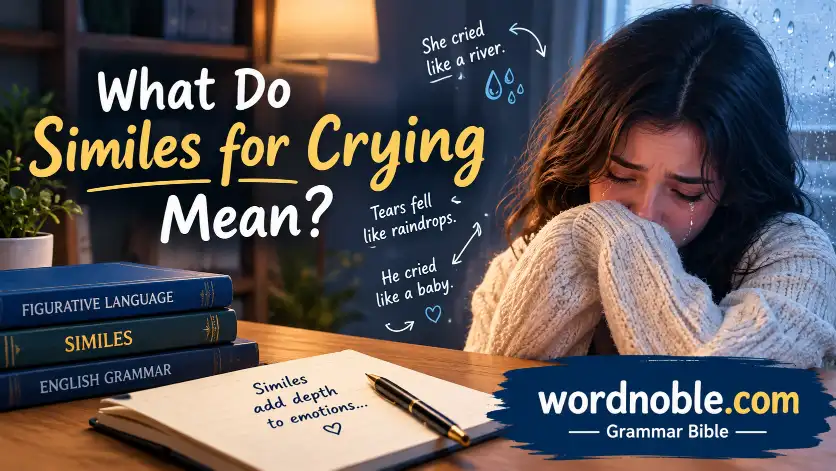
A simile for crying does more than tell readers that someone has tears in their eyes. It helps communicate how the person is crying and what that crying feels like.
Consider the difference:
She cried.
This sentence gives basic information.
Now consider:
Her tears fell like rain against a window.
The second sentence creates an image. Readers can imagine the steady movement of the tears and connect it with a mood of sadness.
Similes can describe different aspects of crying, including:
- The amount of tears
- The speed at which tears fall
- The sound of sobbing
- The intensity of emotion
- The appearance of wet eyes
- The sense of loneliness or grief
- The suddenness of emotional release
This makes similes especially useful in creative writing, poetry, storytelling, personal writing, and English literature.
How Do Similes for Crying Work?

Similes for crying usually connect an emotional action with something familiar.
For example:
Her tears flowed like a river.
The river comparison suggests that the tears are plentiful and continuous.
Another example is:
He cried like a child who had lost his favorite toy.
This comparison focuses more on emotional behavior than the physical tears.
The comparison should match the feeling you want to communicate. A gentle comparison can make crying seem quiet and delicate, while a dramatic comparison can make the emotion feel overwhelming.
Why Do Writers Use Similes for Crying?
Writers use similes because emotions can be difficult to explain directly. Instead of simply naming sadness, a comparison gives readers something concrete to imagine.
Similes can:
- Create vivid imagery
- Show emotional intensity
- Make characters feel more realistic
- Strengthen descriptions
- Add poetic beauty
- Help readers connect emotionally
- Make scenes easier to visualize
- Give ordinary sentences more personality
They are particularly powerful when the comparison fits the character and situation.
Types of Similes for Crying
🐾 Animal-Based Similes
Animal comparisons can make crying feel innocent, vulnerable, dramatic, or uncontrolled.
1. She cried like a frightened puppy.
Meaning: Her crying showed fear and vulnerability.
Category: Animal-based
2. He sobbed like a lost kitten.
Meaning: His crying suggested helplessness and loneliness.
Category: Animal-based
3. She whimpered like a wounded bird.
Meaning: Her crying was soft, weak, and painful.
Category: Animal-based
Animal-based similes work especially well in storytelling because readers already associate certain animals with particular behaviors and emotions.
📡 Technology-Based Similes
Modern comparisons can give emotional writing a fresh and relatable style.
4. His tears streamed like rain on a smartphone screen.
Meaning: His face was covered with flowing tears.
Category: Technology-based
5. She cried like an alarm that would not stop ringing.
Meaning: Her crying was loud, persistent, and difficult to ignore.
Category: Technology-based
6. His sobs came like messages arriving one after another.
Meaning: The crying continued repeatedly without much pause.
Category: Technology-based
These comparisons can work particularly well in contemporary fiction, social media writing, humorous descriptions, and informal storytelling.
🌿 Nature-Based Similes
Nature is one of the most useful sources of imagery for describing tears.
7. Her tears fell like summer rain.
Meaning: The tears came steadily and naturally.
Category: Nature-based
8. His tears flowed like a river.
Meaning: He was crying heavily and continuously.
Category: Nature-based
9. Tears rolled down her cheeks like drops of morning dew.
Meaning: Her tears were small, delicate, and gentle.
Category: Nature-based
10. She cried like a storm breaking over the sea.
Meaning: Her emotions were powerful and overwhelming.
Category: Nature-based
Nature-based similes are common in poetry because they combine emotional meaning with sensory imagery.
😂 Funny and Exaggerated Similes
Not every description of crying has to be serious. Humorous similes can make an emotional scene playful.
11. He cried like a faucet someone forgot to turn off.
Meaning: His tears seemed endless.
Category: Humorous
12. She was crying like a toddler who had lost the last cookie.
Meaning: Her reaction seemed dramatically upset.
Category: Exaggerated
13. He cried like his Wi-Fi had disappeared forever.
Meaning: The comparison humorously exaggerates his sadness.
Category: Humorous
These comparisons are best used when the tone allows humor. They may feel inappropriate in serious scenes involving grief or trauma.
🎭 Emotional and Behavioral Similes
These similes focus on the emotional state behind crying.
14. She cried like someone carrying a broken heart.
Meaning: Her tears reflected deep emotional pain.
Category: Emotional
15. He sobbed like he had been holding his sadness inside for years.
Meaning: The crying represented a powerful emotional release.
Category: Emotional
16. She cried as quietly as a person afraid to be heard.
Meaning: Her crying was restrained and secretive.
Category: Behavioral
These comparisons can reveal character traits instead of merely describing tears.
15 More Similes for Crying
Here are additional examples that can be used in stories, essays, poems, captions, and creative writing.
| # | Simile | Meaning | Category |
|---|---|---|---|
| 1 | Her tears fell like heavy rain. | She was crying intensely. | Nature |
| 2 | He cried like a child lost in a crowd. | He felt helpless and frightened. | Emotional |
| 3 | Tears streamed down her face like a waterfall. | She cried heavily. | Nature |
| 4 | His sobs shook like thunder. | His crying was loud and powerful. | Nature |
| 5 | She cried like a broken-hearted singer. | Her sadness was deeply emotional. | Emotional |
| 6 | His tears appeared like sudden rain. | His crying began unexpectedly. | Nature |
| 7 | She sobbed like a wounded animal. | Her crying sounded painful. | Animal |
| 8 | His tears rolled like beads down his cheeks. | Individual tears were clearly visible. | Object |
| 9 | She cried like the sky after a storm. | Her tears seemed abundant and emotional. | Nature |
| 10 | He wept like someone saying goodbye forever. | His crying expressed deep loss. | Emotional |
| 11 | Her tears flowed like water from a broken pipe. | She could not stop crying. | Object |
| 12 | He cried like a child denied his greatest wish. | His reaction was dramatic and emotional. | Humorous |
| 13 | Her tears shimmered like tiny pearls. | The description focuses on appearance. | Object |
| 14 | He sobbed like thunder trapped in a small room. | His crying was loud and overwhelming. | Exaggerated |
| 15 | She cried as softly as falling snow. | Her crying was quiet and delicate. | Nature |
Similes for Crying in Different Contexts
| Context | Meaning | Use Case | Example |
|---|---|---|---|
| Storytelling | Shows a character’s emotional state | Fiction | Her tears fell like rain. |
| Poetry | Creates emotional imagery | Poems | Her tears shone like pearls. |
| Casual speech | Adds personality | Conversation | He cried like a baby. |
| Humor | Exaggerates emotion | Funny writing | She cried like her phone had vanished. |
| Academic writing | Explains literary technique | Essays | The writer compares tears to rain. |
| Personal writing | Expresses feelings vividly | Journals | My tears flowed like a river. |
Poetic Similes for Crying
Poetry often depends on imagery, rhythm, emotion, and sensory language. Similes can make tears feel almost physical.
Here are some poetic examples:
- Her tears fell like silver rain beneath the moon.
- His sorrow flowed like a river without an end.
- Her tears sparkled like dew on a winter morning.
- He cried like the sky mourning the vanished sun.
- Her sobs rose and fell like waves against the shore.
- Tears slipped down his cheeks like melting snow.
- She wept like a lonely bird beneath a dark sky.
These comparisons work because they connect emotional experiences with visual and natural images.
How to Use Similes for Crying in Writing
A good simile should feel natural rather than forced.
1. Decide what kind of crying you want to describe
Is the person:
- Crying quietly?
- Sobbing uncontrollably?
- Crying from happiness?
- Crying from grief?
- Crying from fear?
- Crying from frustration?
- Trying to hide their tears?
Your answer determines the most suitable comparison.
2. Match the comparison to the emotion
A gentle comparison such as “tears like morning dew” creates a different mood from “tears like a broken waterfall.”
Choose imagery that supports the scene.
3. Use sensory language
Strong descriptions can involve sight, sound, movement, and emotional perception.
For example:
Her sobs sounded like distant thunder.
This combines crying with auditory imagery, allowing readers to imagine the sound.
4. Avoid explaining too much
A powerful simile can communicate an emotion without several sentences of explanation.
Instead of:
She was extremely sad and cried for a very long time.
You might write:
Her tears flowed like a river after the rain.
The comparison carries much of the emotional meaning.
Simile vs. Metaphor for Crying
A simile directly compares two things using words such as like or as.
Her tears fell like rain.
A metaphor makes a more direct comparison without using “like” or “as.”
Her tears were rain.
Both are forms of figurative language, but they create slightly different effects.
| Simile | Metaphor |
|---|---|
| Uses like or as | Usually does not use like or as |
| Makes an explicit comparison | Makes a direct comparison |
| Her tears fell like rain. | Her tears were rain. |
| Often feels descriptive | Can feel more dramatic or symbolic |
Understanding this distinction is important for students studying English literature and creative writing.
Common Mistakes When Writing Similes for Crying
Overusing Comparisons
Too many similes in one paragraph can make writing feel crowded.
Better: Use one strong comparison where it matters most.
Choosing an Illogical Comparison
A comparison should make sense in context.
For example, comparing quiet tears to an exploding volcano may confuse readers unless intentional exaggeration is being used.
Repeating the Same Image
Using “tears like rain” repeatedly can become predictable. Try rivers, dew, waves, melting snow, or other relevant imagery when appropriate.
Confusing Similes With Metaphors
Remember:
Simile: Her tears fell like rain.
Metaphor: Her tears were rain.
Using Humor in the Wrong Situation
A funny comparison can work in casual writing but may weaken a serious emotional scene.
Do and Don’t: Using Similes for Crying
👍 Do
- Choose comparisons that match the emotion.
- Keep the language clear.
- Use fresh imagery.
- Consider the tone of your writing.
- Use sensory details.
- Let the comparison support the story.
- Experiment with nature, objects, animals, and behavior.
👎 Don’t
- Add a simile to every sentence.
- Use complicated words unnecessarily.
- Force an unrelated comparison.
- Repeat the same image.
- Use humor during a serious scene without purpose.
- Confuse metaphors and similes.
- Explain a simple comparison excessively.
Natural Chat Responses Using Similes for Crying
Here are some casual ways people might use crying similes in conversation:
“I was crying like a baby during that movie.”
“She was crying like the rain would never stop.”
“He cried like someone had broken his whole world.”
“I was laughing and crying like a complete mess.”
“She started crying like a faucet that couldn’t be turned off.”
These are informal and conversational rather than formal literary expressions.
Why Are Similes Important in English Literature?
Similes are important because they help writers communicate ideas through comparison and imagery.
In literature, crying can represent more than sadness. It may communicate:
- Grief
- Relief
- Fear
- Joy
- Loneliness
- Anger
- Love
- Emotional exhaustion
- Vulnerability
- Personal transformation
A carefully selected simile can therefore contribute to characterization, atmosphere, symbolism, and tone.
Similes also connect abstract emotions to concrete experiences. Readers may not personally experience the character’s exact situation, but a familiar comparison can help them understand it.
Related Figurative Language Terms
If you’re learning about similes for crying, these related concepts can help expand your understanding:
Figurative Language
Language that communicates ideas beyond strictly literal meanings.
Auditory Imagery
Words that help readers imagine sounds, such as loud sobbing or quiet whimpering.
Sensory Language
Description that appeals to sight, sound, touch, taste, or smell.
Descriptive Writing
Writing that uses specific details to create a vivid mental picture.
Metaphor
A direct comparison between unlike things without typically using “like” or “as.”
Personification
Giving human qualities to something nonhuman.
Emotional Imagery
Language designed to create or strengthen an emotional response.
FAQs:
1. What are similes for crying?
Similes for crying are comparisons that describe tears, sobbing, or emotional sadness using “like” or “as.” They make a simple statement such as “she cried” more vivid. Common comparisons connect tears with rain, rivers, waterfalls, dew, waves, or other familiar things. Writers use these comparisons to communicate the intensity, appearance, sound, or emotional meaning of crying.
2. What are some examples of similes for crying?
Examples include “her tears fell like rain,” “his tears flowed like a river,” and “she cried like a frightened puppy.” Each comparison emphasizes something different. Rain suggests steady tears, a river suggests a large or continuous flow, and a frightened puppy suggests vulnerability. The best example depends on the emotion and situation the writer wants to communicate.
3. What are some funny similes for crying?
Funny similes exaggerate crying to create humor. Examples include “he cried like someone had deleted his favorite game” or “she cried like a faucet nobody could turn off.” These comparisons work best in casual conversation, comedy, social media captions, or lighthearted stories. They should be avoided when the subject involves serious grief or another sensitive emotional situation.
4. What are poetic similes for crying?
Poetic similes use beautiful or emotionally rich imagery to describe tears. Examples include “her tears fell like silver rain” and “his sobs rolled like waves against the shore.” Nature is especially useful in poetry because rain, rivers, waves, snow, and storms can represent sadness, emotional release, loneliness, or overwhelming feelings.
5. What is the difference between a simile and a metaphor?
A simile makes a comparison using words such as “like” or “as.” For example, “her tears fell like rain” is a simile. A metaphor makes a direct comparison, such as “her tears were rain.” Both are forms of figurative language, but similes make the comparison more explicit while metaphors present the two ideas more directly.
6. How can I use similes for crying in writing?
First, decide what emotion the crying represents. Then choose an image that supports that feeling. Quiet sadness might work with dew or falling snow, while intense grief might suit a river or storm. Keep the comparison relevant and avoid using too many similes close together. A single strong comparison can often make a scene more memorable.
7. Why are similes important in English literature?
Similes help literary writers turn abstract emotions into concrete images. Crying is an emotional action, but comparing tears to rain or a river gives readers something recognizable to visualize. Similes can also strengthen characterization, mood, atmosphere, symbolism, and tone. They are therefore useful tools for making literary descriptions more vivid and emotionally meaningful.
8. How do students use similes for crying?
Students can use similes for crying in creative writing, poetry, English assignments, stories, and literary analysis. They can describe a character’s emotions without relying on simple statements such as “the character was sad.” For example, a student might write that tears “fell like rain” and then explain how the comparison communicates sadness and emotional intensity.
9. Can crying similes describe happy tears?
Yes. Crying does not always represent sadness. People can cry because they are happy, relieved, proud, grateful, or emotionally overwhelmed. A writer can use a gentle comparison to communicate these feelings. For example, tears might be described as sparkling like morning dew. The surrounding context helps readers understand whether the tears represent happiness, sadness, relief, or another emotion.
10. Can similes describe the sound of crying?
Yes. Similes can describe the sound of crying through auditory imagery. A writer might compare loud sobs to thunder or quiet crying to a soft breeze. These comparisons help readers imagine the sound rather than simply being told that someone cried loudly or quietly. Sound-based similes are especially useful in fiction, poetry, and dramatic storytelling.
Conclusion:
Similes for crying give writers a simple way to transform an ordinary emotional description into vivid imagery. Instead of simply saying that someone cried, you can compare tears with rain, rivers, dew, waves, storms, or familiar objects to communicate the emotion more clearly.
The strongest similes match the character, situation, and tone of the scene. They can make stories more visual, poetry more expressive, and school writing more engaging.
Remember that a simile uses a comparison such as “like” or “as,” while a metaphor makes a more direct comparison. Choose one meaningful image rather than filling every sentence with figurative language, and your writing will feel clearer, stronger, and more memorable.

I am Naqash Ayub, proudly writing for WordNoble, where I focus on creating clear, informative, and SEO-friendly content. I enjoy turning detailed information into simple, trustworthy articles that help readers find the answers they need.