
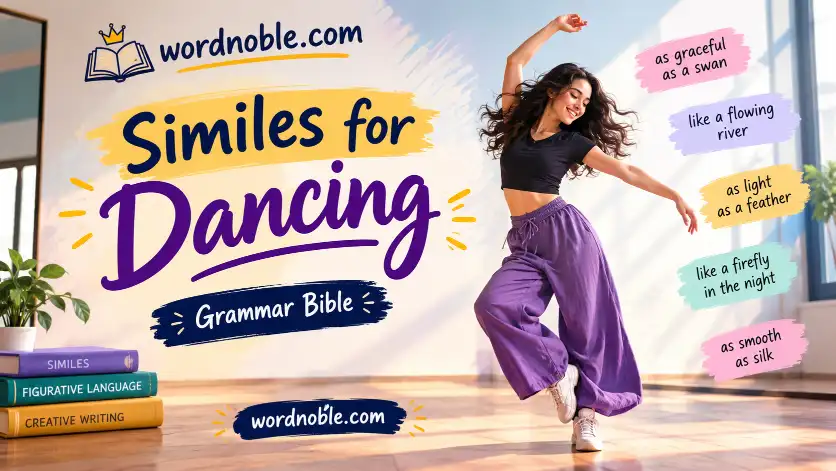
Watch a skilled dancer for even ten seconds, and your brain starts reaching for comparisons before you realize it she moves like water, he spins like a coin balanced on a table.
That instinct is exactly why similes for dancing show up so often in poetry, lyrics, and everyday conversation: dance is pure movement, and movement begs to be compared to something else.
Whether you’re writing a poem, drafting a wedding speech, or simply trying to describe how someone tore up the floor last weekend, plain words like “graceful” or “energetic” only carry you so far.
A good simile does the heavy lifting instead, painting a whole picture in a single phrase. Below, you’ll find comparisons drawn from nature, motion, music, and emotion the kind that make writing feel alive rather than flat. Some suit ballet’s precision, others fit the wild energy of a nightclub floor.
By the end, you’ll have a ready collection of phrases to borrow, adapt, or use as inspiration for your own work. Let’s start with the classics the similes almost everyone already knows.
What Are Similes for Dancing?
Similes for dancing are comparisons that describe dance movements, rhythm, energy, or emotion by using words such as “like” or “as.” They make dance descriptions more vivid, expressive, and memorable.
Similes for dancing are a form of figurative language used to compare a dancer or dance movement with a familiar person, animal, object, natural element, or experience. They help writers communicate qualities such as grace, speed, rhythm, flexibility, excitement, elegance, and emotion through vivid imagery.
Meaning and Deep Explanation
Dancing involves much more than physical movement. It can communicate confidence, happiness, sadness, freedom, romance, excitement, tension, or cultural identity without using spoken words.
That is why similes are particularly useful when describing dance.
Compare these two sentences:
- She danced beautifully.
- She moved like a feather floating on a gentle breeze.
The first sentence gives a basic judgment. The second creates an image. The reader can imagine light, controlled, effortless movement.
A good simile connects an unfamiliar or difficult-to-describe movement with something familiar. The comparison gives the reader a visual or emotional reference point.
How Similes for Dancing Work
A dancing simile usually follows one of these patterns:
- The dancer moved like a ______.
- She danced as gracefully as a ______.
- His feet moved like ______.
- They spun as quickly as ______.
- The dancers were like ______.
The comparison should match the quality you want to emphasize.
For example, comparing a dancer to a whirlwind suggests speed and energy, while comparing the dancer to a swan suggests grace and elegance.
Why Do Writers Use Similes for Dancing?
Writers use dance similes because movement can be difficult to explain with literal language alone.
1. They create visual imagery
A reader may not immediately understand what “fluid movement” looks like. Comparing the dancer to flowing water makes the movement easier to visualize.
2. They communicate emotion
A dance can be described as light as a butterfly to suggest happiness or delicacy, while like a storm can communicate intensity or emotional power.
3. They make descriptions memorable
Creative comparisons stay in the reader’s mind longer than plain descriptions.
4. They add personality
Two dancers can perform the same routine but appear completely different through descriptive language.
5. They strengthen creative writing
Similes are useful in stories, poems, essays, scripts, reviews, and personal writing because they add imagery without requiring lengthy explanations.
Similes for Dancing in Different Contexts
The meaning of a dance simile depends on where and how it is used.
Storytelling
In fiction, similes help readers visualize characters.
She danced through the room like a butterfly escaping a summer garden.
The comparison makes the character seem light, joyful, and energetic.
Poetry
Poetry often uses more imaginative and emotional comparisons.
His feet moved like rain tapping softly against a window.
This creates a gentle and rhythmic image.
Casual Speech
Everyday descriptions can use simple similes.
She was dancing like nobody was watching.
The expression emphasizes freedom and confidence.
Humor
Funny comparisons can make a description entertaining.
He danced like a penguin trying to cross an icy sidewalk.
The comparison suggests awkward and amusing movement.
Academic Writing
Similes can sometimes appear in literary analysis or descriptive assignments, but they should support the point rather than overwhelm it.
For example:
The poet compares the dancer’s movements to flowing water to emphasize freedom and continuity.
This explains the literary function of the comparison rather than simply using figurative language for decoration.
Types of Similes for Dancing
Organizing dance similes into categories makes it easier to select the right comparison.
Animal-Based Similes
Animals provide familiar examples of movement, balance, speed, and grace.
Examples
- She danced like a graceful swan.
Meaning: Her movements were elegant and smooth. - He moved like a playful puppy.
Meaning: His dancing was energetic and cheerful. - She spun like a butterfly in the wind.
Meaning: Her movements were light and delicate. - They jumped like excited gazelles.
Meaning: Their movements were fast, lively, and energetic.
Animal-based similes work particularly well when the animal’s natural behavior clearly matches the quality being described.
Technology-Based Similes
Modern technology can create unusual and memorable comparisons.
Examples
- His feet moved like perfectly programmed machines.
Meaning: His movements were precise and controlled. - She spun like a rapidly turning fan.
Meaning: She turned very quickly. - The dancers moved like synchronized robots.
Meaning: Their movements were highly coordinated. - Her feet flashed like computer signals.
Meaning: Her movements were extremely quick.
These comparisons can work especially well in contemporary writing, humorous descriptions, or modern performance reviews.
Nature-Based Similes
Nature is one of the richest sources of dance imagery.
Examples
- She moved like a leaf carried by the wind.
Meaning: Her movements were light and flowing. - He danced like waves rolling across the sea.
Meaning: His movements were fluid and continuous. - They spun like leaves in an autumn breeze.
Meaning: Their movements were gentle and swirling. - She moved as smoothly as a river.
Meaning: Her movements flowed without interruption.
Nature-based comparisons are especially effective in poetry and descriptive writing because they create strong sensory imagery.
Funny and Exaggerated Similes
Humorous similes do not need to be realistic. Their purpose is often entertainment.
Examples
- He danced like a chicken wearing roller skates.
Meaning: His movements were funny, awkward, and uncontrolled. - She jumped like a kangaroo at a birthday party.
Meaning: She was moving around with exaggerated energy. - He spun like a washing machine on its fastest cycle.
Meaning: He was turning extremely quickly. - They danced like squirrels after drinking too much coffee.
Meaning: Their movements were wildly energetic and chaotic.
Funny similes are useful for humorous stories, social posts, casual conversations, and playful descriptions.
Emotional and Behavioral Similes
Sometimes the most important part of a dance is not speed or physical technique but emotion.
Examples
- She danced like someone who had just received wonderful news.
Meaning: Her movements showed excitement and happiness. - He moved like a person carrying a heavy sadness.
Meaning: His dancing appeared slow and emotionally painful. - She danced as freely as a child playing outside.
Meaning: She seemed relaxed and uninhibited. - He moved like a nervous bird.
Meaning: His movements appeared uncertain and restless.
These similes connect physical movement with psychological or emotional states.
15 Examples of Similes for Dancing
Here are practical examples that can be used in creative writing, poetry, school assignments, or everyday descriptions.
| # | Simile Sentence | Meaning | Category |
|---|---|---|---|
| 1 | She danced like a graceful swan. | Her movement was elegant and smooth. | Animal |
| 2 | He moved like a whirlwind. | He danced with tremendous energy and speed. | Nature |
| 3 | Her feet moved as quickly as raindrops. | Her footwork was fast and rhythmic. | Nature |
| 4 | They danced like waves across the stage. | Their movements were fluid and continuous. | Nature |
| 5 | She spun like a spinning top. | She turned rapidly and repeatedly. | Object |
| 6 | He danced like a joyful child. | His movement showed happiness and freedom. | Emotional |
| 7 | Her arms flowed like ribbons in the wind. | Her arm movements were soft and graceful. | Nature |
| 8 | They moved like perfectly synchronized machines. | Their timing was extremely precise. | Technology |
| 9 | He danced like a penguin on hot sand. | His movement was awkward and funny. | Humorous |
| 10 | She moved as lightly as a feather. | Her dancing appeared delicate and effortless. | Object |
| 11 | His feet tapped like a drummer keeping time. | His footwork closely followed the rhythm. | Object |
| 12 | She danced like fire in the wind. | Her movements were energetic and unpredictable. | Nature |
| 13 | They spun like leaves in a storm. | Their movements were rapid and dramatic. | Nature |
| 14 | He moved like a puppet controlled by music. | The rhythm seemed to control his movements. | Object |
| 15 | She danced as freely as a bird in the sky. | Her movement suggested freedom and confidence. | Animal |
Context Table for Dancing Similes
| Context | Meaning | Use Case | Example |
|---|---|---|---|
| Graceful dance | Elegance and smoothness | Poetry, stories | She moved like a swan. |
| Fast dance | Speed and energy | Performance writing | He spun like a whirlwind. |
| Emotional dance | Feelings expressed through movement | Fiction, poetry | She danced like someone celebrating freedom. |
| Funny dance | Awkward or exaggerated movement | Humor, casual speech | He danced like a penguin on ice. |
| Rhythmic dance | Strong connection with music | Reviews, descriptions | Her feet tapped like falling rain. |
| Romantic dance | Softness and intimacy | Poetry, fiction | They moved like two leaves drifting together. |
| Powerful dance | Strength and intensity | Performance writing | He danced like a storm. |
| Delicate dance | Light, gentle movement | Poetry | She floated like a feather. |
How to Use Similes for Dancing in Your Writing
A good simile should make the reader understand something more clearly. It should not simply sound creative.
1. Identify the movement
Ask what the dancer is actually doing.
Is the dancer:
- spinning?
- jumping?
- moving slowly?
- moving gracefully?
- dancing aggressively?
- following a rhythm?
- expressing sadness?
- celebrating?
2. Find a matching image
Think about something that behaves similarly.
For example:
Fast spinning → whirlwind, spinning top, wheel
Gentle movement → feather, leaf, butterfly
Powerful movement → storm, fire, wave
3. Match the emotion
The comparison should support the emotional tone.
A joyful dance might be compared with a bird in flight. A dramatic dance might be compared with a storm.
4. Avoid forced comparisons
A strange comparison can distract the reader.
Instead of choosing an object simply because it sounds interesting, ask:
Does this image actually resemble the movement?
5. Keep it natural
The best similes often feel effortless.
She moved like water.
This is short but effective because flowing water naturally suggests smooth movement.
How Can Similes Make Dance Descriptions More Creative?
Similes work because they connect physical movement with familiar experiences.
Instead of listing technical details, a writer can create an immediate mental picture.
For example:
Basic:
The dancer moved quickly.
More descriptive:
The dancer moved like a flash of lightning.
The second sentence emphasizes speed while creating a stronger visual impression.
Good creative writing does not require complicated vocabulary. It requires precise imagery.
Simile vs. Metaphor
Similes and metaphors both create comparisons, but they do so differently.
A simile usually uses words such as like or as:
She danced like a butterfly.
A metaphor makes a direct comparison:
She was a butterfly on the stage.
The first explicitly signals the comparison. The second presents the dancer as the thing being compared.
Both are important English literature concepts, but they create slightly different effects.
Common Mistakes When Using Dancing Similes
Overusing Similes
Putting a simile in every sentence can make writing feel crowded.
Use comparisons where they add meaning or imagery.
Choosing an Illogical Comparison
A comparison should have a recognizable connection to the movement.
If the reader cannot understand why two things are being compared, the simile becomes confusing.
Mixing Simile and Metaphor
Remember:
Simile: She danced like a bird.
Metaphor: She was a bird on the stage.
Using Clichés Too Often
Common comparisons can become predictable. When appropriate, try creating a fresh image that fits the specific scene.
Ignoring Context
A funny comparison may work perfectly in a casual story but feel inappropriate in a serious literary analysis.
Do and Don’t: Using Dance Similes
Do
- Choose comparisons that match the movement.
- Connect the simile to emotion.
- Use familiar images when clarity matters.
- Experiment with nature and animals.
- Create original comparisons when appropriate.
- Read the sentence aloud to check its flow.
Don’t
- Add a simile to every sentence.
- Use comparisons that have no clear connection.
- Choose complicated images simply to sound intelligent.
- Mix metaphors accidentally.
- Let figurative language hide the main meaning.
- Use humorous comparisons in serious contexts unless the tone supports them.
Natural Chat Responses Using Similes for Dancing
Here are some casual ways people might naturally use dance similes in conversation:
- “She was dancing like nobody else existed in the room.”
- “He moves like a professional when that song comes on.”
- “You were spinning like a tornado out there!”
- “They danced like two leaves floating on water.”
- “I was dancing like a chicken, but at least I was having fun.”
- “She moved like a butterfly when the music started.”
These sound more natural in conversation because they describe a noticeable quality rather than forcing complicated literary language into everyday speech.
Related Terms and Concepts
Understanding dancing similes also connects to several broader language and literature concepts.
Figurative Language
Figurative language communicates ideas beyond their strictly literal meaning. Similes and metaphors are two common forms.
Sensory Language
Sensory language helps readers imagine sight, sound, touch, movement, taste, or other experiences.
Visual Imagery
Dance descriptions often depend heavily on visual imagery because readers need to picture movement, posture, direction, and rhythm.
Auditory Imagery
Music and dance frequently work together. Auditory imagery helps readers imagine the beat, tempo, melody, or sound accompanying movement.
Descriptive Writing
Similes are valuable descriptive-writing techniques because they transform simple statements into vivid images.
Metaphor vs. Simile
Both create comparisons, but similes generally use explicit comparison words such as “like” or “as,” while metaphors make a direct comparison.
FAQs:
What are similes for dancing?
Similes for dancing are comparisons used to describe movement, rhythm, appearance, speed, or emotion. They commonly use “like” or “as” to connect a dance with something familiar. For example, saying “she danced like a butterfly” suggests light and delicate movement. Writers use these comparisons to make dance descriptions more vivid and easier for readers to imagine.
What are some examples of similes for dancing?
Examples include “she danced like a swan,” “he moved like a whirlwind,” “they spun like leaves in the wind,” and “her feet moved as quickly as raindrops.” Each comparison highlights a different quality. A swan suggests grace, a whirlwind suggests energy, leaves suggest flowing movement, and raindrops can suggest quick rhythmic footwork.
What are some funny similes for dancing?
Funny dancing similes exaggerate or playfully compare movement with unusual situations. Examples include “he danced like a penguin on hot sand,” “she moved like a chicken wearing roller skates,” and “he spun like a washing machine.” These comparisons are mainly used for humor and should match the casual or playful tone of the writing.
What are poetic similes for dancing?
Poetic similes for dancing often compare movement with nature, weather, light, water, or animals. Examples include “she moved like moonlight across the water” and “his arms flowed like branches in a gentle breeze.” These comparisons create visual and emotional imagery, making them especially useful in poems, creative writing, and literary descriptions.
What is the difference between a simile and a metaphor?
A simile makes an explicit comparison, usually using “like” or “as.” For example, “She danced like a butterfly” is a simile. A metaphor makes the comparison directly: “She was a butterfly on the stage.” Both are forms of figurative language, but a simile makes the comparison more openly.
How can I use similes for dancing in writing?
First, identify the quality you want to describe, such as speed, grace, rhythm, strength, or emotion. Then find something that naturally shares that quality. For example, compare gentle movement with a feather or flowing water. Keep the comparison relevant and avoid adding too many similes. The goal is clearer imagery, not decoration.
Why are similes important in English literature?
Similes help writers create imagery, communicate emotion, and make abstract ideas easier to visualize. In literature, a comparison can reveal something about a character, atmosphere, movement, or theme. Dance similes are particularly useful because physical movement can be difficult to describe literally. A carefully chosen comparison gives readers a clearer mental and emotional picture.
How can students use similes for dancing?
Students can use dancing similes in creative-writing assignments, descriptive paragraphs, poetry, stories, and literary analysis. They should first decide what aspect of the dance they want to describe. A student might compare graceful movement with a swan or fast movement with a whirlwind. The comparison should be clear, relevant, and appropriate for the assignment’s tone.
Can similes describe different types of dancing?
Yes. Similes can describe ballet, hip-hop, ballroom dancing, folk dancing, contemporary dance, traditional performances, and many other styles. The comparison should reflect the movement. Ballet might be compared with a feather or swan, while an energetic dance could be compared with fire or a storm. Choosing an appropriate image makes the description more specific.
Why do writers compare dancers with animals and nature?
Animals and natural elements provide familiar patterns of movement. A butterfly suggests delicacy, a swan suggests grace, a storm suggests power, and flowing water suggests smoothness. Because readers already understand these qualities from everyday experience, the comparisons can communicate the character of a dance quickly and effectively.
Conclusion:
Similes for dancing make movement easier to visualize, understand, and remember. A simple comparison can transform an ordinary sentence into vivid sensory language that communicates speed, grace, rhythm, power, or emotion.
Whether you are writing a poem, story, school assignment, dance review, or casual description, choose a comparison that genuinely matches the movement you want to show.
The strongest similes are not necessarily the most complicated. They are the ones that give readers an immediate mental picture.
Experiment with animals, nature, objects, technology, and emotions, but always keep context in mind. Once you understand how similes work, you can describe dancing with greater precision, creativity, and personality.

I am Naqash Ayub, proudly writing for WordNoble, where I focus on creating clear, informative, and SEO-friendly content. I enjoy turning detailed information into simple, trustworthy articles that help readers find the answers they need.