Growing older is something everyone experiences, yet finding the right words to describe it can be surprisingly difficult.
That’s where metaphors for aging become powerful—they transform the passage of time into vivid images that capture wisdom, change, resilience, and life’s natural rhythm.
Whether you’re writing a poem, story, speech, or simply looking for a creative way to express the aging process, the right metaphor can add depth and emotion to your words.
Metaphors for aging are figurative comparisons that describe growing older by saying a person or life is something else, such as a journey, a changing season, or a well-worn book. They help express the emotional, physical, and personal meaning of aging in vivid language.
What Are Metaphors for Aging?
A metaphor for aging is a figure of speech that describes the aging process by directly comparing it to another object, idea, or experience without using the words like or as. Instead of saying someone is like an old tree, a metaphor says:
- Life is an autumn forest.
- Time is a quiet sculptor.
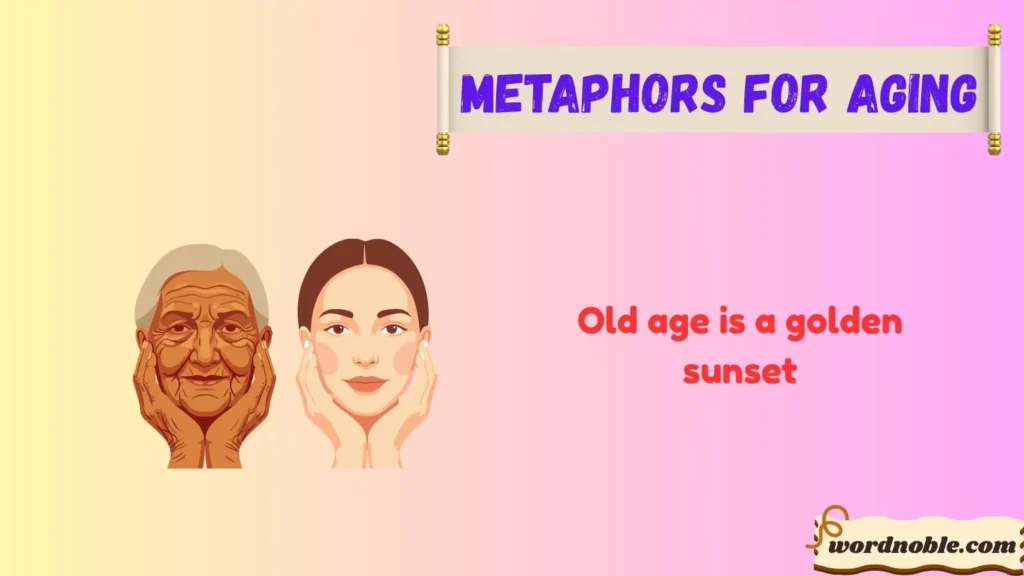
- Old age is a golden sunset.
These comparisons create stronger imagery and allow readers to understand aging through emotions, experiences, and familiar scenes rather than plain facts.
Unlike literal language, metaphors invite readers to imagine what growing older feels like instead of simply describing it.
Why Writers Use Metaphors for Aging
Aging is more than counting birthdays. It involves change, memory, wisdom, loss, growth, resilience, and new beginnings. Because these ideas are emotional and complex, metaphors make them easier to understand.
Writers use metaphors for aging to:
- Create vivid mental images.
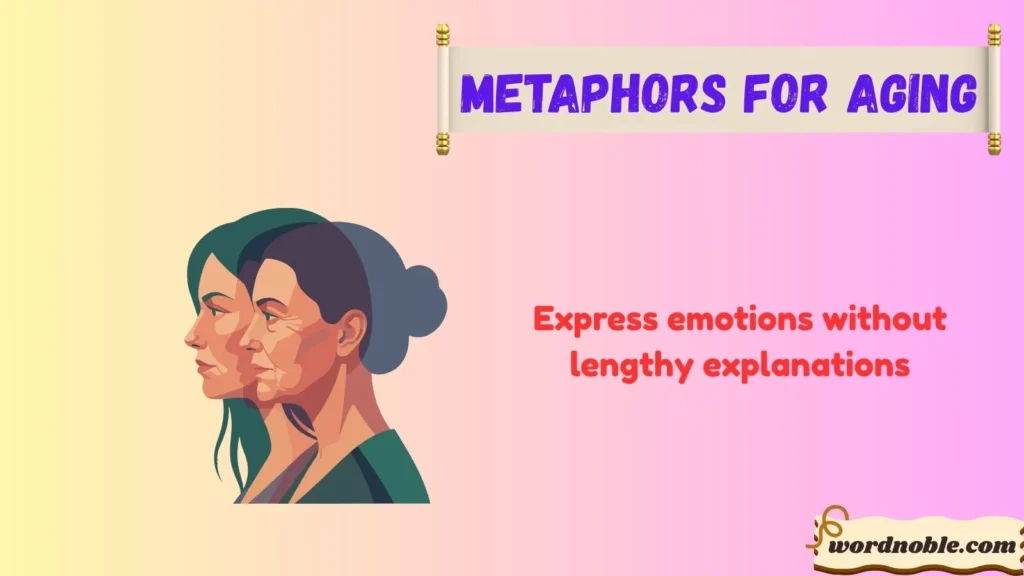
- Express emotions without lengthy explanations.
- Add beauty and depth to poems and stories.
- Make speeches and essays more memorable.
- Help readers connect personally with the passage of time.
- Turn abstract ideas into meaningful experiences.
In literature, metaphors often transform aging from something people fear into something that reflects experience, character, and personal growth.
Metaphors vs. Similes for Aging
Many learners confuse metaphors and similes because both compare two different things. The key difference is how the comparison is made.
| Feature | Metaphor | Simile |
|---|---|---|
| Comparison | Direct | Uses like or as |
| Example | Aging is a winding river. | Aging is like a winding river. |
| Effect | Stronger and more symbolic | Softer and more explicit |
| Common Use | Literature, speeches, poetry | Everyday writing, teaching, descriptions |
A metaphor states that one thing is another to create powerful imagery, while a simile simply says one thing is like another.
Metaphors for aging are figurative expressions that describe growing older through symbolic comparisons rather than literal explanations. They help readers understand the emotional, physical, and psychological aspects of aging by connecting them to familiar experiences, natural cycles, and meaningful objects. These metaphors are widely used in literature, poetry, storytelling, speeches, and creative writing because they communicate complex ideas with clarity and emotional depth.
Understanding the Meaning of Aging Through Metaphors
Aging is often viewed as a gradual journey instead of a single event. Metaphors allow writers to highlight different perspectives depending on the message they want to share.
For example, when aging is described as a journey, the focus is on learning and personal growth. When it is called an autumn season, the emphasis shifts to maturity, reflection, and change. A metaphor such as a weathered lighthouse suggests strength, guidance, and endurance despite life’s storms.
This flexibility makes metaphors valuable in many forms of writing because the same concept can communicate hope, wisdom, resilience, nostalgia, or transformation.
How Metaphors for Aging Work in Different Types of Writing
Storytelling
Novelists use metaphors to reveal a character’s emotional journey without directly explaining every feeling. A single metaphor can show years of experience in just a few words.
Poetry
Poets rely on metaphors to create emotional imagery. Comparing aging to changing seasons, fading light, or deep-rooted trees allows readers to experience the emotion behind the words.
Speeches
Inspirational speakers often use metaphors to encourage audiences to see aging as growth instead of decline. Symbolic language makes important messages easier to remember.
Everyday Conversation
People naturally use metaphors such as “I’ve reached a new chapter in life” or “Time has carved its lessons into me.” These expressions make conversations more expressive and meaningful.
Academic and Literary Writing
In literary analysis, metaphors help explain themes such as identity, mortality, wisdom, transformation, and the passage of time. Students frequently analyze aging metaphors in novels, poems, and classic literature.
Why Metaphors for Aging Matter
Metaphors do more than decorate language—they shape the way people think about growing older. Positive metaphors can encourage acceptance, resilience, gratitude, and hope, while negative metaphors may reinforce fear or decline. Choosing thoughtful metaphors allows writers to present aging as a meaningful stage of life filled with experience, reflection, and continued growth.
By understanding how metaphors work, you can write with greater clarity, emotion, and creativity, whether you’re crafting a poem, preparing a speech, completing a school assignment, or telling a personal story.
🌿 Nature-Based Metaphors for Aging
Nature provides some of the richest metaphors because aging, like nature, follows cycles of growth, maturity, and renewal.
1. Aging is an Autumn Season
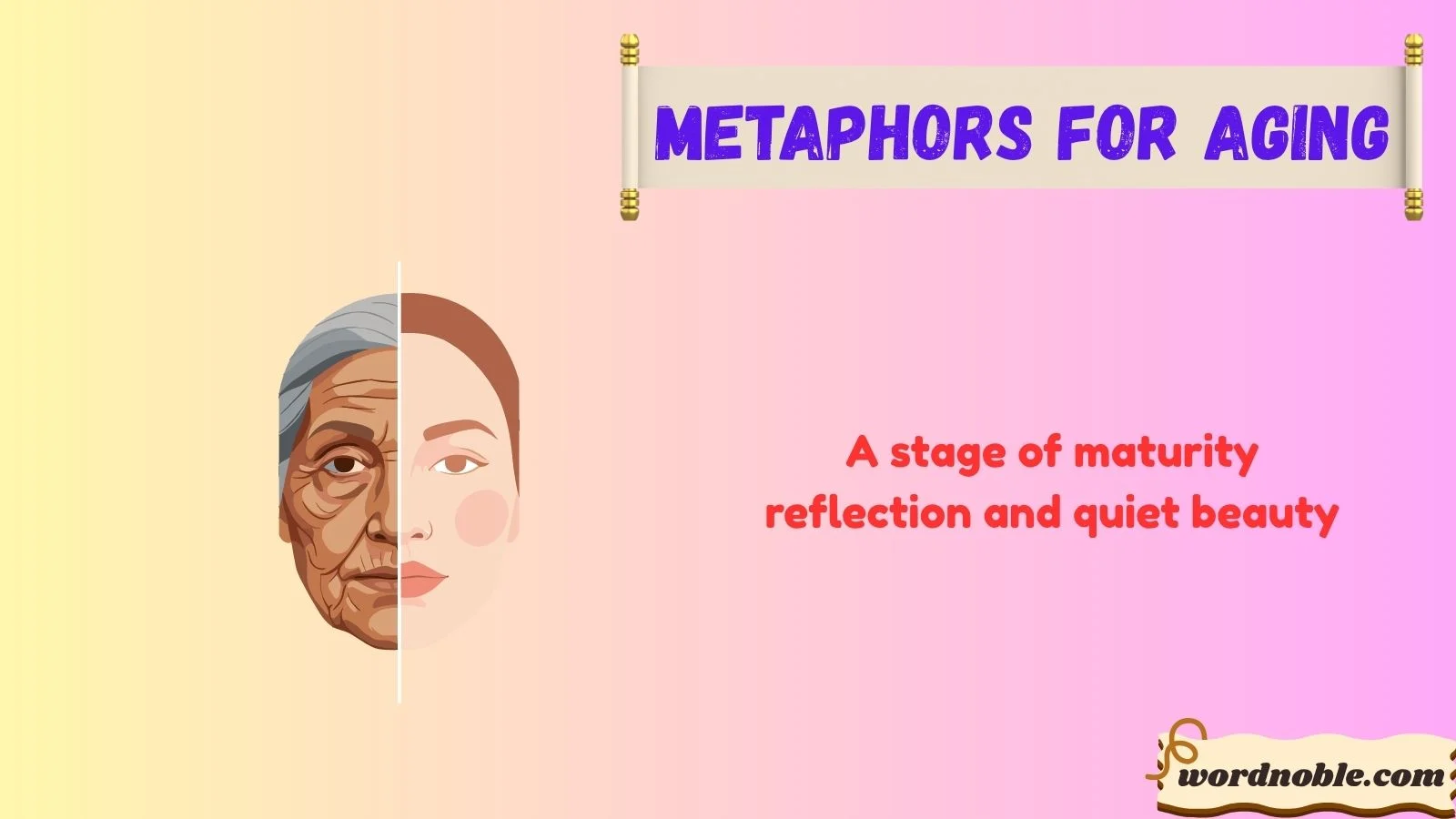
Meaning: A stage of maturity, reflection, and quiet beauty.
Example:
Her life had entered its autumn, glowing with wisdom and gratitude.
Why it works: Autumn symbolizes change without suggesting an ending, making it one of the most balanced metaphors for aging.
2. Aging is a Deep-Rooted Tree
Meaning: Strength, stability, and years of experience.
Example:
He had become a deep-rooted oak, standing firm through every storm.
Why it works: Trees grow stronger over time, making them powerful symbols of resilience and wisdom.
3. Aging is a Flowing River
Meaning: Continuous movement through life’s stages.
Example:
Her years flowed like a river, carrying lessons with every turn.
Why it works: Rivers suggest progress rather than decline.
4. Aging is a Mountain Trail
Meaning: Every step brings new experiences and perspectives.
Example:
The mountain trail of life revealed broader views with every climb.
Why it works: It emphasizes growth through challenges.
🐾 Animal-Based Metaphors for Aging
Animals often represent qualities developed through time, such as patience, endurance, or wisdom.
5. Aging is a Wise Owl
Meaning: Knowledge gained through experience.
Example:
Grandfather had become the wise owl of the family.
Why it works: Owls traditionally symbolize wisdom across many cultures.
6. Aging is an Old Lion
Meaning: Strength that now comes from experience rather than youth.
Example:
Though slower than before, he remained an old lion commanding respect.
Why it works: It combines dignity with earned authority.
7. Aging is a Sea Turtle
Meaning: Longevity, patience, and perseverance.
Example:
She moved through life like a sea turtle, calm and enduring.
Why it works: Sea turtles are associated with long life and steady progress.
🏛️ Object-Based Metaphors for Aging
Everyday objects can symbolize the value that comes with years of use.
8. Aging is a Well-Worn Book
Meaning: A life filled with stories, memories, and lessons.
Example:
His life was a well-worn book, each page revealing another adventure.
Why it works: Books naturally represent accumulated knowledge.
9. Aging is Fine Wine
Meaning: Improving in value and character over time.
Example:
She is fine wine, becoming richer with every passing year.
Why it works: This classic metaphor celebrates maturity rather than youth.
10. Aging is a Weathered Lighthouse
Meaning: Guidance shaped by years of experience.
Example:
He stood as the family’s weathered lighthouse through every storm.
Why it works: Lighthouses symbolize reliability and hope.
💻 Technology-Based Metaphors for Aging
Modern writing sometimes uses technology to explain aging in relatable ways.
11. Aging is a Living Archive
Meaning: A lifetime of stored memories and experiences.
Example:
Her mind had become a living archive of family history.
Why it works: It highlights the richness of accumulated knowledge.
12. Aging is Updated Software
Meaning: Better judgment through continuous learning.
Example:
His years had upgraded his outlook on life.
Why it works: It reframes aging as improvement rather than decline.
😂 Humorous Metaphors for Aging
Humor makes discussions about aging more relatable and lighthearted.
13. Aging is a Battery Running Low
Meaning: Less physical energy while still functioning.
Example:
By evening, I was a battery flashing one percent.
Why it works: It’s playful and instantly understandable.
14. Aging is a Vintage Classic
Meaning: Old but valuable and admired.
Example:
I’m not old—I’m a vintage classic.
Why it works: It transforms age into a compliment.
🎭 Emotional and Behavioral Metaphors for Aging
These metaphors focus on inner growth rather than physical changes.
15. Aging is a Library
Meaning: A collection of wisdom, memories, and life lessons.
Example:
Her heart had become a library where every chapter mattered.
Why it works: Libraries represent learning, reflection, and accumulated experience.
15 Best Metaphors for Aging (Quick Reference Table)
| Metaphor | Meaning | Category | Best Used In |
|---|---|---|---|
| Autumn season | Maturity and reflection | Nature | Poetry, essays |
| Deep-rooted tree | Strength and stability | Nature | Speeches, stories |
| Flowing river | Continuous life journey | Nature | Creative writing |
| Mountain trail | Growth through challenges | Nature | Motivational writing |
| Wise owl | Experience and wisdom | Animal | Literature |
| Old lion | Respected strength | Animal | Character descriptions |
| Sea turtle | Longevity and patience | Animal | Inspirational writing |
| Well-worn book | Life full of stories | Object | Memoirs |
| Fine wine | Improves with time | Object | Celebrations |
| Weathered lighthouse | Guidance and resilience | Object | Speeches |
| Living archive | Memory and knowledge | Technology | Modern essays |
| Updated software | Continuous learning | Technology | Blogs |
| Battery running low | Less energy | Humorous | Casual conversation |
| Vintage classic | Valuable with age | Humorous | Birthday messages |
| Library | Wisdom and experience | Emotional | Reflective writing |
Choosing the Right Metaphor for Aging
Not every metaphor fits every situation. Consider the tone and purpose of your writing:
- For inspirational speeches: Deep-rooted tree, weathered lighthouse, mountain trail.
- For poetry: Autumn season, flowing river, library.
- For fiction: Wise owl, old lion, well-worn book.
- For humorous writing: Vintage classic, battery running low.
- For personal essays: Fine wine, living archive, flowing river.
Choosing a metaphor that matches your audience and message makes your writing more vivid, memorable, and emotionally engaging.
Context Table: Using Metaphors for Aging in Different Situations
| Context | Meaning | Best Use Case | Example |
|---|---|---|---|
| Poetry | Beauty, change, and emotion | Poems and spoken word | Her years were an autumn sunset, glowing with quiet grace. |
| Storytelling | Character growth | Novels and short stories | Time had carved him into a weathered lighthouse. |
| Personal Essay | Reflection and life lessons | Memoirs and school assignments | My life became a well-worn book filled with unforgettable chapters. |
| Speech | Inspiration and wisdom | Retirement and birthday speeches | Aging is a mountain trail that rewards every step with a broader view. |
| Everyday Conversation | Lighthearted expression | Casual discussions | I’m becoming a vintage classic. |
| Literature Analysis | Theme and symbolism | English assignments | The author uses the changing seasons as a metaphor for aging. |
| Motivational Writing | Growth and resilience | Blogs and articles | Every wrinkle is another chapter of strength. |
| Greeting Cards | Celebration of life | Birthday wishes | You’re fine wine—better with every passing year. |
Writing Guide: How to Use Metaphors for Aging Naturally
A good metaphor doesn’t simply replace a word—it adds meaning, emotion, and imagery. The best metaphors feel natural because they match the tone of your writing and help readers visualize an idea without confusing them.
1. Choose a Familiar Image
Pick something your readers already understand, such as:
- Seasons
- Trees
- Rivers
- Books
- Mountains
- Sunrises and sunsets
- Birds
- Light
Familiar images create stronger emotional connections.
2. Match the Emotion
Think about the feeling you want to express.
| Emotion | Good Metaphor |
|---|---|
| Wisdom | A well-stocked library |
| Hope | A new dawn |
| Reflection | Autumn leaves |
| Strength | An ancient oak |
| Peace | A calm river |
| Resilience | A weathered lighthouse |
| Growth | A winding trail |
When the metaphor reflects the emotion, your writing becomes more memorable.
3. Keep It Consistent
Avoid mixing unrelated metaphors in the same sentence.
Weak Example
Life is a river that flies through the sky like a train.
The images don’t connect.
Better Example
Life is a river that grows deeper and calmer with time.
One clear image creates stronger impact.
4. Show, Don’t Explain
Instead of writing:
She became wiser with age.
Write:
She became an old oak whose roots reached deeper every year.
Readers experience the idea rather than simply reading it.
5. Use Metaphors Sparingly
Too many metaphors can overwhelm readers. One strong metaphor often has more impact than several weak ones packed into a paragraph.
How to Create Original Metaphors for Aging
If you want your writing to stand out, create fresh metaphors instead of relying only on common ones.
Step 1: Identify a Quality of Aging
Ask yourself:
- Is it about wisdom?
- Change?
- Memory?
- Patience?
- Resilience?
- New beginnings?
Step 2: Find Something That Shares That Quality
Examples:
- Compass
- Lighthouse
- Garden
- Clock
- Forest
- Ocean
- Quilt
- Candle
- Bridge
Step 3: Connect Them Naturally
Instead of saying:
She became older.
Write:
She became a garden where every season left something beautiful behind.
Metaphor vs. Simile
Although both are figures of speech, they work differently.
| Feature | Metaphor | Simile |
|---|---|---|
| Comparison | Direct | Uses like or as |
| Example | Life is a river. | Life is like a river. |
| Strength | More vivid and symbolic | More straightforward |
| Common Use | Literature, speeches, poetry | Teaching, conversation, descriptive writing |
Quick Tip
If the sentence uses like or as, it’s usually a simile.
If it directly says one thing is another, it’s a metaphor.
Common Mistakes to Avoid
1. Mixing Metaphors
❌ Life is a river climbing a mountain.
✔ Life is a river finding its way to the sea.
2. Using Clichés Too Often
Common metaphors like fine wine or golden years are effective, but overusing them can make your writing feel predictable.
Try creating original comparisons whenever possible.
3. Choosing Illogical Comparisons
A metaphor should highlight a shared quality.
Weak:
Aging is a pencil.
Readers may not understand the connection.
Better:
Aging is a compass that points toward wisdom.
4. Confusing Metaphors with Similes
Remember:
- He is an old oak. ✔ Metaphor
- He is like an old oak. ✔ Simile
5. Overloading a Paragraph
Using several metaphors together can distract readers.
Instead, develop one clear metaphor before introducing another.
Do and Don’t Guide
✅ Do
- Use clear, meaningful imagery.
- Match the metaphor to your audience.
- Choose comparisons readers recognize.
- Keep the tone consistent.
- Use metaphors to strengthen emotion.
- Revise your metaphors for clarity.
❌ Don’t
- Mix unrelated images.
- Force unusual comparisons.
- Overuse clichés.
- Explain the metaphor immediately after writing it.
- Fill every sentence with figurative language.
- Confuse metaphors with similes.
Natural Chat Responses Using Metaphors for Aging
Here are some everyday examples that sound natural in conversation.
Friend: How do you feel about getting older?
Reply:
“I see it as climbing a mountain—every year gives me a better view.”
Friend: You seem calmer these days.
Reply:
“I’ve become a deep-rooted tree. Storms don’t shake me like they used to.”
Friend: Happy birthday! Another year older.
Reply:
“Thanks! I’m just becoming a vintage classic.”
Friend: You’ve learned so much over the years.
Reply:
“Life has turned me into a well-worn book with plenty of stories left.”
Friend: Do birthdays bother you?
Reply:
“Not really. I think every year adds another chapter instead of taking one away.”
Friend: What’s the best part of aging?
Reply:
“It feels like watching a garden bloom season after season—each stage has its own beauty.”
Related Terms (SEO Topic Cluster Expansion)
These related concepts help deepen your understanding of metaphors for aging and strengthen your descriptive writing skills.
- Figurative language
- Metaphor vs. simile
- Symbolism in literature
- Personification
- Imagery
- Sensory language
- Descriptive writing techniques
- Creative writing
- Literary devices
- English literature concepts
- Extended metaphors
- Symbolic language
- Narrative writing
- Poetry techniques
- Character description
- Life journey metaphor
- Passage of time symbolism
- Growth and transformation
- Reflective writing
- Emotional imagery
These closely related topics improve semantic understanding and help writers use metaphors more effectively across essays, poetry, fiction, speeches, and everyday communication.
FAQs:
1. What are metaphors for aging?
Metaphors for aging are figurative expressions that describe the process of growing older by saying one thing is another. Instead of explaining aging literally, they compare it to ideas such as a journey, a changing season, or a tree with deep roots. These comparisons make writing more vivid, emotional, and memorable.
2. What are some common examples of metaphors for aging?
Some popular metaphors include:
- Aging is an autumn season.
- Life is a winding river.
- Time is a sculptor.
- She is a well-worn book.
- He is an ancient oak.
- Old age is a golden sunset.
- Life is a mountain trail.
- She is fine wine.
Each metaphor highlights a different aspect of aging, such as wisdom, growth, resilience, or reflection.
3. Why do writers use metaphors for aging?
Writers use metaphors to make complex ideas easier to understand and more emotionally engaging. Aging involves change, experience, memory, and personal growth, which can be difficult to describe with literal language. A well-chosen metaphor creates strong imagery, helping readers connect with the message on a deeper level.
4. What’s the difference between a metaphor and a simile?
A metaphor makes a direct comparison by stating that one thing is another, while a simile compares two things using the words like or as.
Metaphor: Life is a river.
Simile: Life is like a river.
Both are forms of figurative language, but metaphors usually create stronger and more symbolic imagery.
5. Can metaphors for aging be used in school assignments?
Yes. Metaphors are widely used in essays, speeches, poems, and English literature assignments. They help students express ideas creatively while improving descriptive writing skills. Teachers often encourage figurative language because it demonstrates imagination, critical thinking, and a stronger command of language.
6. Are metaphors for aging suitable for poetry?
Absolutely. Poetry relies heavily on imagery and symbolism, making metaphors one of its most effective tools. Comparing aging to changing seasons, flowing rivers, or deep-rooted trees allows poets to communicate emotions and life experiences in a powerful and memorable way.
7. How can I create my own metaphor for aging?
Start by identifying a quality of aging you want to express, such as wisdom, patience, or resilience. Then think of an object, place, or natural element that shares that quality. Finally, make a direct comparison without using like or as. The best original metaphors are simple, meaningful, and easy to visualize.
8. Are positive metaphors for aging better than negative ones?
Neither is universally better—it depends on your purpose and audience. Positive metaphors emphasize growth, experience, and resilience, making them suitable for inspirational writing. Negative metaphors may express loss or struggle and can be effective in stories or reflective essays. The key is choosing a metaphor that supports your intended message.
9. What mistakes should I avoid when using metaphors?
Avoid mixing unrelated metaphors, forcing comparisons that don’t make sense, or filling every sentence with figurative language. Also, don’t confuse metaphors with similes. A single clear and meaningful metaphor is often more effective than several weak or conflicting comparisons.
10. How do metaphors improve creative writing?
Metaphors transform ordinary descriptions into vivid experiences. They help readers picture scenes, understand emotions, and remember key ideas. Whether you’re writing fiction, poetry, speeches, or personal essays, strong metaphors add depth, originality, and emotional impact while making your work more engaging.
Conclusion:
Metaphors for aging do more than describe growing older—they shape how we understand life’s journey. By comparing aging to seasons, rivers, trees, books, or lighthouses, writers turn abstract experiences into meaningful images that readers can easily visualize and relate to.
Whether you’re writing a poem, school assignment, speech, or story, thoughtful metaphors add emotion, depth, and creativity to your work.
Focus on choosing comparisons that fit your message, avoid overused or mixed metaphors, and let your imagery support the ideas you want to express.
With practice, you’ll be able to use metaphors naturally and create writing that is both memorable and impactful.

I am Naqash Ayub, proudly writing for WordNoble, where I focus on creating clear, informative, and SEO-friendly content. I enjoy turning detailed information into simple, trustworthy articles that help readers find the answers they need.