
Some people wait for a bus like it’s the end of the world. Others wait the way a farmer waits for rain calm, certain, unhurried.
That difference is exactly what similes for patience help capture. Words alone often fall flat when you’re trying to describe someone’s quiet endurance or steady temperament, but a well-chosen comparison brings that quality to life instantly.
Whether you’re writing a poem, crafting a character description, or just searching for patience quotes and expressions that feel fresh instead of clichéd, similes offer a shortcut straight to vivid, memorable language.
They turn an abstract trait into something you can picture: a monk sitting in silence, a tree bending in a storm, a spider rebuilding its web after every gust of wind.
In the sections ahead, you’ll find a wide collection of similes for patience, grouped by tone and use case, so you can pick the perfect one for your writing, speech, or everyday conversation. Let’s start with some of the most classic and widely loved examples.
What Are Similes for Patience?
Similes for patience are comparisons that describe someone’s ability to wait, remain calm, or endure difficulty by using words such as “like” or “as.”
For example, “She was as patient as a tree waiting through winter” compares patience with the steady endurance of a tree.
Patience is an abstract quality, so it can be difficult for readers to visualize. Similes solve this problem by connecting patience to familiar things from nature, animals, technology, everyday life, or human behavior.
Similes for patience are figurative comparisons that make calm waiting, endurance, and self-control easier to imagine, often using “like” or “as.”
Meaning and Deep Explanation
Patience means being able to wait without becoming unnecessarily angry, frustrated, restless, or discouraged. It can also describe the ability to tolerate difficulty and continue calmly when something takes time.
Because patience cannot be physically seen, writers often use figurative language to give it a recognizable image.
Consider these ideas:
- A tree suggests stillness and endurance.
- A river suggests steady progress without rushing.
- A turtle suggests slow, deliberate movement.
- A mountain suggests strength and stability.
- A clock suggests the passage of time.
- A candle suggests quiet endurance.
- A gardener suggests waiting for gradual growth.
These comparisons allow readers to understand patience through sensory language and mental imagery.
How Similes for Patience Work
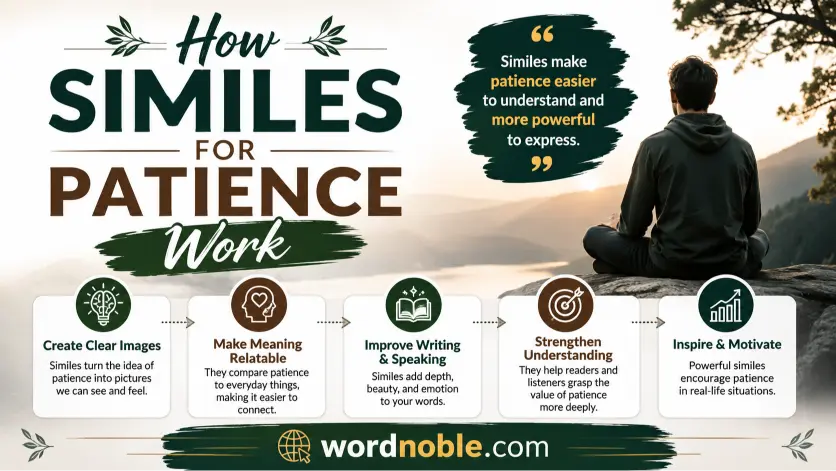
A useful patience simile generally connects three elements:
Patience → familiar image → shared quality
For example:
“He waited as patiently as a gardener watching seeds grow.”
The reader understands the comparison because a gardener must accept that growth takes time.
The strongest similes do more than say someone is patient. They show what that patience feels like.
Why Do Writers Use Similes for Patience?
Writers use these comparisons because abstract qualities become more memorable when connected to concrete images.
Similes can:
- Make descriptions more vivid
- Strengthen emotional expression
- Create visual imagery
- Improve creative writing
- Make poetry more memorable
- Help students explain abstract ideas
- Give characters more personality
- Add rhythm and color to ordinary sentences
- Make an explanation easier to understand
Patience can be peaceful, stubborn, hopeful, disciplined, gentle, or exhausting. A carefully chosen simile can communicate that specific type of patience.
Similes for patience are expressions that compare calm waiting, endurance, or self-control to a familiar person, animal, object, or natural process. They use figurative language to make the abstract quality of patience more vivid and understandable.
Contextual Meaning: How Patience Similes Change by Situation
The same quality can be expressed differently depending on the context.
Storytelling
In fiction, a patience simile can reveal a character’s personality without directly telling readers that the character is patient.
Example:
“He waited like a fisherman watching a motionless lake.”
This suggests quiet, focused patience.
Poetry
Poetry often uses nature-based comparisons because they create emotional and visual imagery.
Example:
“Her patience was like the moon, quietly enduring the darkness.”
The comparison gives patience a peaceful, poetic quality.
Casual Speech
Everyday conversations usually work best with short, familiar comparisons.
Example:
“He’s as patient as a saint.”
The expression is simple and immediately understandable.
Humor
Funny comparisons can exaggerate patience for comic effect.
Example:
“She waited like someone watching a microwave countdown from three seconds.”
The humor comes from recognizing how impatient people normally become during a tiny wait.
Academic Writing
In formal writing, similes should be used carefully and only when they genuinely clarify an idea.
Example:
“The student’s persistence was like that of a researcher repeatedly testing a difficult hypothesis.”
The comparison emphasizes sustained effort rather than merely waiting.
Types of Similes for Patience
🐾 Animal-Based Similes
Animals can represent patience because many naturally wait, observe, hunt, or move slowly.
1. As patient as a turtle
Meaning: Extremely willing to wait without rushing.
2. Like a cat waiting for its prey
Meaning: Calm, alert, and willing to wait for the right moment.
3. As patient as a heron by a pond
Meaning: Quietly waiting without unnecessary movement.
4. Like a spider waiting in its web
Meaning: Remaining still and waiting for an opportunity.
5. As patient as an old dog at the door
Meaning: Waiting loyally and calmly for someone or something.
Animal comparisons work particularly well when you want patience to feel observant, quiet, persistent, or deliberate.
📡 Technology-Based Similes
Technology can provide modern and humorous comparisons.
6. As patient as a loading screen
Meaning: Continuing to wait even when progress seems slow.
7. Like a computer waiting for an update
Meaning: Remaining inactive until the right process is complete.
8. As patient as a timer counting down
Meaning: Calmly allowing time to pass.
9. Like a phone waiting for a signal
Meaning: Remaining ready without rushing the outcome.
These comparisons are especially useful in modern blogs, dialogue, social writing, and humorous content.
🌿 Nature-Based Similes
Nature offers some of the strongest images for patience.
10. As patient as a tree through winter
Meaning: Enduring difficult conditions without giving up.
11. Like a river carving through stone
Meaning: Making progress slowly through persistence.
12. As patient as a seed beneath the soil
Meaning: Waiting quietly for the right conditions to grow.
13. Like a mountain waiting through the seasons
Meaning: Remaining steady while circumstances change.
14. As patient as the moon waiting for night
Meaning: Quietly accepting the natural passage of time.
15. Like clouds waiting for the wind
Meaning: Allowing events to unfold naturally.
Nature-based similes are particularly effective in poetry and descriptive writing because they create strong visual imagery.
😂 Humorous and Exaggerated Similes
Humor allows writers to exaggerate patience.
16. As patient as someone waiting for pizza when they’re starving
Meaning: Waiting despite strong impatience.
17. Like a person watching a one-minute download at 99%
Meaning: Enduring an especially frustrating wait.
18. As patient as a child waiting for Christmas morning
Meaning: Waiting excitedly while trying to remain calm.
19. Like someone waiting for their turn in the world’s longest queue
Meaning: Showing exaggerated endurance.
20. As patient as a person waiting for a slow elevator
Meaning: Staying calm despite an annoying delay.
These work best in casual writing, dialogue, captions, jokes, and conversational storytelling.
🎭 Emotional and Behavioral Similes
These comparisons focus on the inner quality of patience.
21. As patient as a teacher explaining the same lesson again
Meaning: Remaining calm while helping someone understand.
22. Like a parent waiting for a child to finish a story
Meaning: Giving someone time and attention without rushing them.
23. As patient as a craftsman polishing wood
Meaning: Accepting that quality takes time.
24. Like a listener giving someone time to speak
Meaning: Showing patience through attention and restraint.
25. As patient as a gardener tending a young plant
Meaning: Caring for gradual progress.
25 More Similes for Patience
Here are additional comparisons you can adapt for essays, stories, poetry, captions, and everyday descriptions:
- As patient as a mountain in the rain.
- Like a river waiting to reach the sea.
- As patient as a candle burning through the night.
- Like a farmer waiting for harvest.
- As patient as a clock moving one second at a time.
- Like a seed waiting for spring.
- As patient as a fisherman beside still water.
- Like a book waiting to be opened.
- As patient as a sunrise arriving after darkness.
- Like a bridge waiting for travelers.
- As patient as an old oak tree.
- Like snow waiting for the sun.
- As patient as a gardener before the first flower blooms.
- Like a painter allowing each layer to dry.
- As patient as a potter shaping clay.
- Like a student waiting for the answer to become clear.
- As patient as a lighthouse watching the sea.
- Like a road waiting for the next traveler.
- As patient as a bee building its hive.
- Like rain waiting inside a cloud.
- As patient as a craftsman carving stone.
- Like a sailor waiting for favorable winds.
- As patient as a shadow following the sun.
- Like a leaf waiting for autumn.
- As patient as the earth waiting for spring.
15 Best Simile Sentences for Patience
| # | Simile sentence | Meaning | Category |
|---|---|---|---|
| 1 | She was as patient as a tree through winter. | She endured difficulty calmly. | Nature |
| 2 | He waited like a fisherman beside still water. | He waited quietly for the right moment. | Nature |
| 3 | Her patience was like a river carving through stone. | Persistence eventually creates progress. | Nature |
| 4 | He was as patient as a turtle crossing a garden. | He never felt the need to rush. | Animal |
| 5 | She waited like a cat watching its prey. | She remained calm and alert. | Animal |
| 6 | His patience was like a seed beneath the soil. | Progress was happening slowly and quietly. | Nature |
| 7 | She was as patient as a gardener awaiting spring. | She accepted that good results take time. | Nature |
| 8 | He waited like a clock counting down the final minute. | He calmly allowed time to pass. | Object |
| 9 | Her patience was as steady as a mountain. | She remained emotionally stable. | Nature |
| 10 | He waited like a loading screen stuck at ninety-nine percent. | His patience was tested by delay. | Technology |
| 11 | She was as patient as a teacher repeating a difficult lesson. | She remained calm while helping someone. | Behavioral |
| 12 | His patience was like a candle burning through the night. | He endured quietly for a long time. | Nature/Object |
| 13 | She waited like a painter allowing each layer to dry. | She understood that quality requires time. | Creative |
| 14 | He was as patient as an old dog waiting by the door. | He waited faithfully. | Animal |
| 15 | Her patience was like rain gathering in a cloud. | She quietly held back until the right moment. | Nature |
Context Table
| Context | Meaning | Use Case | Example |
|---|---|---|---|
| Storytelling | Quiet endurance | Character description | He waited like a fisherman beside still water. |
| Poetry | Peaceful patience | Emotional imagery | Her patience was like a moonlit river. |
| School writing | Clear explanation | Essays and assignments | Patience is like a seed waiting for spring. |
| Casual speech | Simple patience | Conversation | He’s as patient as a turtle. |
| Humor | Exaggerated waiting | Jokes and dialogue | She waited like a loading screen at 99%. |
| Character development | Self-control | Fiction | He stood as still as a mountain. |
| Descriptive writing | Gradual progress | Creative descriptions | Her patience was like a river shaping stone. |
| Inspirational writing | Persistence | Motivational passages | Stay patient like a seed beneath the soil. |
How to Use Similes for Patience in Writing
A good simile should feel natural rather than inserted simply because you want to use figurative language.
1. Identify the kind of patience
Ask what you are actually describing:
- Calm waiting?
- Emotional self-control?
- Endurance?
- Persistence?
- Hope?
- Tolerance?
- Delayed gratification?
Then choose an image that shares that quality.
2. Choose a familiar comparison
A reader should understand the connection without needing a long explanation.
A gardener, tree, river, mountain, clock, or turtle can usually communicate patience quickly.
3. Match the tone
A poem may need an elegant nature comparison, while a comedy scene might benefit from an exaggerated technology comparison.
4. Avoid explaining too much
Once the simile clearly communicates the idea, let the image do the work.
5. Use sensory language
Think about what the reader can see, hear, feel, or imagine.
Instead of simply writing:
“He was very patient.”
You might write:
“He waited like a fisherman beside a silent lake.”
The second sentence creates a scene.
How Similes Improve Creativity
Similes encourage writers to look beyond direct descriptions.
Instead of asking, “What is patience?”, ask:
“What behaves like patience?”
That question opens creative possibilities.
Patience can resemble:
- A tree because it endures.
- A river because it progresses gradually.
- A seed because it waits for growth.
- A mountain because it remains steady.
- A clock because it never rushes time.
- A gardener because it accepts gradual results.
This technique strengthens descriptive writing, creative writing, poetry, storytelling, and English literature analysis.
When Not to Use a Simile
Similes are useful, but more figurative language does not automatically mean better writing.
Avoid a simile when:
- The comparison is confusing.
- The image has no meaningful connection.
- The sentence is already clear.
- The comparison interrupts the story.
- You are writing highly technical material where precision matters more than imagery.
- Several similes appear in every sentence.
- The comparison sounds forced or cliché.
The goal is not to decorate every sentence. The goal is to make the right sentence more vivid.
Simile vs. Metaphor
A simile makes a comparison explicitly, usually with “like” or “as.”
Simile:
“Her patience was like a quiet river.”
A metaphor makes a direct comparison without “like” or “as.”
Metaphor:
“Her patience was a quiet river.”
Both are forms of figurative language, but their structures are different.
Quick Difference
| Simile | Metaphor |
|---|---|
| Uses an explicit comparison | Makes a direct comparison |
| Often uses “like” or “as” | Usually avoids “like” or “as” |
| “He was patient like a mountain.” | “He was a mountain of patience.” |
| Often feels more explanatory | Often feels more imaginative or forceful |
Common Mistakes
1. Overusing Similes
A paragraph filled with comparisons can become distracting.
Better: Use one memorable comparison where it adds meaning.
2. Choosing an Illogical Comparison
A simile should have a recognizable connection.
If the reader cannot understand why two things are being compared, the sentence becomes confusing.
3. Confusing Similes and Metaphors
Remember:
Simile = comparison using like/as.
Metaphor = direct comparison.
4. Using Clichés Without Purpose
Common expressions can work, but original comparisons often create stronger imagery.
5. Forgetting Context
A humorous patience simile may work beautifully in dialogue but feel inappropriate in a serious academic essay.
👍 Usage Guide: Do and Don’t
Do
- Choose comparisons that genuinely reflect patience.
- Match the simile to your audience.
- Use familiar imagery.
- Experiment with nature and animal comparisons.
- Keep the sentence easy to understand.
- Use similes to reveal emotion or personality.
- Combine figurative language with sensory details.
Don’t
- Add similes to every sentence.
- Force a comparison.
- Mix unrelated images.
- Explain an obvious comparison repeatedly.
- Use complicated vocabulary unnecessarily.
- Confuse a metaphor with a simile.
- Sacrifice clarity just to sound poetic.
Natural Chat-Style Responses
Here are some natural ways to use patience similes in everyday conversation:
1. “Just give her time she’s as patient as a gardener waiting for spring.”
2. “You need patience like a fisherman waiting for the perfect catch.”
3. “He’s as patient as a turtle; nothing seems to make him rush.”
4. “I’ve been waiting like a loading screen stuck at 99%!”
5. “She stayed calm like a mountain even when everything went wrong.”
6. “Good things take time, so be patient like a seed waiting underground.”
Related Terms and Concepts
Understanding patience similes also connects to several broader English-language concepts.
Figurative Language
Language that communicates ideas beyond strictly literal meanings.
Auditory Imagery
Language that helps readers imagine sounds. While not central to patience, it is one form of sensory imagery writers can combine with other descriptive techniques.
Sensory Writing
Writing that appeals to sight, sound, touch, taste, or smell to make descriptions more vivid.
Metaphor vs. Simile
Two closely related forms of figurative comparison that differ mainly in how the comparison is expressed.
Descriptive Writing
Writing that uses precise details and imagery to help readers picture a person, place, object, feeling, or experience.
FAQs:
1. What are similes for patience?
Similes for patience are comparisons that describe calm waiting, endurance, persistence, or self-control through a familiar image. They commonly use “like” or “as” to connect patience with something recognizable. For example, a writer might compare patience with a tree enduring winter or a gardener waiting for a plant to grow. The comparison makes an abstract quality easier to visualize.
2. What is a good simile for patience?
A strong simile for patience is “as patient as a tree through winter.” It works because a tree remains in place while enduring changing conditions over time. Another effective comparison is “like a river carving through stone,” which emphasizes persistence. The best choice depends on whether you want patience to seem peaceful, persistent, enduring, humorous, or emotionally strong.
3. What are some funny similes for patience?
Funny patience similes usually exaggerate how long someone is willing to wait. Examples include “as patient as someone watching a download stuck at 99%” and “like a person waiting for a slow elevator.” These comparisons work because readers recognize the frustration involved. Humor comes from describing ordinary delays as tests of extraordinary patience.
4. What are poetic similes for patience?
Poetic similes often use nature, seasons, light, water, or time. Examples include “her patience was like a river moving toward the sea” and “as patient as a seed beneath the soil.” Such comparisons suggest gradual movement, hope, endurance, or quiet strength. They are especially effective in poems, reflective writing, inspirational passages, and emotional storytelling.
5. What is the difference between a simile and a metaphor?
A simile makes a comparison explicitly, commonly using “like” or “as.” For example, “His patience was like a mountain.” A metaphor makes the comparison directly: “His patience was a mountain.” Both are forms of figurative language and can create imagery, but a simile signals the comparison more clearly while a metaphor presents the two ideas as directly connected.
6. How can I use patience similes in writing?
First, decide what kind of patience you want to communicate: calmness, endurance, persistence, tolerance, or hope. Then choose an image that naturally shares that quality. For example, a gardener represents waiting for gradual growth, while a mountain suggests stability. Place the simile where it strengthens the description rather than adding it merely for decoration.
7. Why are similes important in English literature?
Similes help English literature communicate abstract emotions and qualities through concrete imagery. Patience, fear, love, sadness, courage, and hope can be difficult to describe directly. A carefully chosen comparison gives readers something recognizable to visualize. Similes can also establish tone, reveal character, strengthen descriptions, and make literary passages more memorable.
8. How can students use similes for patience?
Students can use patience similes in essays, creative writing, poetry, short stories, speeches, and descriptive assignments. A simple example is “Patience is like a seed waiting for spring.” Students should explain the connection if the assignment requires analysis. The key is choosing a comparison that clearly communicates the intended meaning instead of using complicated imagery unnecessarily.
9. Can patience similes be used in poetry?
Yes. Patience similes are particularly useful in poetry because they turn an abstract feeling into an image. Nature-based comparisons such as rivers, seeds, trees, mountains, seasons, and stars can create emotional depth. Poets can also use rhythm, repetition, and sensory language around the simile to make the image more powerful and memorable.
10. Are all comparisons about patience similes?
No. A comparison is not automatically a simile. A true simile normally makes the comparison explicit with words such as “like” or “as.” For example, “She waited like a gardener for spring” is a simile. “She was a gardener of patience” functions more like a metaphor. Understanding this difference helps writers use figurative language accurately.
Conclusion:
Similes for patience turn an abstract quality into something readers can picture, feel, and remember. A tree enduring winter can represent calm endurance, a river shaping stone can suggest persistent effort, and a seed beneath the soil can symbolize quiet hope.
The strongest comparisons are not simply decorative they reveal exactly what kind of patience a writer wants to communicate. Whether you are creating poetry, writing a story, completing a school assignment, or making everyday conversation more expressive, choose an image that naturally matches the emotion.
Once you understand how similes connect familiar experiences with abstract ideas, your descriptive writing becomes clearer, richer, and far more memorable.

I am Naqash Ayub, proudly writing for WordNoble, where I focus on creating clear, informative, and SEO-friendly content. I enjoy turning detailed information into simple, trustworthy articles that help readers find the answers they need.