
“She sings like an angel.” “He fights like a lion.” Two words carry all the weight in sentences like these and once you notice “like,” you start seeing it everywhere. That tiny word is the doorway to some of the most vivid comparisons in the English language.
Similes for like aren’t just a grammar topic; they’re a toolkit for writers, students, and anyone who wants their words to paint a clearer picture.
Maybe you’re stuck writing a poem and need fresh imagery. Maybe you’re helping your kid with homework and blanking on examples. Or maybe you’re just curious why this simple structure shows up in songs, speeches, and stories so often.
Whatever brought you here, you’re about to get a practical, easy-to-use collection of similes using “like,” sorted by mood, subject, and everyday use plus tips on crafting your own.
No dry definitions, no filler. Just clear examples you can actually use in your writing today. Let’s start with what makes a simile using “like” work in the first place.
Similes for like are comparisons that use the word “like” to connect one thing with another. They describe a quality, feeling, action, or appearance by showing what it resembles.
Example: Her smile was like sunshine.
What Does “Similes for Like” Mean?
The phrase similes for like usually refers to similes that use like as a comparison word. A simile connects two different things to highlight a shared quality.
For example:
- The baby slept like a log.
- His voice was like thunder.
- The water sparkled like diamonds.
- She moved like a graceful dancer.
In each sentence, the comparison helps the reader imagine the subject more clearly.
A simile does not mean that two things are literally the same. A person is not actually a cheetah, and water is not truly made of diamonds. The comparison simply emphasizes speed, brightness, or another shared quality.
How Does “Like” Work in a Simile?
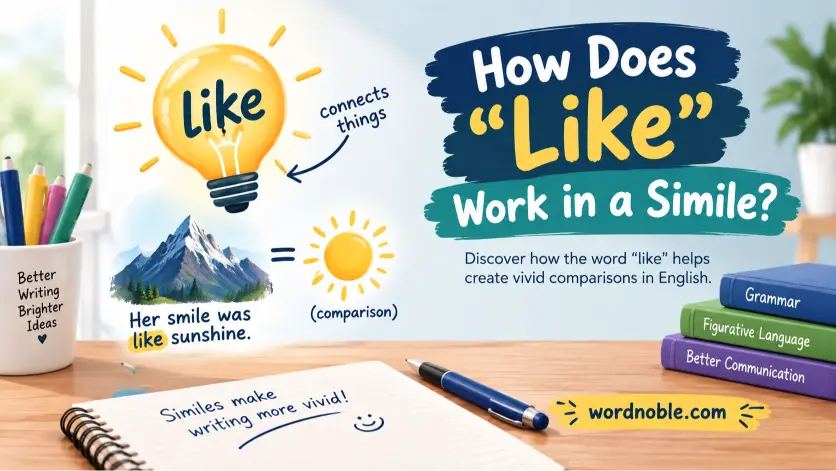
The word like acts as a comparison signal. It introduces an image that makes the original idea easier to understand.
Basic structure:
Subject + verb + like + comparison
Examples:
- The child ran like the wind.
- Her eyes shone like stars.
- The old door creaked like a wounded animal.
The comparison can describe:
- Appearance
- Sound
- Movement
- Emotion
- Texture
- Speed
- Strength
- Behavior
- Atmosphere
This makes similes an important part of figurative language, especially in creative and descriptive writing.
A simile using “like” is a figurative language technique that compares two different things to show a shared quality. The comparison makes an idea more vivid, memorable, or emotionally meaningful without claiming that the two things are literally identical.
Why Do Writers Use Similes?
Writers use similes because a direct description does not always create a strong mental image. A comparison gives the reader something familiar to picture.
1. They Make Descriptions Vivid
Instead of writing:
The room was very dark.
A writer can say:
The room was like a cave at midnight.
The second sentence creates a stronger image of darkness and isolation.
2. They Express Emotions
Feelings can be difficult to explain directly. Similes give emotions a recognizable shape.
Her sadness felt like a heavy stone in her chest.
The reader can imagine the weight and discomfort of the emotion.
3. They Add Sensory Language
Similes help readers experience a scene through sight, sound, touch, taste, and movement.
The soup was as hot as a summer sidewalk.
This comparison creates a physical sense of heat.
4. They Improve Creative Writing
Stories, poems, speeches, and personal essays become more engaging when descriptions contain fresh, meaningful comparisons.
5. They Make Ideas Memorable
A familiar image often stays in the reader’s mind longer than a plain statement.
His words cut like a sharp knife.
The comparison makes the emotional impact easy to understand.
Simile Taxonomy: Types of Similes Using “Like”
Different categories of similes help writers describe different experiences. The best comparison depends on the subject, tone, and context.
🐾 Animal-Based Similes
Animal comparisons are useful because readers already associate animals with particular qualities.
| Simile | Meaning |
|---|---|
| He ran like a cheetah. | He ran extremely fast. |
| She was as quiet as a mouse. | She made very little noise. |
| The child clung to his mother like a koala. | He stayed very close to her. |
| The boxer fought like a lion. | He showed courage and strength. |
| The puppy followed me like a shadow. | It stayed close behind me. |
Animal-based similes work especially well in storytelling, children’s writing, and descriptions of behavior.
📡 Technology-Based Similes
Technology comparisons give modern writing a familiar and sometimes humorous tone.
| Simile | Meaning |
|---|---|
| My brain felt like a computer with too many tabs open. | I felt mentally overwhelmed. |
| The message spread like a viral video. | It spread very quickly. |
| Her memory worked like a search engine. | She could find information easily. |
| The old phone was as slow as a frozen computer. | It responded very slowly. |
| His explanation was like a broken internet connection. | It was unclear and difficult to follow. |
These comparisons are useful in casual speech, blogs, social media, and contemporary creative writing.
🌿 Nature-Based Similes
Nature offers familiar images for beauty, movement, sound, and emotion.
| Simile | Meaning |
|---|---|
| The stars glittered like scattered diamonds. | The stars looked bright and sparkling. |
| The wind moved like a restless dancer. | The wind moved continuously and energetically. |
| Her voice was soft like falling snow. | Her voice was gentle and quiet. |
| The river flowed like a silver ribbon. | The river looked smooth and winding. |
| His anger spread like a wildfire. | His anger grew quickly and intensely. |
Nature-based similes are common in poetry, descriptive essays, and English literature.
😂 Humorous and Exaggerated Similes
Funny similes use unexpected comparisons to create humor. They often exaggerate a situation for effect.
| Simile | Meaning |
|---|---|
| I was as hungry as a bear after a week without food. | I was extremely hungry. |
| He slept like a phone with no battery. | He slept very deeply. |
| My room looked like a tornado had paid a visit. | My room was extremely messy. |
| She talked like a radio that could never be switched off. | She talked continuously. |
| My feet felt like two bricks after the long walk. | My feet felt heavy and tired. |
Humorous similes are especially effective in conversations, personal stories, and informal writing.
🎭 Emotional and Behavioral Similes
These comparisons describe feelings, reactions, and personality traits.
| Simile | Meaning |
|---|---|
| He stood like a statue. | He remained completely still. |
| She smiled like someone who had just won a prize. | She looked extremely happy. |
| His heart raced like a drum in a marching band. | He felt nervous or excited. |
| The child trembled like a leaf in the wind. | The child was very frightened. |
| She held the secret like a locked treasure chest. | She kept the secret carefully. |
These similes help writers show emotions instead of simply naming them.
15 Examples of Similes Using “Like”
The following examples show how like creates comparisons in different contexts.
| # | Simile Sentence | Meaning | Category |
|---|---|---|---|
| 1 | The baby slept like a log. | The baby slept very deeply. | Animal/Object |
| 2 | Her smile was like sunshine after rain. | Her smile brought happiness and comfort. | Nature |
| 3 | He ran like the wind. | He ran very quickly. | Nature |
| 4 | The classroom was as quiet as a library. | The classroom was very quiet. | Place |
| 5 | The news spread like wildfire. | The news spread rapidly. | Nature |
| 6 | His voice sounded like distant thunder. | His voice was deep and powerful. | Nature |
| 7 | She moved like a graceful swan. | She moved smoothly and elegantly. | Animal |
| 8 | My thoughts were like tangled wires. | My thoughts were confused. | Object |
| 9 | The child stared at the cake like a hungry wolf. | The child looked extremely eager to eat it. | Animal |
| 10 | The lake shone like a polished mirror. | The lake was smooth and reflective. | Object |
| 11 | He was shaking like a leaf. | He was very frightened or nervous. | Nature |
| 12 | Her laughter sounded like tiny bells. | Her laughter was light and pleasant. | Sound |
| 13 | The old man moved like a slow-moving turtle. | He moved very slowly. | Animal |
| 14 | The city glowed like a sea of stars. | The city was filled with bright lights. | Nature |
| 15 | My workload felt like a mountain on my shoulders. | My responsibilities felt overwhelming. | Nature |
A Closer Look at Three Examples
The lake shone like a polished mirror.
This simile compares the lake’s reflective surface to a mirror. It creates a clear visual image and suggests that the water is calm.
He was shaking like a leaf.
Leaves tremble in the wind, so this comparison communicates fear, nervousness, or physical weakness.
My thoughts were like tangled wires.
Tangled wires suggest confusion and disorder. The simile makes an invisible mental state easier to picture.
Context Table: When to Use Similes
| Context | Meaning | Use Case | Example |
|---|---|---|---|
| Storytelling | Makes scenes vivid | Describing characters or settings | The forest was dark like a hidden tunnel. |
| Poetry | Creates imagery and emotion | Expressing feelings beautifully | Her voice floated like a morning breeze. |
| Casual Speech | Makes conversation expressive | Everyday descriptions | I’m as tired as a dog after a long walk. |
| Humor | Adds exaggeration | Jokes and funny stories | My desk looks like a hurricane hit it. |
| Academic Writing | Clarifies difficult ideas | Explaining abstract concepts | Memory works like a storage system. |
| Personal Essays | Adds personality | Sharing experiences | The exam felt like a mountain I had to climb. |
| Children’s Writing | Makes ideas easy to imagine | Simple stories and lessons | The rabbit jumped like a spring. |
How to Use Similes Naturally in Writing
A good simile should clarify an idea, not distract from it. Follow these steps to make your comparisons stronger.
1. Identify the Quality You Want to Show
Ask yourself what you are describing:
- Is it fast?
- Quiet?
- Bright?
- Heavy?
- Frightening?
- Beautiful?
- Confusing?
For example, if you want to describe a loud sound, focus on comparisons connected to loudness.
2. Choose a Familiar Image
Readers understand comparisons more quickly when the image is recognizable.
Clear: His voice was like thunder.
Less clear: His voice was like a mysterious machine from another universe.
The second comparison may work in science fiction, but it is less direct.
3. Make Sure the Comparison Fits
A simile should share a meaningful quality with the subject.
Logical: The ice was cold like winter air.
Illogical: The ice was cold like a bright yellow pencil.
The second sentence does not create a useful connection.
4. Use Specific Images
Specific comparisons are often stronger than vague ones.
Weak: The garden was beautiful like something nice.
Stronger: The garden was colorful like a painter’s palette.
5. Match the Tone
A poetic simile may suit a poem, while a funny comparison may suit a casual conversation.
Formal: The process works like a carefully organized system.
Casual: My brain feels like a laptop with twenty tabs open.
6. Avoid Explaining Too Much
A strong simile often communicates its meaning immediately. Let the image do the work.
Overexplained: The moon was like a silver coin, meaning it was round, bright, shiny, and visible in the night sky.
Better: The moon hung like a silver coin in the dark sky.
Simile vs. Metaphor
Both similes and metaphors compare different things, but they use different structures.
| Feature | Simile | Metaphor |
|---|---|---|
| Comparison word | Uses like or as | Usually does not use like or as |
| Style | Makes an explicit comparison | Makes a direct comparison |
| Example | Her eyes were like stars. | Her eyes were stars. |
| Meaning | Her eyes were bright or beautiful. | Her eyes are described as stars for effect. |
Simple Rule
If the sentence uses like or as to compare two things, it is usually a simile.
If it directly says one thing is another, it is usually a metaphor.
Simile: The classroom was like a zoo.
Metaphor: The classroom was a zoo.
Both sentences suggest noise or disorder, but the structures are different.
When Not to Use Similes
Similes are useful, but they are not necessary in every sentence.
Avoid using them when:
- The meaning is already perfectly clear.
- The comparison feels forced.
- The subject requires precise technical language.
- The simile distracts from the main idea.
- Too many comparisons make the writing difficult to follow.
- The comparison is confusing or culturally unfamiliar.
- A direct statement is more effective.
Direct: The instructions were unclear.
Unnecessary simile: The instructions were like a foggy road covered in invisible clouds.
The second sentence adds complexity without improving meaning.
Common Mistakes with Similes
1. Overusing Comparisons
Too many similes can make writing feel crowded.
Problem:
The sun was like gold, the sky was like silk, the clouds were like cotton, and the birds were like music.
Better:
The sun shone like gold, while soft clouds drifted across the sky.
2. Using Illogical Comparisons
The two things should share a recognizable quality.
Weak: She was brave like a glass of water.
Better: She was brave like a lion.
3. Confusing Similes with Metaphors
A simile usually uses like or as. A metaphor makes a direct comparison.
4. Choosing Clichés Too Often
Common similes are easy to understand, but original comparisons can make writing more memorable.
Common: He ran like the wind.
More original: He raced down the street like a spark escaping a fire.
5. Forgetting the Intended Meaning
A comparison should support the message. A beautiful image is not always the right image.
Usage Guide: Do and Don’t
DO
- Use similes to clarify an idea.
- Choose comparisons readers can understand.
- Match the simile to the tone.
- Use sensory details.
- Create fresh comparisons when appropriate.
- Keep the sentence natural.
- Make sure the comparison has a clear purpose.
DON’T
- Add a simile to every sentence.
- Use unrelated images.
- Mix several comparisons awkwardly.
- Explain an obvious simile too much.
- Use complicated words just to sound creative.
- Choose a comparison that changes the intended meaning.
- Let figurative language hide the main point.
Natural Chat Responses Using Similes
Here are some everyday ways to use similes naturally in conversation.
1. Talking About Tiredness
I’m tired like a phone that’s down to one percent battery.
2. Describing Hunger
I’m as hungry as a bear after a long hike.
3. Talking About Confusion
My brain feels like a browser with too many tabs open.
4. Describing Excitement
I’m bouncing around like a kid on a trampoline.
5. Talking About Weather
It’s hot like an oven outside today.
6. Describing Someone’s Silence
He sat there like a statue and said nothing.
These examples sound natural because they connect everyday feelings with familiar images.
How Students Can Use Similes
Students can use similes in many types of schoolwork:
- Creative writing
- Poetry
- Personal narratives
- Descriptive paragraphs
- Character descriptions
- Story openings
- Literature analysis
- Speeches
- Journal entries
- Classroom presentations
For example:
The examination hall was quiet like a sleeping village.
This sentence uses a simile to create an atmosphere of silence.
Students should focus on choosing a comparison that supports the topic rather than adding figurative language simply to make a sentence longer.
Similes in English Literature
Similes are an important literary device because they help writers communicate ideas through imagery. In English literature, authors use them to describe characters, settings, emotions, and abstract concepts.
A simile can:
- Reveal a character’s personality.
- Create a mood.
- Make a setting memorable.
- Express love, fear, anger, or sadness.
- Strengthen a poem’s rhythm and imagery.
- Help readers connect with unfamiliar experiences.
For example, comparing a character’s voice to thunder may suggest power, anger, or authority. Comparing a voice to a gentle breeze may suggest calmness or kindness.
The meaning depends on the context, so readers should consider both the comparison and the surrounding text.
Related Terms and Semantic Concepts
Understanding these related concepts can help you use similes more effectively.
Figurative Language
Language that communicates meaning beyond a strictly literal interpretation. Similes, metaphors, personification, and hyperbole are common examples.
Auditory Imagery
Descriptive language that helps readers imagine sounds. A simile such as “her voice was like soft bells” creates auditory imagery.
Sensory Writing
Writing that appeals to the five senses: sight, hearing, touch, taste, and smell.
Metaphor vs. Simile
Both compare ideas, but similes use comparison words such as like or as, while metaphors make direct comparisons.
Descriptive Writing
Writing that helps readers visualize a person, place, object, or experience through precise details and imagery.
English Literature Devices
Techniques such as simile, metaphor, symbolism, personification, alliteration, and imagery help writers create meaning and emotional impact.
FAQs:
1. What are similes for like?
Similes for like are comparisons that use the word like to connect two different things. They show a shared quality, such as speed, beauty, sound, or emotion. For example, “She ran like the wind” compares her speed with the movement of wind. The comparison is not literal; it helps readers imagine how quickly she ran.
2. What is an easy example of a simile using like?
An easy example is: The baby slept like a log. This means the baby slept very deeply and peacefully. The sentence compares the baby’s sleep with a log, which does not move. Other simple examples include “He ran like the wind” and “Her smile was like sunshine.”
3. What are some funny similes using like?
Funny similes often use exaggerated or unexpected comparisons. Examples include “My room looks like a tornado visited it,” “My brain feels like a computer with too many tabs open,” and “He talks like a radio that cannot be switched off.” These comparisons create humor by connecting ordinary situations with amusing images.
4. What are poetic similes using like?
Poetic similes use beautiful or imaginative comparisons to create emotion and imagery. Examples include “The moon floated like a silver boat,” “Her voice drifted like a morning breeze,” and “The stars shimmered like scattered diamonds.” Poetic similes are especially useful when writers want readers to picture a scene or feel a particular mood.
5. What is the difference between a simile and a metaphor?
A simile makes a comparison using words such as like or as. A metaphor makes a direct comparison without those words. For example, “His voice was like thunder” is a simile, while “His voice was thunder” is a metaphor. Both sentences suggest that his voice was loud or powerful.
6. How do I use similes in writing?
First, identify the quality you want to describe. Then choose a familiar image that shares that quality. Connect the two using like or as. For example, if you want to describe nervousness, you might write, “Her hands shook like leaves in the wind.” Make sure the comparison fits the tone and does not feel forced.
7. Why are similes important in English literature?
Similes help literary writers create vivid imagery, express emotions, and make descriptions memorable. They allow readers to connect unfamiliar experiences with familiar images. A simile can also reveal a character’s personality or create a particular mood. Because of this, similes are widely used in poetry, novels, short stories, and descriptive passages.
8. How can students use similes in school assignments?
Students can use similes in creative writing, poems, descriptive paragraphs, personal narratives, and literature analysis. A well-chosen comparison can make a sentence more vivid and help explain a character’s feelings or a setting’s atmosphere. Students should use similes naturally and choose comparisons that clearly support the topic.
9. Can a simile use “as” instead of “like”?
Yes. Similes commonly use both like and as. For example, “Her face was as bright as the morning sun” is a simile. However, not every sentence containing “as” is a simile. The words must create a comparison between two things rather than simply connect clauses or describe an action.
10. How can I create original similes?
Start by identifying the exact quality you want to describe. Then brainstorm objects, animals, sounds, or natural events that share that quality. Instead of choosing the first familiar comparison, look for a more specific image. For example, rather than “He was nervous like a leaf,” you could write, “He was nervous like a bird trapped inside a room.”
Conclusion:
Similes for like make ordinary descriptions more vivid by connecting one thing with another through a familiar image.
They can describe movement, appearance, sound, emotions, and everyday experiences. Whether you are writing a poem, completing a school assignment, creating a story, or chatting with friends, a well-chosen simile helps readers understand your meaning more clearly.
The key is to choose a comparison that fits the subject and adds value. Use similes thoughtfully, avoid forced comparisons, and focus on images that make your writing easier to picture, feel, and remember.

I am Naqash Ayub, proudly writing for WordNoble, where I focus on creating clear, informative, and SEO-friendly content. I enjoy turning detailed information into simple, trustworthy articles that help readers find the answers they need.