
Feeling confused and can’t find the right words to describe it? Similes make that feeling easier to picture. Saying you felt “like a tourist reading a map upside down” tells a reader far more than “I was confused.”
This guide gives you a practical list of similes for confused, sorted by mood and situation, so you can pick one that fits your writing, conversation, or story.
You’ll see everyday comparisons for mild puzzlement, sharper images for total bewilderment, and a few playful options for lighter moments.
Each one comes with a short example so you can see how it reads in a real sentence. Along the way, we’ll also cover how to avoid tired phrases that readers have seen a hundred times.
By the end, you’ll know how to choose a comparison that feels fresh and matches exactly how confused your character, or you, really are. Let’s start with the simplest comparisons and build up from there.
Similes for confused are comparisons that use words such as like or as to describe a person who feels uncertain, lost, puzzled, or unable to understand something clearly.
What Do Similes for Confused Mean?
Similes for confused are a form of figurative language used to make confusion easier to visualize. Instead of simply saying someone is confused, a writer compares that mental state to a recognizable situation, object, animal, or natural event.
For example, saying someone is like a compass spinning without direction suggests that the person cannot determine which choice or direction is correct.
The comparison gives readers more than a definition. It creates an image.
Confusion can involve several related feelings:
- Uncertainty about what to do
- Difficulty understanding information
- Feeling mentally lost
- Indecision between choices
- Lack of awareness
- Overwhelming thoughts
- Forgetfulness
- Disorientation
- Mixed emotions
A good simile identifies one of these qualities and connects it to something readers already understand.
Why Writers Use Similes for Confused
Writers use these comparisons to make abstract emotions visible and memorable. Confusion is an internal experience, so it can be difficult to describe directly.
A simile provides a bridge between the reader’s imagination and the character’s mental state.
It can also add:
- Sensory language that creates a vivid mental picture
- Emotional depth that reveals how strongly someone feels
- Characterization that shows how a person reacts under pressure
- Humor when confusion is exaggerated
- Poetic imagery in poems, stories, and reflective writing
- Clarity when explaining difficult emotional states
Similes for confused are figurative expressions that compare a state of uncertainty or mental disorientation to a familiar person, object, animal, place, or situation. They help readers visualize confusion by connecting an abstract mental experience with something concrete and recognizable.
How Similes for Confused Work
The basic structure is simple:
Person or situation + like/as + comparison
The comparison should share a meaningful quality with confusion.
For example:
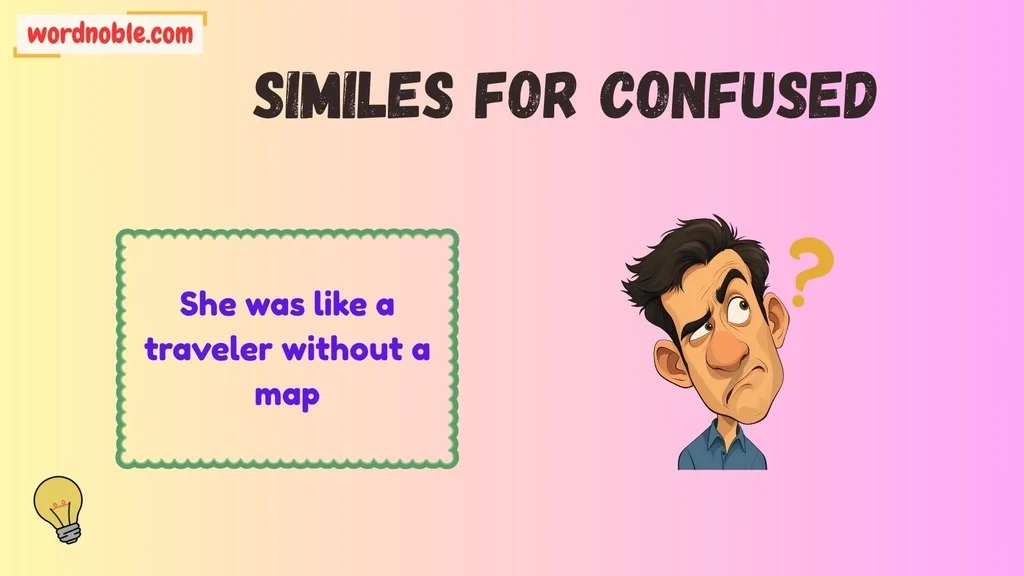
She was like a traveler without a map.
The traveler is not literally confused in every possible sense. The comparison focuses on the lack of direction.
This is an important principle in creative writing: the comparison does not need to be identical to the original subject. It only needs to share the quality you want to emphasize.
A confused student might be compared to a tangled knot because their thoughts seem difficult to separate. A confused character might be compared to a spinning compass because they cannot determine which direction to take.
Contextual Meaning of Similes for Confused
Storytelling
In fiction, similes can reveal a character’s internal thoughts without lengthy explanation.
Instead of repeatedly writing that a character does not understand what is happening, an author can create a memorable comparison.
This improves characterization and keeps the prose engaging.
Poetry
Poetry often depends on imagery, emotion, rhythm, and unusual associations. Similes for confused can turn uncertainty into a visual or sensory experience.
A poet might compare confusion to fog, a maze, shifting shadows, or a stormy sky.
Casual Speech
People naturally use comparisons when explaining how they feel.
Someone might say they feel like they are trying to solve a puzzle with missing pieces. This makes ordinary conversation more expressive without sounding overly formal.
Humor
Confusion can become funny when the comparison is deliberately exaggerated.
A character who looks at a complicated instruction manual and feels like a penguin trying to solve a mathematics exam creates a playful image.
Academic Writing
Academic writing generally requires controlled use of figurative language. A carefully chosen simile can help explain an abstract idea, particularly in literature, psychology, education, or communication.
However, formal writing should prioritize precision. A colorful comparison should clarify the idea rather than distract from it.
Types of Similes for Confused
Animal-Based Similes
Animals provide familiar behavior that can represent uncertainty or disorientation.
Examples
- As confused as a squirrel in a maze
Shows frantic uncertainty and inability to find a way forward. - Like a lost puppy in a crowded market
Suggests someone who feels overwhelmed and does not know where to go. - As puzzled as an owl in bright daylight
Creates a humorous image of someone struggling to understand an unfamiliar situation. - Like a bird flying without knowing where its nest is
Suggests uncertainty about direction or destination.
Animal-based comparisons work especially well in children’s stories, humorous writing, and informal descriptions.
Technology-Based Similes
Modern technology offers excellent comparisons for mental confusion.
Examples
- Like a computer with too many windows open
Describes a mind overloaded with information. - As confused as a GPS with no signal
Suggests a complete lack of direction. - Like a phone searching endlessly for a network
Represents someone trying to find an answer but receiving no clear result. - As puzzled as a computer processing an impossible command
Suggests difficulty understanding something that does not make sense.
Technology-based similes are useful in contemporary writing because they connect an old human emotion with familiar modern experiences.
Nature-Based Similes
Nature creates powerful imagery for confusion because fog, storms, changing winds, and darkness naturally suggest uncertainty.
Examples
- Like a traveler walking through thick fog
Suggests an inability to see the correct path. - As confused as leaves swirling in the wind
Shows thoughts moving unpredictably in different directions. - Like a ship drifting through a storm
Suggests emotional or mental instability. - As uncertain as a cloud changing shape
Describes a constantly changing state of mind.
Nature-based similes are particularly effective in poetry and descriptive writing.
Humorous and Exaggerated Similes
Humor makes confusion memorable by pushing the comparison beyond ordinary reality.
Examples
- As confused as a cat at a dog show
Creates an amusing image of someone who clearly does not belong in the situation. - Like a chef trying to read a recipe upside down
Suggests unnecessary difficulty and frustration. - As puzzled as a tourist reading a map backward
Describes someone attempting to find an answer while using the wrong approach. - Like a penguin trying to understand a traffic light
Creates an intentionally absurd image of total bewilderment.
Funny similes work best when the goal is entertainment rather than seriousness.
Emotional and Behavioral Similes
These comparisons focus on the psychological side of confusion.
Examples
- Like a person standing between two open doors
Suggests indecision between choices. - As tangled as a mind full of unanswered questions
Emphasizes mental complexity. - Like a puzzle missing its final pieces
Suggests partial understanding. - As uncertain as someone hearing two different directions
Highlights conflicting information.
These are useful when writing about characters, relationships, decisions, anxiety, or difficult situations.
15 Examples of Similes for Confused
| Simile Sentence | Meaning | Category |
|---|---|---|
| He was as confused as a traveler without a map. | He had no idea where to go or what to do. | Nature/Travel |
| She looked like a computer with too many windows open. | Her mind was overloaded with information. | Technology |
| I felt like a puzzle missing half its pieces. | I could not understand the complete situation. | Object |
| He was as confused as a squirrel in a maze. | He was moving around without knowing the right direction. | Animal |
| Her thoughts were like leaves spinning in the wind. | Her thoughts were scattered and difficult to control. | Nature |
| I was like a GPS with no signal. | I had no clear sense of direction. | Technology |
| He looked as puzzled as a cat at a dog show. | He seemed completely out of place. | Humorous |
| She was like someone reading a map upside down. | She was trying to understand something but approaching it incorrectly. | Humorous |
| His mind was as tangled as a ball of yarn. | His thoughts were complicated and difficult to organize. | Object |
| I felt like a ship drifting without a compass. | I had no clear direction or decision. | Nature |
| She was as confused as a student facing a test in an unknown language. | She could not understand what was expected. | Educational |
| He looked like a detective with all the clues missing. | He wanted an answer but lacked enough information. | Character |
| My thoughts were like clouds racing across the sky. | My ideas were changing rapidly and lacked focus. | Nature |
| She stood there like a traveler at a crossroads. | She could not decide which path to choose. | Travel |
| He was as puzzled as someone solving a puzzle with no picture. | He had little guidance for understanding the problem. | Object |
Similes for Confused in Different Situations
| Context | Meaning | Use Case | Example |
|---|---|---|---|
| Storytelling | Mental uncertainty | Character development | He was like a traveler without a map. |
| Poetry | Emotional disorientation | Imagery | My thoughts drifted like leaves in the wind. |
| Casual speech | Everyday uncertainty | Conversation | I felt like a GPS with no signal. |
| Humor | Playful confusion | Comedy | He was as confused as a cat at a dog show. |
| Academic writing | Difficulty understanding | Explanation | The concept felt like a puzzle missing several pieces. |
| School writing | Lack of understanding | Essays | She was like a student facing an unfamiliar test. |
| Drama | Emotional conflict | Character dialogue | I feel like I’m standing between two doors. |
| Creative nonfiction | Personal uncertainty | Reflection | My mind was like a compass spinning in circles. |
How to Use Similes for Confused in Writing
1. Identify the Type of Confusion
First determine what kind of confusion you want to communicate.
Is the character:
- Lost?
- Overwhelmed?
- Unsure?
- Distracted?
- Forgetful?
- Indecisive?
- Shocked?
- Unable to understand information?
The answer determines the strongest comparison.
2. Choose a Familiar Image
Pick something your audience can immediately visualize.
A maze, missing puzzle pieces, fog, a broken compass, or an overloaded computer can all communicate uncertainty quickly.
3. Match the Emotional Intensity
A mild misunderstanding needs a different simile from complete mental chaos.
For mild confusion:
She looked like someone searching for a misplaced key.
For intense confusion:
His thoughts were like a storm tearing across the ocean.
4. Avoid Forced Comparisons
The comparison should have a logical connection to confusion.
Do not choose an object simply because it sounds unusual. Creativity works best when the reader can understand the connection.
5. Use Sensory Language
Strong descriptive writing often involves sight, sound, movement, texture, or atmosphere.
Fog gives visual imagery. A spinning compass gives movement. A tangled knot gives tactile imagery.
This turns an abstract emotion into something readers can almost experience.
Simile vs Metaphor: What Is the Difference?
A simile directly compares two things using words such as like or as.
His thoughts were like a tangled knot.
A metaphor makes the comparison directly without using like or as.
His thoughts were a tangled knot.
Both are forms of figurative language, but the grammatical structure differs.
Simile
She was like a traveler without a map.
Metaphor
She was a traveler without a map.
The simile makes the comparison explicit, while the metaphor presents the comparison more directly.
Common Mistakes When Writing Similes for Confused
Overusing Similes
A paragraph filled with comparisons can become distracting.
One strong simile is often more effective than five weak ones.
Using Illogical Comparisons
The connection should make sense.
If the reader cannot understand why two things are being compared, the simile becomes confusing rather than clarifying.
Making Every Simile Dramatic
Not every moment of uncertainty requires a storm, disaster, or catastrophe.
Match the strength of the image to the situation.
Confusing Similes With Metaphors
Remember:
Like/as = usually a simile
Direct comparison = metaphor
Using Clichés Too Often
Common expressions can be useful, but original comparisons often create stronger imagery.
Instead of always writing about being lost in a maze, consider a more specific image that fits your character or situation.
Do and Don’t: Simile Usage Guide
Do
- Choose comparisons that clarify confusion.
- Match the simile to the emotional situation.
- Use familiar images.
- Experiment with nature and technology.
- Consider your audience.
- Use sensory details.
- Keep comparisons concise.
- Make creative writing sound natural.
Don’t
- Add a simile to every sentence.
- Choose a comparison that has no clear connection.
- Mix several unrelated images together.
- Use overly complicated language.
- Explain an obvious comparison for too long.
- Force figurative language into formal writing.
- Sacrifice clarity just to sound creative.
Natural Chat Responses Using Similes for Confused
Real conversations often use simple comparisons rather than elaborate literary language.
Here are natural examples:
- Honestly, I’m like a GPS with no signal right now.
- I’m as confused as a tourist trying to read a map backward.
- My brain feels like a computer with fifty tabs open.
- I’m standing here like I just walked into the wrong classroom.
- I feel like I’m trying to solve a puzzle with half the pieces missing.
- My thoughts are all over the place, like leaves blowing in the wind.
These expressions sound natural because they communicate confusion quickly without requiring a long explanation.
Why Similes for Confused Matter in English Literature
Similes are important in English literature because they transform abstract ideas into concrete images.
Confusion is especially suitable for figurative language because readers cannot physically see another person’s thoughts. A writer therefore needs language that can represent an internal experience.
A carefully selected comparison can reveal:
- A character’s emotional condition
- Their level of uncertainty
- Their response to a difficult situation
- Their personality
- The atmosphere of a scene
- The intensity of a conflict
Similes also connect with broader literary concepts such as imagery, characterization, symbolism, sensory language, descriptive writing, and figurative expression.
When used effectively, a simile does more than decorate a sentence. It gives the reader a way to experience an idea.
Related Terms and Semantic Concepts
Understanding similes for confused also connects to several related language concepts:
- Figurative language
- Simile
- Metaphor
- Sensory language
- Descriptive writing
- Visual imagery
- Auditory imagery
- Emotional imagery
- Creative writing techniques
- English literature devices
- Characterization
- Symbolism
- Personification
- Analogy
- Descriptive language
Auditory imagery can also be used when confusion involves hearing conflicting instructions, unclear voices, or too much information at once. Similarly, visual imagery can represent confusion through fog, tangled paths, shadows, or scattered objects.
FAQs:
What are similes for confused?
Similes for confused are comparisons that describe uncertainty, puzzlement, or mental disorientation by connecting those feelings to familiar things. They usually use like or as. For example, someone may be described as being like a traveler without a map. The comparison helps readers visualize the person’s uncertainty instead of simply being told that the person is confused.
What are some examples of similes for confused?
Examples include like a GPS with no signal, as confused as a traveler without a map, like a puzzle missing its pieces, and as tangled as a ball of yarn. Each comparison emphasizes a slightly different type of confusion. A GPS suggests lack of direction, while missing puzzle pieces suggest incomplete understanding.
What are some funny similes for confused?
Funny similes exaggerate confusion to create humor. Examples include as confused as a cat at a dog show, like a penguin trying to understand a traffic light, and like someone reading a map upside down. These comparisons work because the situations are unusual and easy to imagine. They are especially useful in casual conversation, comedy, children’s writing, and humorous storytelling.
What are poetic similes for confused?
Poetic similes often use nature and atmospheric imagery. Confusion can be compared to fog covering an unfamiliar road, leaves spinning in the wind, or a ship drifting without a compass. These comparisons create emotional and visual depth. Poets can use them to communicate uncertainty without directly naming the feeling, allowing readers to interpret and experience the emotion.
What is the difference between a simile and a metaphor for confused?
A simile uses an explicit comparison, usually with like or as. For example, His mind was like a maze is a simile. A metaphor removes the comparison word and makes the statement directly: His mind was a maze. Both expressions communicate confusion, but the simile clearly signals that one thing is being compared with another.
How can I use similes for confused in writing?
First identify the exact type of confusion you want to describe. Then choose a familiar image that shares that quality. For example, use a maze for being lost, missing puzzle pieces for incomplete understanding, or a spinning compass for uncertainty about direction. Keep the comparison relevant and avoid using too many similes in the same paragraph.
Why are similes important in English literature?
Similes help writers turn abstract feelings and ideas into concrete images. Confusion is difficult to see directly because it happens inside the mind. A comparison gives readers something recognizable to visualize. In English literature, similes contribute to imagery, characterization, tone, atmosphere, and emotional expression, making descriptions more memorable and helping readers connect with characters.
How can students use similes for confused?
Students can use them in creative writing, descriptive paragraphs, poetry, narratives, and literature assignments. A strong simile can make an ordinary sentence more vivid. Instead of writing The character was confused, a student might write The character was like a traveler without a map. The key is to make the comparison clear, relevant, and appropriate for the assignment.
Can similes for confused be used in poetry?
Yes. Poetry often benefits from comparisons because similes create imagery and emotional resonance. A poet can compare confusion to fog, a storm, a shifting shadow, or a path with no signs. These images allow readers to interpret the emotion rather than receiving only a direct statement. Poetic similes can therefore make uncertainty feel visual, atmospheric, and personal.
Can similes for confused be used in everyday conversation?
Absolutely. Everyday speakers often use comparisons to explain feelings quickly. Saying I’m like a GPS with no signal can communicate uncertainty more vividly than simply saying I’m confused. Casual similes are especially effective when they are short, familiar, and slightly humorous. The best conversational comparison should sound natural rather than like formal literary writing.
Conclusion:
Similes for confused make an abstract mental state easier to see, understand, and remember. By comparing uncertainty to a maze, missing puzzle pieces, thick fog, a spinning compass, or an overloaded computer, writers can turn a simple emotion into vivid imagery.
The strongest similes are not merely decorative; they communicate a specific kind of confusion and fit the situation naturally. Whether you are writing a poem, story, school assignment, dialogue, or casual message, choose a comparison that your reader can immediately understand.
Use figurative language with purpose, keep your images relevant, and avoid overloading your writing. When used thoughtfully, a single strong simile can make confusion feel remarkably clear.

I am Naqash Ayub, proudly writing for WordNoble, where I focus on creating clear, informative, and SEO-friendly content. I enjoy turning detailed information into simple, trustworthy articles that help readers find the answers they need.