Picture a blank page, a half-finished painting, or a pitch that needs one more spark creative work often demands words that feel as alive as the ideas behind them.
That’s where similes for creative come in, turning flat descriptions into something a reader can actually picture. Whether you’re writing a poem, polishing a resume, or trying to capture someone’s artistic spirit in a story, the right comparison can do more work than three plain sentences combined.
Think about it: calling someone “creative” is accurate but forgettable. Saying their mind works “like a kaleidoscope, twisting ordinary pieces into something new” sticks. That’s the power of a well-chosen simile it doesn’t just describe, it shows.
This article pulls together a wide range of imaginative, original phrases you can use to describe creative people, creative ideas, and creative energy, along with inventive expressions and descriptive comparisons that add color to everyday writing. You’ll find options for casual writing, formal pieces, and everything in between.
Ready to find the perfect phrase? Let’s start with similes that capture the spark of a truly creative mind.
Similes for creative are imaginative comparisons that describe something by showing how it is similar to another person, object, animal, place, or experience, usually with like or as.
What Do Similes for Creative Mean?
A creative simile compares two different things in a way that makes a description more vivid or interesting.
For example:
Her imagination was like a colorful fireworks display.
The sentence does not mean that imagination is literally fireworks. Instead, the comparison suggests that her imagination is bright, energetic, varied, and full of unexpected ideas.
Creative similes are a form of figurative language. They allow writers to communicate more than a literal description can provide. Rather than simply saying that someone is imaginative, a writer can create an image that helps readers experience that quality.
This makes similes particularly useful in:
- Creative writing
- Poetry
- Stories
- Personal essays
- Speeches
- Descriptive writing
- Fiction
- School assignments
- Everyday conversation
A simile for creative writing is a figurative comparison that connects a subject with another familiar or imaginative thing to communicate a quality, feeling, appearance, action, or idea more vividly. Creative similes commonly use like or as and help readers visualize abstract concepts through concrete comparisons.
How Do Similes Make Writing More Creative?
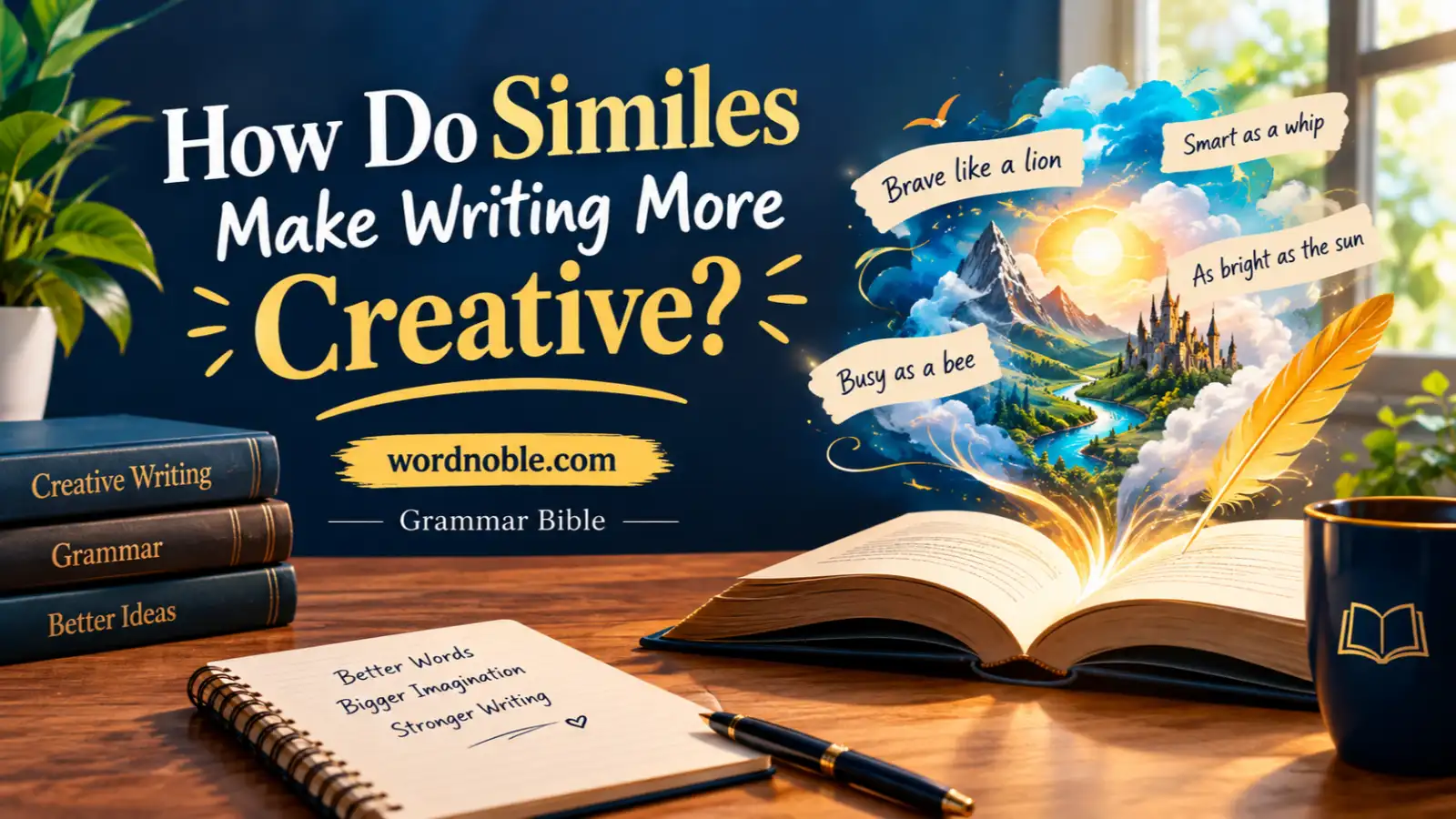
A basic sentence gives information:
The writer had many ideas.
A simile can transform it:
The writer’s ideas flowed like a rushing river.
The second sentence gives readers something to imagine. They can picture movement, energy, abundance, and continuous flow.
This is why similes are powerful creative writing techniques. They combine meaning with imagery.
A strong simile can communicate:
- Appearance
- Emotion
- Personality
- Movement
- Sound
- Energy
- Intelligence
- Imagination
- Mood
- Atmosphere
Similes can also use sensory language. A comparison may help readers visualize something, hear it, feel it, or even imagine its movement.
Why Do Writers Use Creative Similes?
Writers use creative similes because comparisons can make ordinary ideas more memorable.
1. They create vivid imagery
Instead of telling readers that something is beautiful, energetic, strange, or exciting, a simile gives them an image.
2. They explain abstract ideas
Ideas such as creativity, freedom, fear, hope, and imagination can be difficult to describe literally. A comparison gives these abstract concepts a recognizable shape.
3. They make descriptions memorable
A surprising comparison can stay in a reader’s mind longer than a plain statement.
4. They add emotion
A carefully chosen simile can make a sentence feel joyful, mysterious, dramatic, peaceful, or humorous.
5. They strengthen storytelling
Similes help readers visualize characters, settings, actions, and experiences instead of simply receiving information.
Types of Similes for Creative Writing
Creative similes can be organized into different categories depending on the comparison being made.
Animal-Based Creative Similes
Animals provide familiar characteristics that writers can use to describe people and behavior.
- Her imagination was like a butterfly, constantly moving from one idea to another.
Meaning: Her thoughts were colorful, active, and unpredictable. - His creativity was as wild as a fox in the forest.
Meaning: His ideas were clever, unconventional, and difficult to predict. - The young artist worked like a busy bee.
Meaning: The artist was energetic and hardworking.
Animal comparisons work well because readers already associate animals with recognizable traits such as speed, cleverness, freedom, strength, or curiosity.
Technology-Based Creative Similes
Modern technology offers unusual comparisons for contemporary writing.
- Her ideas spread like messages across a social network.
Meaning: Her ideas moved quickly between people. - His imagination worked like a powerful search engine.
Meaning: He could quickly find or generate many ideas. - The concept grew like an app gaining thousands of users.
Meaning: The concept developed rapidly and attracted attention.
Technology-based similes can make writing feel modern, especially in articles, advertisements, social media content, and contemporary fiction.
Nature-Based Creative Similes
Nature provides some of the richest material for figurative language.
- Her creativity bloomed like a flower after spring rain.
Meaning: Her creative ability developed beautifully after receiving encouragement or inspiration. - His ideas flowed like a river through the valley.
Meaning: His ideas came continuously and naturally. - The artist’s imagination was as vast as the ocean.
Meaning: The artist had an enormous range of ideas.
Nature-based comparisons are especially effective in poetry and descriptive writing because they create strong visual imagery.
Humorous and Exaggerated Similes
Not every simile needs to sound serious. Humor can make comparisons memorable.
- His creative ideas appeared like popcorn in a hot pan.
Meaning: Ideas seemed to appear rapidly. - Her imagination was as busy as a squirrel hiding snacks everywhere.
Meaning: Her mind was constantly occupied with different thoughts. - My notebook looked like a tornado had a meeting inside it.
Meaning: The notebook was extremely messy and full of scattered ideas.
Exaggerated similes work particularly well in casual writing, comedy, dialogue, and social media content.
Emotional and Behavioral Similes
Some similes describe how people think, feel, or behave.
- Her creativity was like a candle glowing in the darkness.
Meaning: Her ideas provided inspiration when things seemed difficult. - His imagination was as restless as a bird searching for an open sky.
Meaning: His mind constantly searched for new possibilities. - The idea appeared like a spark in a quiet room.
Meaning: A sudden thought created excitement or inspiration.
These comparisons are useful when writing about personality, motivation, imagination, or emotional experiences.
15 Creative Simile Examples With Meanings
| # | Simile Sentence | Meaning | Category |
|---|---|---|---|
| 1 | Her imagination was like a colorful fireworks display. | Her ideas were vivid and varied. | Nature |
| 2 | His creativity flowed like a river. | He produced ideas continuously. | Nature |
| 3 | Her ideas were like butterflies in a garden. | Her thoughts were beautiful and constantly moving. | Nature |
| 4 | His imagination was as vast as the ocean. | He had countless creative possibilities. | Nature |
| 5 | The artist worked like a busy bee. | The artist was energetic and productive. | Animal |
| 6 | Her mind moved like a lightning storm. | She generated ideas very quickly. | Nature |
| 7 | His ideas multiplied like rabbits. | His number of ideas increased rapidly. | Animal |
| 8 | Creativity entered the room like a burst of sunlight. | New ideas immediately created energy and optimism. | Nature |
| 9 | Her notebook was like a treasure chest of ideas. | The notebook contained many valuable thoughts. | Object |
| 10 | His imagination worked like a powerful engine. | His mind constantly produced ideas. | Technology |
| 11 | The story unfolded like a colorful dream. | The story was imaginative and unusual. | Abstract |
| 12 | Her words danced like leaves in the wind. | Her writing was expressive and lively. | Nature |
| 13 | His creativity was as sharp as a fresh pencil. | His thinking was active and precise. | Object |
| 14 | Ideas popped into her mind like popcorn. | She received ideas rapidly. | Humorous |
| 15 | His imagination was like an open door to another world. | His ideas created new possibilities. | Object |
Context Table: Using Creative Similes
| Context | Meaning | Use Case | Example |
|---|---|---|---|
| Storytelling | Creates vivid scenes | Fiction and narratives | Her imagination was like a hidden treasure chest. |
| Poetry | Adds imagery and emotion | Poems and lyrical writing | His thoughts flowed like a silver river. |
| Casual Speech | Makes conversation expressive | Everyday communication | That idea came like a lightning bolt. |
| Humor | Creates unexpected comparisons | Comedy and social posts | My brain is like a browser with 100 tabs open. |
| Academic Writing | Clarifies difficult concepts | Essays and explanations | Creativity can work like a bridge between ideas. |
| Descriptive Writing | Builds mental pictures | School and professional writing | Her creativity bloomed like a spring garden. |
How to Use Similes Naturally in Creative Writing
A good simile should support the sentence rather than distract from it.
Start with the quality you want to describe
Ask yourself:
What exactly am I trying to communicate?
Is the subject:
- Fast?
- Beautiful?
- Unusual?
- Energetic?
- Confusing?
- Powerful?
- Emotional?
- Imaginative?
Once you identify the quality, find something that naturally represents it.
Choose a meaningful comparison
Do not select a comparison simply because it sounds unusual.
For example:
His ideas were like a refrigerator.
This is possible, but without additional context, the connection is unclear.
A stronger comparison might be:
His ideas were like sparks from a fire, appearing suddenly and spreading quickly.
The relationship between the two things is immediately understandable.
Make the comparison specific
Specific details make similes stronger.
Instead of:
Her creativity was like a flower.
Try:
Her creativity bloomed like a wildflower after the first spring rain.
The second version gives readers more sensory information and emotional context.
How Similes Improve Creativity
Writing similes can actually encourage creative thinking because it requires you to connect unrelated things.
For example, consider the word creative.
You might connect it with:
- Fire
- Water
- Birds
- Stars
- Paint
- Music
- Technology
- Gardens
- Storms
- Roads
- Treasure
- Light
Each comparison can create a different interpretation.
Creativity is like fire suggests energy.
😊Creativity is like a garden suggests growth.
Creativity is like an ocean suggests depth and possibility.
The subject remains the same, but the comparison changes the reader’s perception.
When Should You Not Use a Simile?
Similes are useful, but more is not always better.
Avoid unnecessary similes when:
- The sentence is already clear.
- The comparison adds no useful meaning.
- The writing needs to be extremely direct.
- The comparison is confusing.
- Several similes appear in every sentence.
- The comparison feels forced or predictable.
For example, technical instructions usually benefit from precision rather than decorative comparisons.
The goal is not to make every sentence poetic. The goal is to make the right sentences more vivid.
Simile vs. Metaphor
Similes and metaphors both make comparisons, but they structure those comparisons differently.
Simile
A simile usually uses like or as.
Her creativity was like a river.
Metaphor
A metaphor directly identifies one thing with another.
Her creativity was a river.
The meanings can be similar, but the grammatical structure differs.
A useful shortcut is:
Simile = comparison using like or as.
Metaphor = direct comparison without like or as.
Both are important forms of figurative language and are widely used in English literature and creative writing.
Common Mistakes When Writing Creative Similes
1. Using too many similes
A paragraph filled with comparisons can become difficult to read.
Use similes selectively so important descriptions receive attention.
2. Choosing an illogical comparison
The reader should be able to understand why two things are being compared.
A strange comparison can work for humor, but it should still have a recognizable purpose.
3. Confusing a simile with a metaphor
Remember that a simile normally makes the comparison explicit with like or as.
4. Using clichés repeatedly
Expressions such as familiar stock comparisons can lose their impact when used too often.
Try creating comparisons that fit your specific subject.
5. Forgetting the intended meaning
A beautiful comparison is not automatically a useful comparison. Always consider what the reader is supposed to understand from it.
Do and Don’t: Creative Simile Usage
Do
- Choose comparisons that support your meaning.
- Use familiar images when clarity matters.
- Experiment with unexpected comparisons.
- Connect similes to the mood of your writing.
- Use sensory details.
- Keep comparisons understandable.
- Read the sentence aloud to check its flow.
Don’t
- Add a simile to every sentence.
- Choose comparisons only because they sound fancy.
- Mix several unrelated comparisons together.
- Use a comparison whose meaning is unclear.
- Let figurative language hide the main point.
- Confuse similes with metaphors.
Natural Chat-Style Responses Using Creative Similes
Creative similes can also appear naturally in everyday conversations.
- Your idea came out of nowhere like a lightning strike.
- My brain is working like a machine today.
- Her imagination is like an endless playlist; there is always another idea.
- That story was like stepping into a completely different world.
- His creativity is as wild as a storm.
- This project is growing like a garden after rain.
These conversational examples sound less formal and can work well in messages, captions, comments, and informal discussions.
Related Terms
Understanding related concepts can help you use similes more effectively.
Figurative Language
Language that communicates meaning beyond a strictly literal interpretation. Similes and metaphors are common forms.
Auditory Imagery
Language that helps readers imagine sounds. It is especially useful when writing about music, voices, environments, or noise.
Sensory Writing
Writing that appeals to the senses, including sight, hearing, smell, taste, and touch.
Descriptive Writing
Writing that uses details to help readers visualize or experience a person, place, object, event, or idea.
Metaphor vs. Simile
Both create comparisons, but similes generally use like or as, while metaphors make a direct comparison.
FAQs:
What are similes for creative?
Similes for creative are imaginative comparisons used to describe creativity, imagination, ideas, writing, art, or other subjects in a vivid way. They commonly use like or as. For example, saying that someone’s imagination is “like an endless ocean” suggests depth and abundance. The purpose is to give readers a clearer emotional or visual understanding rather than simply stating that someone is creative.
What are some examples of creative similes?
Examples include “Her imagination was like a fireworks display,” “His ideas flowed like a river,” and “Her creativity bloomed like a wildflower.” Each comparison emphasizes a different quality. Fireworks can suggest energy and variety, a river can suggest continuous ideas, and a flower can suggest growth. Strong examples connect the comparison to a specific quality rather than simply choosing two unrelated things.
What are some funny similes for creativity?
Funny creative similes often use exaggeration or unexpected comparisons. For example, “My brain is like a browser with 100 tabs open” suggests that many ideas are happening at once. Another is “Her ideas appeared like popcorn in a hot pan,” meaning ideas came rapidly. Humorous similes work especially well in casual conversations, social media posts, comedy writing, and character dialogue.
What are poetic similes for creativity?
Poetic similes often use nature, light, weather, music, or movement. Examples include “Her creativity bloomed like a flower after rain” and “His imagination stretched like the horizon.” These comparisons create emotional and sensory imagery. Poetic similes are especially useful when a writer wants readers to feel an idea rather than simply understand it intellectually.
What is the difference between a simile and a metaphor?
A simile makes a comparison using words such as like or as, while a metaphor makes a direct comparison. For example, “Her creativity is like a river” is a simile. “Her creativity is a river” is a metaphor. Both are forms of figurative language and can communicate similar ideas, but their grammatical structures are different.
How can I use similes in creative writing?
Begin by identifying the quality you want to describe. Then think of something familiar that has the same quality. If you are describing rapid ideas, you might compare them to sparks, fireworks, or rushing water. Keep the connection clear and relevant. A strong simile should add meaning, imagery, emotion, or personality rather than simply decorate the sentence.
Why are similes important in English literature?
Similes are important because they help writers turn abstract or ordinary ideas into vivid images. They can communicate emotion, atmosphere, appearance, movement, and personality in a memorable way. English literature uses figurative language extensively, and similes are among the most recognizable techniques. They help readers visualize what a writer means and engage more deeply with descriptive or imaginative passages.
How can students use creative similes?
Students can use creative similes in stories, poems, essays, descriptive paragraphs, presentations, and creative-writing assignments. A student might write, “The classroom was as quiet as a sleeping forest,” to create atmosphere. Similes can make school writing more descriptive, but students should prioritize clear meaning. The comparison should fit the subject and contribute something useful to the paragraph.
Can similes make writing more interesting?
Yes. A well-chosen simile can make a familiar statement more vivid and memorable. Instead of saying that an idea developed quickly, a writer might compare it to a spark spreading through dry grass. The comparison gives readers an image and emphasizes speed. However, similes work best when they are purposeful rather than added simply to make writing sound complicated.
How do I create my own creative similes?
Start with the subject and identify one characteristic you want to emphasize. Then brainstorm objects, animals, natural events, places, or experiences that share that characteristic. Finally, connect them with like or as and check whether the comparison makes sense. For example, if an idea is unpredictable, you might compare it to a butterfly changing direction in the wind.
Conclusion:
Similes for creative writing give ordinary ideas a stronger visual and emotional impact. By comparing creativity, imagination, emotions, people, or experiences with familiar things, writers can help readers understand and feel an idea more clearly. The best similes are not simply unusual; they are meaningful, relevant, and easy to understand.
Whether you are writing a poem, story, essay, conversation, or school assignment, try asking one simple question: What does this idea remind me of? That question can lead to powerful comparisons.
Use similes thoughtfully, combine them with sensory language, and let each comparison serve a clear purpose. When used naturally, a creative simile can turn a plain sentence into an image readers remember.

I am Naqash Ayub, proudly writing for WordNoble, where I focus on creating clear, informative, and SEO-friendly content. I enjoy turning detailed information into simple, trustworthy articles that help readers find the answers they need.