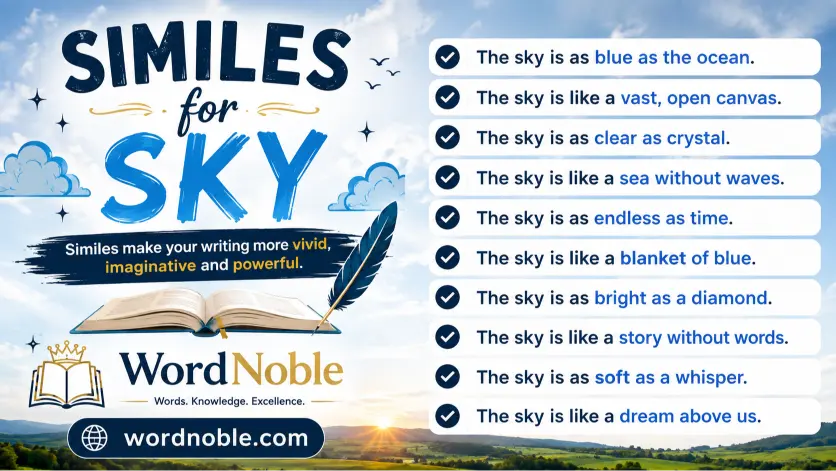
Look up on a clear evening and the sky rarely looks like just “sky.” It looks like spilled ink, or a bruise fading into violet, or a canvas someone forgot to finish.
That’s the magic of similes for sky they turn an ordinary glance upward into something worth remembering. Writers have leaned on this trick for centuries, comparing clouds to cotton candy and sunsets to wildfire, because plain description just doesn’t cut it when nature puts on a show.
Maybe you’re working on a poem that needs one perfect line. Maybe you’re a student stuck on a descriptive essay, staring at a blank page while the deadline creeps closer. Or maybe you just love language and want fresh ways to talk about the world above you.
Whatever brought you here, you’re about to find a collection of vivid sky comparisons and weather-inspired metaphors sorted by mood, time of day, and season.
No filler, no clichés you’ve read a hundred times just phrases that actually paint a picture. Let’s start with morning skies, where the day’s first similes begin.
Similes for sky are comparisons that describe the sky by using “like” or “as” to create vivid mental images. They help writers express its color, shape, mood, movement, and atmosphere more creatively.
Meaning of Similes for Sky
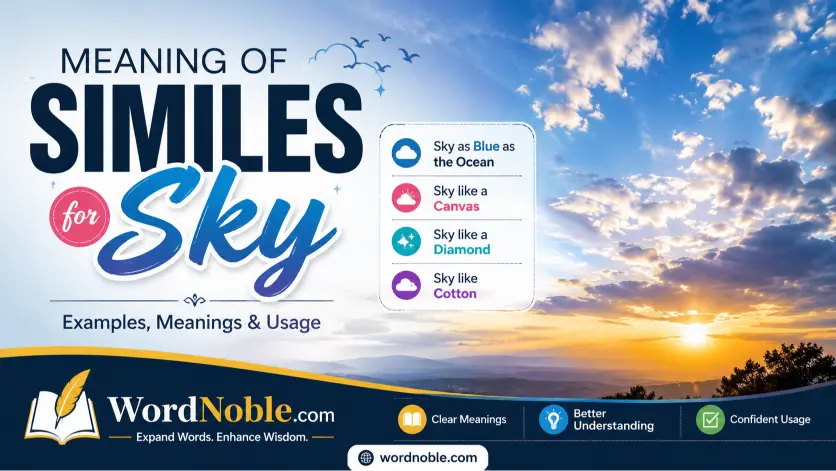
A simile is a figure of speech that compares two different things using words such as like or as. When writers use similes for the sky, they connect something familiar to the sky to make its appearance or mood easier to imagine.
For example:
- The sky was as blue as the ocean.
- The clouds floated like ships across the sky.
- The sunset glowed like a ball of fire.
These comparisons do more than decorate a sentence. They give readers a visual reference.
Instead of simply saying the sky was dark, a writer might say:
The sky was as dark as a cave.
The second sentence creates a stronger picture and gives the reader an emotional impression of darkness.
Similes for the sky can describe color, brightness, darkness, clouds, stars, sunsets, weather, openness, movement, and emotional atmosphere. They are especially useful in descriptive writing, poetry, stories, essays, and creative assignments.
How Similes for Sky Work
Sky similes work by connecting an unfamiliar or changing visual experience with something readers already understand.
Consider:
The clouds were like cotton.
Most readers know what cotton looks like soft, white, and fluffy. The comparison therefore helps them imagine the clouds without a long technical description.
A strong sky simile usually does one of three things:
- Creates a visual image – helping readers picture the scene.
- Communicates emotion – making the sky feel peaceful, threatening, lonely, joyful, or mysterious.
- Adds personality to description – making ordinary language more memorable.
This makes similes an important part of figurative language and sensory writing.
Why Do Writers Use Similes for the Sky?
Writers use sky similes because the sky is constantly changing. Its appearance can shift from bright and cheerful to dark and frightening within minutes.
A carefully chosen comparison allows writers to communicate these changes quickly.
Sky similes can:
- Make descriptions more vivid.
- Help readers visualize a scene.
- Create mood and atmosphere.
- Add poetic beauty.
- Make school assignments more descriptive.
- Strengthen storytelling.
- Improve creative writing.
- Make poetry more expressive.
- Turn simple observations into memorable images.
A simile is particularly effective when the comparison is clear, relevant, and easy to visualize.
Similes for sky are forms of figurative language that compare the sky or elements within it to familiar objects, animals, places, or natural phenomena using “like” or “as.” They are used in creative writing to make descriptions more vivid, emotional, visual, and memorable.
75+ Similes for Sky
Here is a useful collection of creative comparisons organized by meaning and style.
🐾 Animal-Based Similes for Sky
Animal comparisons can make the sky feel alive, active, or dramatic.
- The sky was like a soaring eagle.
Meaning: It appeared vast, free, and powerful. - The clouds moved like birds across the sky.
Meaning: The clouds traveled smoothly and freely. - The sunset spread like a peacock’s feathers.
Meaning: The sunset displayed many beautiful colors. - The clouds were as soft as a swan’s feathers.
Meaning: They looked gentle and fluffy. - The stars twinkled like fireflies.
Meaning: The stars appeared as tiny, glowing lights. - The moon hung like a white owl in the sky.
Meaning: The moon looked bright and mysterious against the darkness. - The clouds raced like wild horses.
Meaning: They moved quickly across the sky. - The sunset was like a flaming bird spreading its wings.
Meaning: The colors stretched dramatically across the horizon.
📡 Technology-Based Similes for Sky
Technology comparisons give sky descriptions a modern and imaginative feeling.
- The sky was like a giant television screen.
Meaning: It displayed constantly changing scenes. - The stars looked like tiny LED lights.
Meaning: They appeared small, bright, and numerous. - The moon was like a glowing satellite.
Meaning: It looked bright and isolated in the night sky. - The clouds were like floating screensavers.
Meaning: They slowly created changing patterns. - Lightning flashed like a camera.
Meaning: Lightning appeared suddenly and brightly. - The stars were like pixels scattered across a dark screen.
Meaning: They looked like tiny points of light against darkness. - The sky glowed like a giant digital display.
Meaning: It was filled with striking colors and light.
🌿 Nature-Based Similes for Sky
Nature-based comparisons are especially useful for poetry and descriptive writing.
- The sky was as blue as the ocean.
- The clouds were like mountains of snow.
- The sunset looked like a field of burning flowers.
- The sky was like an endless sea.
- The clouds floated like islands.
- The stars were like diamonds scattered across velvet.
- The sunrise was like a golden flower opening.
- The sky was as bright as a summer meadow.
- The clouds were like waves on an invisible ocean.
- The sunset spread like spilled paint across the horizon.
- The dawn was like a golden river flowing across the sky.
- The moon looked like a pearl in a dark ocean.
- The stars shimmered like dew in sunlight.
- The clouds were as white as winter snow.
- The evening sky was like a garden filled with colors.
These comparisons work well because nature already provides familiar visual patterns that readers can quickly recognize.
😂 Funny and Exaggerated Similes for Sky
Humorous similes can make ordinary descriptions playful and memorable.
- The clouds were like giant marshmallows having a meeting.
- The sky was as blue as a cartoon character’s hat.
- The clouds looked like someone had dropped cotton balls everywhere.
- The sunset was like the sky showing off its new outfit.
- The clouds were like a giant pile of whipped cream.
- The moon looked like a cookie someone had forgotten in the sky.
- The stars were like glitter thrown across a ceiling.
- The clouds moved like sleepy sheep looking for a bed.
- The sky was like a giant painting that refused to stay finished.
- The sunset looked like someone had spilled a box of crayons.
Funny similes are particularly effective in children’s writing, humorous stories, informal descriptions, and creative assignments.
🎭 Emotional and Behavioral Similes for Sky
These comparisons connect the appearance of the sky with human emotions or behavior.
- The sky was as calm as a sleeping child.
- The storm clouds gathered like an angry crowd.
- The sky looked as lonely as an empty room.
- The sunset smiled like a happy child.
- The dark clouds hung like a worried face.
- The sky was as peaceful as a quiet garden.
- The storm moved like an angry giant.
- The clouds gathered like people preparing for an argument.
- The dawn appeared like hope after a difficult night.
- The evening sky looked as peaceful as a sleeping village.
These similes are useful when the writer wants the environment to reflect the emotional tone of a scene.
15 Best Similes for Sky With Meanings
| Simile sentence | Meaning | Category | Why it works |
|---|---|---|---|
| The sky was as blue as the ocean. | Very blue and clear | Nature | Creates an instantly familiar color image |
| The clouds were like cotton balls. | Soft and fluffy | Object/Nature | Makes clouds easy to visualize |
| The stars were like diamonds. | Bright and sparkling | Object | Emphasizes their brilliance |
| The sunset was like a painting. | Colorful and beautiful | Art | Highlights artistic beauty |
| The sky was like an endless ocean. | Vast and open | Nature | Suggests great depth and space |
| The clouds moved like ships. | Slowly crossing the sky | Object | Gives clouds a sense of movement |
| Lightning flashed like a camera. | Sudden and bright | Technology | Emphasizes a quick burst of light |
| The sunset was like fire. | Red, orange, and intense | Nature | Creates a powerful visual image |
| The moon was like a pearl. | Bright and luminous | Nature/Object | Suggests softness and beauty |
| The stars twinkled like fireflies. | Small points of moving-looking light | Animal/Nature | Creates a magical nighttime image |
| The clouds were like snowy mountains. | Large, white, and layered | Nature | Emphasizes shape and whiteness |
| The sky was as dark as a cave. | Extremely dark | Place | Makes darkness immediately understandable |
| The dawn was like a golden curtain. | Light spreading gradually | Object | Suggests a beautiful opening scene |
| The storm clouds were like an angry army. | Dark and threatening | Emotional | Creates tension |
| The evening sky was like a purple blanket. | Soft, calm, and purple | Object | Creates a peaceful mood |
😊Similes for Different Types of Sky
Similes for a Blue Sky
- The sky was as blue as a deep ocean.
- The sky looked like a giant blue dome.
- The blue sky was like a clear glass window.
- The sky stretched like an endless sea.
- The sky was as bright as a summer morning.
Similes for a Cloudy Sky
- The sky was like a ceiling covered in cotton.
- The clouds moved like ships across an ocean.
- The cloudy sky looked like a gray blanket.
- The clouds were as thick as mountains.
- The sky was like a painting made with soft gray brushes.
😊Similes for a Dark Sky
- The sky was as dark as a cave.
- The night sky looked like black velvet.
- The clouds hung like a heavy curtain.
- The sky was like an ink-filled page.
- Darkness covered the sky like a blanket.
Similes for a Beautiful Sky
- The sky was like a masterpiece.
- The sunset was like a golden painting.
- The sky looked like a rainbow-colored dream.
- The stars were like diamonds on black velvet.
- The evening sky was like a magical garden.
Context Table: When to Use Sky Similes
| Context | Meaning | Use Case | Example |
|---|---|---|---|
| Storytelling | Creates atmosphere | Fiction and narratives | The sky was like a dark curtain over the village. |
| Poetry | Adds beauty and emotion | Poems and lyrical writing | The stars were like diamonds in velvet. |
| Casual speech | Makes descriptions interesting | Conversation | The clouds look like giant pillows. |
| Humor | Creates playful imagery | Funny writing | The sky looks like someone spilled blue paint. |
| Academic writing | Clarifies descriptive observations | School assignments | The sky appeared as blue as the ocean. |
| Children’s writing | Makes imagery accessible | Stories and homework | The clouds were like fluffy sheep. |
| Travel writing | Captures scenery | Travel descriptions | The sunset was like fire across the horizon. |
Similes for Sky in Storytelling
In storytelling, the sky can establish the mood before anything happens.
A bright sky may suggest peace, happiness, freedom, or hope.
A cloudy sky can suggest uncertainty, sadness, or anticipation.
A dark stormy sky may create fear, danger, suspense, or conflict.
For example:
The sky was as dark as a sealed room, and thunder rolled beyond the hills.
The simile does not merely describe darkness. It prepares the reader for something unsettling.
This is an example of atmospheric description, where the setting supports the emotional direction of the story.
Similes for Sky in Poetry
Poetry often depends on imagery, and the sky provides endless opportunities for comparison.
A poet might write:
The sunset spread like a river of fire across the horizon.
This comparison combines visual imagery, movement, color, and intensity.
Poetic sky similes can describe:
- Light
- Color
- Darkness
- Stars
- Clouds
- Sunrise
- Sunset
- Weather
- Space
- Freedom
- Loneliness
- Hope
The strongest poetic comparisons usually avoid predictable wording and connect the sky with an image that fits the poem’s emotional purpose.
How to Use Similes for Sky Naturally in Writing
1. Observe before comparing
Ask what you actually notice. Is the sky bright, hazy, pale, stormy, colorful, empty, crowded with clouds, or filled with stars?
2. Choose a familiar comparison
Readers should understand the comparison without having to decode it.
3. Match the mood
A peaceful scene needs a different comparison from a frightening storm.
4. Use sensory language
Focus on what the reader can see, and when appropriate, connect the description with sound, temperature, or atmosphere.
5. Avoid forcing the comparison
If the simile does not naturally fit the scene, simple descriptive language may be better.
6. Vary your comparisons
Do not compare every cloud to cotton or every star to a diamond. Familiar images can become repetitive when overused.
How to Make Sky Similes More Creative
A creative simile does not have to be complicated.
Instead of:
The sky was beautiful like a painting.
Try focusing on a specific visual quality:
The sunset spread like wet paint across the horizon.
The second version gives the reader a clearer image because it describes movement and color, not just beauty.
A useful formula is:
Sky feature + like/as + familiar image + specific quality
For example:
The clouds + looked like + snowy mountains + floating above the horizon.
This technique helps students and writers produce comparisons that feel purposeful rather than random.
Simile vs. Metaphor: What’s the Difference?
A simile makes a comparison using like or as.
The sky was like an ocean.
A metaphor makes a direct comparison without using like or as.
The sky was an ocean.
Both are forms of figurative language, but they construct comparisons differently.
| Simile | Metaphor |
|---|---|
| Uses like or as | Makes a direct comparison |
| The sky is like an ocean. | The sky is an ocean. |
| Usually makes the comparison explicit | Makes the comparison more direct |
| Common in descriptive writing | Common in poetry and creative prose |
When NOT to Use a Simile
Similes are useful, but more comparisons do not automatically make writing better.
Avoid using one when:
- The comparison is confusing.
- It does not relate to the subject.
- It interrupts the sentence.
- The description is already clear.
- You have used several similes in every sentence.
- The comparison sounds forced or cliché.
- Precision matters more than imagery.
For example, a scientific observation generally benefits from precise language rather than an elaborate poetic comparison.
Good writing is not about adding figurative language everywhere. It is about using it where it improves communication.
❌ Common Mistakes With Sky Similes
Overusing familiar comparisons
If every cloud is “like cotton,” the writing can become predictable.
Choosing an illogical comparison
A comparison should share a meaningful quality with the sky.
Confusing similes and metaphors
Remember:
Simile: The sky is like an ocean.
Metaphor: The sky is an ocean.
Making comparisons too complicated
A simple, powerful image is usually better than a comparison that requires several sentences to understand.
Forgetting the purpose
Ask yourself: What does this simile help the reader see or feel?
👍 Simile Usage: Do and Don’t
Do
- Choose clear comparisons.
- Match the simile to the mood.
- Use specific visual details.
- Experiment with fresh imagery.
- Read the sentence aloud.
- Use similes to strengthen meaning.
Don’t
- Add a simile to every sentence.
- Use random comparisons.
- Repeat the same image constantly.
- Choose complexity over clarity.
- Mix up similes and metaphors.
- Use figurative language when literal wording is more appropriate.
Natural Chat-Style Responses Using Sky Similes
“Wow, look at that sky! It’s like a giant painting.”
“The clouds look like fluffy pillows today.”
“That sunset is like fire spreading across the horizon.”
“The stars are shining like tiny diamonds tonight.”
“The sky is as blue as the ocean today.”
These examples show that similes do not belong only in formal literature. People naturally use comparisons in everyday conversation when they want to make an observation more vivid.
Related Figurative Language Concepts
Learning sky similes can also strengthen understanding of several related English literature concepts.
Figurative Language
A broad category that includes similes, metaphors, personification, hyperbole, and other nonliteral expressions.
Auditory Imagery
Language that helps readers imagine sounds. Although sky descriptions are primarily visual, weather scenes can include thunder, wind, rain, or other sounds.
Sensory Writing
Writing that engages the senses to make an experience feel more immediate.
Descriptive Writing
Writing that uses specific details and imagery to help readers visualize people, places, objects, or scenes.
Metaphor vs. Simile
Both create comparisons, but similes explicitly use words such as like or as, while metaphors make direct comparisons.
FAQs:
1. What are similes for sky?
Similes for sky are comparisons that use like or as to describe the sky, clouds, stars, sunrise, sunset, or weather. They make descriptions more vivid by connecting the sky with something familiar. For example, saying the sky is as blue as the ocean gives readers a clear idea of its color and creates stronger visual imagery than simply saying the sky is blue.
2. What is a good simile for a blue sky?
A simple and effective simile is “The sky was as blue as the ocean.” Other possibilities include “The sky was like a giant blue dome” or “The sky stretched like an endless sea.” The best choice depends on the scene. Use a comparison that communicates the particular quality you want readers to notice, such as color, openness, brightness, or depth.
3. What are some poetic similes for the sky?
Poetic sky similes often compare the sky with oceans, paintings, blankets, gardens, rivers, or jewels. For example, “The stars were like diamonds scattered across black velvet” creates a rich nighttime image. “The sunset spread like a river of fire” emphasizes movement and intense color. Poetic comparisons work best when they support the emotion, atmosphere, and imagery of the poem.
4. What are some funny similes for the sky?
Funny sky similes use unexpected or exaggerated comparisons. For example, “The clouds looked like giant marshmallows having a meeting” or “The sky looked like someone spilled blue paint everywhere.” These comparisons are not meant to be scientifically accurate. Their purpose is to make the description playful, surprising, and memorable, making them especially useful in children’s writing, humorous stories, and casual conversation.
5. How do students use similes for sky?
Students can use sky similes in descriptive essays, creative stories, poems, journal entries, classroom assignments, and nature descriptions. A student might write, “The clouds floated across the sky like ships on a silent ocean.” The comparison adds imagery while demonstrating an understanding of figurative language. Students should choose comparisons that are clear, relevant, and appropriate for the assignment.
6. Why are similes important in English literature?
Similes are important because they allow authors to communicate images, emotions, and ideas in memorable ways. Instead of giving only literal information, writers can connect an unfamiliar experience to something readers already understand. In English literature, similes contribute to imagery, tone, characterization, atmosphere, and poetic expression. They are one of the most accessible ways to make descriptive language more vivid.
7. What is the difference between a simile and a metaphor?
A simile compares two things using like or as, while a metaphor makes a direct comparison. For example, “The sky is like an ocean” is a simile. “The sky is an ocean” is a metaphor. Both are examples of figurative language, but the grammatical structure is different. Understanding this distinction helps students identify and use literary devices correctly.
8. Can similes make sky descriptions more emotional?
Yes. A sky simile can influence how readers emotionally interpret a scene. A peaceful comparison such as “the sky was as calm as a sleeping child” creates tranquility, while “the storm clouds gathered like an angry crowd” creates tension. The comparison therefore does more than describe appearance. It can establish atmosphere and guide the reader’s emotional response.
9. How can I create my own similes for the sky?
Start by observing one specific feature of the sky. Think about its color, shape, movement, brightness, darkness, or mood. Then ask what familiar object, animal, place, or natural feature has a similar quality. Finally, connect the two with like or as. For example, if clouds are moving slowly, you might compare them to ships drifting across an ocean.
10. Should I use similes in every sentence?
No. Similes are most effective when used selectively. If every sentence contains a comparison, the writing may feel crowded, repetitive, or unnatural. Choose a simile when it adds an image, emotion, explanation, or memorable detail. Strong descriptive writing balances figurative language with clear literal sentences so readers can follow the scene easily.
Conclusion:
Similes for sky turn ordinary observations into vivid, memorable descriptions. Whether the sky is as blue as the ocean, the clouds move like ships, or the stars shine like diamonds, a well-chosen comparison helps readers see the scene more clearly.
The most effective similes are not simply decorative; they communicate color, movement, emotion, atmosphere, and meaning.
For students, poets, storytellers, and everyday writers, these comparisons are an easy way to strengthen descriptive writing and develop a richer understanding of figurative language.
The key is simple: choose a familiar image, connect it naturally to the sky, and make sure the comparison adds something meaningful to your sentence.

I am Naqash Ayub, proudly writing for WordNoble, where I focus on creating clear, informative, and SEO-friendly content. I enjoy turning detailed information into simple, trustworthy articles that help readers find the answers they need.