

A kind person once told me my sentences were “gentler than a lullaby,” and I never forgot it. That’s the quiet power of a good comparison it turns an abstract quality like kindness into something you can practically feel.
Similes for kind do exactly this: they take warmth, generosity, and compassion and pin them to images we already understand, like sunlight, honey, or a warm blanket.
Writers reach for these phrases when plain adjectives fall flat and a story needs heart instead of just description. Maybe you’re crafting a character sketch, writing a heartfelt card, or simply trying to describe someone who’s shaped your life in a way that does them justice.
Whatever the reason, the right simile can carry more emotional weight than three sentences of explanation ever could.
In the sections ahead, you’ll find a wide collection of similes for kindness some classic, some unexpected along with tips on choosing the perfect one for your tone and context. By the end, you’ll have a toolkit of expressions that make kindness leap off the page instead of just sitting there as a word.
Similes for kind compare a kind person or kind behavior to something familiar using words such as “like” or “as.” They make kindness easier to picture, understand, and remember.
What Are Similes for Kind?
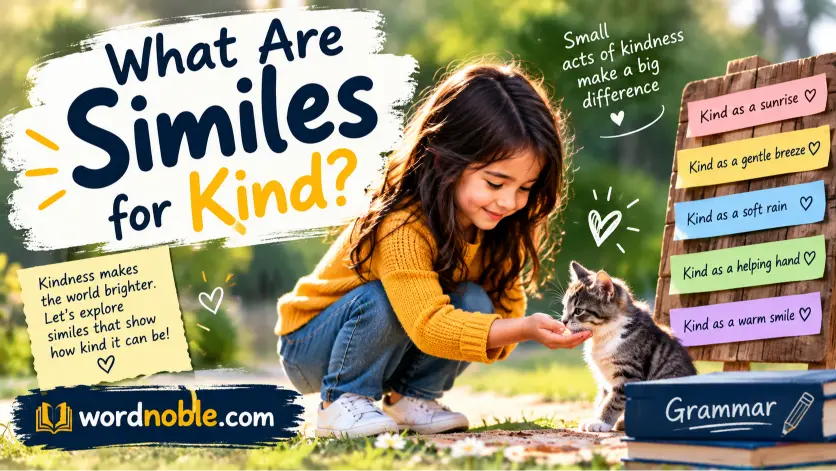
Sometimes, simply saying someone is kind does not fully show what that kindness looks or feels like. A simile gives the reader a clearer picture by connecting kindness with a familiar person, object, animal, or natural image.
For example:
- She was as kind as an angel.
- His kindness was like sunshine on a cold morning.
- He treated everyone like a gentle lamb.
- Her words were as comforting as a warm blanket.
These are examples of figurative language. Instead of describing kindness in a plain, literal way, they create an image that helps the reader understand the person’s behavior.
Similes for kind can describe generosity, compassion, patience, friendliness, gentleness, helpfulness, and warmth. They are useful in creative writing, poetry, stories, speeches, school assignments, and everyday conversation.
How Do Similes for Kind Work?

A simile usually connects two different things with like or as.
The basic pattern is:
Subject + is/was + as + quality + as + comparison
For example:
Mia was as kind as a caring mother.
Another common structure is:
Subject + verb + like + comparison
He helped strangers like a guardian angel.
The comparison does not mean the person is literally an angel or that kindness is literally sunshine. The comparison creates an image that communicates an emotional quality.
Why Do Writers Use Similes for Kindness?
Writers use similes because abstract qualities can be difficult to visualize. Kindness is an idea, but a comparison can turn that idea into something concrete.
A phrase such as “She was kind” is clear but ordinary.
A phrase such as “Her kindness was like a warm blanket on a freezing night” gives the reader a stronger emotional experience.
Good similes can:
- Make descriptions more vivid
- Show personality
- Create emotional imagery
- Strengthen storytelling
- Make poetry more memorable
- Help students improve descriptive writing
- Add warmth to conversations
- Make characters easier to understand
Similes for kind are figurative expressions that compare a person’s kindness, compassion, generosity, or gentle behavior with a familiar person, object, animal, or natural phenomenon to create a clearer and more vivid description.
Contextual Meaning of Similes for Kind
The same comparison can work differently depending on the context.
Storytelling
In stories, similes help readers understand a character’s personality without simply stating that the character is good or kind.
Example:
The old woman was as gentle as a dove, welcoming every child who knocked on her door.
The comparison helps establish her as peaceful, caring, and approachable.
Poetry
Poetry often uses stronger emotional and sensory imagery.
Example:
Her kindness flowed like a quiet river.
This creates an image of kindness that is calm, continuous, and generous.
Casual Speech
In everyday conversation, simple comparisons sound more natural.
Example:
My neighbor is as kind as can be.
The expression is easy to understand and does not feel overly literary.
Humor
Exaggerated comparisons can make kindness sound playful.
Example:
He is so kind, he would probably apologize to a fly after accidentally stepping near it.
Humor works especially well when the comparison is obviously exaggerated.
Academic Writing
Similes can be useful in academic discussions of literature, but they should be used carefully. Formal writing generally benefits from precise explanation rather than excessive figurative language.
Types of Similes for Kind
🐾 Animal-Based Similes
Animals can represent gentleness, loyalty, care, or friendliness.
Examples
- As kind as a gentle dove
- As gentle as a lamb
- As caring as a mother bear
- As loyal as a faithful dog
- As harmless as a bunny
Meaning
These comparisons emphasize qualities such as gentleness, protection, affection, loyalty, and innocence.
For example:
She was as gentle as a lamb.
This suggests that she treated others softly and patiently.
📡 Technology-Based Similes
Technology can create modern comparisons for kindness, especially in contemporary stories, blogs, and casual writing.
Examples
- His kindness was like a helpful notification at the perfect moment.
- She was as supportive as a reliable navigation system.
- His advice was like a search engine that always found the right answer.
- Her kindness was like a fully charged phone when you needed it most.
Meaning
These comparisons connect kindness with reliability, support, availability, and helpfulness.
They can make descriptions feel more modern and relatable.
🌿 Nature-Based Similes
Nature provides some of the most powerful imagery for kindness.
Examples
- Her kindness was like sunshine after a storm.
- He was as gentle as a spring breeze.
- Her compassion flowed like a peaceful river.
- His smile was like sunlight through the clouds.
- She was as warm as a summer morning.
Meaning
Nature-based similes often make kindness feel warm, peaceful, comforting, or life-giving.
😂 Humorous and Exaggerated Similes
Funny similes use exaggeration to create personality and entertainment.
Examples
- He was as kind as a teddy bear with a heart of gold.
- She was so kind, she would probably share her last cookie with a stranger.
- He was as helpful as a superhero on a busy Monday.
- She was kinder than a grandmother carrying an endless supply of cookies.
Meaning
These comparisons deliberately exaggerate kindness to make the description amusing or memorable.
🎭 Emotional and Behavioral Similes
These similes focus directly on how a kind person behaves toward others.
Examples
- She was as caring as a loving parent.
- He treated strangers like old friends.
- Her words were like a soft hug.
- He was as patient as a teacher explaining something for the tenth time.
- Her compassion was like a light in a dark room.
Meaning
These comparisons emphasize emotional warmth, patience, compassion, friendliness, and support.
15 Similes for Kind With Meanings
| # | Simile Sentence | Meaning | Category |
|---|---|---|---|
| 1 | She was as kind as an angel. | She was extremely caring and helpful. | Emotional |
| 2 | He was as gentle as a lamb. | He treated others with softness and care. | Animal |
| 3 | Her kindness was like sunshine after rain. | Her kindness brought comfort and happiness. | Nature |
| 4 | He treated everyone like an old friend. | He was friendly and welcoming toward everyone. | Behavioral |
| 5 | She was as warm as a summer morning. | Her personality made people feel comfortable. | Nature |
| 6 | His words were like a warm blanket. | His words provided emotional comfort. | Emotional |
| 7 | She was as caring as a mother bear. | She strongly cared for and protected others. | Animal |
| 8 | His kindness flowed like a peaceful river. | His kindness seemed natural and continuous. | Nature |
| 9 | He was as helpful as a superhero. | He was always ready to help. | Humorous |
| 10 | Her smile was like sunlight through clouds. | Her friendliness brightened difficult moments. | Nature |
| 11 | He was as patient as a saint. | He showed exceptional patience. | Emotional |
| 12 | She was as sweet as honey. | She was pleasant, friendly, and kind. | Nature |
| 13 | His compassion was like a guiding light. | His care helped others through difficulty. | Emotional |
| 14 | She was gentle like a quiet breeze. | Her manner was calm and soft. | Nature |
| 15 | He was kind like a loyal dog. | He showed friendliness and loyalty. | Animal |
Context Table: Similes for Kind
| Context | Meaning | Use Case | Example |
|---|---|---|---|
| Story | Caring personality | Character description | She was as kind as an angel. |
| Poetry | Emotional warmth | Poetic imagery | Her kindness flowed like a river. |
| School writing | Good behavior | Descriptive paragraph | He was as gentle as a lamb. |
| Friendship | Friendliness | Personal description | She treated everyone like an old friend. |
| Humor | Exaggerated kindness | Funny dialogue | He was as helpful as a superhero. |
| Speech | Compassion | Inspirational writing | Her kindness was like sunshine. |
| Literature analysis | Character traits | Literary discussion | His words were like a warm blanket. |
| Social media | Positive personality | Caption | Kindness shines like sunlight. |
How to Use Similes for Kind in Writing
The strongest similes do more than add decoration. They should help the reader understand something about the person, emotion, or situation.
1. Identify the Kindness You Want to Show
Ask yourself what type of kindness you mean.
Is the person:
- Gentle?
- Generous?
- Patient?
- Friendly?
- Protective?
- Compassionate?
- Supportive?
- Comforting?
Then choose a comparison that matches that specific quality.
2. Choose a Familiar Comparison
Readers understand familiar images quickly.
For example:
“as gentle as a lamb”
is easier to understand than an unusual comparison that requires explanation.
3. Match the Tone
A children’s story may benefit from a simple animal comparison, while poetry can use more imaginative nature imagery.
4. Avoid Forcing the Comparison
A simile should feel natural within the sentence.
Instead of adding a comparison simply because you need figurative language, ask whether it actually improves the description.
5. Combine Similes With Specific Details
Rather than writing:
She was as kind as an angel.
you can make the scene stronger:
She was as kind as an angel, stopping to help the term man carry his bags home.
The action proves the kindness.
How Similes Make Writing More Creative
A simple adjective tells the reader what something is like. A strong simile helps the reader imagine it.
Compare:
He was kind.
with:
He was as gentle as a lamb, always speaking softly to people who felt nervous.
The second sentence gives the reader a clearer personality and behavior.
This is why similes are valuable creative writing techniques. They can support sensory language, emotional imagery, characterization, and descriptive writing.
Good comparisons also help readers remember a character.
Simile vs. Metaphor
A simile makes a direct comparison using words such as like or as.
Simile:
Her kindness was like sunshine.
A metaphor makes the comparison directly without using “like” or “as.”
Metaphor:
Her kindness was sunshine.
Both expressions communicate warmth and positivity, but their grammatical structures are different.
Quick Difference
Simile: uses like/as to compare.
Metaphor: says one thing is another for figurative effect.
Both are important forms of figurative language in English literature and creative writing.
Common Mistakes When Using Similes for Kind
1. Overusing Similes
Using a simile in every sentence can make writing feel crowded.
Better: Use one strong comparison where it adds meaning.
2. Choosing an Illogical Comparison
The comparison should support the quality you are describing.
For example, calling someone “as kind as a thunderstorm” may confuse readers because a thunderstorm does not naturally represent kindness.
3. Confusing Similes With Metaphors
Remember:
Like/as = usually simile
Direct comparison = metaphor
4. Using Clichés Too Often
Expressions such as “as kind as an angel” are easy to understand, but original writing can become stronger when you create fresh comparisons.
5. Forgetting the Context
A funny comparison may not work in a serious poem. A highly poetic comparison may sound strange in casual conversation.
Do and Don’t: Using Similes Naturally
👍 Do
- Choose comparisons that match the intended meaning.
- Use familiar imagery when clarity matters.
- Make the comparison support the character or emotion.
- Mix simple and creative descriptions.
- Use sensory and emotional imagery.
- Consider your audience and writing style.
- Explain unusual comparisons through context.
❌ Don’t
- Add similes to every sentence.
- Use comparisons that make no logical sense.
- Force “like” or “as” into a sentence.
- Confuse similes with metaphors.
- Rely entirely on clichés.
- Use complicated imagery when a simple comparison works better.
Natural Chat Responses Using Similes for Kind
Here are some casual ways people might naturally use these expressions:
- “She’s as kind as a person can be.”
- “Honestly, he’s like sunshine whenever someone needs help.”
- “My teacher was as gentle as a lamb when explaining my mistake.”
- “Your friend sounds as caring as a mother bear.”
- “She treated me like an old friend even though we had just met.”
- “He’s so kind, he’d probably give away his last slice of pizza.”
Related Terms and Concepts
Understanding similes for kind also connects to several broader English language concepts.
Figurative Language
Figurative language uses words creatively rather than relying only on literal meanings. Similes and metaphors are two major examples.
Sensory Writing
Sensory writing uses descriptions connected to sight, sound, touch, taste, or smell. Similes can strengthen these descriptions by creating familiar mental images.
Descriptive Writing
Descriptive writing aims to help readers visualize people, places, emotions, and experiences. Similes are useful tools for making descriptions more vivid.
Metaphor vs. Simile
Both compare ideas, but a simile generally uses like or as, while a metaphor makes the comparison directly.
Characterization
In stories, a comparison can reveal personality. Describing someone as “gentle as a lamb” tells readers something about their behavior without simply saying “he was gentle.”
FAQs:
1. What are similes for kind?
Similes for kind are comparisons that describe kindness by connecting a person or behavior to something familiar. They commonly use like or as. For example, saying someone is “as gentle as a lamb” suggests that the person behaves softly and compassionately. These expressions are useful for describing personality, emotions, relationships, and helpful actions in creative and descriptive writing.
2. What are some examples of similes for kind?
Examples include “as kind as an angel,” “as gentle as a lamb,” “her kindness was like sunshine,” and “he treated everyone like an old friend.” Each comparison highlights a slightly different quality. An angel suggests goodness, a lamb suggests gentleness, sunshine suggests warmth, and an old friend suggests friendliness and familiarity.
3. What are some funny similes for kind?
Funny similes exaggerate kindness to make the description playful. For example, you could say, “He is as kind as a superhero on a rescue mission” or “She is so kind, she would probably share her last cookie with a stranger.” These comparisons are especially useful in casual conversations, humorous stories, character descriptions, and social media writing.
4. What are some poetic similes for kind?
Poetic similes often connect kindness with nature, light, warmth, or peaceful images. Examples include “her kindness was like sunshine after rain,” “his compassion flowed like a quiet river,” and “her words were like a soft breeze.” These comparisons create emotional and visual imagery, making them useful in poetry, reflective writing, and literary descriptions.
5. What is the difference between a simile and a metaphor?
A simile usually makes a comparison with like or as, while a metaphor makes a direct comparison. For example, “Her kindness was like sunshine” is a simile. “Her kindness was sunshine” is a metaphor. Both are forms of figurative language, but they create comparisons in different grammatical ways.
6. How can I use similes for kind in writing?
Start by identifying the exact quality you want to describe, such as generosity, patience, gentleness, or compassion. Then choose a familiar image that represents that quality. For example, use a lamb for gentleness or sunshine for warmth. Place the simile where it adds useful detail rather than inserting one simply to make the writing sound more creative.
7. Why are similes important in English literature?
Similes help writers turn abstract ideas and emotions into recognizable images. Kindness, fear, sadness, courage, and love can be difficult to visualize directly. A carefully chosen comparison gives readers something concrete to imagine. English literature frequently uses figurative language to develop characters, establish mood, create imagery, and communicate emotional ideas more effectively.
8. How can students use similes for kind?
Students can use them in descriptive paragraphs, essays, stories, poems, speeches, and creative writing assignments. A student might write, “My grandmother was as kind as sunshine, always welcoming everyone into her home.” The comparison makes the description more vivid while also providing a clear example of figurative language.
9. Can similes for kind describe actions as well as people?
Yes. Similes can describe both people and their behavior. For example, “She helped the injured bird like a careful nurse” describes a kind action rather than simply labeling the person kind. This approach can make writing stronger because it shows kindness through behavior instead of relying only on an adjective.
10. How do I create an original simile for kindness?
Think about what kindness feels like or what it does for another person. Then connect that effect with a familiar image. Kindness may feel like warmth, guidance, shelter, sunlight, or a helping hand. Instead of copying a common comparison, consider the particular scene and create an image that naturally fits its emotion, setting, and tone.
Conclusion:
Similes for kind give writers a simple way to turn an ordinary description of kindness into a vivid image. Instead of simply saying someone is kind, you can show that quality through comparisons involving sunshine, gentle animals, warm objects, nature, or familiar experiences.
The best similes are clear, relevant, and suited to the tone of the writing. They can strengthen characterization, emotional imagery, poetry, storytelling, and school assignments without making the writing complicated. Remember that a simile usually uses like or as, while a metaphor makes a direct comparison.
Choose one meaningful image, connect it naturally to the situation, and let the comparison make your description memorable.

I am Naqash Ayub, proudly writing for WordNoble, where I focus on creating clear, informative, and SEO-friendly content. I enjoy turning detailed information into simple, trustworthy articles that help readers find the answers they need.