Picture this: you’re describing the view from a mountaintop, and “huge” just feels flat. That’s the exact moment similes for big earn their keep they turn a plain adjective into something the reader can actually picture.
A towering skyscraper, a sky that stretches forever, a problem that feels impossible to solve plain size words rarely capture how massive something truly feels. That’s where vivid comparisons step in, giving your writing texture and emotion instead of leaving it flat and generic.
Whether you’re a student polishing an essay, a writer crafting a story, or just someone who wants their words to pack more punch, this collection of expressions will give your descriptions new life.
You’ll find comparisons for size, scale, and even emotional weight covering everything from colossal mountains to enormous feelings. Along the way, we’ll also touch on related phrases and descriptive language that pair naturally with size-based comparisons, so your writing stays fresh and varied.
Ready to stop repeating “big” and start writing descriptions people actually remember? Let’s dive into the full list below.
What Are Similes for Big?
Similes for big are figurative expressions that compare something large to another familiar object, person, animal, or natural feature, usually using the words “like” or “as.” They help readers imagine size, height, width, volume, or an exaggerated sense of scale.
Examples include:
- As big as a house.
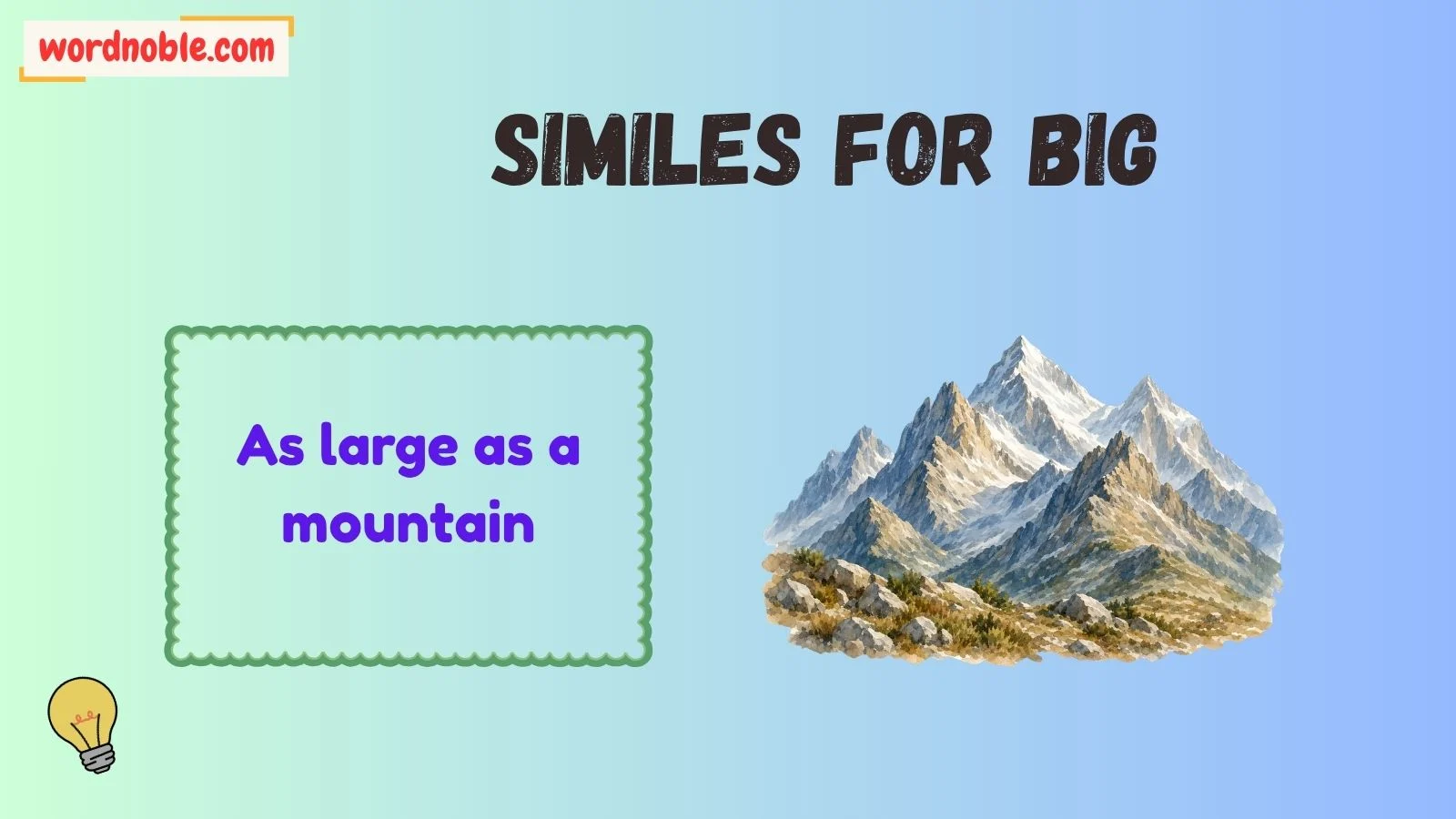
- As large as a mountain.
- Like a giant standing above the crowd.
- As huge as the ocean.
These comparisons make descriptions easier to understand because readers can connect an unfamiliar size with something they already recognize.
Meaning and Deep Explanation of Similes for Big
The word big can describe physical size, importance, influence, ambition, or even an emotion. Similes help writers communicate these different meanings more clearly.
For example, describing a building as big as a mountain emphasizes its enormous size. Comparing someone’s dreams to the sky suggests ambition without limits. The first comparison focuses on physical scale, while the second expresses an abstract idea.
Similes belong to figurative language, a group of techniques that communicate ideas beyond their literal meanings. They also support sensory language by helping readers picture the size, shape, and presence of something.
How Do Similes for Big Work?
A simile connects two things through a recognizable shared quality.
- Subject: The thing being described.
- Comparison: A familiar object or idea.
- Shared quality: The feature that makes the comparison meaningful.
For instance, in “The elephant was as big as a truck,” the elephant is the subject, the truck is the comparison, and their impressive size creates the connection.
A good simile does not need to be scientifically exact. It needs to communicate a clear image that suits the context.
Why Do Writers Use Similes for Big?
Writers use these comparisons to:
- Make descriptions more vivid and memorable.
- Help readers visualize large objects.
- Create humor through exaggeration.
- Establish a dramatic or emotional tone.
- Improve storytelling, poetry, and descriptive writing.
- Explain abstract ideas such as ambition or influence.
A carefully chosen comparison can communicate more than a plain adjective because it gives the reader something concrete to imagine.
Similes for big are expressions that describe large size, scale, or importance by comparing something to a familiar object, living thing, or natural feature. They commonly use “like” or “as” to create an understandable connection. Writers use them in stories, poems, conversations, and educational writing to improve imagery, clarify descriptions, and make language more engaging.
1. Animal-Based Similes for Big
1. As big as an elephant
Meaning: Extremely large or bulky.
Example: The stuffed toy was as big as an elephant, taking up half the sofa.
2. As big as a bear
Meaning: Large, strong, or powerfully built.
Example: The wrestler looked as big as a bear beside his teammates.
3. As tall as a giraffe
Meaning: Remarkably tall.
Example: My little brother looked as tall as a giraffe in his oversized costume.
4. As huge as a whale
Meaning: Exceptionally large or massive.
Example: The inflatable pool looked as huge as a whale in our tiny backyard.
5. Like a lion towering over the others
Meaning: Appearing large, imposing, or powerful.
Example: The captain stood like a lion towering over the younger players.
2. Object-Based and Technology-Based Similes
6. As big as a house
Meaning: Extremely large. Example: Their new playhouse was as big as a house in a fairy tale.
7. As large as a bus
Meaning: Comparable to a large vehicle in size. Example: The parade float was as large as a bus.
8. Like a giant billboard
Meaning: Broad, conspicuous, or difficult to overlook. Example: The colorful sign stood like a giant billboard above the entrance.
9. As big as a warehouse
Meaning: Vast, spacious, or capable of holding many things. Example: The exhibition hall was as big as a warehouse.
10. As wide as a computer screen
Meaning: Broad across its surface. Example: The digital display was as wide as a computer screen.
11. Like a giant robot in the street
Meaning: Tall, bulky, and imposing. Example: The construction machine looked like a giant robot in the street.
12. As massive as a spacecraft
Meaning: Impressively large and complex-looking. Example: The futuristic stage looked as massive as a spacecraft.
13. As big as a shopping mall
Meaning: Enormous in overall scale. Example: The new entertainment complex was as big as a shopping mall.
3. Nature-Based Similes for Big
14. As big as a mountain
Meaning: Enormous and imposing.
Example: The pile of laundry looked as big as a mountain.
15. As vast as the ocean
Meaning: Seemingly endless in size or extent.
Example: Her imagination was as vast as the ocean.
16. As wide as the sky
Meaning: Extremely broad or seemingly limitless.
Example: His plans were as wide as the sky.
17. As broad as an ancient tree
Meaning: Wide and spreading.
Example: The old tree’s branches were as broad as an ancient tree’s crown can be.
18. As huge as a thundercloud
Meaning: Massive, looming, or visually overwhelming.
Example: A cloud as huge as a thundercloud drifted over the stadium.
19. As endless as the horizon
Meaning: Seemingly without a limit. Example: The golden fields looked as endless as the horizon.
20. As deep as a canyon
Meaning: Extending far downward or inward. Example: The crack in the rock looked as deep as a canyon.
21. Like a wave swallowing the shore
Meaning: Spreading over an enormous area. Example: The crowd moved like a wave swallowing the shore.
22. As towering as a cliff
Meaning: Extremely tall and imposing. Example: The wall looked as towering as a cliff.
23. As wide as a river
Meaning: Broad across its width. Example: The painted blue stripe was as wide as a river.
4. Funny and Exaggerated Similes for Big
Humorous similes often use playful exaggeration, sometimes called hyperbole. These comparisons are especially useful in casual conversation, comedy, and children’s writing.
24. As big as my problems on Monday morning
Meaning: Comically enormous or overwhelming. Example: That homework pile was as big as my problems on Monday morning.
25. As huge as a giant’s sandwich
Meaning: Absurdly large. Example: He made an omelet as huge as a giant’s sandwich.
26. Like a balloon ready to take over the room
Meaning: Bulging or taking up too much space. Example: His overstuffed backpack looked like a balloon ready to take over the room.
27. As big as a sofa with an appetite
Meaning: Comically bulky. Example: The oversized beanbag was as big as a sofa with an appetite.
28. As enormous as a dinosaur’s lunchbox
Meaning: Fantastically huge. Example: She carried a handbag as enormous as a dinosaur’s lunchbox.
29. Like a mountain wearing a hat
Meaning: Tall, bulky, and amusingly conspicuous. Example: The snow-covered hill looked like a mountain wearing a hat.
30. As big as a pizza made for giants
Meaning: Unusually large and appetizing. Example: Our party pizza was as big as a pizza made for giants.
31. As wide as my eyes after seeing the bill
Meaning: A humorous exaggeration of surprise or astonishment. Example: My eyes became as wide as my eyes after seeing the bill when the price appeared.
32. Like a giant taking up two seats
Meaning: Very large in appearance or build. Example: The mascot looked like a giant taking up two seats.
33. As big as a mountain of chocolate
Meaning: Excessively large, especially in a fun or tempting way. Example: The dessert display was as big as a mountain of chocolate.
5. Emotional and Behavioral Similes for Big
Not every use of big concerns physical measurements. It can also describe feelings, ambitions, reputations, or importance.
34. As big as a dream
Meaning: Ambitious or full of possibility. Example: Her hopes were as big as a dream.
35. As strong as a giant’s promise
Meaning: Powerful or deeply reassuring. Example: His determination felt as strong as a giant’s promise.
36. Like a shadow stretching across the world
Meaning: Having an enormous influence or reach. Example: The news spread like a shadow stretching across the world.
37. As important as the sun to the earth
Meaning: Essential or extremely significant. Example: Her support felt as important as the sun to the earth.
38. As big as a heart full of love
Meaning: Emotionally generous or full of affection. Example: His kindness was as big as a heart full of love.
39. Like a dream too large to contain
Meaning: An ambition that feels almost limitless. Example: His vision was like a dream too large to contain.
40. As bold as a giant’s footsteps
Meaning: Confident, noticeable, and fearless. Example: She entered the competition with a confidence as bold as a giant’s footsteps.
41. As wide as the distance between two worlds
Meaning: Extremely different or far apart. Example: Their opinions were as wide as the distance between two worlds.
42. Like thunder filling the sky
Meaning: Powerful and impossible to ignore. Example: His announcement spread like thunder filling the sky.
43. As large as a lifetime of memories
Meaning: Emotionally extensive or significant. Example: The family’s shared history felt as large as a lifetime of memories.
6. More Everyday Similes for Big
44. As big as a football field
Meaning: Extremely spacious. Example: The open ground was as big as a football field.
45. As round as a giant marble
Meaning: Large and rounded. Example: The decorative ornament was as round as a giant marble.
46. As tall as a tower
Meaning: Very high. Example: The new building was as tall as a tower.
47. Like a wall rising into the clouds
Meaning: Enormously high or imposing. Example: The skyscraper looked like a wall rising into the clouds.
48. As full as a packed stadium
Meaning: Holding a very large crowd or quantity. Example: The auditorium was as full as a packed stadium.
49. As heavy as a boulder
Meaning: Extremely weighty. Example: The oversized suitcase felt as heavy as a boulder.
50. As thick as a tree trunk
Meaning: Very thick or bulky. Example: The old rope was as thick as a tree trunk.
51. As long as a train
Meaning: Extremely long. Example: The queue outside the store was as long as a train.
52. As crowded as a city square
Meaning: Filled with many people or objects. Example: The market was as crowded as a city square.
53. As bright as a giant spotlight
Meaning: Exceptionally bright or visually striking. Example: The full moon looked as bright as a giant spotlight.
54. Like a giant blanket covering the land
Meaning: Spreading over a wide area. Example: The snow lay like a giant blanket covering the land.
55. As grand as a royal palace
Meaning: Impressive in size, appearance, or magnificence. Example: The wedding hall looked as grand as a royal palace.
Note: Some comparisons above are familiar expressions, while others are original, imaginative constructions. Choose one that fits your audience and context.
How Similes for Big Change Across Different Contexts
The same comparison can have different effects depending on where and how it is used.
| Context | Meaning | Use case | Example |
|---|---|---|---|
| Storytelling | Creates a visual picture | Describing settings or characters | The castle was as big as a mountain. |
| Poetry | Adds imagery and emotion | Expressing feelings or wonder | Her dreams were as wide as the sky. |
| Casual speech | Makes everyday descriptions lively | Talking with friends | That burger was as big as my head. |
| Humor | Exaggerates for comic effect | Jokes and funny stories | His backpack was as big as a dinosaur’s lunchbox. |
| Academic writing | Clarifies a comparison | Explaining scale in accessible language | The exhibition area was as large as a football field. |
| Children’s writing | Creates memorable images | Stories and school assignments | The giant was as tall as a tower. |
How to Use Similes for Big in Writing
A good simile should make your meaning clearer rather than simply decorate a sentence.
1. Identify What You Want to Describe
First, decide whether big means tall, wide, heavy, important, powerful, or emotionally significant.
For example, a mountain comparison communicates scale, while a comparison to the sun can suggest importance.
2. Choose a Familiar Comparison
Readers understand similes more quickly when the comparison is recognizable. Houses, elephants, mountains, buses, and oceans provide useful reference points.
3. Match the Tone
- For stories: Choose vivid, imaginative comparisons.
- For poems: Select comparisons with emotional or symbolic meaning.
- For humor: Use playful exaggeration.
- For schoolwork: Prefer clear, easy-to-explain examples.
- For formal writing: Use comparisons sparingly and prioritize accuracy.
4. Explain the Intended Meaning
If a comparison is unusual, make its meaning clear through the surrounding sentence.
Instead of writing, “The project was as big as a universe,” you could write, “The project felt as big as a universe because it involved hundreds of tasks and months of planning.”
The extra context helps readers understand the intended exaggeration.
5. Read the Sentence Aloud
A simile should sound natural when spoken. If it feels confusing, overly long, or unrelated to the subject, choose a simpler comparison.
Simile vs. Metaphor: What Is the Difference?
Both similes and metaphors compare things, but they express the comparison differently.
| Feature | Simile | Metaphor |
|---|---|---|
| Structure | Usually uses like or as | Describes one thing as another |
| Example | The building was as big as a mountain. | The building was a mountain of concrete. |
| Effect | Makes the comparison explicit | Makes the comparison more direct |
| Common use | Clear, descriptive comparisons | Symbolism, strong imagery, concise expression |
A simile says that two things are alike in a particular way. A metaphor presents one thing in terms of another without explicitly using like or as.
For example, “Her ambition was as big as the sky” is a simile. “Her ambition was the sky” is a metaphor.
Common Mistakes When Writing Similes
1. Overusing comparisons
Too many similes in a single paragraph can distract readers. Use them where they add a useful image or emotional effect.
2. Choosing illogical comparisons
A comparison should have a recognizable connection. Saying “The box was as big as a whisper” may confuse readers because a whisper is associated with sound, not physical size.
3. Confusing similes with metaphors
A comparison does not automatically become a simile simply because it is figurative. Check whether it explicitly compares things using like or as.
4. Using exaggeration in the wrong context
Funny comparisons can work in casual stories but may weaken a serious report. Match the expression to the audience and purpose.
5. Repeating familiar expressions without adding detail
Common phrases can be useful, but original comparisons may make creative writing more distinctive. Add a specific detail when the context calls for it.
Similes for Big: Do and Don’t
Do:
- Choose comparisons that clearly express size or scale.
- Use familiar objects to help readers visualize the subject.
- Match the comparison to the tone of your writing.
- Experiment with nature, animals, objects, and emotions.
- Explain unusual comparisons through context.
Don’t:
- Add a simile to every sentence.
- Mix unrelated ideas without a clear connection.
- Treat exaggerated comparisons as literal facts.
- Use humorous expressions in inappropriate formal contexts.
- Confuse metaphors with similes.
Natural Chat Responses Using Similes for Big
These examples show how similes for big can appear in everyday conversations.
1. Talking about food
Friend: “How was the burger?”
You: “It was as big as my head. I could barely finish it!”
2. Describing a new house
Friend: “Have you seen their new house?”
You: “Yes! It’s as big as a mansion.”
3. Talking about a crowd
Friend: “Was the concert busy?”
You: “The crowd was as big as a sea of people.”
4. Describing homework
Friend: “How much work do you have?”
You: “My homework pile is as big as a mountain.”
5. Talking about dreams
Friend: “What do you want to achieve?”
You: “My dreams are as wide as the sky.”
6. Describing a shopping bag
Friend: “What did you buy?”
You: “So much stuff! My shopping bag is as big as a suitcase.”
Related Figurative Language Terms
Understanding related concepts helps you develop stronger descriptive writing.
- Figurative language: Words and expressions that communicate ideas beyond their literal meanings.
- Auditory imagery: Language that helps readers imagine sounds. It is especially useful when describing loud crowds, thunder, or other sounds associated with large scenes.
- Sensory writing: Descriptions that appeal to sight, sound, touch, taste, or smell.
- Metaphor vs. simile: Two comparison techniques that create imagery in different ways.
- Descriptive writing: Writing that helps readers visualize people, places, objects, and experiences.
- Hyperbole: Deliberate exaggeration used for emphasis or humor.
- Personification: Giving human qualities to nonhuman things.
- Visual imagery: Language that creates mental pictures through details about appearance, color, shape, and size.
For more descriptive ideas, explore similes for eyes, similes for face, similes for hands, figurative language examples, descriptive writing techniques, English literature devices, and sensory language writing.
FAQs:
1. What are similes for big?
Similes for big are comparisons that describe something large by connecting it to another familiar thing. They usually use like or as to highlight size, height, width, or importance. For example, “The building was as big as a mountain” helps readers imagine an enormous structure. Writers use these expressions in stories, poems, school assignments, and everyday conversations.
2. What are five examples of similes for big?
Five examples are “as big as a house,” “as huge as a whale,” “as large as a bus,” “as vast as the ocean,” and “as big as a mountain.” Each comparison communicates impressive size through a recognizable object or natural feature. These expressions work well when describing buildings, crowds, landscapes, toys, and other objects that seem unusually large.
3. What are some funny similes for big?
Funny similes exaggerate size to create a playful mental picture. Examples include “as big as a giant’s sandwich,” “as huge as a dinosaur’s lunchbox,” and “as big as a mountain of chocolate.” They work especially well in casual conversations, children’s stories, and comedy. The humor comes from imagining something familiar on an absurdly large scale rather than taking the comparison literally.
4. What are some poetic similes for big?
Poetic similes often connect size with emotion, imagination, or nature. Examples include “her dreams were as wide as the sky,” “his grief felt as deep as a canyon,” and “their love was as vast as the ocean.” These comparisons do more than describe physical dimensions. They help communicate abstract experiences and create emotional imagery that readers can picture and feel.
5. What is the difference between a simile and a metaphor?
A simile explicitly compares two things, usually using like or as. A metaphor describes one thing in terms of another without directly stating that they are alike. For example, “The building was as big as a mountain” is a simile, while “The building was a mountain of concrete” is a metaphor. Both techniques strengthen figurative language, but they create slightly different effects.
6. How can I use similes for big in a sentence?
Choose the subject, identify the quality you want to emphasize, and select a familiar comparison. For example, “The stadium was as big as a small town” emphasizes scale, while “Her ambition was as wide as the sky” communicates limitless goals. Make sure the comparison suits your meaning and sounds natural. A useful simile should improve understanding instead of making the sentence unnecessarily complicated.
7. Why are similes important in English literature?
Similes help writers make descriptions more vivid, express emotions, and communicate complex ideas through familiar comparisons. In English literature, they can establish mood, develop characters, create atmosphere, and strengthen imagery. A comparison involving a mountain might suggest size or an overwhelming challenge, depending on the context. Similes also help readers connect abstract themes with concrete experiences, making literary language more accessible and memorable.
8. How can students use similes for big in school assignments?
Students can use similes to make descriptive paragraphs, short stories, poems, and creative writing exercises more engaging. For example, “The school hall was as big as an airport terminal” communicates a strong impression of size. Students should choose comparisons they understand, explain unusual expressions clearly, and avoid repeating the same structure too often. Teachers can also use similes to introduce figurative language and comparison techniques.
9. Can a simile for big describe something other than physical size?
Yes. The word big can describe importance, ambition, influence, emotions, or expectations as well as physical dimensions. For instance, “Her dreams were as big as the sky” suggests ambitious goals, while “His influence spread like a shadow across the country” suggests a broad reach. The intended meaning depends on the comparison and the surrounding context, so writers should make their purpose clear.
10. What makes a simile for big effective?
An effective simile creates a clear, relevant mental image that supports the writer’s purpose. It should connect the subject to something readers recognize and emphasize a specific quality, such as height, width, volume, or importance. Original comparisons can make writing distinctive, while familiar expressions can communicate ideas quickly. The strongest similes feel natural, fit the tone, and add meaning rather than simply making a sentence longer.
Conclusion:
Similes for big help transform simple descriptions into vivid, memorable expressions. Whether you compare a building to a mountain, a crowd to an ocean, or an ambitious dream to the sky, the right comparison makes your meaning easier to visualize.
These expressions are useful in creative writing, poetry, school assignments, storytelling, and everyday conversation. The key is to choose a comparison that fits your subject, audience, and tone. Avoid overusing familiar phrases, and experiment with original images when they improve clarity.
By understanding how similes work and how they differ from metaphors, you can develop stronger descriptive writing and communicate ideas with greater creativity and confidence.

I am Naqash Ayub, proudly writing for WordNoble, where I focus on creating clear, informative, and SEO-friendly content. I enjoy turning detailed information into simple, trustworthy articles that help readers find the answers they need.