
Have you ever wanted to describe someone or something as incredibly beautiful without using the same old words like pretty or handsome? That’s where idioms for attractive come in.
These colorful expressions add personality, emotion, and creativity to your language, making your conversations and writing far more engaging.
Whether you’re complimenting a person’s appearance, describing a breathtaking place, or adding flair to a story, attractive idioms help you express admiration in a natural and memorable way.
Idioms for attractive are figurative expressions used to describe someone or something as beautiful, handsome, charming, appealing, or captivating. They make descriptions more vivid, natural, and expressive than using the word “attractive” repeatedly.
What Are Idioms for Attractive?
Idioms for attractive are figurative expressions that describe someone’s physical beauty, charm, appeal, elegance, or magnetic personality. Unlike literal adjectives such as beautiful or handsome, idioms create stronger imagery and often carry cultural meaning.
They appear in:
- Everyday conversations
- Creative writing
- English literature
- Movies and television
- Poetry
- Social media captions
- School assignments
Instead of simply saying someone is attractive, idioms help readers and listeners imagine the person’s appearance or charm in a more memorable way.
Idioms for attractive are fixed expressions that describe beauty, charm, elegance, or appeal in a figurative way. They enrich communication by adding imagery, emotion, and personality while making speech and writing more engaging than literal descriptions.
Why Writers Use Idioms Instead of “Attractive”
Using idioms improves communication because they:
- Create stronger visual imagery
- Make descriptions more memorable
- Express personality and emotion
- Avoid repetitive vocabulary
- Sound more natural in conversation
- Add style to storytelling
- Enhance descriptive writing
- Reflect cultural expressions
Good writers vary their language instead of repeating the same adjective throughout a paragraph.
Idioms For Attractive Man

- Handsome as the day is long
- Easy on the eyes
- A real head-turner
- Look like a million dollars
- Turn heads wherever he goes
- A sight to behold
- As handsome as a picture
- Cut a fine figure
- Dressed to the nines
- Have movie-star looks
- Look sharp
- Have a magnetic presence
- Steal the show
- Look incredibly dashing
Types of Idioms for Attractive
Beauty and Appearance
Examples include:
These idioms focus on physical attractiveness.
- Easy on the eyes
- Drop-dead gorgeous
- Picture perfect
- A sight for sore eyes
- Pretty as a picture
Charm and Personality
Some people are attractive because of their personality rather than appearance.
Examples:
- Full of charm
- Lights up the room
- Turns heads
- Has the Midas touch (for style or charisma in some contexts)
- Magnetic personality
Romantic Attraction
These idioms describe someone who attracts admiration or affection.
Examples:
- Catch someone’s eye
- Steal someone’s heart
- Head turner
- The apple of someone’s eye
- Fall head over heels
Elegant and Stylish
These expressions highlight sophistication and grace.
Examples:
- Dressed to the nines
- Looks like a million bucks
- Red-carpet ready
- Class act
- Well put together
Timeless Beauty
These idioms emphasize lasting attractiveness.
Examples:
- Doesn’t look a day over…
- Age like fine wine
- Beauty never fades
- Forever young (figurative)
- Graceful as ever
Idioms For Attractive Woman
- Drop-dead gorgeous
- Easy on the eyes
- A sight to behold
- Look like a million dollars
- Turn heads wherever she goes
- A real head-turner
- As pretty as a picture
- Beauty personified
- A vision of beauty
- A feast for the eyes
- Look absolutely stunning
- Have a magnetic presence
- Steal the spotlight
- Make heads turn
15 Common Idioms for Attractive with Meanings and Examples
| Idiom | Meaning | Example | Category |
|---|---|---|---|
| Easy on the eyes | Pleasant to look at | The new actor is easy on the eyes. | Appearance |
| Drop-dead gorgeous | Extremely beautiful | She looked drop-dead gorgeous at the wedding. | Appearance |
| A sight for sore eyes | Pleasant to see after a long time | After months away, my sister was a sight for sore eyes. | Beauty |
| Pretty as a picture | Very beautiful | The garden looked pretty as a picture. | Beauty |
| Turn heads | Attract attention | His stylish outfit turned heads everywhere. | Attention |
| Catch someone’s eye | Attract attention | Her smile caught everyone’s eye. | Attraction |
| Head turner | Someone remarkably attractive | That sports car is a real head turner. | Attraction |
| Looks like a million bucks | Looks fantastic | You look like a million bucks today. | Style |
| Dressed to the nines | Elegantly dressed | Everyone arrived dressed to the nines. | Fashion |
| Apple of someone’s eye | Someone deeply admired | She has always been the apple of her grandfather’s eye. | Affection |
| Steal someone’s heart | Win affection | His kindness stole her heart. | Romance |
| Magnetic personality | Naturally attractive personality | The speaker has a magnetic personality. | Personality |
| Lights up the room | Brightens everyone’s mood | Her smile lights up the room. | Personality |
| Class act | Elegant and admirable | She handled the interview like a class act. | Elegance |
| Age like fine wine | Become more attractive with age | He seems to age like fine wine. | Timeless beauty |
Context Table
| Context | Meaning | Use Case | Example |
|---|---|---|---|
| Daily conversation | Good-looking | Talking with friends | He’s easy on the eyes. |
| Storytelling | Describing a character | Fiction writing | She turned heads wherever she went. |
| Poetry | Symbolic beauty | Creative expression | Her smile lit the room. |
| Literature | Character development | Novels | The hero was the apple of everyone’s eye. |
| Fashion | Stylish appearance | Reviews | They were dressed to the nines. |
| Romance | Emotional attraction | Love stories | He stole her heart instantly. |
| Public speaking | Charisma | Biographies | She has a magnetic personality. |
Idioms About Beautiful Girl
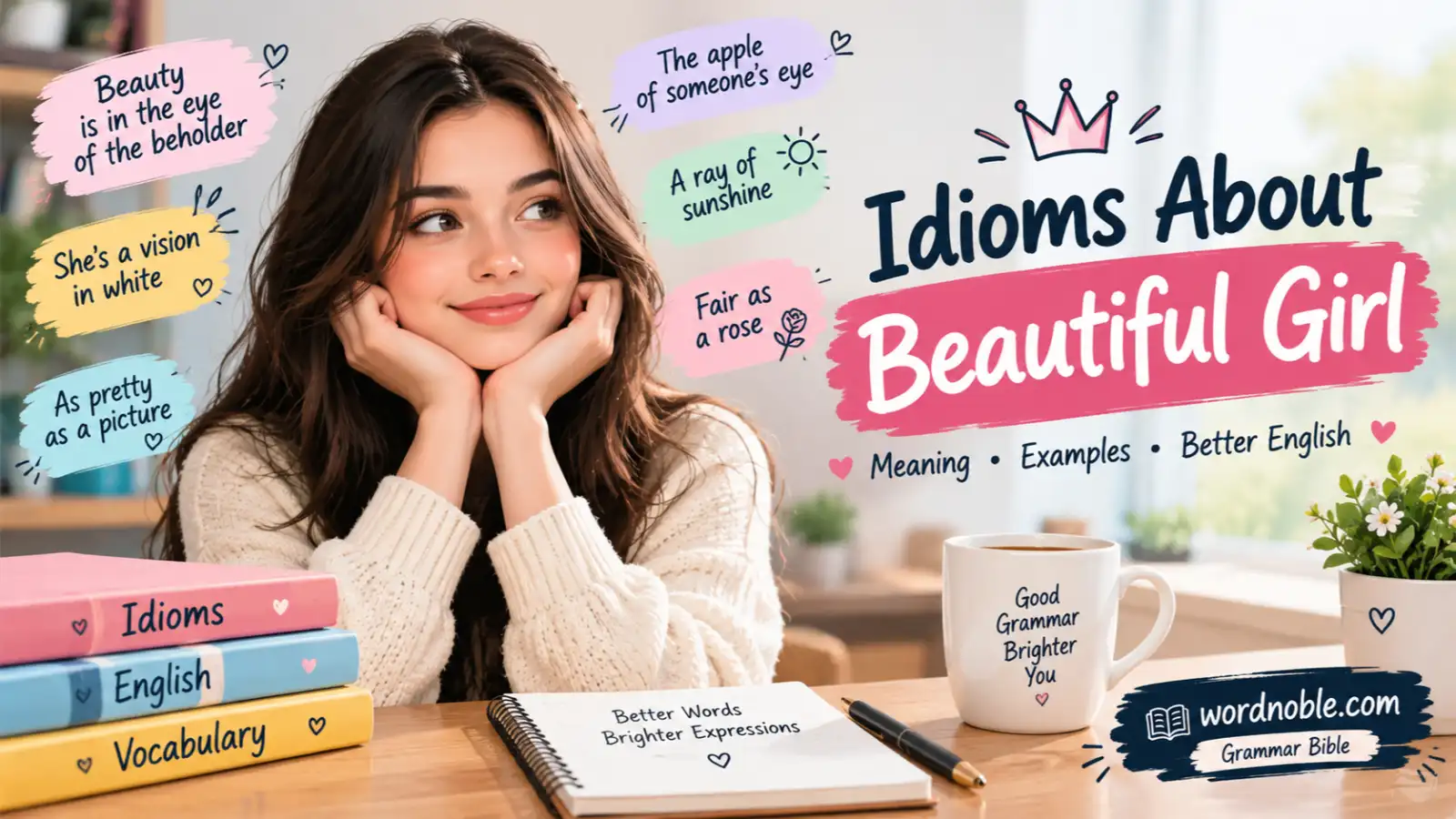
- Pretty as a picture
- A vision of beauty
- As lovely as a rose
- A sight to behold
- Drop-dead gorgeous
- Easy on the eyes
- A breath of fresh air
- Beauty personified
- A real head-turner
- Have a radiant smile
- Shine like a star
- Look like a dream
- Be the belle of the ball
- Have a face that could launch a thousand ships
How to Use Idioms Naturally
Follow these tips for smoother writing.
Match the Situation
Choose an idiom that fits the context.
Formal writing often prefers:
- Well put together
- Elegant
- Class act
Casual conversations commonly use:
- Easy on the eyes
- Head turner
- Looks like a million bucks
Avoid Overusing Idioms
Using too many idioms in one paragraph can make your writing sound unnatural.
Instead, combine idioms with literal descriptions.
Consider Your Audience
Some idioms are informal.
Others work better in essays, speeches, or fiction.
Show Rather Than Tell
Instead of writing:
She was attractive.
Write:
She turned heads the moment she entered the room.
The second sentence paints a stronger picture.
Idioms For Attractive Girl
- Drop-dead gorgeous
- Pretty as a picture
- Easy on the eyes
- A real head-turner
- A vision of beauty
- Look like a million dollars
- Turn heads wherever she goes
- A sight to behold
- Beauty personified
- A feast for the eyes
- Look absolutely stunning
- Have a radiant glow
- Steal the spotlight
- Be the belle of the ball
Idioms vs. Similes vs. Metaphors
| Figure of Speech | Definition | Example |
|---|---|---|
| Idiom | Expression whose meaning isn’t literal | Easy on the eyes |
| Simile | Compares using “like” or “as” | As pretty as a picture |
| Metaphor | Direct comparison | She is a rose among thorns |
Understanding the difference helps you choose the most effective figurative language for your writing.
Common Mistakes
Using Idioms Literally
Remember that idioms have figurative meanings.
“A sight for sore eyes” does not mean someone literally cures eye pain.
Choosing the Wrong Context
Some idioms sound too informal for academic essays.
Always consider your audience.
Overusing Figurative Language
Too many idioms can distract readers.
Balance figurative language with clear, direct sentences.
Mixing Idioms
Avoid combining unrelated idioms in the same sentence, as it may confuse readers.
Idioms About Beauty And Appearance
- Beauty is in the eye of the beholder
- Pretty as a picture
- Easy on the eyes
- Look like a million dollars
- Dress to impress
- Dressed to the nines
- A sight to behold
- A feast for the eyes
- Turn heads
- A real head-turner
- Put your best face forward
- Look your best
- Cut a fine figure
- Beauty is only skin deep
Do and Don’t Guide
Do
- Use idioms naturally.
- Learn the meaning before using them.
- Match the idiom to the situation.
- Read examples from books and articles.
- Practice in conversations.
Don’t
- Translate idioms word for word.
- Overuse them.
- Mix multiple idioms unnecessarily.
- Use informal idioms in highly formal writing.
- Assume every culture uses the same expressions.
Idioms For Cute Girl
- Cute as a button
- Cute as a kitten
- Pretty as a picture
- Sweet as sugar
- Cute as a daisy
- A little ray of sunshine
- As sweet as pie
- Easy on the eyes
- A breath of fresh air
- A bundle of joy
- As charming as can be
- Have a heart of gold
- Melt hearts wherever she goes
- Put a smile on everyone’s face
Natural Conversation Examples
Friend: “Did you see Emma at the party?”
You: “Yes, she looked like a million bucks.”
Friend: “Everyone noticed the new teacher.”
You: “He really turns heads.”
Friend: “What do you think of the new actor?”
You: “He’s definitely easy on the eyes.”
Friend: “Why does everyone like her?”
You: “She has such a magnetic personality.”
Friend: “How was the reunion?”
You: “Seeing everyone again was a sight for sore eyes.”
Beautiful Idioms About Life
- Life is a bed of roses
- Every cloud has a silver lining
- Make the most of life
- Live life to the fullest
- Life is what you make it
- Count your blessings
- Stop and smell the roses
- Turn over a new leaf
- When one door closes, another opens
- Go with the flow
- Take life one day at a time
- See the glass as half full
- Make every moment count
- The best is yet to come
Related Terms
To deepen your vocabulary, explore these related concepts:
- Figurative language
- Idiomatic expressions
- Metaphors
- Similes
- Descriptive writing
- Sensory language
- Character description
- English literature devices
- Creative writing techniques
- Imagery in writing
Beautiful Idioms With Meaning
- A blessing in disguise means something that seems bad but turns out to be good
- Every cloud has a silver lining means there is something positive in difficult situations
- A bed of roses means a pleasant and comfortable life or situation
- Stop and smell the roses means to slow down and appreciate life’s simple pleasures
- Turn over a new leaf means to make a fresh start
- When one door closes, another opens means a new opportunity can appear after a setback
- Count your blessings means to focus on the good things in your life
- Live life to the fullest means to enjoy life and make the most of your opportunities
- Go with the flow means to accept situations and adapt naturally
- Take life one day at a time means to focus on the present instead of worrying about the future
- See the glass as half full means to maintain a positive outlook
- Make every moment count means to use your time in a meaningful way
- The best is yet to come means better experiences may still be ahead
- Life is what you make it means your choices and actions strongly shape your experience
FAQs:
1. What are idioms for attractive?
Idioms for attractive are figurative expressions used to describe someone’s beauty, charm, elegance, or appeal without relying on literal adjectives. They make communication more vivid and engaging.
2. What is the most common idiom for attractive?
One of the most common is easy on the eyes, which means someone or something is pleasant and attractive to look at.
3. Are idioms the same as similes?
No. Idioms have meanings that cannot always be understood literally, while similes compare two things using words like “like” or “as.”
4. Can idioms describe personality as well as appearance?
Yes. Expressions like magnetic personality or lights up the room describe someone’s charm rather than physical beauty.
5. Are these idioms suitable for students?
Yes. Many are commonly taught in English classes and help students improve vocabulary, creative writing, and reading comprehension.
6. Can I use attractive idioms in essays?
Yes, but choose formal and widely understood idioms. Avoid overly casual expressions in academic writing unless they suit the assignment.
7. Why do writers use idioms?
Writers use idioms to add color, emotion, imagery, and natural flow while making descriptions more memorable and expressive.
8. Which idiom describes someone extremely beautiful?
Drop-dead gorgeous is often used to describe someone who is exceptionally attractive in an informal context.
9. How can I remember idioms more easily?
Learn them in context, read authentic examples, and practice using them in conversations or writing instead of memorizing isolated definitions.
10. What’s the difference between beauty and attractiveness in idioms?
Some idioms focus on physical appearance, while others emphasize charisma, confidence, elegance, or emotional appeal. Choosing the right idiom depends on the quality you want to highlight.
Conclusion:
Idioms for attractive bring life, personality, and vivid imagery to your writing and conversations. Rather than repeating words like beautiful or handsome, these expressions allow you to describe appearance, charm, confidence, and elegance with greater creativity and precision.
Whether you’re a student, writer, or English learner, understanding when and how to use attractive idioms will make your language more natural and engaging.
Practice them in everyday conversations, read them in literature, and use them thoughtfully in your writing to develop a richer, more expressive vocabulary that leaves a lasting impression.

I am Naqash Ayub, proudly writing for WordNoble, where I focus on creating clear, informative, and SEO-friendly content. I enjoy turning detailed information into simple, trustworthy articles that help readers find the answers they need.