

Have you ever wanted to give advice that sounds more natural, memorable, and fluent? Instead of using plain words, English speakers often rely on idioms to express guidance, wisdom, and life lessons in a more colorful way.
Whether you’re writing, speaking, studying for school, or improving your English, learning idioms for advice can make your communication more engaging and impactful.
By the end, you’ll know when and how to use these expressions confidently to sound more like a native English speaker.
Idioms for advice are figurative expressions used to suggest, guide, or encourage someone without speaking literally. They make advice more engaging, memorable, and natural in everyday English.
What Are Idioms for Advice?

Idioms for advice are common English expressions that people use to recommend an action, offer guidance, or help someone make a better decision. Unlike literal statements, idioms have meanings that cannot always be understood from the individual words.
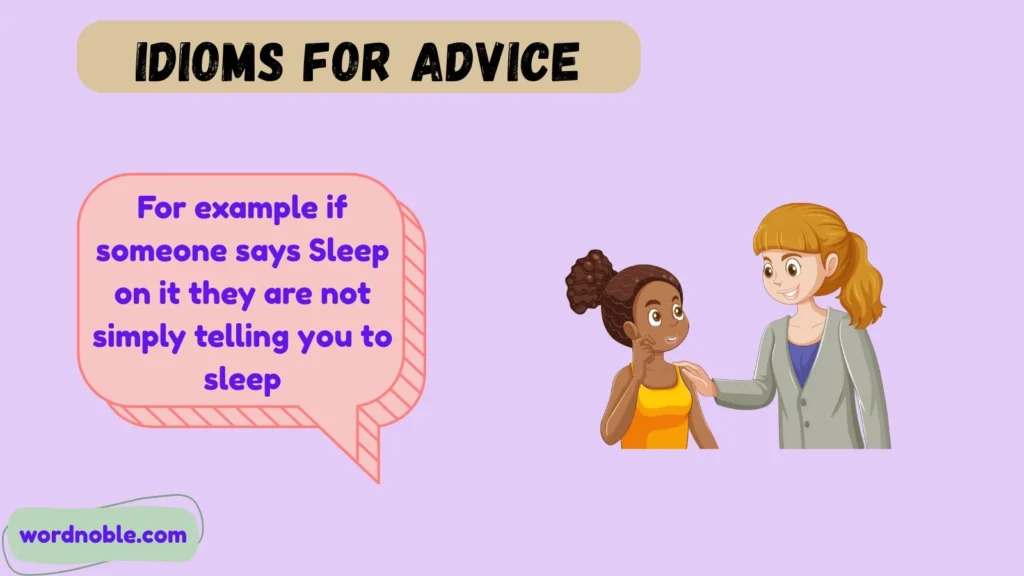
For example, if someone says, “Sleep on it,” they are not simply telling you to sleep. They mean you should wait until the next day before making an important decision.
Advice idioms are widely used in:
- Everyday conversations
- English classrooms
- Business communication
- Motivational speeches
- Literature
- Movies and television
- Social media
- Professional writing
Because these expressions are short and memorable, they often communicate wisdom more effectively than direct instructions.
Idioms for advice are figurative expressions that encourage, warn, or guide someone toward a wise decision. They are commonly used in spoken and written English to make recommendations more natural, engaging, and culturally meaningful. Understanding these idioms improves communication, writing, and English fluency.
Understanding Advice Idioms in Depth
Advice is something people give every day. Sometimes it is direct:
“Study harder.”
Sometimes it is more natural:
“Hit the books.”
Both communicate similar ideas, but the idiom sounds more conversational and memorable.
An advice idiom usually carries years of cultural wisdom in just a few words. Native speakers use these expressions because they quickly communicate ideas while adding personality and emotion.
These idioms often encourage someone to:
- Think carefully
- Stay patient
- Work harder
- Avoid mistakes
- Be cautious
- Stay positive
- Learn from experience
- Keep improving
Using advice idioms appropriately also demonstrates a deeper understanding of English language and culture.
Why Writers and Speakers Use Advice Idioms
Advice idioms are more than decorative language. They serve important communication purposes.
They Simplify Complex Ideas
Instead of giving a long explanation, an idiom delivers the message instantly.
Example:
“Don’t make decisions too quickly.”
becomes
“Sleep on it.”
They Sound Natural
Native English speakers frequently use idioms in everyday conversations. Learning them helps learners sound more fluent.
They Make Writing More Engaging
Advice idioms add personality to blogs, speeches, stories, and essays.
Instead of writing:
“He should continue trying.”
You can write:
“He should keep the ball rolling.”
They Improve Emotional Impact
Many advice idioms encourage people during difficult situations.
Examples include:
- Keep your chin up.
- Every cloud has a silver lining.
- Don’t cry over spilled milk.
These expressions comfort listeners while giving practical guidance.
Where Are Advice Idioms Commonly Used?
Advice idioms appear in many forms of communication.
Everyday Conversations
Friends often give advice using familiar idioms because they sound warm and informal.
Example:
“Take it one step at a time.”
School and Education
Teachers encourage students with motivational idioms.
Examples include:
- Hit the books.
- Practice makes perfect.
- Learn the ropes.
Workplace Communication
Managers often use advice idioms when coaching employees.
Examples:
- Think outside the box.
- Keep your eye on the prize.
- Don’t cut corners.
Literature
Authors use idioms to make dialogue sound realistic and relatable.
Characters who use idioms often feel more authentic because they speak like real people.
Public Speaking
Speakers use advice idioms because audiences remember vivid expressions better than plain instructions.
Categories of Idioms for Advice
Different situations call for different kinds of advice. Organizing idioms into categories makes them easier to understand and remember.
1. Encouragement Idioms
These motivate someone to keep trying.
Examples:
- Keep your chin up
- Hang in there
- Keep the ball rolling
- Stick with it
- Never say die
2. Decision-Making Idioms
These encourage careful thinking.
Examples:
- Sleep on it
- Think twice
- Weigh your options
- Trust your gut
- Read the room
3. Caution Idioms
These warn someone before they act.
Examples:
- Look before you leap
- Better safe than sorry
- Don’t bite off more than you can chew
- Watch your step
- Keep your guard up
4. Learning and Growth Idioms
These encourage improvement.
Examples:
- Learn the ropes
- Hit the books
- Practice makes perfect
- Learn from your mistakes
- Back to the drawing board
5. Wisdom Idioms
These express life lessons.
Examples:
- Actions speak louder than words
- Don’t judge a book by its cover
- Rome wasn’t built in a day
- Every cloud has a silver lining
- Time will tell
15 Common Idioms for Advice (Meanings & Examples)
| Idiom | Meaning | Example |
|---|---|---|
| Sleep on it | Wait before deciding | Sleep on it before accepting the offer. |
| Think twice | Consider carefully | Think twice before quitting your job. |
| Better safe than sorry | Be cautious | Bring an umbrella—better safe than sorry. |
| Keep your chin up | Stay positive | Keep your chin up; things will improve. |
| Hit the books | Study seriously | You should hit the books before the exam. |
| Learn the ropes | Understand the basics | Spend your first week learning the ropes. |
| Look before you leap | Think before acting | Look before you leap when investing money. |
| Don’t cut corners | Do things properly | Don’t cut corners on safety. |
| Keep your eye on the prize | Stay focused | Keep your eye on the prize during your studies. |
| Hang in there | Be patient | Hang in there—you’ll succeed soon. |
| Don’t cry over spilled milk | Don’t worry about the past | The mistake is done, so don’t cry over spilled milk. |
| Stick to your guns | Stay true to your beliefs | Stick to your guns if you know you’re right. |
| Take it with a grain of salt | Be skeptical | Take online rumors with a grain of salt. |
| Read the room | Understand the situation | Read the room before making jokes. |
| Practice makes perfect | Improvement comes through repetition | Keep practicing because practice makes perfect. |
Why Learning Advice Idioms Improves Your English
Mastering advice idioms offers several benefits:
- Makes your English sound more fluent.
- Helps you understand native speakers.
- Improves creative and academic writing.
- Adds variety to conversations.
- Strengthens listening comprehension.
- Enhances storytelling and dialogue.
- Builds confidence in speaking English.
- Makes essays and presentations more engaging.
Advice idioms also reflect cultural wisdom, making them valuable for anyone studying English language or literature.
Encouragement and Motivation Idioms
These idioms inspire someone to stay determined and keep moving toward a goal.
| Idiom | Meaning | Example |
|---|---|---|
| Keep the ball rolling | Continue making progress | Keep the ball rolling by practicing every day. |
| Stick with it | Don’t give up | Learning English takes time, so stick with it. |
| Never say die | Never lose hope | Never say die, even when life gets difficult. |
| Go the extra mile | Do more than expected | Go the extra mile if you want to impress your employer. |
| Keep pushing forward | Continue despite difficulties | Keep pushing forward because success takes patience. |
| Stay the course | Continue your current plan | Stay the course, and you’ll reach your goals. |
| Hold your head high | Remain confident | Hold your head high after giving your best effort. |
| Take one step at a time | Progress gradually | Recovering from failure starts by taking one step at a time. |
Decision-Making Advice Idioms
These idioms encourage thoughtful choices before taking action.
| Idiom | Meaning | Example |
|---|---|---|
| Weigh your options | Compare all choices | Weigh your options before buying a new car. |
| Trust your gut | Follow your instincts | Trust your gut if something feels wrong. |
| Keep an open mind | Consider different ideas | Keep an open mind during the discussion. |
| Read the writing on the wall | Notice clear warning signs | Read the writing on the wall before the business fails. |
| Think outside the box | Be creative | Think outside the box when solving problems. |
| Put yourself in someone’s shoes | Consider another person’s feelings | Put yourself in her shoes before judging her decision. |
| Follow your heart | Choose based on feelings | Sometimes it’s okay to follow your heart. |
Caution and Warning Idioms
These idioms advise people to avoid unnecessary risks.
| Idiom | Meaning | Example |
|---|---|---|
| Watch your step | Be careful | Watch your step when making important decisions. |
| Keep your guard up | Stay alert | Keep your guard up against online scams. |
| Don’t put all your eggs in one basket | Avoid relying on one option | Invest wisely and don’t put all your eggs in one basket. |
| Don’t jump the gun | Don’t act too early | Don’t jump the gun until you know all the facts. |
| Bite your tongue | Avoid saying something hurtful | Bite your tongue during the argument. |
| Let sleeping dogs lie | Don’t restart old conflicts | Let sleeping dogs lie if the issue has already been resolved. |
| Look before you leap | Think before acting | Always look before you leap when changing careers. |
Hard Work and Success Idioms
These idioms encourage discipline and consistent effort.
| Idiom | Meaning | Example |
|---|---|---|
| Burn the midnight oil | Work late into the night | Burn the midnight oil before your final exams. |
| Put your best foot forward | Make a strong first impression | Put your best foot forward during your interview. |
| Get the ball rolling | Start something | Get the ball rolling by creating a study schedule. |
| Keep your nose to the grindstone | Work diligently | Keep your nose to the grindstone until the project is finished. |
| Learn by doing | Gain experience through practice | The best programmers learn by doing. |
| No pain, no gain | Success requires effort | Remember, no pain, no gain. |
Wisdom and Life Lesson Idioms
These expressions share timeless advice based on experience.
| Idiom | Meaning | Example |
|---|---|---|
| Actions speak louder than words | Deeds matter more than promises | Show your commitment because actions speak louder than words. |
| Rome wasn’t built in a day | Great things take time | Be patient—Rome wasn’t built in a day. |
| Every cloud has a silver lining | Every problem has something positive | Every cloud has a silver lining if you stay hopeful. |
| Time will tell | The future will reveal the answer | Don’t worry; time will tell. |
| What goes around comes around | Good and bad actions return | Be kind because what goes around comes around. |
| You reap what you sow | Your actions determine your results | Study consistently because you reap what you sow. |
| Better late than never | Doing something late is better than not doing it | Start learning today—better late than never. |
Relationship Advice Idioms
These idioms help people communicate and build healthy relationships.
| Idiom | Meaning | Example |
|---|---|---|
| Meet halfway | Compromise | Both partners should meet halfway. |
| Clear the air | Resolve misunderstandings | Let’s clear the air before moving on. |
| Be on the same page | Share the same understanding | Make sure everyone is on the same page. |
| Give someone the benefit of the doubt | Assume good intentions | Give him the benefit of the doubt. |
| Lend a helping hand | Offer assistance | Lend a helping hand whenever possible. |
Context Table: Using Advice Idioms Naturally
| Context | Meaning | Best Use Case | Example |
|---|---|---|---|
| Daily conversation | Friendly advice | Talking with friends | Sleep on it before deciding. |
| School | Study encouragement | Students | Hit the books tonight. |
| Workplace | Professional coaching | Team meetings | Think outside the box. |
| Family | Personal guidance | Parents and children | Keep your chin up. |
| Business | Decision-making | Management | Weigh your options carefully. |
| Public speaking | Motivation | Inspirational speeches | Keep the ball rolling. |
| Literature | Character dialogue | Fiction writing | Rome wasn’t built in a day. |
| Social media | Short motivational posts | Captions and quotes | Never say die. |
How to Use Idioms for Advice Naturally
Using idioms effectively is about choosing the right expression for the situation. Here are some practical tips:
Match the Idiom to the Situation
Use encouraging idioms when motivating someone, cautionary idioms when warning them, and wisdom idioms when sharing life lessons.
Natural:
“Keep your chin up—you’ve already made great progress.”
Less natural:
“Keep your chin up before signing the contract.”
Don’t Force Idioms Into Every Sentence
Idioms add variety, but overusing them can make your writing sound unnatural. One well-chosen idiom often has more impact than several in the same paragraph.
Consider Your Audience
Idioms work well in conversations, blogs, speeches, and creative writing. In formal academic or legal writing, use them sparingly unless the style allows for figurative language.
Learn the Meaning Before Using One
Many idioms cannot be understood literally. Always learn their figurative meaning and typical context before using them.
Writing Guide: Making Advice Idioms Sound Natural
In Conversations
Use idioms to encourage, comfort, or guide others in a friendly way.
Example:
“Hang in there. Things usually get better with time.”
In Essays
Use advice idioms only when they support your point and fit the tone.
In Stories
Let characters use idioms naturally to make dialogue more realistic and relatable.
In Speeches
A memorable idiom can reinforce your message and help the audience remember your advice.
Idioms vs. Proverbs vs. Metaphors
| Feature | Idiom | Proverb | Metaphor |
|---|---|---|---|
| Meaning | Figurative expression | Traditional saying with wisdom | Direct comparison without “like” or “as” |
| Literal? | No | Usually no | No |
| Purpose | Everyday communication | Teach a lesson | Create imagery |
| Example | Sleep on it | Honesty is the best policy | Time is a thief |
Common Mistakes When Using Idioms for Advice
Learning idioms is valuable, but using them incorrectly can confuse readers and listeners. Avoid these common mistakes to sound more natural and confident.
1. Taking Idioms Literally
Idioms have figurative meanings, not literal ones.
Incorrect understanding:
Sleep on it means to sleep on top of something.
Correct meaning:
It means to wait before making an important decision.
2. Using the Wrong Idiom for the Situation
Choose an idiom that matches the context.
❌ Incorrect:
“Hit the books before buying a house.”
✅ Correct:
“Think twice before buying a house.”
3. Overusing Idioms
Too many idioms in one paragraph can make your writing sound unnatural.
❌ Overused:
“Keep your chin up, keep the ball rolling, stay the course, never say die, and go the extra mile.”
✅ Better:
“Keep your chin up. With patience and consistent effort, you’ll succeed.”
4. Mixing Idioms
Don’t combine two unrelated idioms into one expression.
❌ Incorrect:
“Don’t put all your eggs before you leap.”
✅ Correct:
- Don’t put all your eggs in one basket.
- Look before you leap.
5. Ignoring Tone
Some idioms are informal and may not fit formal writing.
Formal Report:
Consider all available options before making a decision.
Conversation:
Sleep on it.
Do & Don’t Guide
✅ Do
- Learn the figurative meaning before using an idiom.
- Match the idiom to the situation.
- Use idioms naturally in conversations.
- Include idioms in stories and creative writing.
- Practice using one or two idioms daily.
- Read English books to see idioms in context.
- Listen to native speakers using idiomatic expressions.
❌ Don’t
- Translate idioms word for word into another language.
- Overuse idioms in every sentence.
- Mix two different idioms together.
- Use informal idioms in highly formal documents.
- Assume every proverb is an idiom.
- Memorize idioms without learning their meaning.
Natural Chat Responses Using Advice Idioms
These examples show how advice idioms sound in everyday conversations.
Example 1
Friend: I’m not sure whether I should accept the new job.
You: I’d sleep on it before making such an important decision.
Example 2
Friend: Learning English is harder than I expected.
You: Keep your chin up. Practice makes perfect.
Example 3
Friend: I’m thinking about investing all my money in one company.
You: Don’t put all your eggs in one basket.
Example 4
Friend: I failed my driving test.
You: Don’t cry over spilled milk. Learn from it and try again.
Example 5
Friend: My project feels impossible.
You: Take one step at a time. Rome wasn’t built in a day.
Example 6
Friend: I’m nervous about tomorrow’s interview.
You: Put your best foot forward and be yourself.
Related Terms (Semantic SEO Cluster)
Understanding related language concepts will strengthen your vocabulary and improve your writing.
- Figurative language
- Idiomatic expressions
- Proverbs
- Metaphors
- Similes
- English phrases
- Common English expressions
- Everyday English
- Descriptive writing
- Creative writing techniques
- Conversational English
- English literature devices
- Writing style
- Context clues
- Communication skills
FAQs:
1. What are idioms for advice?
Idioms for advice are figurative expressions that guide, encourage, or warn someone in a memorable way. Instead of giving direct instructions, they communicate wisdom through commonly understood phrases. Examples include sleep on it, think twice, and keep your chin up.
2. Why are advice idioms important?
Advice idioms make communication more engaging, natural, and culturally authentic. They help English learners understand native speakers, improve writing, and express ideas in a concise yet meaningful way.
3. What are some common idioms for advice?
Some of the most common advice idioms include:
- Sleep on it
- Think twice
- Better safe than sorry
- Look before you leap
- Keep your chin up
- Hang in there
- Don’t cut corners
- Take it with a grain of salt
- Practice makes perfect
- Rome wasn’t built in a day
These idioms are widely used in everyday English.
4. How can I learn advice idioms quickly?
Read English books, watch movies, listen to podcasts, and pay attention to how native speakers use idioms. Practice using a few expressions each week in conversations or writing to build confidence and remember them naturally.
5. Are advice idioms suitable for students?
Yes. Students often use advice idioms in essays, classroom discussions, speeches, and creative writing. They make language more expressive while demonstrating a stronger understanding of English vocabulary and figurative language.
6. What’s the difference between an idiom and a proverb?
An idiom is a figurative phrase whose meaning differs from the literal words, such as sleep on it. A proverb is a traditional saying that teaches a lesson, such as Honesty is the best policy. Some proverbs offer advice, but not all advice expressions are idioms.
7. Can advice idioms be used in professional writing?
Yes, but use them carefully. Advice idioms can make blogs, presentations, and speeches more engaging. In highly formal reports or academic papers, it’s usually better to use clear, literal language unless an idiom fits the tone and audience.
8. Are advice idioms used in English literature?
Absolutely. Authors use advice idioms to create realistic dialogue, reveal character personalities, and communicate life lessons. Because readers often recognize these expressions, they add familiarity and emotional impact to stories.
9. How do advice idioms improve speaking skills?
Using idioms appropriately helps speakers sound more fluent and natural. They make conversations more expressive, improve listening comprehension, and increase confidence when communicating with native English speakers.
10. What is the best way to remember idioms for advice?
The best method is to learn idioms in context. Read example sentences, practice speaking them aloud, write your own examples, and review them regularly. Associating each idiom with a real-life situation makes it much easier to remember and use correctly.
Conclusion:
Idioms for advice are more than colorful expressions—they are practical tools that make English communication clearer, more engaging, and more memorable.
Whether you’re encouraging a friend, writing an essay, giving professional guidance, or improving your conversational skills, these idioms help you express wisdom naturally and effectively.
By learning their meanings, understanding when to use them, and practicing them in real-life contexts, you’ll build stronger vocabulary, greater fluency, and more confident communication.
Keep exploring new idioms, use them thoughtfully, and you’ll discover that even simple advice can leave a lasting impression.

I am Naqash Ayub, proudly writing for WordNoble, where I focus on creating clear, informative, and SEO-friendly content. I enjoy turning detailed information into simple, trustworthy articles that help readers find the answers they need.