
Most people get this one wrong the first time they type it: “cryer” looks right, but “crier” is the word English actually recognizes.
The mix-up happens because “cry” ends in a consonant, and we’re used to adding “-er” straight onto verbs like that think “player” or “singer.” But crier breaks that pattern, and that’s exactly why so many writers second-guess themselves mid-sentence.
This article clears up the confusion for good, walking through the correct spelling, where it comes from, and why “cryer” keeps showing up anyway despite being wrong in standard English. You’ll also see how the word is used in real sentences, plus a note on “town crier,” a phrase that adds its own twist to the story.
Related terms like crybaby and tearful come up too, since they often get tangled in the same spelling mix-ups.
By the end, you won’t just know which spelling to use you’ll understand the reasoning behind it, so it sticks. Let’s start with the one you should actually be writing.
Crier is the standard English spelling for someone who cries or, traditionally, makes public announcements. Cryer is a less common variant found mainly as a surname and occasionally as a spelling variant. In most everyday writing, crier is the safer choice.
What Do Cryer and Crier Mean?
The words cryer and crier are closely related in appearance and pronunciation. However, they differ in standard usage, and knowing when to use each form makes your writing more accurate.
What Does Crier Mean?
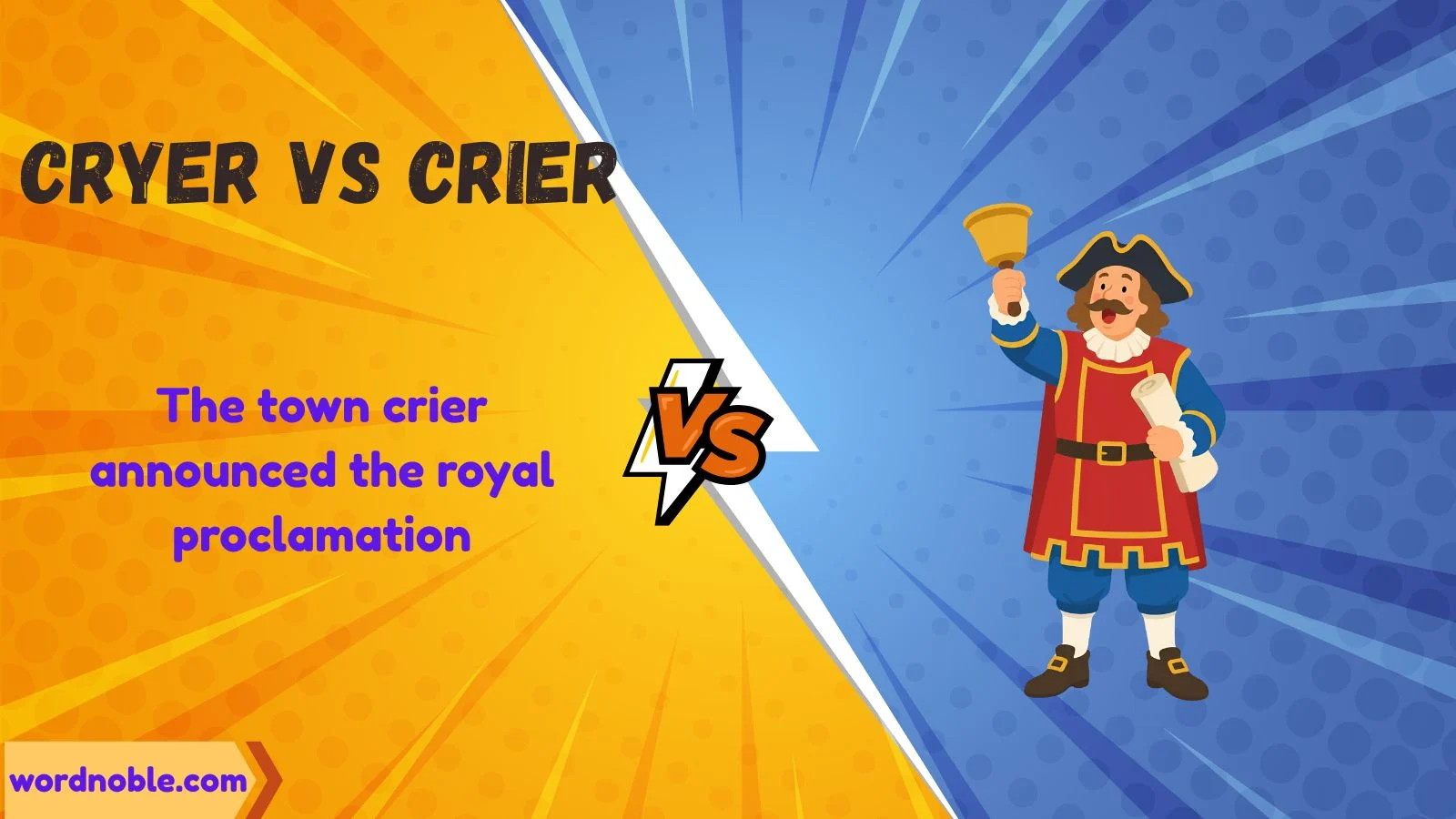
A crier is a person who cries or announces information publicly. Historically, a town crier was an official who delivered news, laws, and public notices to a community, often by calling out in the streets.
The word can also describe someone who frequently cries or becomes emotional.
Examples:
- The town crier announced the royal proclamation.
- My little brother is a loud crier when he feels tired.
- The crier called out the market’s opening hours.
In each sentence, crier refers to a person who performs an action associated with crying or calling out.
What Does Cryer Mean?

Cryer is a less common spelling that may appear as a surname or as a variant form in some contexts. It is not generally the preferred spelling for the ordinary noun meaning a person who cries or makes announcements.
Examples:
- Mr. Cryer introduced himself to the new students.
- The family welcomed a visitor named Cryer.
- A historical record may use cryer as a variant spelling.
When Cryer is a person’s surname, its spelling should be preserved. Do not automatically change it to Crier, because names have their own established spellings.
Crier is the standard modern English noun for a person who cries or makes a public announcement. Cryer is much less common and is most familiar as a surname, although it can occur as a spelling variant. For ordinary writing, use crier unless you are reproducing a proper name or following a specific historical source.
Cryer vs Crier: Key Differences
| Feature | Crier | Cryer |
|---|---|---|
| Standard everyday spelling | Yes | Generally no |
| Meaning | A person who cries or announces information | Usually a surname or uncommon variant |
| Historical association | Town criers and public announcements | May occur in historical spelling or family names |
| Pronunciation | Usually /ˈkraɪər/ | Usually /ˈkraɪər/ |
| Best use | General English writing | Proper names and source-specific contexts |
| Example | The crier announced the news. | Ms. Cryer joined the meeting. |
The main distinction is spelling and conventional usage rather than pronunciation. In ordinary sentences, crier is the most reliable option.
Why Are Cryer and Crier Confused?
English spelling can be difficult because similar sounds do not always correspond to the same written letters. The ending -er is common in words describing people who perform actions, while -ier also appears in several familiar nouns.
For example:
- Writer: A person who writes.
- Player: A person who plays.
- Crier: A person who cries or calls out.
- Buyer: A person who buys something.
Because cry ends in a y, learners may assume that adding -er produces cryer. That pattern is understandable, but conventional English usage favors crier for the ordinary noun.
The best approach is to remember the established spelling rather than trying to predict it from pronunciation alone.
The Origin of the Word Crier
The word crier comes from the verb cry, which historically had a broader meaning than shedding tears. It could also mean calling loudly, shouting, or making something known.
That older sense explains the expression town crier. Before modern communication systems, communities relied on people who announced important information aloud in public places.
A town crier might communicate royal orders, local laws, market news, or other public notices. The role became associated with distinctive clothing, a loud voice, and the familiar call for attention.
Today, crier remains useful in historical writing, literature, and descriptions of people who cry or call out.
Is Cryer Ever Correct?
Yes, Cryer can be correct when it is a person’s established name. It may also appear in historical records or other contexts where a variant spelling is preserved.
Consider these situations:
- A surname: Keep the spelling used by the person or family.
- A historical document: Preserve the original spelling when quoting or transcribing a source.
- Ordinary modern English: Prefer crier when referring to someone who cries or announces information.
This distinction is important because a word’s conventional spelling and a person’s proper name do not always follow the same rules.
For example, if a teacher named Ms. Cryer introduces herself, writing Ms. Crier would incorrectly alter her name. If you are describing a person who loudly announces a message, however, the crier is the usual form.
Cryer vs Crier: 12 Examples in Sentences
The following examples show how to choose between the two spellings in different situations.
1. The Town Crier Announced the News
Sentence: The town crier announced the king’s decision in the village square.
Meaning: A person publicly communicated important information.
Category: Historical usage.
Explanation: Crier is correct because the person is making a public announcement.
2. The Baby Was a Frequent Crier
Sentence: The baby was a frequent crier during the first few weeks.
Meaning: The baby cried often.
Category: Everyday English.
Explanation: The noun crier can describe a person who cries frequently.
3. The Crier Called for Attention
Sentence: The crier called for attention before reading the notice.
Meaning: The person used a loud voice to gather listeners.
Category: Public communication.
Explanation: The word refers to someone who calls out publicly.
4. Ms. Cryer Joined the Class
Sentence: Ms. Cryer joined the class and introduced herself.
Meaning: Cryer is the teacher’s surname.
Category: Proper name.
Explanation: Use Cryer because it is the person’s established name.
5. The Crier Delivered the Proclamation
Sentence: The crier delivered the proclamation to the townspeople.
Meaning: An official announcement was communicated.
Category: Historical writing.
Explanation: The standard noun is crier.
6. The Little Crier Needed Comfort
Sentence: The little crier needed comfort after falling off the swing.
Meaning: The child cried and needed reassurance.
Category: Descriptive writing.
Explanation: Crier describes someone who is crying or tends to cry.
7. The Crier Spoke in a Loud Voice
Sentence: The crier spoke in a loud voice so everyone could hear.
Meaning: The person projected their voice to reach an audience.
Category: Communication.
Explanation: The sentence emphasizes the traditional announcing role.
8. The Author Introduced a Character Named Cryer
Sentence: The author introduced Detective Cryer in the opening chapter.
Meaning: Cryer is the fictional character’s surname.
Category: Creative writing.
Explanation: A character’s name should retain its intended spelling.
9. The Crier Gathered the Crowd
Sentence: The crier gathered the crowd before the festival began.
Meaning: The person called out to attract people’s attention.
Category: Public events.
Explanation: Crier is the standard spelling for this role.
10. The Record Listed the Name as Cryer
Sentence: The historical record listed the official’s surname as Cryer.
Meaning: The document preserves a particular person’s name.
Category: Historical records.
Explanation: Do not change a proper name merely because a similar common noun has a different spelling.
11. The Crier Announced the Market Opening
Sentence: The crier announced that the market was open for business.
Meaning: The person publicly shared information with the community.
Category: Everyday historical description.
Explanation: The standard noun is crier.
12. The Crier Became Emotional
Sentence: The crier became emotional while telling the family story.
Meaning: The person began to show strong feelings or cry.
Category: Emotional description.
Explanation: Crier can refer to a person who cries.
Cryer vs Crier in Different Contexts
The right spelling depends on whether you are using a common noun, a proper name, or reproducing a historical source.
| Context | Meaning | Use Case | Example |
|---|---|---|---|
| Everyday English | A person who cries | Describing someone’s behavior | The child is a crier. |
| History | A public announcer | Describing a town official | The crier announced the decree. |
| Creative writing | A character who cries or calls out | Developing a character | The crier wept at the news. |
| Academic writing | A historical or linguistic term | Explaining traditional public communication | The town crier served the community. |
| Family names | An individual’s surname | Identifying a person | Mr. Cryer arrived early. |
| Historical transcription | An original spelling in a source | Preserving documentary evidence | The record spells the name Cryer. |
How to Use Crier Correctly in Writing
Using crier correctly is straightforward when you focus on the meaning of the sentence.
1. Identify the Person’s Role
Ask yourself whether the word describes a person who cries or someone who makes a public announcement. If so, crier is usually the right choice.
Example: The crier announced the festival schedule.
2. Check Whether It Is a Name
If the word refers to a named individual, confirm the person’s actual spelling. Names should not be altered to match a more common word.
Example: The new principal, Dr. Cryer, welcomed the students.
3. Consider Your Source
Historical documents sometimes preserve spellings that differ from modern conventions. If you are quoting or transcribing a document, reproduce its spelling accurately. If you are writing a modern explanation, use standard contemporary English.
4. Read the Sentence Aloud
Pronunciation alone will not reliably distinguish crier from cryer, since they are generally pronounced alike. Read the sentence aloud to check its meaning and flow, then verify the spelling.
5. Use a Dictionary When Necessary
If you encounter cryer in an unfamiliar text, check whether it is a surname, a historical variant, or an error. Context is often more informative than the spelling by itself.
Cryer vs Crier: Common Mistakes
Even experienced writers can confuse these spellings. Here are the main errors to avoid.
Mistake 1: Using Cryer as the Default Noun
Incorrect for standard usage: The town cryer announced the news.
Correct: The town crier announced the news.
Why: Crier is the conventional modern spelling for the public announcer.
Mistake 2: Changing Someone’s Surname
Incorrect: The school principal, Dr. Crier, gave a speech when the person’s actual surname is Cryer.
Correct: Dr. Cryer gave a speech.
Why: Proper names must retain their established spelling.
Mistake 3: Assuming Both Forms Are Equally Common
Although the words look similar, they are not interchangeable in every context. Crier is the usual common noun, while Cryer appears primarily as a name or uncommon variant.
Mistake 4: Relying Only on Pronunciation
Both spellings are generally pronounced the same way. Hearing the word will not always tell you how it should be written.
Solution: Use context, established spelling conventions, and a reliable dictionary.
Mistake 5: Correcting Historical Sources Without a Reason
If you are transcribing an old record, changing a spelling might distort the original evidence. Preserve the spelling when accuracy to the source is important, and explain any variation when necessary.
Do and Don’t: A Quick Usage Guide
Do:
- Use crier for the standard noun meaning a person who cries or announces information.
- Use Cryer when that is someone’s actual surname.
- Check historical context before correcting an unusual spelling.
- Proofread your writing for commonly confused words.
- Use examples to understand the difference between conventional spelling and proper names.
Don’t:
- Automatically use cryer in ordinary modern sentences.
- Change a person’s surname to match the common noun.
- Assume identical pronunciation means identical spelling.
- Rewrite a historical quotation without considering the original source.
- Treat every unusual spelling as a mistake without checking its context.
Natural Chat Responses Using Crier
Here are a few natural sentences showing how crier can appear in everyday conversation.
- “The baby is such a little crier whenever she gets hungry.”
- “Our history teacher explained how a town crier shared important news.”
- “The crier announced the event, and everyone gathered around.”
- “I checked the spelling because I wasn’t sure whether it was crier or cryer.”
- “The character named Cryer is the detective in my story.”
- “Remember, use crier for the common noun, but keep Cryer if it’s someone’s surname.”
These examples cover both ordinary vocabulary and proper-name usage without confusing the two.
Related Terms and Spelling Concepts
Understanding cryer vs crier also helps you think more carefully about English spelling, word formation, and context.
- Spelling variants: Different written forms of a word that may occur in particular periods or contexts.
- Proper nouns: Names of people, places, and organizations that follow their established spellings.
- Word formation: The way prefixes, suffixes, and spelling conventions shape words.
- Historical vocabulary: Words and expressions associated with earlier social practices, such as town criers.
- Homophones and near-homophones: Words that sound alike or very similar but differ in spelling or meaning.
- Proofreading: Reviewing writing to catch spelling, grammar, and usage mistakes.
Related spelling comparisons worth exploring include adviser vs advisor, gray vs grey, judgment vs judgement, and everyday vs every day. These examples illustrate how English spelling conventions can vary by region, meaning, or grammatical function.
FAQs:
1. Is it cryer or crier?
Crier is the standard spelling for a person who cries or makes public announcements. Cryer is less common and is often encountered as a surname or variant spelling. In ordinary modern writing, choose crier unless you are referring to a person whose name is spelled Cryer or preserving a specific historical source.
2. What is the difference between cryer and crier?
The primary difference is conventional usage. Crier is the established spelling of the common noun for a person who cries or announces information publicly. Cryer is less common and frequently appears as a surname. Both forms are generally pronounced alike, so the surrounding sentence and the identity of the person determine which spelling is appropriate.
3. Is Cryer a real word?
Yes, Cryer is a recognized surname and may also appear as a spelling variant in particular contexts. However, it is not the preferred spelling of the standard noun crier. When you encounter Cryer in a book, document, or official record, determine whether it refers to a name or reflects the spelling used by that source.
4. What does crier mean?
A crier is a person who cries or calls out publicly. Historically, a town crier announced news, laws, and important notices to a community. In modern usage, the word can also describe someone who cries frequently. Its exact meaning depends on the context, but the central idea involves crying or calling out.
5. How do you use crier in a sentence?
You can use crier to describe a person who cries or makes an announcement. For example, “The town crier announced the festival in the village square.” Another example is “The baby is a frequent crier.” Both sentences use the standard spelling, but they refer to different actions: public announcing and emotional crying.
6. Is a town crier the same as a person who cries?
Not necessarily. A town crier is traditionally a public official who announces news or notices aloud. The term comes from an older sense of cry meaning to call out or proclaim something. A person who cries emotionally can also be called a crier, but context makes the intended meaning clear.
7. Why is crier spelled with an i instead of a y?
The spelling crier follows the conventional form of this established English noun. Although adding -er directly to cry might seem logical, common spelling patterns do not always predict every word’s accepted form. The most reliable method is to learn the standard spelling and confirm unfamiliar forms in a dictionary rather than relying only on pronunciation.
8. Can Cryer be a person’s last name?
Yes. Cryer can be a family name, and its spelling should be preserved when referring to someone who uses it. For example, “Professor Cryer delivered the lecture.” Replacing the surname with Crier would change the person’s name. This is why distinguishing common nouns from proper nouns matters in accurate writing.
9. Are cryer and crier pronounced the same way?
They are generally pronounced the same way in English, approximately “CRY-er.” Because pronunciation usually does not reveal which spelling is intended, writers should consider the meaning and context. Use crier for the standard noun and retain Cryer when it is a proper name or a spelling preserved from a source.
10. Which spelling should students use in school assignments?
Students should normally use crier when referring to someone who cries or announces information publicly. For example, “The town crier delivered the king’s message.” If a textbook or historical document uses Cryer as a surname or preserves a variant spelling, students should reproduce it accurately and explain the context when necessary.
Conclusion:
The difference between cryer vs crier is simple once you understand conventional English usage. Crier is the standard spelling for a person who cries or makes a public announcement, while Cryer is less common and is often used as a surname. Although the two forms generally sound alike, their written usage depends on meaning and context.
To improve your spelling, remember the standard form, pay attention to proper names, and check unfamiliar words when necessary.
These small habits make your writing clearer and more professional. Whether you are completing a school assignment, writing a story, or explaining historical vocabulary, choosing the right spelling helps your message remain accurate and easy to understand.

I am Naqash Ayub, proudly writing for WordNoble, where I focus on creating clear, informative, and SEO-friendly content. I enjoy turning detailed information into simple, trustworthy articles that help readers find the answers they need.